Transmission fluid Ram 1500 2015 User Guide
[x] Cancel search | Manufacturer: RAM, Model Year: 2015, Model line: 1500, Model: Ram 1500 2015Pages: 871, PDF Size: 24.83 MB
Page 495 of 871
WARNING!
Do not use the “TOW/HAUL” feature when driving
in icy or slippery conditions. The increased engine
braking can cause the rear wheels to slide, and the
vehicle to swing around with the possible loss of
vehicle control, which may cause an accident possi-
bly resulting in personal injury or death.
Torque Converter Clutch
A feature designed to improve fuel economy has been
included in the automatic transmission on your vehicle.
A clutch within the torque converter engages automati-
cally at calibrated speeds. This may result in a slightly
different feeling or response during normal operation in
the upper gears. When the vehicle speed drops or during
some accelerations, the clutch automatically disengages.
NOTE:
•The torque converter clutch will not engage, and the
transmission will not shift to sixth gear, until the
transmission fluid and engine coolant are warm [usu-
ally after 1 to 3 miles (2 to 5 km) of driving]. Because
sixth gear is disabled, and engine speed is higher when
the torque converter clutch is not engaged, it may
seem as if the transmission is not shifting properly
when cold. This is normal. Using the Electronic Range
Select (ERS) shift control, when the transmission is
sufficiently warm, will demonstrate that the transmis-
sion is able to shift into and out of Overdrive.
•If the vehicle has not been driven for several days, the
first few seconds of operation after shifting the transmis-
sion into gear may seem sluggish. This is due to the fluid
partially draining from the torque converter into the
transmission. This condition is normal and will not
cause damage to the transmission. The torque converter
will refill within five seconds after starting the engine.
5
STARTING AND OPERATING 493
Page 545 of 871
something goes wrong. You should never stop or shut a
vehicle off when crossing deep water unless you ingested
water into the engine air intake. If the engine stalls do not
attempt to restart it. Determine if it has ingested water
first. The key to any crossing is low and slow. You want
to use first gear in 4L (Low Range) and proceed very
slowly with a constant slow speed (3-5 mph [5–8 km/h]
maximum) and light throttle. Keep the vehicle moving;
do not try to accelerate through the crossing. After
crossing any water higher than the bottom of the axle
differentials, you should inspect all of the vehicle fluids
for signs of water ingestion.
CAUTION!
Water ingestion into the axles, transmission, transfer
case, engine or vehicle interior can occur if you drive
too fast or through too deep of water. Water can cause
(Continued)
CAUTION!(Continued)
permanent damage to engine, driveline or other
vehicle components and your brakes will be less
effective once wet and/or muddy.
•Before You Cross Any Type Of Water–Asyou
approach any type of water you need to determine if
you can cross it safely and responsibly. If necessary, get
out and walk through the water or probe it with a
stick. You need to be sure of its depth, approach angle,
current and bottom condition. Be careful of murky or
muddy waters, check for hidden obstacles. Make sure
you will not be intruding on any wildlife and you can
recover the vehicle if necessary. The key to a safe
crossing is the water depth, current and bottom con-
ditions. On soft bottoms the vehicle will sink in,
effectively increasing the water level on the vehicle. Be
sure to consider this when determining the depth and
the ability to safely cross.
5
STARTING AND OPERATING 543
Page 580 of 871

CAUTION!
Do not use chemical flushes in your power steering
system as the chemicals can damage your power
steering components. Such damage is not covered by
the New Vehicle Limited Warranty.
WARNING!
Fluid level should be checked on a level surface and
with the engine off to prevent injury from moving
parts and to ensure accurate fluid level reading. Do
not overfill. Use only manufacturer’s recommended
power steering fluid.
If necessary, add fluid to restore to the proper indicated
level. With a clean cloth, wipe any spilled fluid from all
surfaces. Refer to “Fluids, Lubricants, and Genuine
Parts” in “Maintaining Your Vehicle” for further informa-
tion.
FUEL SAVER TECHNOLOGY 5.7L/6.4L ENGINES
ONLY — IF EQUIPPED
This feature offers improved fuel economy by shutting
off four of the engine’s eight cylinders during light load
and cruise conditions. The system is automatic with no
driver inputs or additional driving skills required.
NOTE:This system may take some time to return to full
functionality after a battery disconnect.
PARKING BRAKE
Before leaving the vehicle, make sure that the parking
brake is fully applied. Also, be certain to leave the
transmission in PARK.
The foot operated parking brake is located below the
lower left corner of the instrument panel. To apply the
park brake, firmly push the park brake pedal fully. To
release the parking brake, pull the parking brake release
handle.
578 STARTING AND OPERATING
Page 670 of 871
![Ram 1500 2015 User Guide When towing a loaded trailer up steep grades at low
speeds (20 mph [32 km/h] or below), holding your
vehicle in first gear (using the ERS shift control) can help
to avoid transmission overheating.
If](/img/34/12541/w960_12541-669.png "Ram 1500 2015 User Guide When towing a loaded trailer up steep grades at low
speeds (20 mph [32 km/h] or below), holding your
vehicle in first gear (using the ERS shift control) can help
to avoid transmission overheating.
If")
When towing a loaded trailer up steep grades at low
speeds (20 mph [32 km/h] or below), holding your
vehicle in first gear (using the ERS shift control) can help
to avoid transmission overheating.
If you regularly tow a trailer for more than 45 minutes of
continuous operation, then change the automatic trans-
mission fluid and filter(s) as specified for#police, taxi,
fleet, or frequent trailer towing.#Refer to the “Mainte-
nance Schedule” for the proper maintenance intervals.
NOTE:Check the automatic transmission fluid level
before towing (6-speed automatic only).
Tow/Haul Mode
To reduce potential for automatic transmission overheat-
ing, activate TOW/HAUL mode when driving in hilly
areas, or select a lower gear range (using the Electronic
Range Select (ERS) shift control) on more severe grades.
Electronic Speed Control — If Equipped
•Do not use in hilly terrain or with heavy loads.
•When using the speed control, if you experience speed
drops greater than 10 mph (16 km/h), disengage until
you can get back to cruising speed.
•Use speed control in flat terrain and with light loads to
maximize fuel efficiency.
Cooling System
To reduce potential for engine and transmission over-
heating, take the following actions:
City Driving
When stopped for short periods of time, shift the trans-
mission into NEUTRAL and increase engine idle speed.
Highway Driving
Reduce speed.
668 STARTING AND OPERATING
Page 677 of 871
CAUTION!
•Towing with the rear wheels on the ground will
cause severe transmission damage. Damage from
improper towing is not covered under the New
Vehicle Limited Warranty.
•Do not disconnect the driveshaft because fluid may
leak from the transmission, causing damage to
internal parts.
Recreational Towing — Four-Wheel Drive Models
NOTE:Both the manual shift and electronic shift trans-
fer cases must be shifted into NEUTRAL (N) for recre-
ational towing. Automatic transmissions must be shifted
into PARK for recreational towing. Manual transmissions
must be placed in gear (NOT in NEUTRAL) for recre-
ational towing. Refer to the following for the proper
transfer case NEUTRAL (N) shifting procedure for your
vehicle.
CAUTION!
•DO NOT dolly tow any 4WD vehicle. Towing with
only one set of wheels on the ground (front or rear)
will cause severe transmission and/or transfer case
damage. Tow with all four wheels either ON the
ground, or OFF the ground (using a vehicle trailer).
(Continued)
5
STARTING AND OPERATING 675
Page 678 of 871
CAUTION!(Continued)
•Tow only in the forward direction. Towing this
vehicle backwards can cause severe damage to the
transfer case.
•Automatic transmissions must be placed in PARK
for recreational towing.
•Manual transmissions must be placed in gear (not
in Neutral) for recreational towing.
•Before recreational towing, perform the procedure
outlined under “Shifting Into NEUTRAL (N)” to be
certain that the transfer case is fully in NEUTRAL
(N). Otherwise, internal damage will result.
•Towing this vehicle in violation of the above re-
quirements can cause severe transmission and/or
transfer case damage. Damage from improper tow-
ing is not covered under the New Vehicle Limited
Warranty.
(Continued)
CAUTION!(Continued)
•Do not disconnect the rear driveshaft because fluid
will leak from the transfer case, causing damage to
internal parts.
•Do not use a bumper-mounted clamp-on tow bar
on your vehicle. The bumper face bar will be
damaged.
Shifting Into NEUTRAL (N)
Use the following procedure to prepare your vehicle for
recreational towing.
WARNING!
You or others could be injured or killed if you leave
the vehicle unattended with the transfer case in the
NEUTRAL (N) position without first fully engaging
(Continued)
676 STARTING AND OPERATING
Page 748 of 871
▫Adding Washer Fluid..................771
▫Exhaust System......................772
▫Cooling System......................774
▫Brake System........................782
▫Rear Axle And 4x4 Front Driving Axle Fluid
Level..............................784
▫Transfer Case........................785
▫Automatic Transmission................786
▫Appearance Care And Protection From
Corrosion...........................790
!FUSES..............................797
▫Power Distribution Center...............798
!VEHICLE STORAGE....................807
!REPLACEMENT BULBS.................808
!BULB REPLACEMENT..................809
▫Base Quad / Premium Bi-Halogen: Low Beam
Headlamp, High Beam Headlamp, Front Park
And Turn — If Equipped...............810
▫Fog Lamps — If Equipped..............812
▫Rear Tail/Stop, Turn Signal And Backup Lamps
..................................812
▫Center High-Mounted Stoplamp (CHMSL) With
Cargo Lamp.........................814
▫Cab Top Clearance Lamps — If Equipped . . . .816
▫Rear Lamp Bar ID Marker (Dual Rear Wheels) —
If Equipped..........................817
▫Side Marker Lamps (Dual Rear Wheels) —
If Equipped.........................818
746 MAINTAINING YOUR VEHICLE
Page 751 of 871
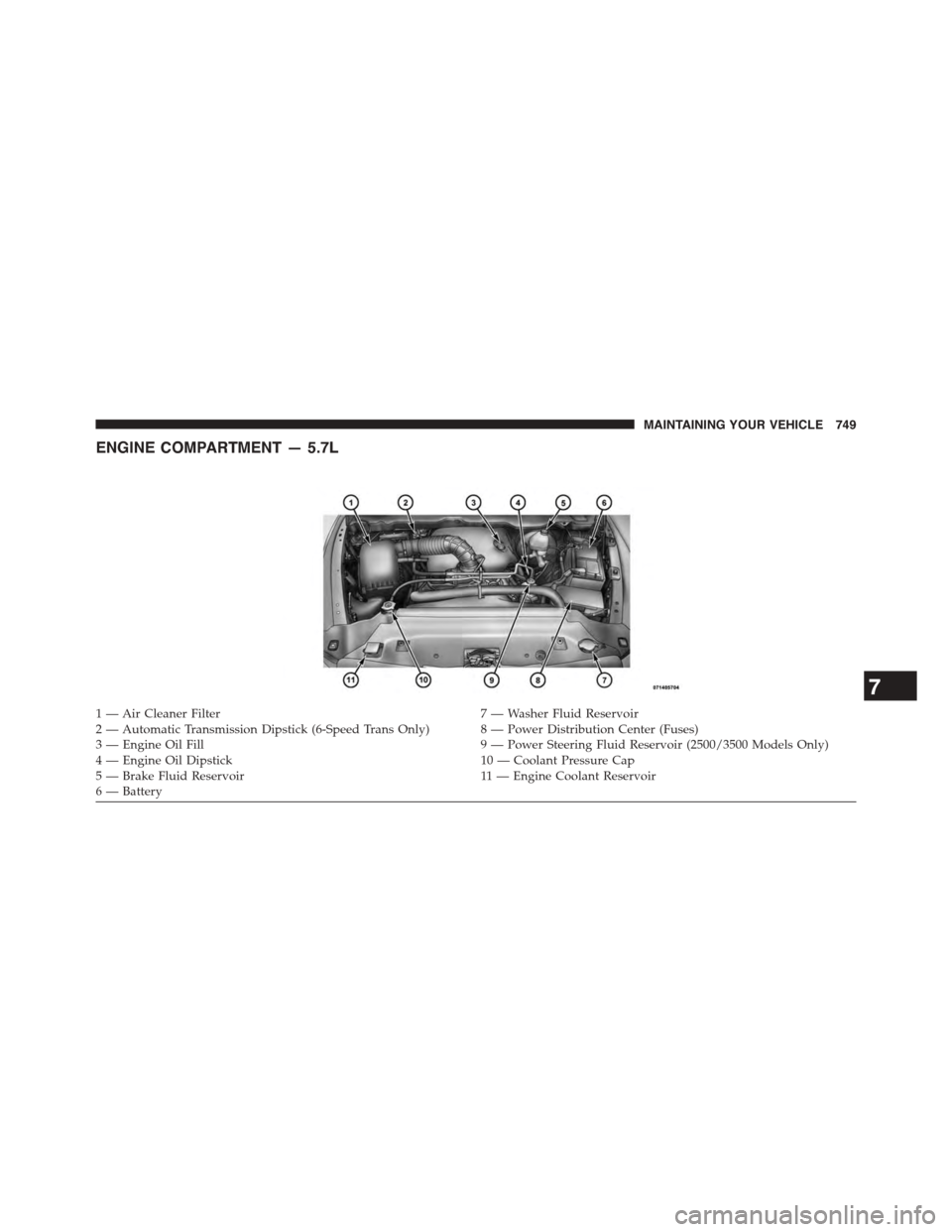
ENGINE COMPARTMENT — 5.7L
1 — Air Cleaner Filter7 — Washer Fluid Reservoir2 — Automatic Transmission Dipstick (6-Speed Trans Only) 8 — Power Distribution Center (Fuses)3 — Engine Oil Fill9 — Power Steering Fluid Reservoir (2500/3500 Models Only)4 — Engine Oil Dipstick10 — Coolant Pressure Cap5 — Brake Fluid Reservoir11 — Engine Coolant Reservoir6 — Battery
7
MAINTAINING YOUR VEHICLE 749
Page 752 of 871
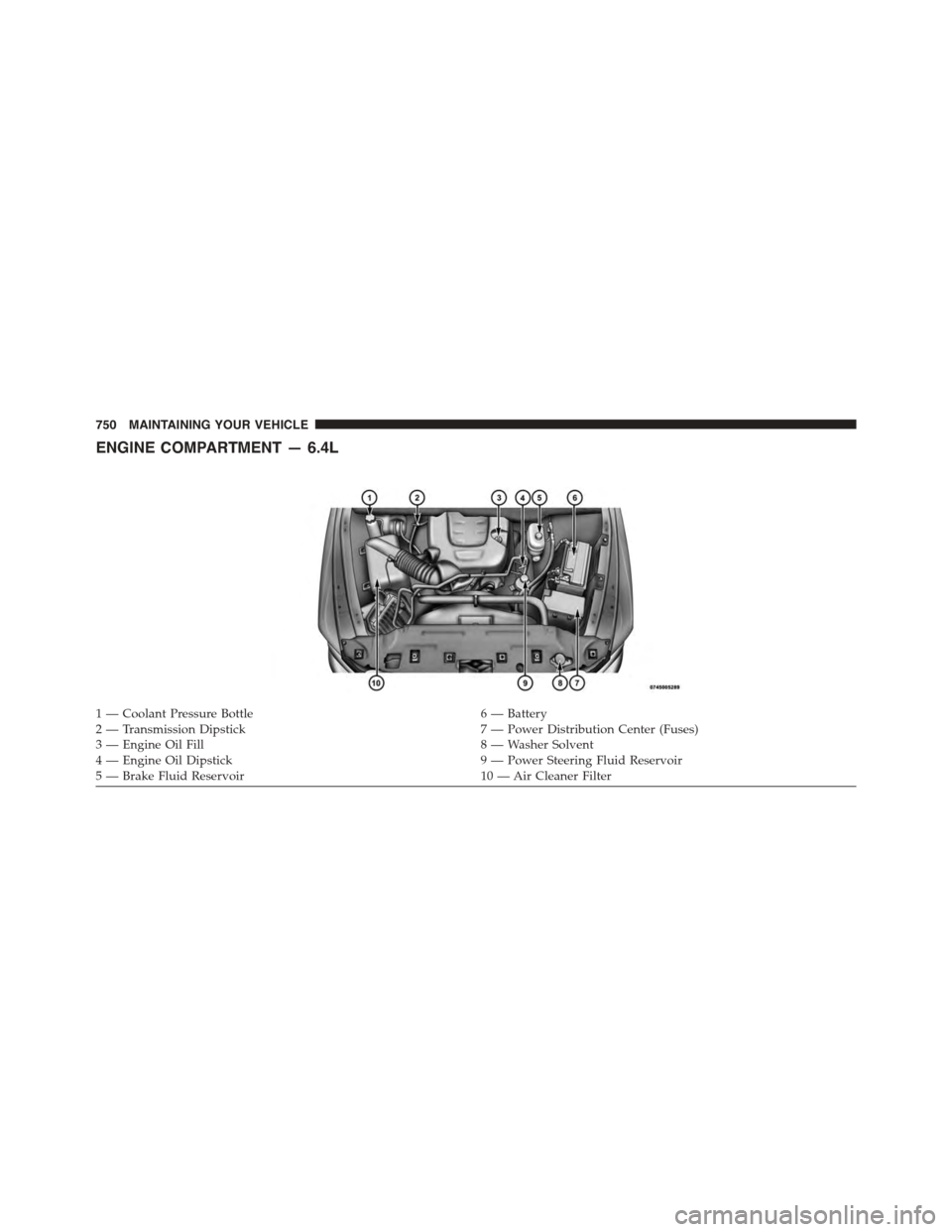
ENGINE COMPARTMENT — 6.4L
1 — Coolant Pressure Bottle6 — Battery2 — Transmission Dipstick7 — Power Distribution Center (Fuses)3—EngineOilFill8—WasherSolvent4 — Engine Oil Dipstick9 — Power Steering Fluid Reservoir5 — Brake Fluid Reservoir10 — Air Cleaner Filter
750 MAINTAINING YOUR VEHICLE
Page 757 of 871
CAUTION!(Continued)
•Your vehicle has been built with improved fluids
that protect the performance and durability of your
vehicle and also allow extended maintenance inter-
vals. Do not use chemical flushes in these compo-
nents as the chemicals can damage your engine,
transmission, power steering or air conditioning.
Such damage is not covered by the New Vehicle
Limited Warranty. If a flush is needed because of
component malfunction, use only the specified
fluid for the flushing procedure.
Engine Oil
Checking Oil Level
To assure proper lubrication of your vehicle’s engine, the
engine oil must be maintained at the correct level. Check
the oil level at regular intervals, such as every fuel stop.
The best time to check the engine oil level is about five
minutes after a fully warmed up engine is shut off.
Checking the oil while the vehicle is on level ground will
improve the accuracy of the oil level readings. Always
maintain the oil level within the SAFE zone on the
dipstick. Adding one quart of oil when the reading is at
the bottom of the SAFE zone will result in a reading at the
top of the safe zone on these engines.
CAUTION!
Overfilling or underfilling the crankcase will cause
oil aeration or loss of oil pressure. This could damage
your engine.7
MAINTAINING YOUR VEHICLE 755