abs Ram 1500 2015 User Guide
[x] Cancel search | Manufacturer: RAM, Model Year: 2015, Model line: 1500, Model: Ram 1500 2015Pages: 871, PDF Size: 24.83 MB
Page 586 of 871
applies optimum pressure to the brakes in emergency
braking conditions. This can help reduce braking dis-
tances. The BAS complements the ABS. Applying the
brakes very quickly results in the best BAS assistance. To
receive the benefit of BAS, you must apply continuous
braking pressure during the stopping sequence. Do not
reduce brake pedal pressure unless braking is no longer
desired.
Once the brake pedal is released, the BAS is deactivated.
WARNING!
•The BAS cannot prevent the natural laws of phys-
ics from acting on the vehicle, nor can it increase
braking efficiency beyond that afforded by the
condition of the vehicle brakes and tires or the
traction afforded.
(Continued)
WARNING!(Continued)
•The BAS cannot prevent collisions, including those
resulting from excessive speed in turns, following
another vehicle too closely, or hydroplaning.
•The capabilities of a BAS-equipped vehicle must
never be exploited in a reckless or dangerous
manner which could jeopardize the user ’s safety or
the safety of others.
Hill Start Assist (HSA)
The HSA system is designed to assist the driver in
launching a vehicle on an incline. HSA will maintain the
level of brake pressure the driver inputs for a short
duration once the driver takes his foot off of the brake
pedal. If the driver does not apply the throttle during this
short duration, the system will release brake pressure
and the vehicle will roll down the incline. The system will
release brake pressure in proportion to the amount of
throttle applied.
584 STARTING AND OPERATING
Page 599 of 871
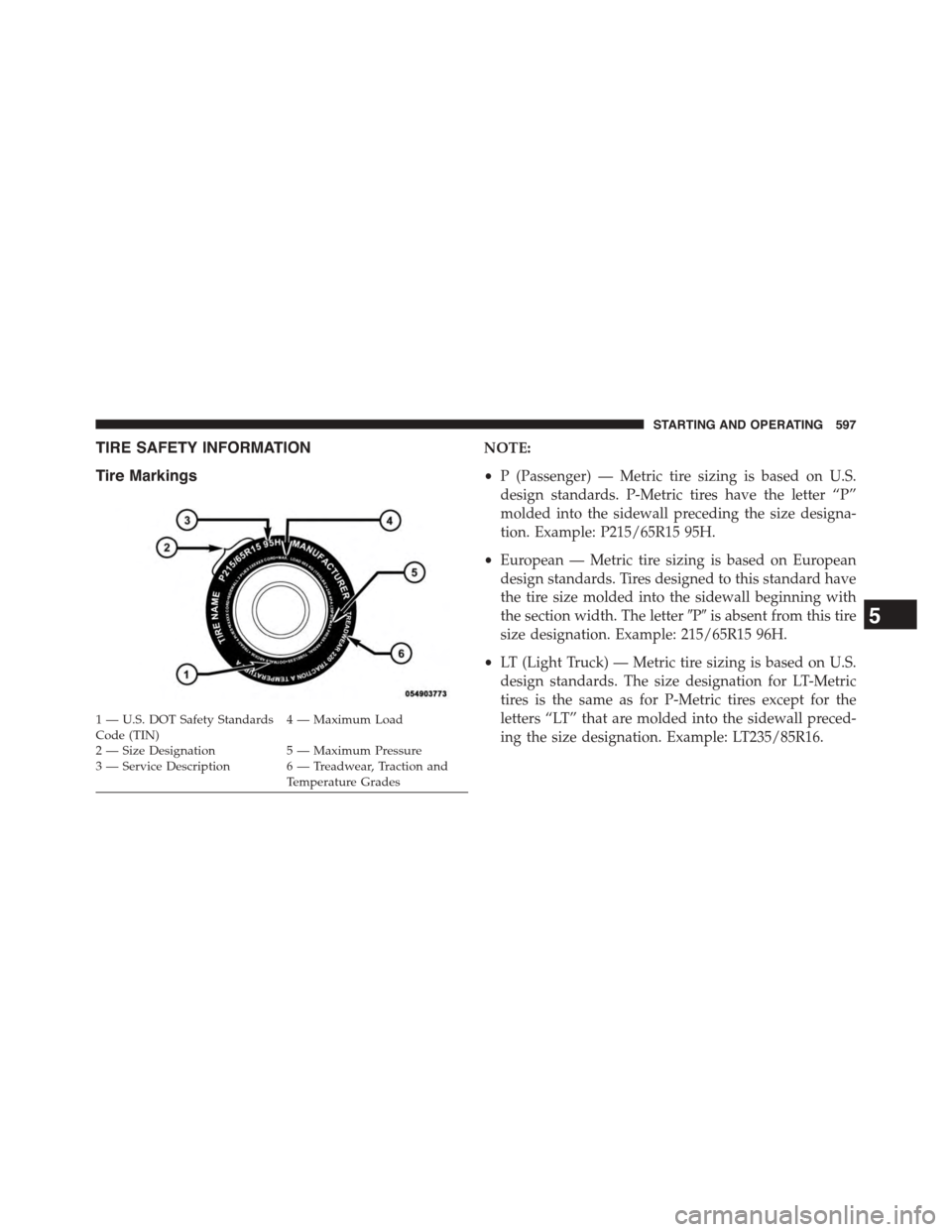
TIRE SAFETY INFORMATION
Tire Markings
NOTE:
•P (Passenger) — Metric tire sizing is based on U.S.
design standards. P-Metric tires have the letter “P”
molded into the sidewall preceding the size designa-
tion. Example: P215/65R15 95H.
•European — Metric tire sizing is based on European
design standards. Tires designed to this standard have
the tire size molded into the sidewall beginning with
the section width. The letter#P#is absent from this tire
size designation. Example: 215/65R15 96H.
•LT (Light Truck) — Metric tire sizing is based on U.S.
design standards. The size designation for LT-Metric
tires is the same as for P-Metric tires except for the
letters “LT” that are molded into the sidewall preced-
ing the size designation. Example: LT235/85R16.
1—U.S.DOTSafetyStandardsCode (TIN)4—MaximumLoad
2—SizeDesignation 5—MaximumPressure3 — Service Description 6 — Treadwear, Traction andTemperature Grades
5
STARTING AND OPERATING 597
Page 602 of 871
EXAMPLE:
Load Identification:
Absence of the following load identification symbols on the sidewall of the tire indicates a Standard Load (SL)
tire:
•XL= Extra load (or reinforced) tire, or
•LL= Light load tire or
•C, D, E, F, G= Load range associated with the maximum load a tire can carry at a specified pressure
Maximum Load– Maximum load indicates the maximum load this tire is designed to carry
Maximum Pressure– Maximum pressure indicates the maximum permissible cold tire inflation pressure for this
tire
Tire Identification Number (TIN)
The TIN may be found on one or both sides of the tire,
however, the date code may only be on one side. Tires
with white sidewalls will have the full TIN, including the
date code, located on the white sidewall side of the tire.
Look for the TIN on the outboard side of black sidewall
tires as mounted on the vehicle. If the TIN is not found on
the outboard side, then you will find it on the inboard
side of the tire.
600 STARTING AND OPERATING
Page 722 of 871
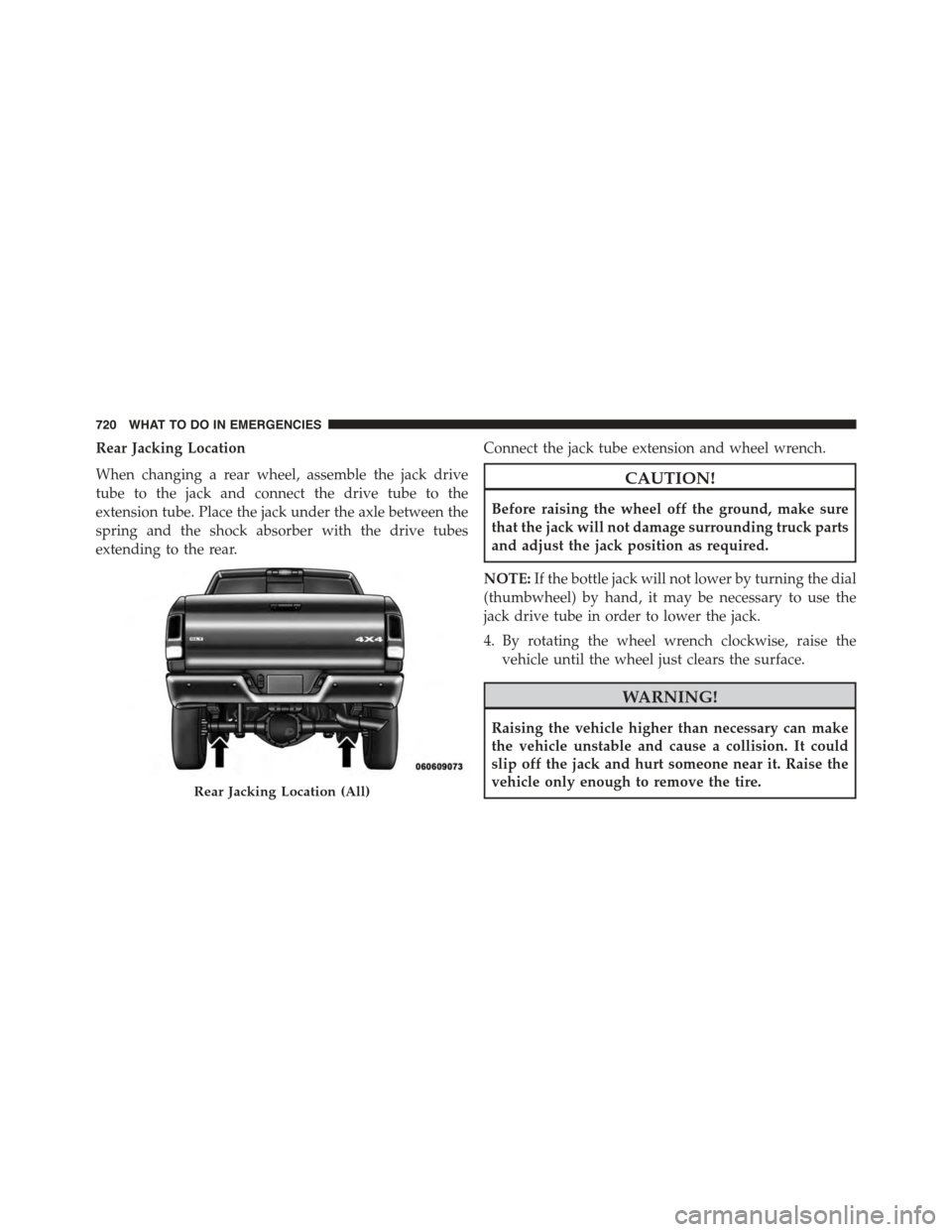
Rear Jacking Location
When changing a rear wheel, assemble the jack drive
tube to the jack and connect the drive tube to the
extension tube. Place the jack under the axle between the
spring and the shock absorber with the drive tubes
extending to the rear.
Connect the jack tube extension and wheel wrench.
CAUTION!
Before raising the wheel off the ground, make sure
that the jack will not damage surrounding truck parts
and adjust the jack position as required.
NOTE:If the bottle jack will not lower by turning the dial
(thumbwheel) by hand, it may be necessary to use the
jack drive tube in order to lower the jack.
4. By rotating the wheel wrench clockwise, raise the
vehicle until the wheel just clears the surface.
WARNING!
Raising the vehicle higher than necessary can make
the vehicle unstable and cause a collision. It could
slip off the jack and hurt someone near it. Raise the
vehicle only enough to remove the tire.Rear Jacking Location (All)
720 WHAT TO DO IN EMERGENCIES
Page 764 of 871
Engine Air Cleaner Filter Installation
NOTE:Inspect and clean the housing if dirt or debris is
present before replacing the air filter element.
1. Install the air cleaner filter element into the housing
assembly with the air cleaner filter inspection surface
facing downward.
2. Install the air cleaner cover onto the housing assembly
locating tabs.
3. Latch the spring clips and lock the air cleaner cover to
the housing assembly.
Accessory Drive Belt Inspection
WARNING!
•Do not attempt to inspect an accessory drive belt
with vehicle running.
(Continued)
WARNING!(Continued)
•When working near the radiator cooling fan, dis-
connect the fan motor lead. The fan is temperature
controlled and can start at any time regardless of
ignition switch position. You could be injured by
the moving fan blades.
•You can be badly injured working on or around a
motor vehicle. Only do service work for which you
have the knowledge and the proper equipment. If
you have any doubt about your ability to perform a
service job, take your vehicle to a competent me-
chanic.
When inspecting accessory drive belts, small cracks that
run across ribbed surface of belt from rib to rib, are
considered normal. These are not a reason to replace belt.
However, cracks running along a rib (not across) are not
762 MAINTAINING YOUR VEHICLE
Page 785 of 871
WARNING!
•Use only manufacturer’s recommended brake
fluid. Refer to “Fluids, Lubricants, and Genuine
Parts” in “Maintaining Your Vehicle” for further
information. Using the wrong type of brake fluid
can severely damage your brake system and/or
impair its performance. The proper type of brake
fluid for your vehicle is also identified on the
original factory installed hydraulic master cylinder
reservoir.
(Continued)
WARNING!(Continued)
•To avoid contamination from foreign matter or
moisture, use only new brake fluid or fluid that has
been in a tightly closed container. Keep the master
cylinder reservoir cap secured at all times. Brake
fluid in a open container absorbs moisture from the
air resulting in a lower boiling point. This may
cause it to boil unexpectedly during hard or pro-
longed braking, resulting in sudden brake failure.
This could result in a collision.
•Overfilling the brake fluid reservoir can result in
spilling brake fluid on hot engine parts, causing
the brake fluid to catch fire. Brake fluid can also
damage painted and vinyl surfaces, care should be
taken to avoid its contact with these surfaces.
(Continued)
7
MAINTAINING YOUR VEHICLE 783
Page 844 of 871
The manufacturer will not stand behind any service
contract that is not the manufacturer’s service contract. It
is not responsible for any service contract other than the
manufacturer’s service contract. If you purchased a ser-
vice contract that is not a manufacturer’s service contract,
and you require service after the manufacturer’s New
Vehicle Limited Warranty expires, please refer to the
contract documents, and contact the person listed in
those documents.
We appreciate that you have made a major investment
when you purchased the vehicle. An authorized dealer
has also made a major investment in facilities, tools, and
training to assure that you are absolutely delighted with
the ownership experience. You will be pleased with their
sincere efforts to resolve any warranty issues or related
concerns.
WARNING!
Engine exhaust (internal combustion engines only),
some of its constituents, and certain vehicle compo-
nents contain, or emit, chemicals known to the State
of California to cause cancer and birth defects, or
other reproductive harm. In addition, certain fluids
contained in vehicles and certain products of compo-
nent wear contain, or emit, chemicals known to the
State of California to cause cancer and birth defects,
or other reproductive harm.
WARRANTY INFORMATION
See the Warranty Information Booklet, located on the
DVD, for the terms and provisions of Chrysler Group
LLC warranties applicable to this vehicle and market.
842 IF YOU NEED CONSUMER ASSISTANCE
Page 850 of 871
Adding Engine Coolant (Antifreeze)............776
Adding Fuel.............................643
Additives, Fuel...........................637
Adjustable Pedals.........................185
Air bag . . . . . . . . . . . . . . . . . . . . . . . . . . . . . . . . .67
Air Bag
Advance Front Air Bag....................68
Air bag Operation.......................70
Air Bag Warning Light....................79
Enhanced Accident Response................78
Event Data Recorder (EDR).................82
Front Air Bag . . . . . . . . . . . . . . . . . . . . . . . . . . .67
If A Deployment Occurs...................77
Knee Impact Bolsters.....................71
Maintaining Your Air Bag System............81
Side Air Bags...........................72
Air bag Deployment........................67
Air bag Light.............................79
Air bag Maintenance........................81
Air Cleaner, Engine (Engine Air Cleaner Filter) . . . .759
Air Conditioner Maintenance.................765
Air Conditioning..........................400
Air Conditioning Controls...................400
Air Conditioning, Operating Tips..............419
Air Conditioning Refrigerant.................765
Air Conditioning System....................400
Air Pressure, Tires.........................610
Air Suspension...........................516
Alarm Light.............................294
Alarm, Panic.............................28
Alarm (Security Alarm)......................21
Alarm System (Security Alarm)................21
Alterations/Modifications, Vehicle...............7
Antifreeze (Engine Coolant)..................776
Disposal..............................778
Anti-Lock Brake System (ABS)................581
Anti-Lock Warning Light....................289
Appearance Care.........................790
848 INDEX
Page 851 of 871
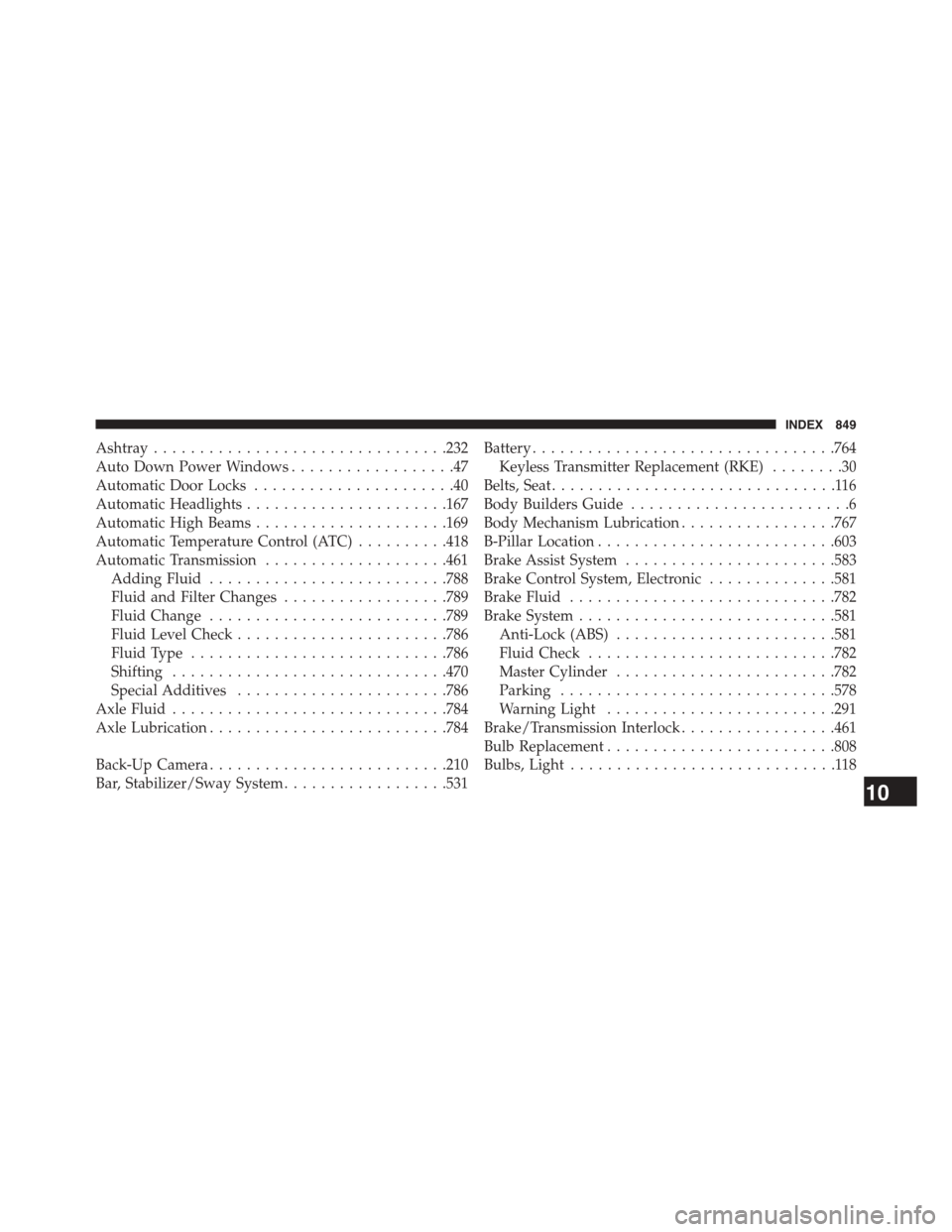
Ashtray................................232
Auto Down Power Windows..................47
Automatic Door Locks......................40
Automatic Headlights......................167
Automatic High Beams.....................169
Automatic Temperature Control (ATC)..........418
Automatic Transmission....................461
Adding Fluid..........................788
Fluid and Filter Changes..................789
Fluid Change..........................789
Fluid Level Check.......................786
Fluid Type............................786
Shifting..............................470
Special Additives.......................786
Axle Fluid..............................784
Axle Lubrication..........................784
Back-Up Camera..........................210
Bar, Stabilizer/Sway System..................531
Battery.................................764
Keyless Transmitter Replacement (RKE)........30
Belts, Seat...............................116
Body Builders Guide........................6
Body Mechanism Lubrication.................767
B-Pillar Location..........................603
Brake Assist System.......................583
Brake Control System, Electronic..............581
Brake Fluid.............................782
Brake System............................581
Anti-Lock (ABS)........................581
Fluid Check...........................782
Master Cylinder........................782
Parking..............................578
Warning Light.........................291
Brake/Transmission Interlock.................461
Bulb Replacement.........................808
Bulbs, Light.............................118
10
INDEX 849