4WD Ram 1500 2015 Owner's Guide
[x] Cancel search | Manufacturer: RAM, Model Year: 2015, Model line: 1500, Model: Ram 1500 2015Pages: 871, PDF Size: 24.83 MB
Page 514 of 871
after engine start up or illuminates during driving, it
means that the four-wheel drive system is not function-
ing properly and that service is required.
WARNING!
Always engage the parking brake when powering
down the vehicle if the “SVC 4WD Warning Light” is
illuminated. Not engaging the parking brake may
allow the vehicle to roll which may cause personal
injury or death.
NOTE:Do not attempt to make a shift while only the
front or rear wheels are spinning. This could cause
damage to driveline components.
When operating your vehicle in 4WD LOW, the engine
speed is approximately three times that of the 2WD, 4WD
AUTO or 4WD LOCK positions at a given road speed.
Take care not to overspeed the engine and do not exceed
25 mph (40 km/h).
Proper operation of four-wheel drive vehicles depends
on tires of equal size, type and circumference on each
wheel. Any difference in tire size can cause damage to the
drivetrain.
Because four-wheel drive provides improved traction,
there is a tendency to exceed safe turning and stopping
speeds. Do not go faster than road conditions permit.
WARNING!
You or others could be injured or killed if you leave
the vehicle unattended with the transfer case in the
NEUTRAL position without first fully engaging the
parking brake. The transfer case NEUTRAL position
(Continued)
512 STARTING AND OPERATING
Page 515 of 871
WARNING!(Continued)
disengages both the front and rear drive shafts from
the powertrain and will allow the vehicle to move
regardless of the transmission position. The parking
brake should always be applied when the driver is
not in the vehicle.
For additional information on the appropriate use of each
transfer case mode position, see the information below:
2WD
Rear-Wheel Drive High Range - This range is for normal
street and highway driving on dry hard surfaced roads.
4WD AUTO
Four-Wheel Drive Auto Range - This range sends power
to the rear wheels. The four–wheel drive system will be
automatically engaged when the vehicle senses a loss of
traction. Additional traction for varying road conditions.
4WD LOCK
Four-Wheel Drive Lock Range - This range maximizes
torque to the front driveshaft, forcing the front and rear
wheels to rotate at the same speed. Additional traction
for loose, slippery road surfaces only.
4WD LOW
Four-Wheel Drive Low Range - This range provides low
speed four-wheel drive. It maximizes torque to the front
driveshaft, forcing the front and rear wheels to rotate at
the same speed. This range provides additional traction
and maximum pulling power for loose, slippery road
surfaces only. Do not exceed 25 mph (40 km/h).
NEUTRAL (N)
Neutral - This range disengages both the front and rear
driveshafts from the powertrain. To be used for flat towing
behind another vehicle. Refer to “Recreational Towing” in
“Starting and Operating” for further information.
5
STARTING AND OPERATING 513
Page 516 of 871
Shifting Procedure
NOTE:
•If any of the requirements to select a new transfer case
position have not been met, the transfer case will not
shift. The position indicator light for the previous
position will remain ON and the newly selected posi-
tion indicator light will continue to flash until all the
requirements for the selected position have been met.
•If all the requirements to select a new transfer case
position have been met, the current position indicator
light will turn OFF, the selected position indicator light
will flash until the transfer case completes the shift.
When the shift is complete, the position indicator light
for the selected position will stop flashing and remain
ON.
2WD To 4WD AUTO Or 4WD LOCK
Press the desired position on the 4WD Control Switch to
shift the transfer case. Shifts between 2WD and 4WD
AUTO and 4WD LOCK can be done with the vehicle
stopped or in motion. With the vehicle in motion, the
transfer case will engage/disengage faster if you momen-
tarily release the accelerator pedal after turning the
control switch. If the vehicle is stopped, the ignition
switch must be in the ON position with the engine either
running or OFF. This shift cannot be completed if the
ignition switch is in the ACC position.
2WD Or 4WD AUTO Or 4WD LOCK To 4WD LOW
NOTE:When shifting into or out of 4WD LOW some
gear noise may be heard. This noise is normal and is not
detrimental to the vehicle or occupants.
Shifting can be performed with the vehicle rolling 2 to
3 mph (3 to 5 km/h) or completely stopped. Use either of
the following procedures:
514 STARTING AND OPERATING
Page 590 of 871
WARNING!
Electronic Stability Control (ESC) cannot prevent the
natural laws of physics from acting on the vehicle,
nor can it increase the traction afforded by prevailing
road conditions. ESC cannot prevent accidents, in-
cluding those resulting from excessive speed in
turns, driving on very slippery surfaces, or hydro-
planing. ESC also cannot prevent accidents resulting
from loss of vehicle control due to inappropriate
driver input for the conditions. Only a safe, attentive,
and skillful driver can prevent accidents. The capa-
bilities of an ESC equipped vehicle must never be
exploited in a reckless or dangerous manner which
could jeopardize the user ’s safety or the safety of
others.
All Two-Wheel Drive Vehicles And Four-Wheel
Drive Vehicles In 2WD, 4WD AUTO, Or 4WD
LOCK Modes Can Choose The Following ESC
Operating Modes:
ESC On
This is the normal operating mode for ESC in 2WD/4WD
AUTO/4WD LOCK modes and in 2WD vehicles. When-
ever the vehicle is started or the transfer case (if
equipped) is shifted from 4WD LOW or Neutral, back to
4WD LOCK or 4WD AUTO, the ESC system will be in
this mode. This mode should be used for almost all
driving situations. ESC should only be turned to#ESC
Partial Off#or “ESC Full Off” for specific reasons as noted
below.
ESC Partial Off
This mode is entered by momentarily pressing the “ESC
Partial Off” switch. When in#Partial Off#mode, the TCS
588 STARTING AND OPERATING
Page 592 of 871
All Four-Wheel Drive Vehicles In 4WD AUTO And
4WD LOCK Modes Can Also Choose The
Following ESC Operating Mode. This Is The Only
Selectable ESC Operating Mode in 4WD LOW:
ESC Full Off
This mode is intended for off-road use when ESC stabil-
ity features could inhibit vehicle maneuverability due to
trail conditions. This mode is entered by pressing and
holding the “ESC Off” switch for five seconds when the
vehicle is stopped and the engine is running. After five
seconds, the “ESC Off Indicator Light” will illuminate.
Press and release the trip odometer button located on the
instrument cluster to clear this message.
NOTE:The “ESC OFF” message will display and the
audible chime will sound when the shift lever is placed
into the PARK position from any other position and then
moved out of the PARK position. This will occur even if
the message was previously cleared.
In this mode, ESC and TCS except for the “limited slip”
feature described in the TCS section are turned off until
the vehicle reaches a speed of 40 mph (64 km/h). At
40 mph (64 km/h) the system returns to “ESC Partial
Off” mode, described above. When the vehicle speed
drops below 35 mph (56 km/h) the ESC system reverts
back to#ESC Full Off#. ESC is off at low vehicle speeds so
that it will not interfere with off-road driving but ESC
function returns to provide the stability feature at speeds
above 40 mph (64 km/h). The “ESC Off Indicator Light”
will always be illuminated when ESC is in#ESC Partial
Off#and#ESC Full Off#. To turn ESC on again, momen-
tarily press the “ESC Off” switch. This will restore the
normal “ESC On” mode of operation.
“ESC Full Off” is the only operating mode for ESC in
4WD LOW. Whenever the vehicle is started in 4WD LOW
or the transfer case (if equipped) is shifted from 4WD
LOCK or NEUTRAL, to 4WD LOW, the ESC system will
be in this mode.
590 STARTING AND OPERATING
Page 594 of 871
NOTE:
•The “ESC Activation/Malfunction Indicator Light”
and the “ESC OFF Indicator Light” come on momen-
tarily each time the ignition switch is turned ON.
•Each time the ignition is turned ON, the ESC system
will be ON even if it was turned off previously. Except
for when the vehicle is started while in 4WD Low
Range.
•The ESC system will make buzzing or clicking sounds
when it is active. This is normal; the sounds will stop
when ESC becomes inactive following the maneuver
that caused the ESC activation.
The “ESC OFF Indicator Light” indicates the
Electronic Stability Control (ESC) is in#ESC
Partial Off#or#ESC Full Off#.
Trailer Sway Control (TSC)
The TSC system uses sensors in the vehicle to recognize
an excessively swaying trailer and will take the appro-
priate actions to attempt to stop the sway. The system
may reduce engine power and apply the brake of the
appropriate wheel(s) to counteract the sway of the trailer.
TSC will become active automatically once an excessively
swaying trailer is recognized. No driver action is re-
quired to activate. Note that TSC cannot stop all trailers
from swaying. Always use caution when towing a trailer
and follow the trailer tongue weight recommendations.
Refer to “Trailer Towing” in “Starting and Operating” for
further information. When TSC is functioning, the “ESC
Activation/Malfunction Indicator Light” will flash, the
engine power may be reduced and you may feel the
brakes being applied to individual wheels to attempt to
stop the trailer from swaying. TSC is disabled when the
ESC system is in the “ESC Partial Off” or “ESC Full Off”
modes.
592 STARTING AND OPERATING
Page 595 of 871
TSC is only active in the default “ESC On” mode. TSC
can be disabled by pressing the “ESC Off” switch and
entering “ESC Partial Off” mode. It is not active in the
“ESC Partial Off” or “ESC Full Off” modes. Refer to the
ESC portion of this section for an explanation of the
different ESC operating modes.
WARNING!
If TSC activates while driving, slow the vehicle
down, stop at the nearest safe location, and adjust the
trailer load to eliminate trailer sway.
Hill Descent Control (HDC) — If Equipped
HDC is intended for low speed off road driving while in
4WD Low Range. HDC maintains vehicle speed while
descending hills, during various driving situations. HDC
controls vehicle speed by actively controlling the brakes.
HDC has three states:
1. Off (feature is not enabled and will not activate).
2. Enabled (feature is enabled and ready but activation
conditions are not met, or driver is actively overriding
with brake or throttle application).
3. Active (feature is enabled and actively controlling
vehicle speed).
Enabling HDC
HDC is enabled by pressing the HDC switch, but the
following conditions must also be met to enable HDC:
•Driveline is in 4WD Low Range.
•Vehicle speed is below 5 mph (8 Km/h).
•Parking brake is released.
•Driver door is closed.
5
STARTING AND OPERATING 593
Page 597 of 871
Driver Override:
The driver may override HDC activation with throttle or
brake application at anytime.
Deactivating HDC
HDC will be deactivated but remain available if any of
the following conditions occur:
•Driver overrides HDC set speed with throttle or brake
application.
•Vehicle speed exceeds 20 mph (32 km/h) but remains
below 40 mph (64 km/h).
•Vehicle is on a downhill grade of insufficient magni-
tude (less than approximately 8%), is on level ground,
or is on an uphill grade.
•Vehicle is shifted to park.
Disabling HDC
HDC will deactivate and be disabled if any of the
following conditions occur:
•The driver presses the HDC switch.
•The driveline is shifted out of 4WD Low Range.
•The parking brake is applied.
•Driver door opens.
•The vehicle is driven greater than 20 mph
(32 km/h)for greater than 70 seconds.
•The vehicle is drive greater than 40 mph (64 km/h)
(HDC exits immediately).
5
STARTING AND OPERATING 595
Page 677 of 871
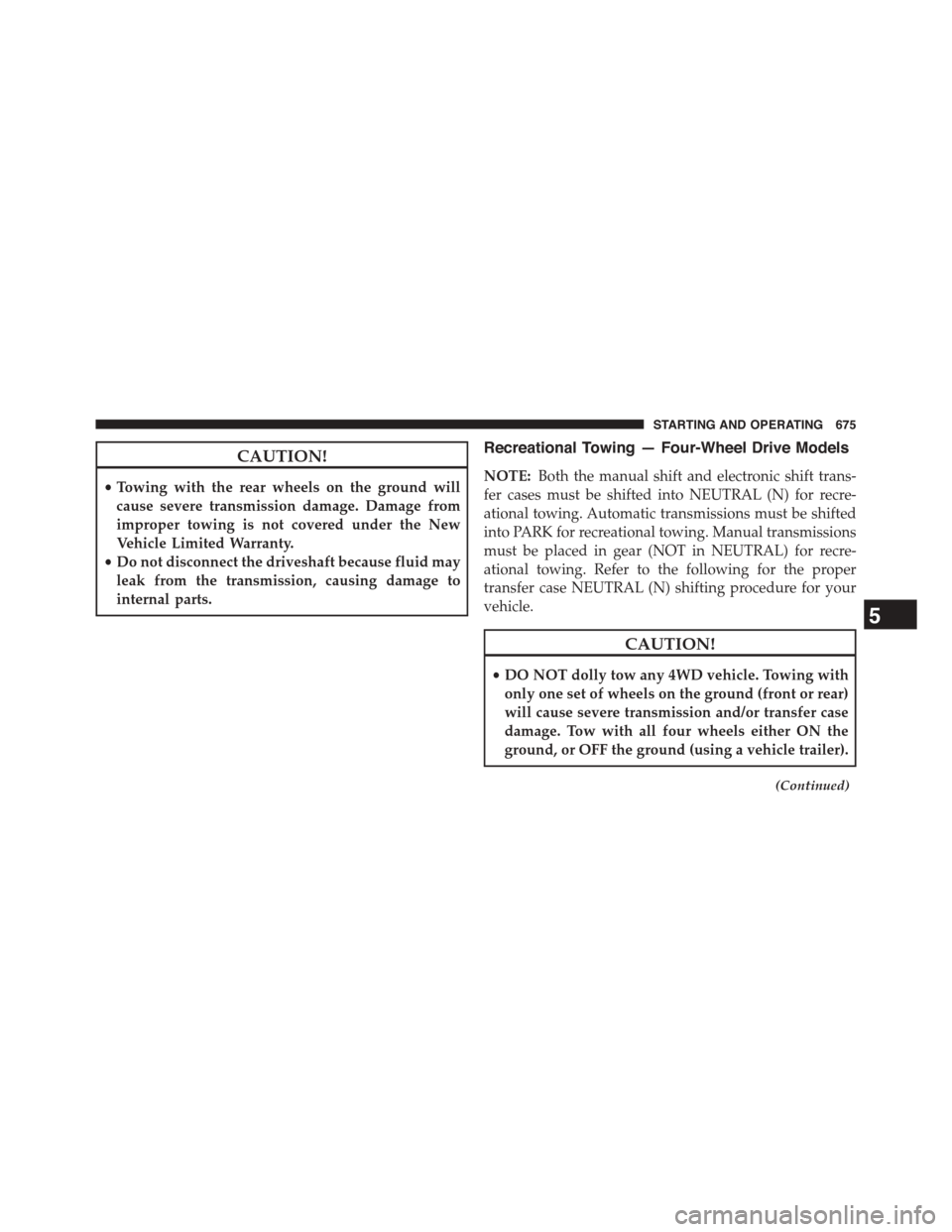
CAUTION!
•Towing with the rear wheels on the ground will
cause severe transmission damage. Damage from
improper towing is not covered under the New
Vehicle Limited Warranty.
•Do not disconnect the driveshaft because fluid may
leak from the transmission, causing damage to
internal parts.
Recreational Towing — Four-Wheel Drive Models
NOTE:Both the manual shift and electronic shift trans-
fer cases must be shifted into NEUTRAL (N) for recre-
ational towing. Automatic transmissions must be shifted
into PARK for recreational towing. Manual transmissions
must be placed in gear (NOT in NEUTRAL) for recre-
ational towing. Refer to the following for the proper
transfer case NEUTRAL (N) shifting procedure for your
vehicle.
CAUTION!
•DO NOT dolly tow any 4WD vehicle. Towing with
only one set of wheels on the ground (front or rear)
will cause severe transmission and/or transfer case
damage. Tow with all four wheels either ON the
ground, or OFF the ground (using a vehicle trailer).
(Continued)
5
STARTING AND OPERATING 675
Page 743 of 871
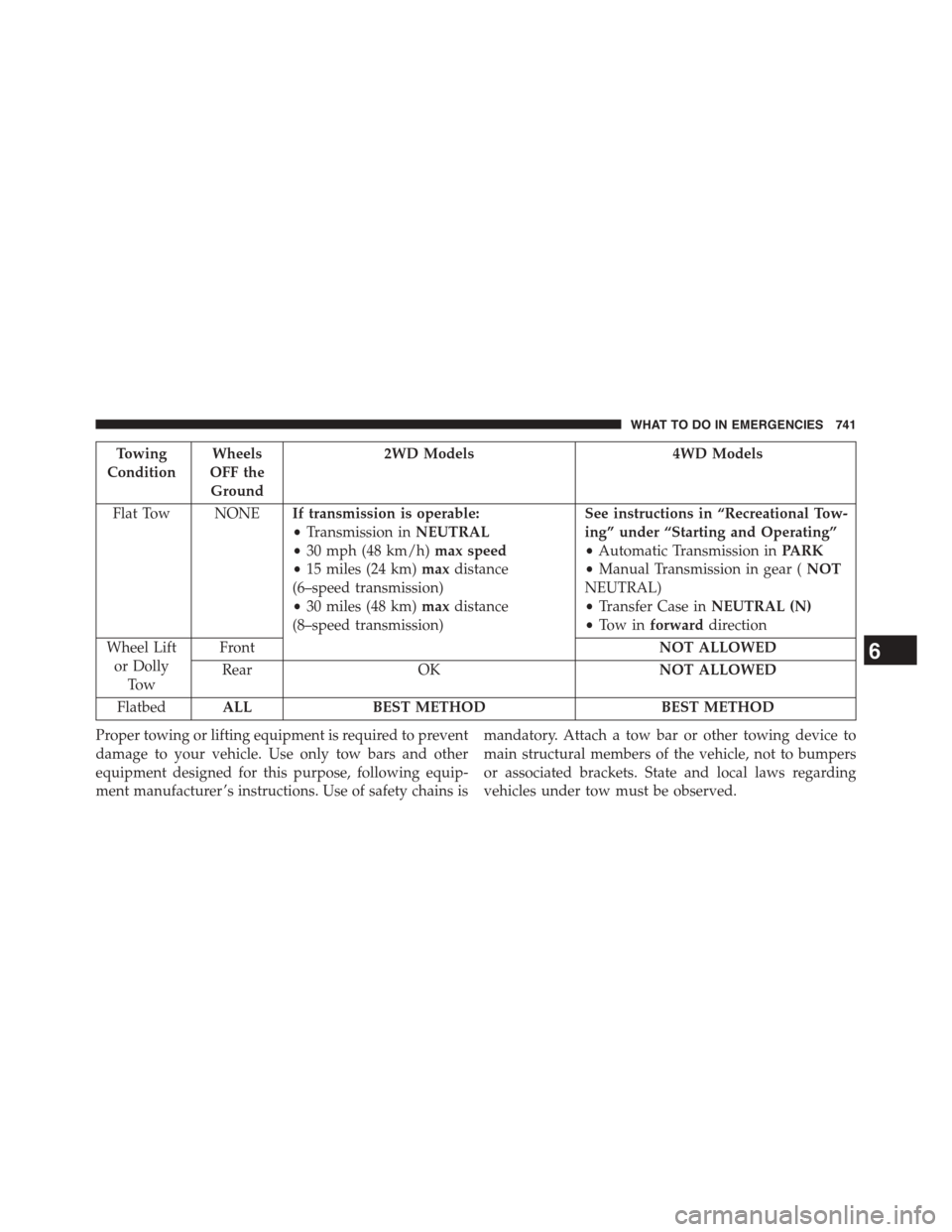
Towing
Condition
Wheels
OFF the
Ground
2WD Models 4WD Models
Flat Tow NONEIf transmission is operable:
•Transmission inNEUTRAL
•30 mph (48 km/h)max speed
•15 miles (24 km)maxdistance
(6–speed transmission)
•30 miles (48 km)maxdistance
(8–speed transmission)
See instructions in “Recreational Tow-
ing” under “Starting and Operating”
•Automatic Transmission inPARK
•Manual Transmission in gear (NOT
NEUTRAL)
•Transfer Case inNEUTRAL (N)
•To w i nforwarddirection
Wheel Lift
or Dolly
To w
FrontNOT ALLOWED
Rear OKNOT ALLOWED
FlatbedALLBEST METHODBEST METHOD
Proper towing or lifting equipment is required to prevent
damage to your vehicle. Use only tow bars and other
equipment designed for this purpose, following equip-
ment manufacturer ’s instructions. Use of safety chains is
mandatory. Attach a tow bar or other towing device to
main structural members of the vehicle, not to bumpers
or associated brackets. State and local laws regarding
vehicles under tow must be observed.
6
WHAT TO DO IN EMERGENCIES 741