TRANSFER Ram 1500 2015 Owner's Guide
[x] Cancel search | Manufacturer: RAM, Model Year: 2015, Model line: 1500, Model: Ram 1500 2015Pages: 871, PDF Size: 24.83 MB
Page 510 of 871
For additional information on the appropriate use of each
transfer case mode position, see the information below:
2WD
Rear-Wheel Drive High Range - This range is for normal
street and highway driving on dry hard surfaced roads.
4WD AUTO
Four-Wheel Drive Auto Range - This range sends power
to the rear wheels. The four – wheel drive system will be
automatically engaged when the vehicle senses a loss of
traction. Additional traction for varying road conditions.
4WD LOCK
Four-Wheel Drive Lock Range - This range maximizes
torque to the front driveshaft, forcing the front and rear
wheels to rotate at the same speed. Additional traction
for loose, slippery road surfaces only.
4WD LOW
Four - Wheel Drive Low Range - This range provides low
speed four-wheel drive. It maximizes torque to the front
driveshaft , forcing the front and rear wheels to rotate at
the same speed. This range provides additional traction
and maximum pulling power for loose, slippery road
surfaces only. Do not exceed 25 mph (40 km/h).
NEUTRAL (N)
Neutral - This range disengages both the front and rear
driveshafts from the powertrain. To be used for flat
towing behind another vehicle. Refer to “Recreational
Towing” in “Starting and Operating” for further infor-
mation.
508 STARTING AND OPERATING
Page 511 of 871
Shifting Procedure
NOTE:
•If any of the requirements to select a new transfer case
position have not been met, the transfer case will not
shift. The position indicator light for the previous posi-
tion will remain ON and the newly selected position
indicator light will continue to flash until all the require-
ments for the selected position have been met. To retry a
shift: return the control knob back to the original posi-
tion, make certain all shift requirements have been met,
wait five seconds and try the shift again.
•If all the requirements to select a new transfer case
position have been met, the current position indicator
light will turn OFF, the selected position indicator light
will flash until the transfer case completes the shift.
When the shift is complete, the position indicator light
for the selected position will stop flashing and remain
ON.
Electronically Shifted Transfer Case
(Five-Position Switch) — If Equipped
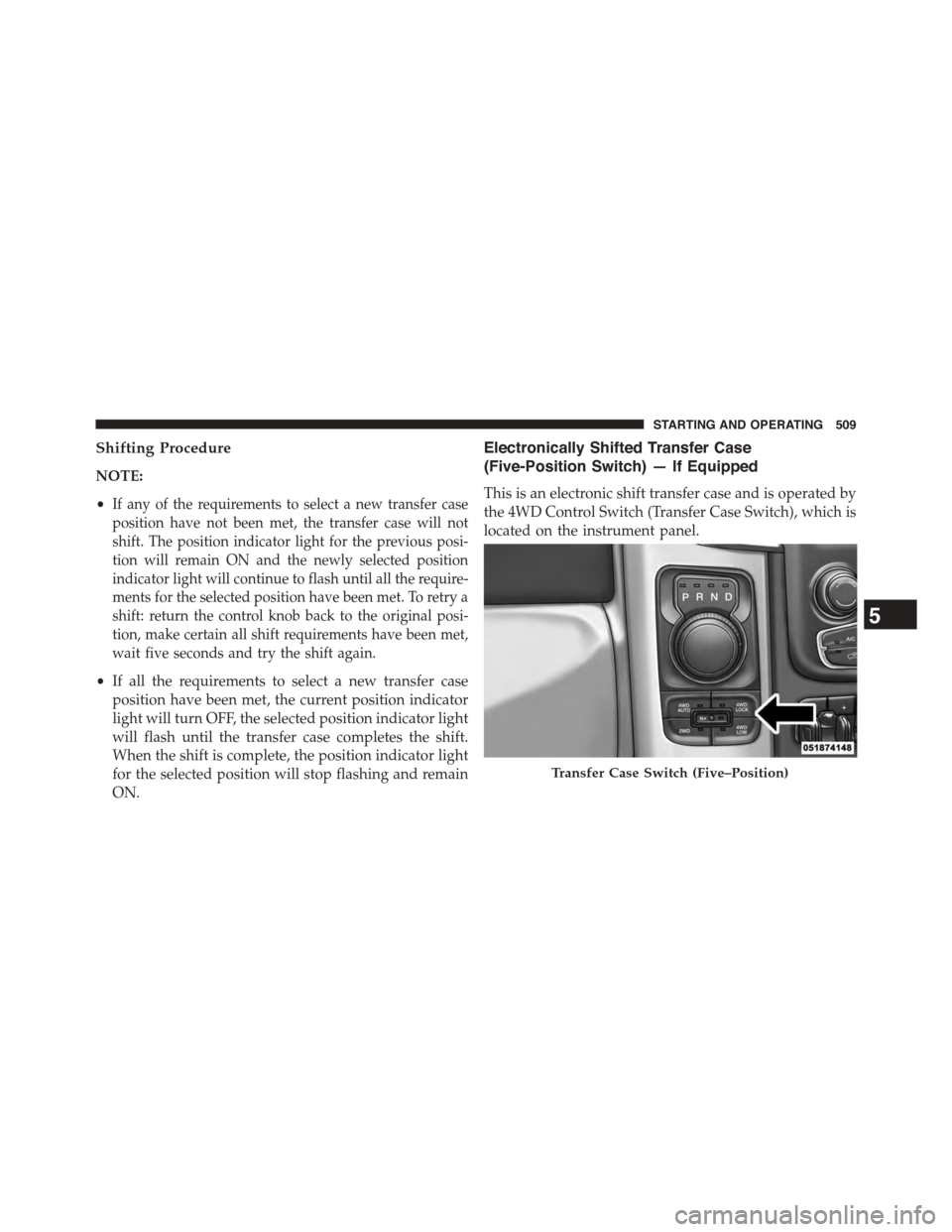
This is an electronic shift transfer case and is operated by
the 4WD Control Switch (Transfer Case Switch), which is
located on the instrument panel.
Transfer Case Switch (Five–Position)
5
STARTING AND OPERATING 509
Page 512 of 871
This electronically shifted transfer case provides five
mode positions:
•Two-wheel drive high range (2WD)
•Four-wheel drive automatic range (4WD AUTO)
•Four-wheel drive lock range (4WD LOCK)
•Four-wheel drive low range (4WD LOW)
•Neutral (NEUTRAL)
This electronically shifted transfer case is designed to be
driven in the two–wheel drive position (2WD) or four-
wheel drive position (4WD AUTO) for normal street and
highway conditions on dry hard surfaced roads). Driving
the vehicle in 2WD will have greater fuel economy
benefits as the front axle is not engaged in 2WD.
For variable driving conditions, the 4WD AUTO mode
can be used. In this mode, the front axle is engaged, but
the vehicle’s power is sent to the rear wheels. Four-wheel
drive will be automatically engaged when the vehicle
senses a loss of traction. Because the front axle is en-
gaged, this mode will result in lower fuel economy than
the 2WD mode.
When additional traction is required, the transfer case
4WD LOCK and 4WD LOW positions can be used to
maximize torque to the front driveshaft, forcing the front
and rear wheels to rotate at the same speed. This is
accomplished by rotating the 4WD Control Switch to the
desired position. Refer to “Shifting Procedure” for spe-
cific shifting instructions. The 4WD LOCK and 4WD
LOW positions are designed for loose, slippery road
surfaces only. Driving in the 4WD LOCK and 4WD LOW
positions on dry hard surfaced roads may cause in-
creased tire wear and damage to the driveline compo-
nents.
510 STARTING AND OPERATING
Page 513 of 871

NOTE:The transfer case NEUTRAL position is selected
by depressing the recessed button (with a ballpoint pen
or similar object) located in the center of the 4WD Control
Switch. The transfer case NEUTRAL position is to be
used for recreational towing only. Refer to “Recreational
Towing” in “Starting and Operating” for further infor-
mation.
Transfer Case Position Indicator Lights
The Transfer Case Position Indicator Lights (4WD,
4LOW, and 4WD AUTO) are located in the instrument
cluster and indicate the current and desired transfer case
selection. When you select a different transfer case posi-
tion, the indicator lights will do the following:
If All Shift Conditions Are Met:
1. The current position indicator light will turn OFF.
2. The selected position indicator light will flash until the
transfer case completes the shift.
3. When the shift is complete, the indicator light for the
selected position will stop flashing and remain ON.
If One Or More Shift Conditions Are Not Met:
1. The indicator light for the current position will remain
ON.
2. The newly selected position indicator light will con-
tinue to flash.
3. The transfer casewill notshift.
NOTE:Before retrying a selection, make certain that all
the necessary requirements for selecting a new transfer
case position have been met. To retry the selection, turn
the control knob back to the current position, wait five
seconds, and retry selection. To find the shift require-
ments, refer to the#Shifting Procedure#for your transfer
case, located in this section.
The “SVC 4WD Warning Light” monitors the electronic
shift four-wheel drive system. If this light remains on
5
STARTING AND OPERATING 511
Page 514 of 871
after engine start up or illuminates during driving, it
means that the four-wheel drive system is not function-
ing properly and that service is required.
WARNING!
Always engage the parking brake when powering
down the vehicle if the “SVC 4WD Warning Light” is
illuminated. Not engaging the parking brake may
allow the vehicle to roll which may cause personal
injury or death.
NOTE:Do not attempt to make a shift while only the
front or rear wheels are spinning. This could cause
damage to driveline components.
When operating your vehicle in 4WD LOW, the engine
speed is approximately three times that of the 2WD, 4WD
AUTO or 4WD LOCK positions at a given road speed.
Take care not to overspeed the engine and do not exceed
25 mph (40 km/h).
Proper operation of four-wheel drive vehicles depends
on tires of equal size, type and circumference on each
wheel. Any difference in tire size can cause damage to the
drivetrain.
Because four-wheel drive provides improved traction,
there is a tendency to exceed safe turning and stopping
speeds. Do not go faster than road conditions permit.
WARNING!
You or others could be injured or killed if you leave
the vehicle unattended with the transfer case in the
NEUTRAL position without first fully engaging the
parking brake. The transfer case NEUTRAL position
(Continued)
512 STARTING AND OPERATING
Page 515 of 871
WARNING!(Continued)
disengages both the front and rear drive shafts from
the powertrain and will allow the vehicle to move
regardless of the transmission position. The parking
brake should always be applied when the driver is
not in the vehicle.
For additional information on the appropriate use of each
transfer case mode position, see the information below:
2WD
Rear-Wheel Drive High Range - This range is for normal
street and highway driving on dry hard surfaced roads.
4WD AUTO
Four-Wheel Drive Auto Range - This range sends power
to the rear wheels. The four–wheel drive system will be
automatically engaged when the vehicle senses a loss of
traction. Additional traction for varying road conditions.
4WD LOCK
Four-Wheel Drive Lock Range - This range maximizes
torque to the front driveshaft, forcing the front and rear
wheels to rotate at the same speed. Additional traction
for loose, slippery road surfaces only.
4WD LOW
Four-Wheel Drive Low Range - This range provides low
speed four-wheel drive. It maximizes torque to the front
driveshaft, forcing the front and rear wheels to rotate at
the same speed. This range provides additional traction
and maximum pulling power for loose, slippery road
surfaces only. Do not exceed 25 mph (40 km/h).
NEUTRAL (N)
Neutral - This range disengages both the front and rear
driveshafts from the powertrain. To be used for flat towing
behind another vehicle. Refer to “Recreational Towing” in
“Starting and Operating” for further information.
5
STARTING AND OPERATING 513
Page 516 of 871
Shifting Procedure
NOTE:
•If any of the requirements to select a new transfer case
position have not been met, the transfer case will not
shift. The position indicator light for the previous
position will remain ON and the newly selected posi-
tion indicator light will continue to flash until all the
requirements for the selected position have been met.
•If all the requirements to select a new transfer case
position have been met, the current position indicator
light will turn OFF, the selected position indicator light
will flash until the transfer case completes the shift.
When the shift is complete, the position indicator light
for the selected position will stop flashing and remain
ON.
2WD To 4WD AUTO Or 4WD LOCK
Press the desired position on the 4WD Control Switch to
shift the transfer case. Shifts between 2WD and 4WD
AUTO and 4WD LOCK can be done with the vehicle
stopped or in motion. With the vehicle in motion, the
transfer case will engage/disengage faster if you momen-
tarily release the accelerator pedal after turning the
control switch. If the vehicle is stopped, the ignition
switch must be in the ON position with the engine either
running or OFF. This shift cannot be completed if the
ignition switch is in the ACC position.
2WD Or 4WD AUTO Or 4WD LOCK To 4WD LOW
NOTE:When shifting into or out of 4WD LOW some
gear noise may be heard. This noise is normal and is not
detrimental to the vehicle or occupants.
Shifting can be performed with the vehicle rolling 2 to
3 mph (3 to 5 km/h) or completely stopped. Use either of
the following procedures:
514 STARTING AND OPERATING
Page 517 of 871
Preferred Procedure
1. With the engine running, slow the vehicle to 2 to
3 mph (3 to 5 km/h).
2. Shift the transmission into NEUTRAL.
3. While still rolling, press the desired position on the
transfer case control switch.
4. After the desired position indicator light is ON (not
flashing), shift the transmission back into gear.
Alternate Procedure
1. Bring the vehicle to complete stop.
2. With the ignition switch in the ON position and the
engine running, shift the transmission into NEUTRAL.
3. Press the desired position on the transfer case control
switch.
4. After the desired position indicator light is ON (not
flashing), shift the transmission back into gear.
NOTE:
•If Steps 1 or 2 of either the Preferred or Alternate
Procedure are not satisfied prior to attempting the shift
or if they no longer are being met while the shift
attempt is in process, the desired position indicator
light will flash continuously while the original position
indicator light is ON, until all requirements have been
met.
•The ignition switch must be in the ON position for a
shift to take place and for the position indicator lights
to be operable. If the ignition switch is not in the ON
position, then the shift will not take place and no
position indicator lights will be on or flashing.
5
STARTING AND OPERATING 515
Page 535 of 871
WARNING!(Continued)
attempt to drive the vehicle over 18 mph (29 km/h).
Driving faster than 18 mph (29 km/h) may cause loss
of control of the vehicle, which could result in
serious injury or death. Contact your local service
center for assistance.
SAFE OFF-ROAD DRIVING — POWER WAGON
ONLY
Off-Road Driving Tips And Vehicle Characteristics
Your vehicle has excellent on and off-road capabilities.
These off-road capabilities will allow you to explore
those wilderness trails where few travel, providing a
source of exciting and satisfying recreation. Before you
venture out, you should contact your local governmental
agency to determine the designated off-road vehicle
(ORV) trails or recreation areas. You should always tread
lightly and only use established roads, trails or ORV
recreational areas. The National Forest Service, Bureau of
Land Management or local Department of Natural Re-
sources are a wealth of information and usually have
maps with marked trails.
Skid Plates And Underbody Protection
Steel skid plates protect the major driveline components
of the truck including the fuel tank, transfer case and
steering damper. In addition, this vehicle is equipped
with boxed cross members and fore/aft rails. This addi-
tional protection allows the vehicle to be utilized in
severe off-road situations that would be considered im-
passable by a normal truck.
Ramp Travel Index (RTI)
The ramp travel index is the distance, in inches, that you
can drive your vehicle with one wheel on a 20-degree
ramp without lifting any other wheel off the ground. This
distance up the ramp divided by the wheelbase of the
vehicle and multiplied by 1,000 is the RTI. This vehicle
5
STARTING AND OPERATING 533
Page 538 of 871
•Snow– In heavy snow or for additional control and
traction at slower speeds, shift the transmission to a
low gear and shift the transfer case to 4L (Low Range)
if necessary. Do not shift to a lower gear than necessary
to maintain headway. Over-revving the engine can
spin the wheels and traction will be lost. If you start to
slow to a stop, try turning your steering wheel no more
than a¼turn quickly back and forth, while still
applying throttle. This will allow the tires to get a fresh
#bite#and help maintain your momentum.
CAUTION!
On icy or slippery roads, do not downshift at high
engine RPMs or vehicle speeds because engine brak-
ing may cause skidding and loss of control.
•Mud– Deep mud creates a great deal of suction
around the tires and is very difficult to get through.
You should use 4L (Low Range) with a gear low
enough to maintain your momentum without shifting.
If you start to slow to a stop, try turning your steering
wheel no more than a¼turn quickly back and forth
for additional traction. Mud holes pose an increased
threat of vehicle damage and getting stuck. They are
normally full of debris from previous vehicles getting
stuck. As a good practice before entering any mud
hole, get out and determine how deep it is, if there are
any hidden obstacles and if the vehicle can be safely
recovered if stuck.
•Sand– Soft sand is very difficult to travel through with
full tire pressure. When crossing soft sandy spots in a
trail maintain your vehicle’s momentum and do not
stop. The key to driving in soft sand using the appro-
priate tire pressure, accelerating slowly, avoiding
abrupt maneuvers and maintaining the vehicle’s mo-
mentum. If you are going to be driving on large soft
sandy areas or dunes, reduce your tire pressure to a
minimum of 15 psi (103 kPa) to allow for a greater tire
536 STARTING AND OPERATING