air suspension system Ram 1500 2015 Owner's Guide
[x] Cancel search | Manufacturer: RAM, Model Year: 2015, Model line: 1500, Model: Ram 1500 2015Pages: 871, PDF Size: 24.83 MB
Page 524 of 871
Electronic Vehicle Information Center
(EVIC)/Driver Information Display (DID) Display
Messages
When the appropriate conditions exist, a message will
appear in the EVIC/DID display. Refer to “Electronic
Vehicle Information Center (EVIC) or Driver Information
Display (DID)” in “Understanding Your Instrument
Panel” for further information.
An audible chime will be heard whenever a system error
has been detected.
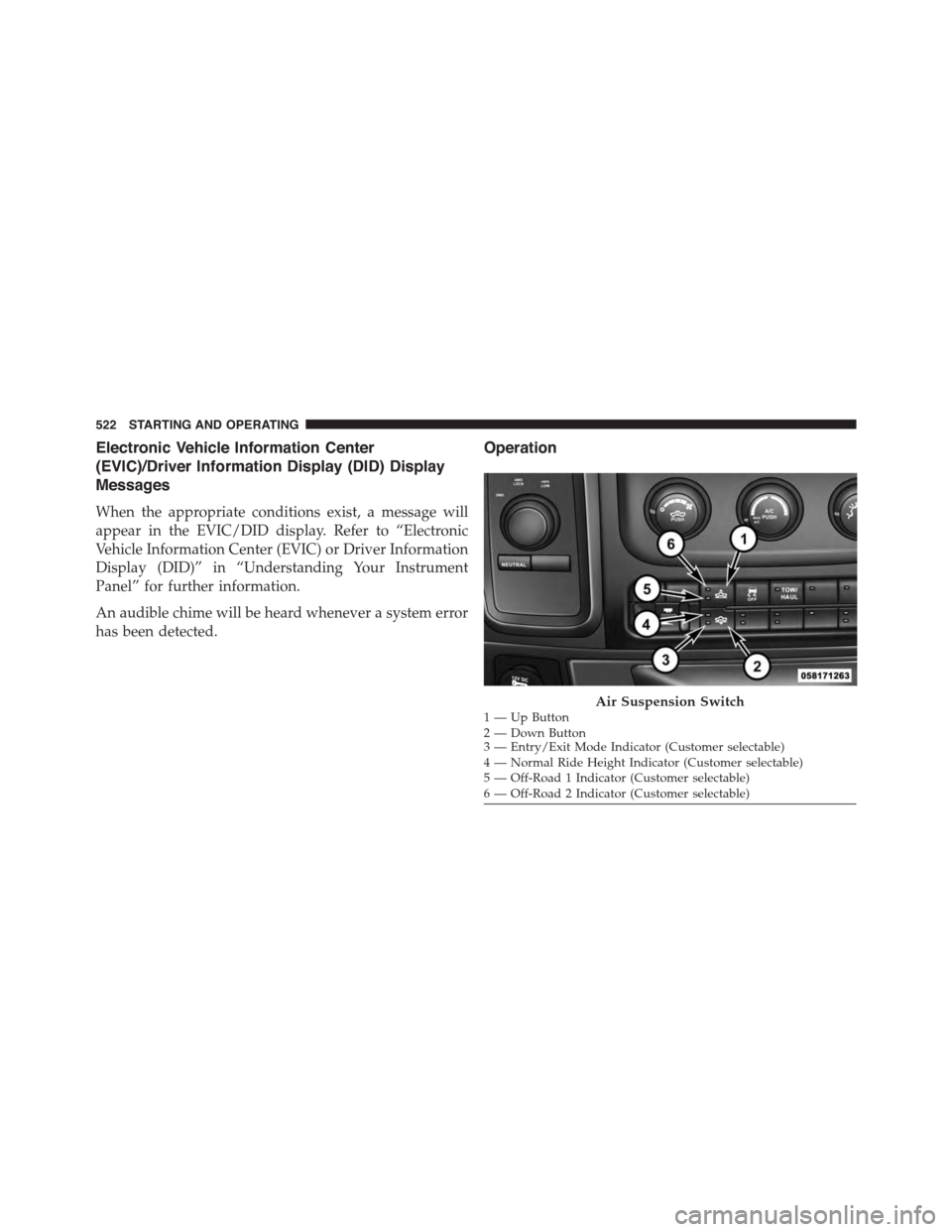
Operation
1—UpButton2—DownButton3 — Entry/Exit Mode Indicator (Customer selectable)4 — Normal Ride Height Indicator (Customer selectable)5 — Off-Road 1 Indicator (Customer selectable)6 — Off-Road 2 Indicator (Customer selectable)
Air Suspension Switch
522 STARTING AND OPERATING
Page 526 of 871
•Entry/Exit Mode – Indicator lamp 3 will be illumi-
nated when the vehicle is in Entry Exit Mode. Entry/
Exit mode can be requested up to 33 mph (53 km/h).
If vehicle speed is reduced to, and kept below, 15 mph
(24 km/h) indicator lamp 4 will flash and indicator
lamp 3 will remain solid until Entry/Exit Mode is
achieved at which point indicator lamp 4 will turn off.
•Transport Mode – No indicator lamps will be illumi-
nated. Transport Mode is disabled by driving the
vehicle.
•Tire/Jack Mode – Indicator lamps 3 and 6 will be
illuminated. Tire/Jack Mode is disabled by driving the
vehicle.
•Wheel Alignment Mode – Indicator lamps 3 and 4 will
be illuminated. Wheel Alignment Mode is disabled by
driving the vehicle.
AIR SUSPENSION SYSTEM (2500/3500 MODELS) —
IF EQUIPPED
Description
The air suspension system is a rear leveling ride height
system. The main purpose of this system is to maintain
the truck’s rear ride height level.
524 STARTING AND OPERATING
Page 527 of 871
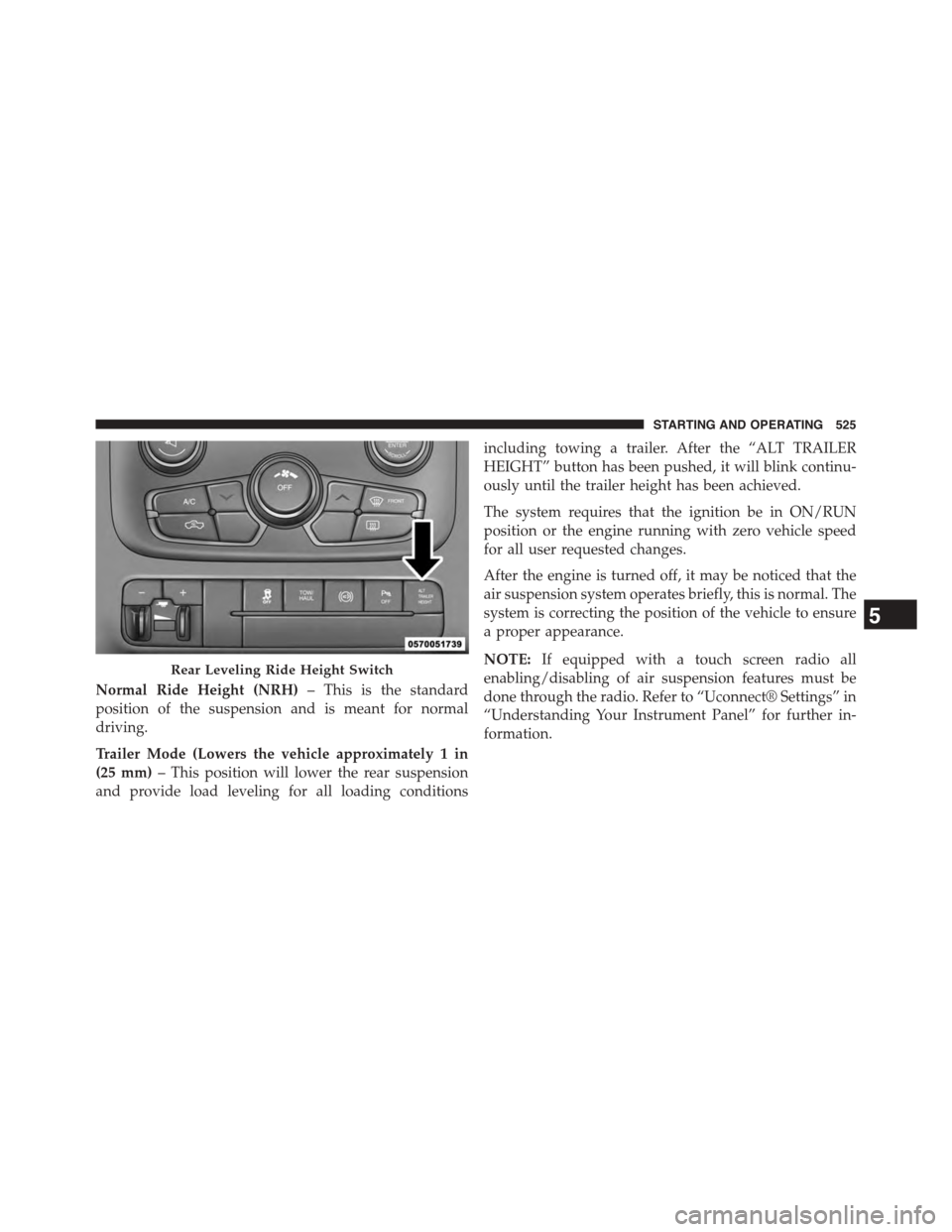
Normal Ride Height (NRH)– This is the standard
position of the suspension and is meant for normal
driving.
Trailer Mode (Lowers the vehicle approximately 1 in
(25 mm)– This position will lower the rear suspension
and provide load leveling for all loading conditions
including towing a trailer. After the “ALT TRAILER
HEIGHT” button has been pushed, it will blink continu-
ously until the trailer height has been achieved.
The system requires that the ignition be in ON/RUN
position or the engine running with zero vehicle speed
for all user requested changes.
After the engine is turned off, it may be noticed that the
air suspension system operates briefly, this is normal. The
system is correcting the position of the vehicle to ensure
a proper appearance.
NOTE:If equipped with a touch screen radio all
enabling/disabling of air suspension features must be
done through the radio. Refer to “Uconnect® Settings” in
“Understanding Your Instrument Panel” for further in-
formation.
Rear Leveling Ride Height Switch
5
STARTING AND OPERATING 525
Page 528 of 871
WARNING!
The air suspension system uses a high pressure
volume of air to operate the system. To avoid per-
sonal injury or damage to the system, see your
authorized dealer for service.
Air Suspension Modes
The Air Suspension system has multiple modes to protect
the system in unique situations:
Tire/Jack Mode
To assist with changing a spare tire, the air suspension
system has a feature which allows the automatic leveling to
be disabled. This mode is intended to be used with engine
running. Refer to “Electronic Vehicle Information Center
(EVIC) or Driver Information Display (DID)” in “Under-
standing Your Instrument Panel” or “Uconnect® Settings”
in “Understanding Your Instrument Panel” if equipped
with a touch screen radio for further information.
NOTE:This mode is intended to be enabled with engine
running.
Transport Mode
To assist with flat bed towing, the air suspension system
has a feature which will put the vehicle below Normal
Ride Height (NRH) and disable the automatic load
leveling system. This mode is intended to be used with
engine running. Refer to “Electronic Vehicle Information
Center (EVIC) or Driver Information Display (DID)” in
“Understanding Your Instrument Panel” or “Uconnect®
Settings” in “Understanding Your Instrument Panel” if
equipped with a touch screen radio for further informa-
tion.
NOTE:This mode is intended to be enabled with engine
running.
526 STARTING AND OPERATING
Page 529 of 871
Wheel Alignment Mode
Before performing a wheel alignment this mode must be
enabled. Refer to “Electronic Vehicle Information Center
(EVIC) or Driver Information Display (DID)” in “Under-
standing Your Instrument Panel” or “Uconnect® Set-
tings” in “Understanding Your Instrument Panel” if
equipped with a touch screen radio for further informa-
tion.
NOTE:This mode is intended to be enabled with engine
running.
Protection Mode
In order to “protect” the air suspension system, the
vehicle will enter Protection Mode when load leveling
cannot be achieved. Some driving may be required to
clear the protection mode telltale in the EVIC/DID. Refer
to “Electronic Vehicle Information Center (EVIC) or
Driver Information Display (DID)” in “Understanding
Your Instrument Panel” or “Uconnect® Settings” in “Un-
derstanding Your Instrument Panel” if equipped with a
touch screen radio for further information.
NOTE:If equipped with a touch screen radio all
enabling/disabling of air suspension features must be
done through the radio. Refer to “Uconnect® Settings” in
“Understanding Your Instrument Panel” for further in-
formation.
Electronic Vehicle Information Center
(EVIC)/Driver Information Display (DID) Display
Messages
When the appropriate conditions exist, a message will
appear in the EVIC/DID display. Refer to “Electronic
Vehicle Information Center (EVIC) or Driver Information
Display (DID)” in “Understanding Your Instrument
Panel” for further information.
An audible chime will be heard whenever a system error
has been detected.
5
STARTING AND OPERATING 527
Page 655 of 871
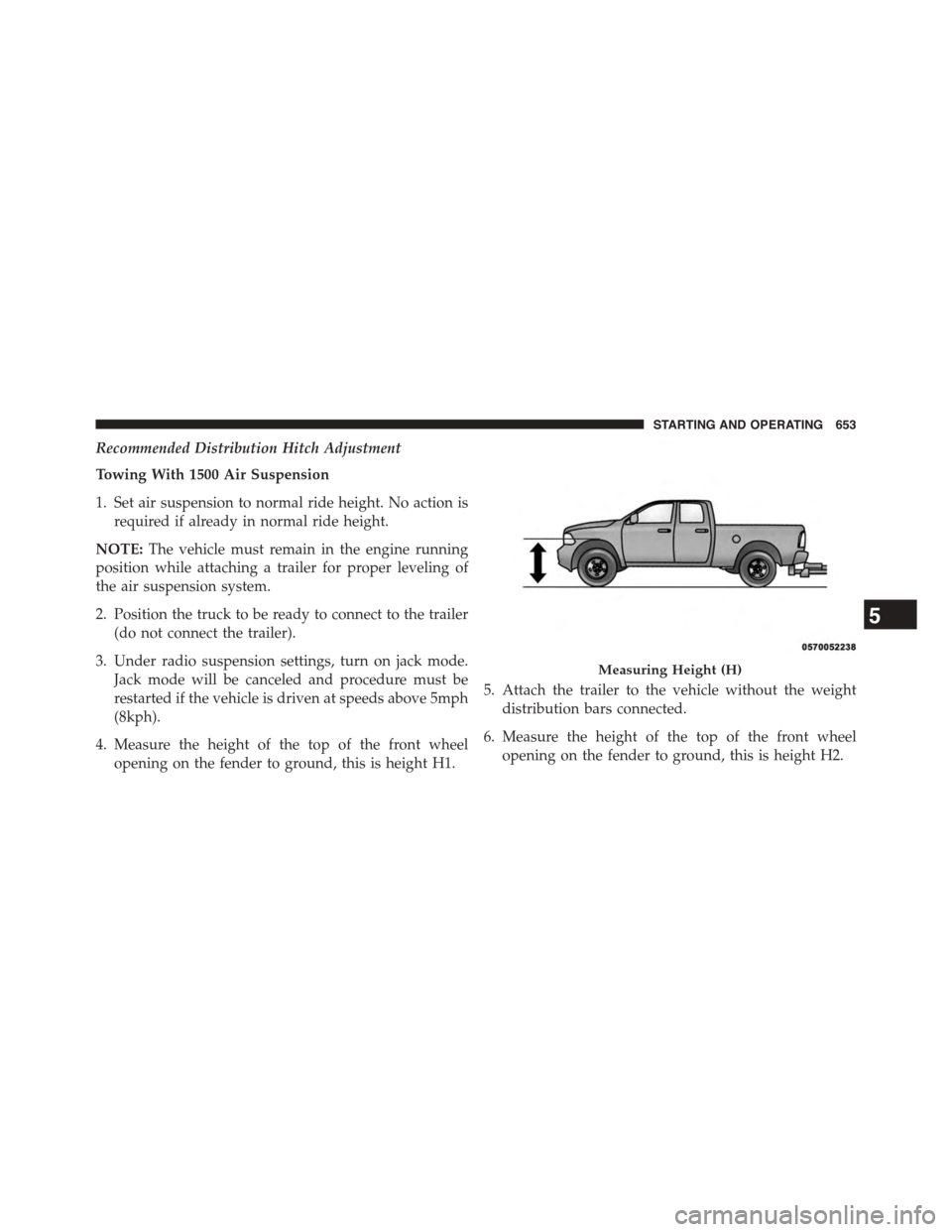
Recommended Distribution Hitch Adjustment
Towing With 1500 Air Suspension
1. Set air suspension to normal ride height. No action is
required if already in normal ride height.
NOTE:The vehicle must remain in the engine running
position while attaching a trailer for proper leveling of
the air suspension system.
2. Position the truck to be ready to connect to the trailer
(do not connect the trailer).
3. Under radio suspension settings, turn on jack mode.
Jack mode will be canceled and procedure must be
restarted if the vehicle is driven at speeds above 5mph
(8kph).
4. Measure the height of the top of the front wheel
opening on the fender to ground, this is height H1.
5. Attach the trailer to the vehicle without the weight
distribution bars connected.
6. Measure the height of the top of the front wheel
opening on the fender to ground, this is height H2.
Measuring Height (H)
5
STARTING AND OPERATING 653
Page 656 of 871
7.Install and adjust the tension in the weight distributing
bars so that the height of the front fender is approxi-
mately (H2-H1)/3+H1 (about 1/3 the difference be-
tween H2 and H1 above normal ride height [H1]).
8. The truck can now be driven. Jack mode will be
canceled and vehicle will return to normal ride height
when drive at speeds above 5mph (8kph).
Measurement ExampleExample 1500
Height (mm)
H1925
H2946
H2-H121
(H2-H1)/37
(H-H1)/3 + H1932
NOTE:For all towing conditions, we recommend towing
with tow haul mode engaged.
All Other 1500/2500/3500 Trucks
1. Position the truck to be ready to connect to the trailer
(do not connect the trailer).
NOTE:For Ram 2500/3500 trucks equipped with rear air
suspension, normal ride height or alternate ride height
can be used. The vehicle must remain in the engine
running position while attaching a trailer for proper
leveling of the air suspension system. It may not be
possible to enter alternate ride height while lightly
loaded.
2. Measure the height of the top of the front wheel
opening on the fender to ground, this is height H1.
3. Attach the trailer to the vehicle without the weight
distribution bars connected.
4. Measure the height of the top of the front wheel
opening on the fender to ground, this is height H1.
654 STARTING AND OPERATING
Page 671 of 871
Air Conditioning
Turn off temporarily.
Air Suspension System
To aid in attaching/detaching the trailer from the vehicle,
the air suspension system can be used. Refer to “Air
Suspension System” in “Starting And Operating” for
further information.
NOTE:The vehicle must remain in the engine running
position while attaching a trailer for proper leveling of
the air suspension system.
SNOWPLOW
1500 Models Only
NOTE:Do not use this model vehicle for snowplow
applications.
WARNING!
Snowplows and other aftermarket equipment should
not be added to the front end of your vehicle. The
airbag crash sensors may be affected by the change in
the front end structure. The airbags could deploy
unexpectedly or could fail to deploy during a colli-
sion resulting in serious injury or death.
CAUTION!
Using this vehicle for snowplow applications can
cause damage to the vehicle.
WARNING!
Attaching a snowplow to this vehicle could adversely
affect performance of the airbag system in a collision.
(Continued)
5
STARTING AND OPERATING 669
Page 804 of 871
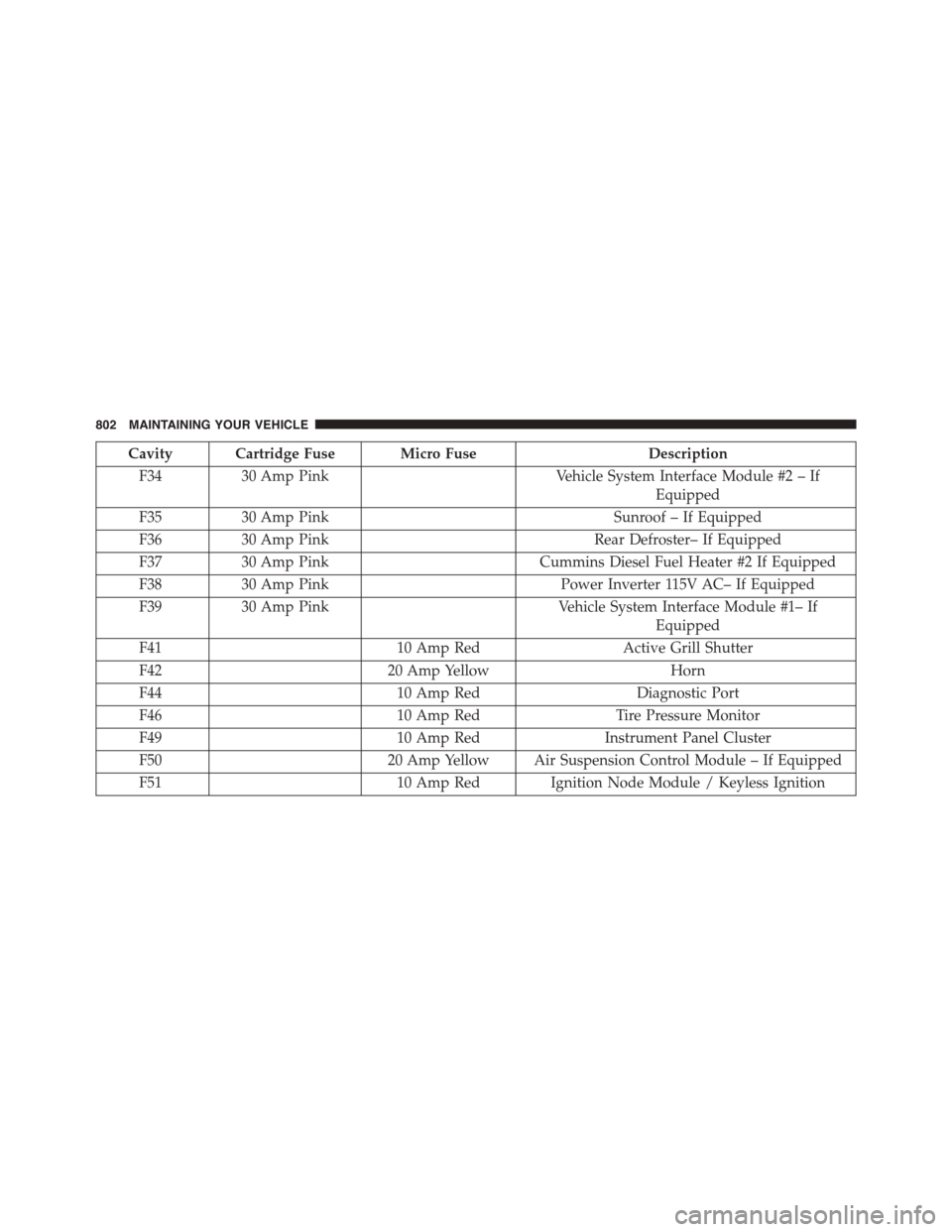
Cavity Cartridge Fuse Micro FuseDescription
F3430 Amp PinkVehicle System Interface Module #2 – If
Equipped
F3530 Amp PinkSunroof – If Equipped
F3630 Amp PinkRear Defroster– If Equipped
F3730 Amp PinkCummins Diesel Fuel Heater #2 If Equipped
F3830 Amp PinkPower Inverter 115V AC– If Equipped
F3930 Amp PinkVehicle System Interface Module #1– If
Equipped
F4110 Amp RedActive Grill Shutter
F4220 Amp YellowHorn
F4410 Amp RedDiagnostic Port
F4610 Amp RedTire Pressure Monitor
F4910 Amp RedInstrument Panel Cluster
F5020 Amp Yellow Air Suspension Control Module – If Equipped
F5110 Amp Red Ignition Node Module / Keyless Ignition
802 MAINTAINING YOUR VEHICLE
Page 850 of 871
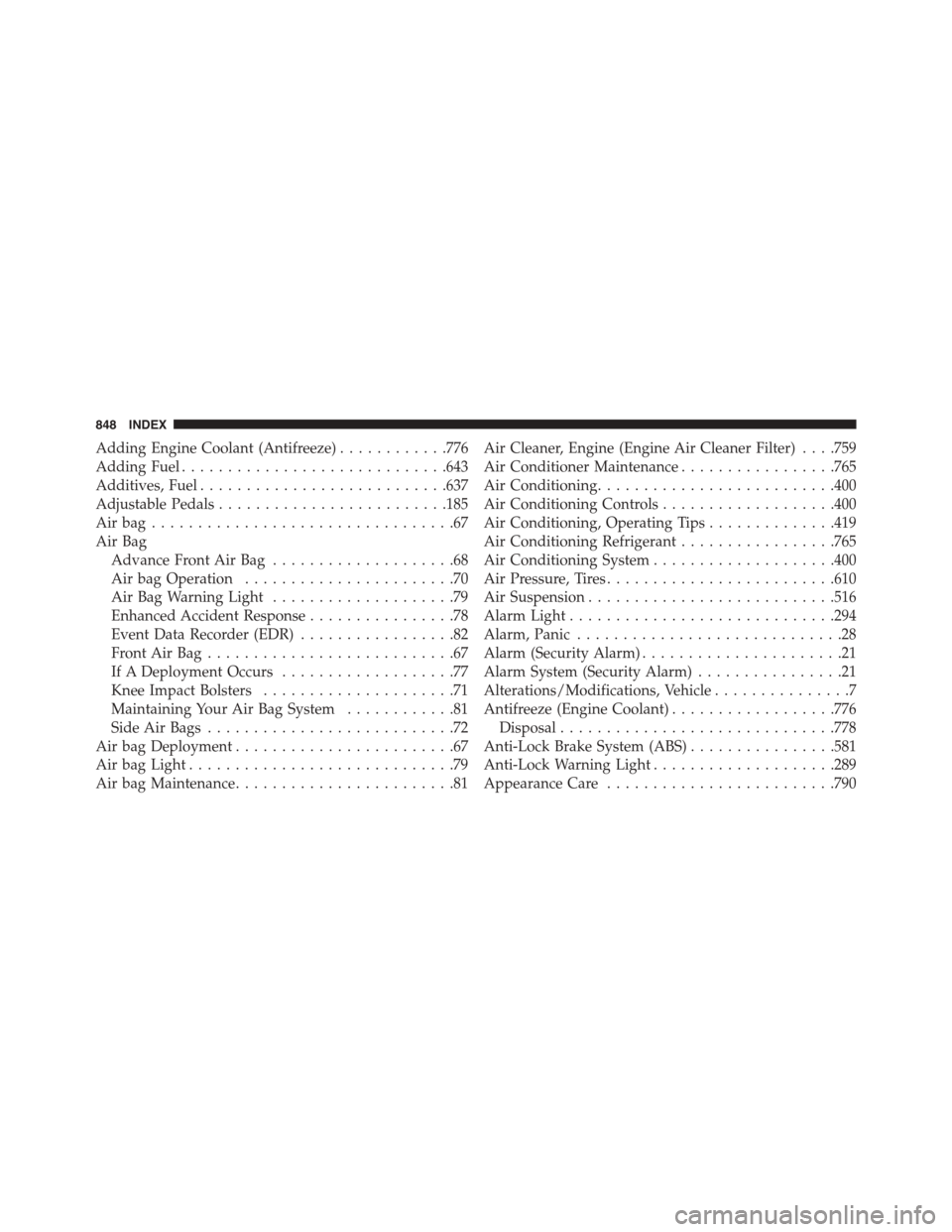
Adding Engine Coolant (Antifreeze)............776
Adding Fuel.............................643
Additives, Fuel...........................637
Adjustable Pedals.........................185
Air bag . . . . . . . . . . . . . . . . . . . . . . . . . . . . . . . . .67
Air Bag
Advance Front Air Bag....................68
Air bag Operation.......................70
Air Bag Warning Light....................79
Enhanced Accident Response................78
Event Data Recorder (EDR).................82
Front Air Bag . . . . . . . . . . . . . . . . . . . . . . . . . . .67
If A Deployment Occurs...................77
Knee Impact Bolsters.....................71
Maintaining Your Air Bag System............81
Side Air Bags...........................72
Air bag Deployment........................67
Air bag Light.............................79
Air bag Maintenance........................81
Air Cleaner, Engine (Engine Air Cleaner Filter) . . . .759
Air Conditioner Maintenance.................765
Air Conditioning..........................400
Air Conditioning Controls...................400
Air Conditioning, Operating Tips..............419
Air Conditioning Refrigerant.................765
Air Conditioning System....................400
Air Pressure, Tires.........................610
Air Suspension...........................516
Alarm Light.............................294
Alarm, Panic.............................28
Alarm (Security Alarm)......................21
Alarm System (Security Alarm)................21
Alterations/Modifications, Vehicle...............7
Antifreeze (Engine Coolant)..................776
Disposal..............................778
Anti-Lock Brake System (ABS)................581
Anti-Lock Warning Light....................289
Appearance Care.........................790
848 INDEX