power steering Ram 1500 2015 Owner's Guide
[x] Cancel search | Manufacturer: RAM, Model Year: 2015, Model line: 1500, Model: Ram 1500 2015Pages: 871, PDF Size: 24.83 MB
Page 652 of 871
Frontal Area
The frontal area is the maximum height multiplied by the
maximum width of the front of a trailer.
Trailer Sway Control
The trailer sway control can be a mechanical telescoping
link that can be installed between the hitch receiver and
the trailer tongue that typically provides adjustable fric-
tion associated with the telescoping motion to dampen
any unwanted trailer swaying motions while traveling.
If equipped, the electronic Trailer Sway Control (TSC)
recognizes a swaying trailer and automatically applies
individual wheel brakes and/or reduces engine power to
attempt to eliminate the trailer sway.
Weight-Carrying Hitch
A weight-carrying hitch supports the trailer tongue weight,
just as if it were luggage located at a hitch ball or some other
connecting point of the vehicle. These kinds of hitches are
the most popular on the market today and they are com-
monly used to tow small and medium sized trailers.
Weight-Distributing Hitch
A weight-distributing system works by applying lever-
age through spring (load) bars. They are typically used
for heavier loads to distribute trailer tongue weight to the
tow vehicle’s front axle and the trailer axle(s). When used
in accordance with the manufacturer’s directions, it pro-
vides for a more level ride, offering more consistent
steering and brake control, thereby enhancing towing
safety. The addition of a friction/hydraulic sway control
also dampens sway caused by traffic and crosswinds and
contributes positively to tow vehicle and trailer stability.
Trailer sway control and a weight distributing (load
equalizing) hitch are recommended for heavier Tongue
Weights (TW) and may be required depending on vehicle
and trailer configuration/loading to comply with GAWR
requirements.
650 STARTING AND OPERATING
Page 665 of 871
sliding the manual brake control lever will display the
GAIN setting for 10 seconds and the “Trailer Brake Status
Indicator Light” will not be displayed.
If a fault is detected in the trailer wiring or the Integrated
Trailer Brake Module (ITBM), the “Trailer Brake Status
Indicator Light” will flash.
GAIN Adjustment Buttons (+/-)
Pressing these buttons will adjust the brake control
power output to the trailer brakes in 0.5 increments. The
GAIN setting can be increased to a maximum of 10 or
decreased to a minimum of 0 (no trailer braking).
GAIN
The GAIN setting is used to set the trailer brake control
for the specific towing condition and should be changed
as towing conditions change. Changes to towing condi-
tions include trailer load, vehicle load, road conditions
and weather.
Adjusting GAIN
NOTE:This should only be performed in a traffic free
environment at speeds of approximately 20–25 mph
(30–40 km/h).
1. Make sure the trailer brakes are in good working
condition, functioning normally and properly ad-
justed. See your trailer dealer if necessary.
2.Hook up the trailer and make the electrical connections
according to the trailer manufacturer’s instructions.
3. When a trailer with electric/EOH brakes is plugged
in, the trailer connected message should appear in the
EVIC/DID (if the connection is not recognized by the
ITBM, braking functions will not be available), the
GAIN setting will illuminate and the correct type of
trailer must be selected from the EVIC/DID options.
4. Press the UP or DOWN button on the steering wheel
until “TRAILER TOW” appears on the screen.
5
STARTING AND OPERATING 663
Page 751 of 871
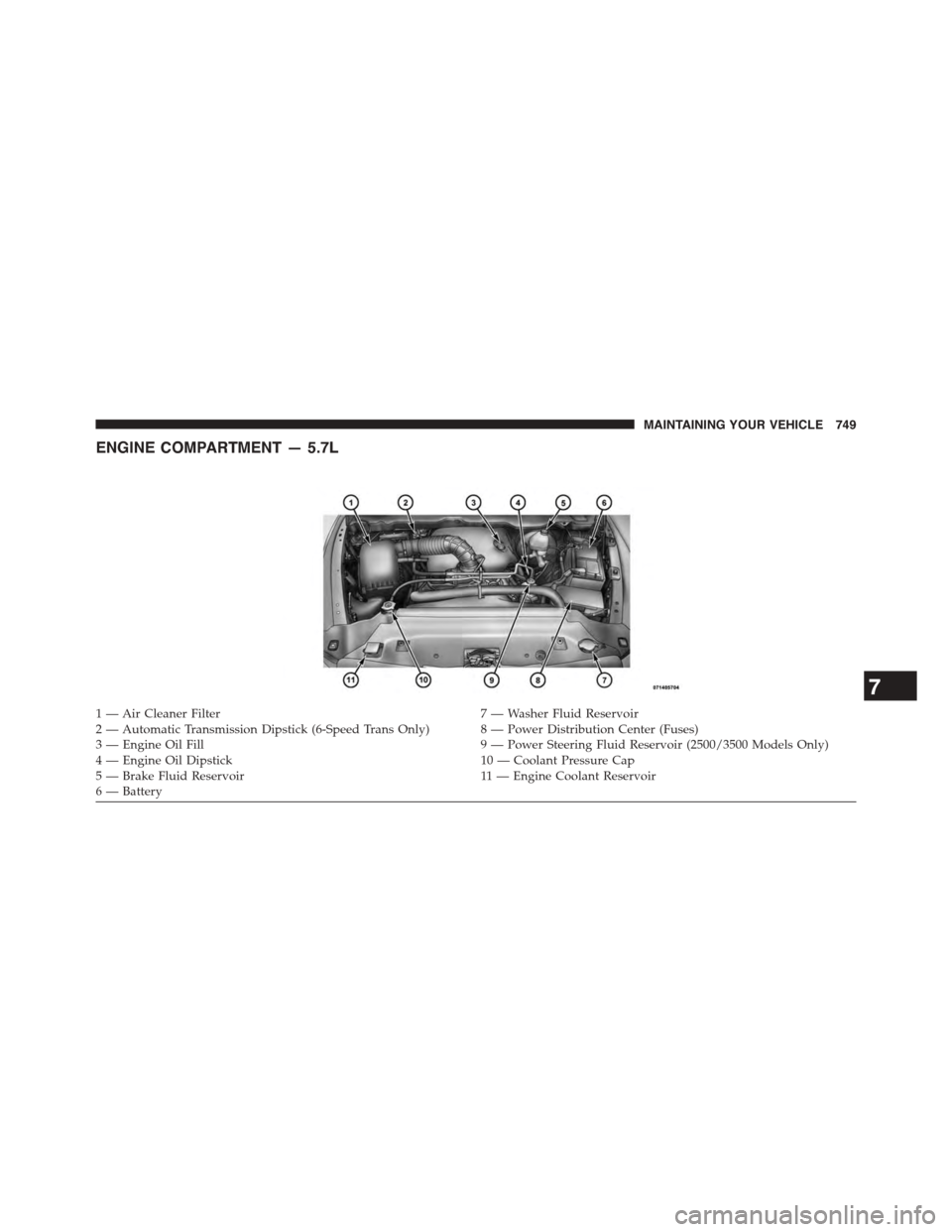
ENGINE COMPARTMENT — 5.7L
1 — Air Cleaner Filter7 — Washer Fluid Reservoir2 — Automatic Transmission Dipstick (6-Speed Trans Only) 8 — Power Distribution Center (Fuses)3 — Engine Oil Fill9 — Power Steering Fluid Reservoir (2500/3500 Models Only)4 — Engine Oil Dipstick10 — Coolant Pressure Cap5 — Brake Fluid Reservoir11 — Engine Coolant Reservoir6 — Battery
7
MAINTAINING YOUR VEHICLE 749
Page 752 of 871
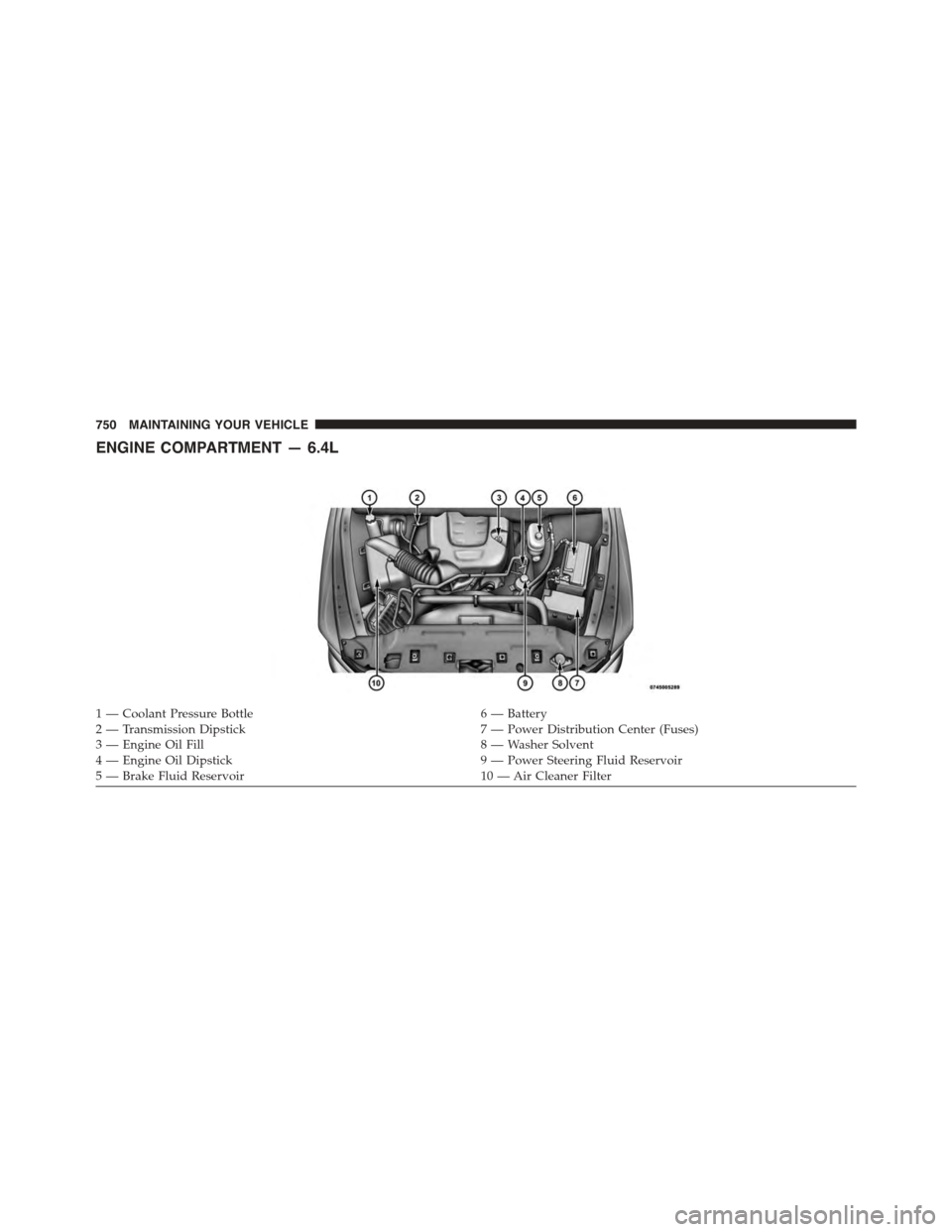
ENGINE COMPARTMENT — 6.4L
1 — Coolant Pressure Bottle6 — Battery2 — Transmission Dipstick7 — Power Distribution Center (Fuses)3—EngineOilFill8—WasherSolvent4 — Engine Oil Dipstick9 — Power Steering Fluid Reservoir5 — Brake Fluid Reservoir10 — Air Cleaner Filter
750 MAINTAINING YOUR VEHICLE
Page 757 of 871
CAUTION!(Continued)
•Your vehicle has been built with improved fluids
that protect the performance and durability of your
vehicle and also allow extended maintenance inter-
vals. Do not use chemical flushes in these compo-
nents as the chemicals can damage your engine,
transmission, power steering or air conditioning.
Such damage is not covered by the New Vehicle
Limited Warranty. If a flush is needed because of
component malfunction, use only the specified
fluid for the flushing procedure.
Engine Oil
Checking Oil Level
To assure proper lubrication of your vehicle’s engine, the
engine oil must be maintained at the correct level. Check
the oil level at regular intervals, such as every fuel stop.
The best time to check the engine oil level is about five
minutes after a fully warmed up engine is shut off.
Checking the oil while the vehicle is on level ground will
improve the accuracy of the oil level readings. Always
maintain the oil level within the SAFE zone on the
dipstick. Adding one quart of oil when the reading is at
the bottom of the SAFE zone will result in a reading at the
top of the safe zone on these engines.
CAUTION!
Overfilling or underfilling the crankcase will cause
oil aeration or loss of oil pressure. This could damage
your engine.7
MAINTAINING YOUR VEHICLE 755
Page 800 of 871
WARNING!(Continued)
•Before replacing a fuse, make sure that the ignition
is off and that all the other services are switched off
and/or disengaged.
•If the replaced fuse blows again, contact an autho-
rized dealer.
•If a general protection fuse for safety systems (air
bag system, braking system), power unit systems
(engine system, gearbox system) or steering system
blows, contact an authorized dealer.
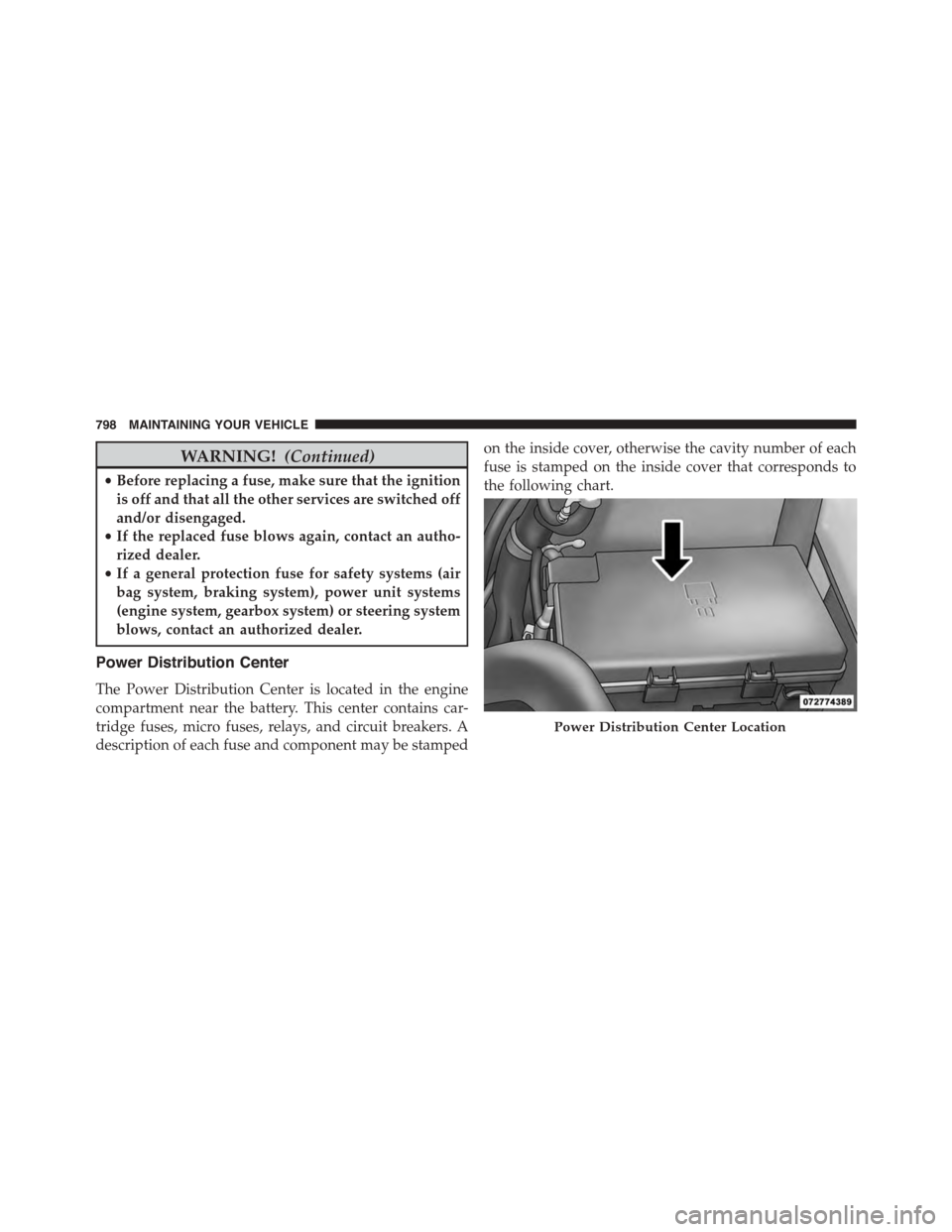
Power Distribution Center
The Power Distribution Center is located in the engine
compartment near the battery. This center contains car-
tridge fuses, micro fuses, relays, and circuit breakers. A
description of each fuse and component may be stamped
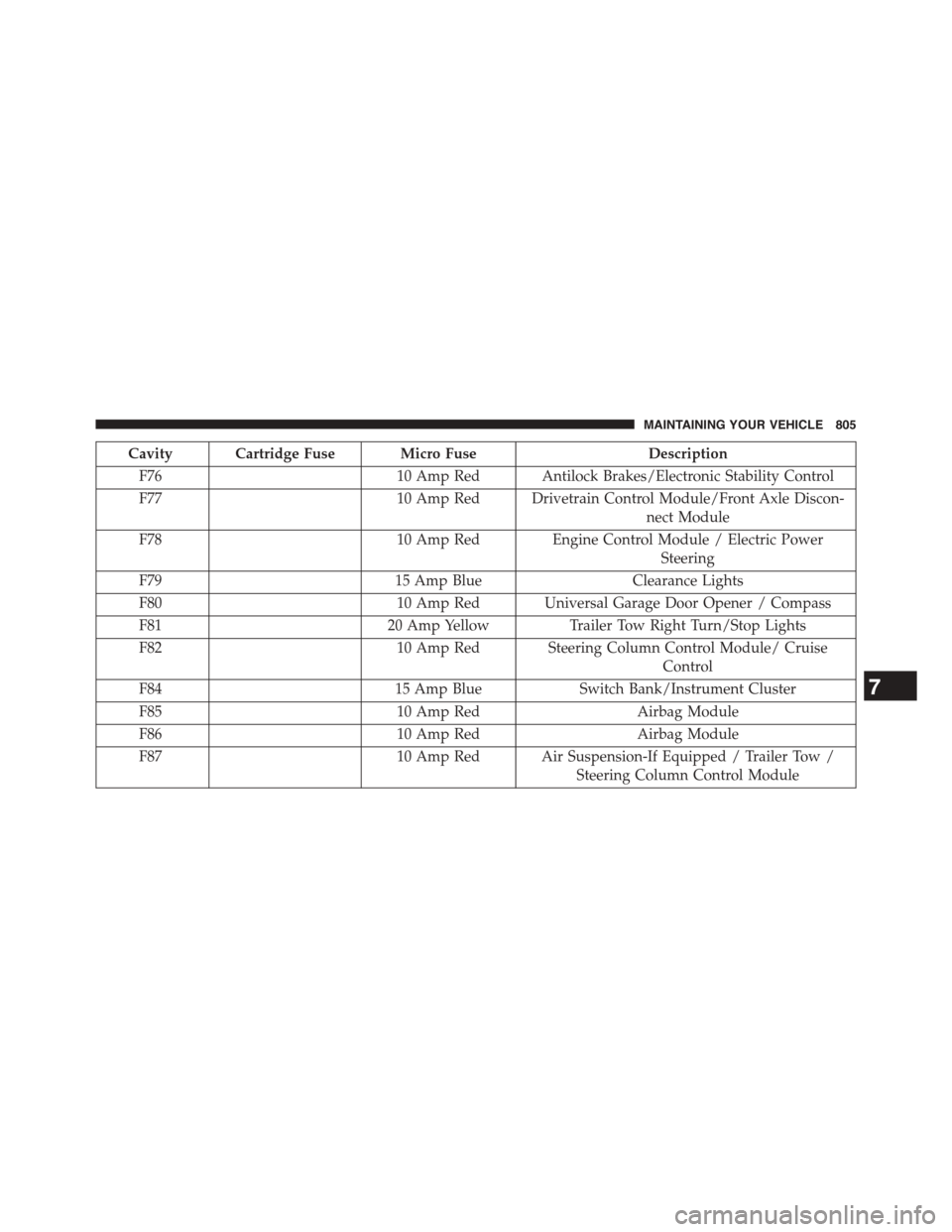
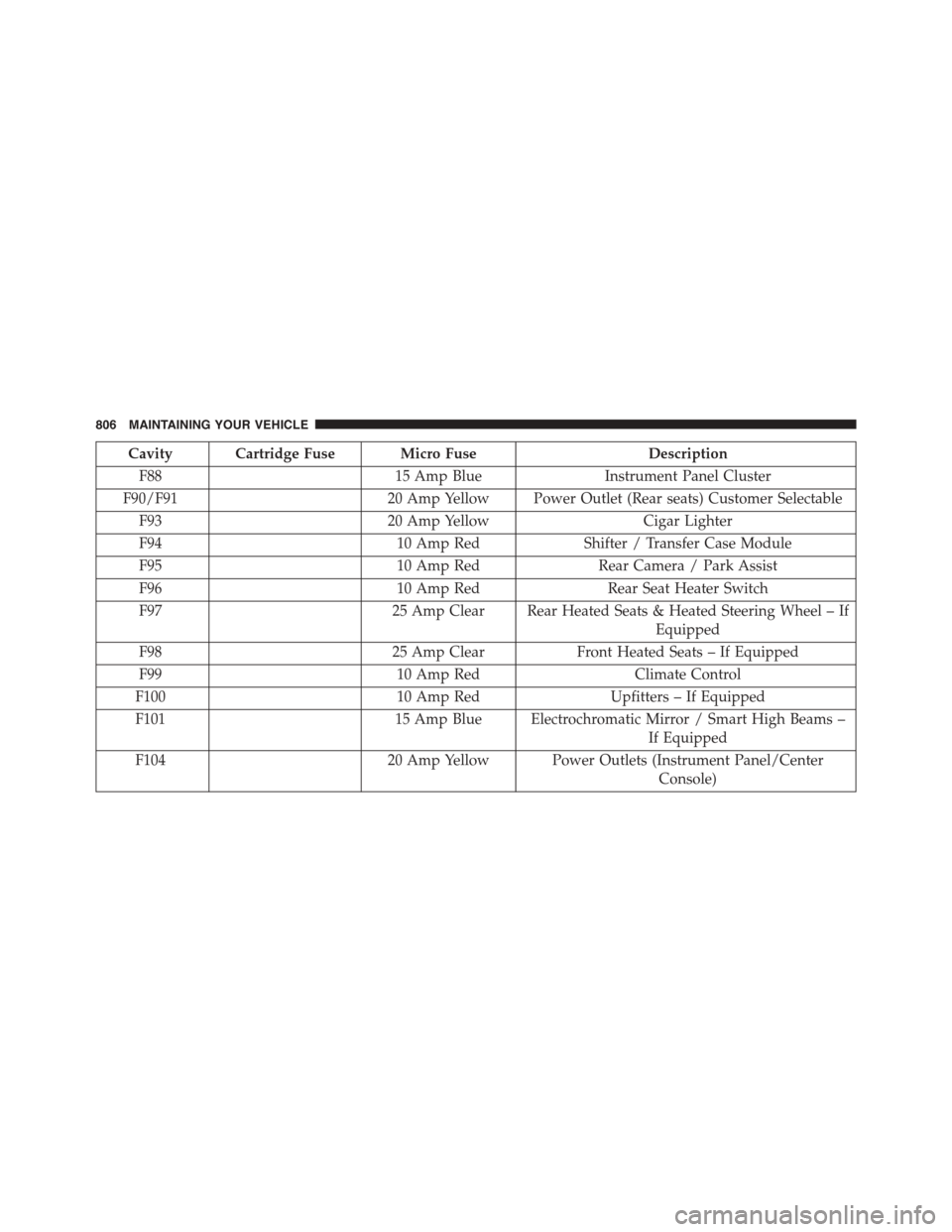
on the inside cover, otherwise the cavity number of each
fuse is stamped on the inside cover that corresponds to
the following chart.
Power Distribution Center Location
798 MAINTAINING YOUR VEHICLE
Page 807 of 871
Cavity Cartridge Fuse Micro FuseDescription
F7610 Amp Red Antilock Brakes/Electronic Stability Control
F7710 Amp Red Drivetrain Control Module/Front Axle Discon-
nect Module
F7810 Amp Red Engine Control Module / Electric Power
Steering
F7915 Amp BlueClearance Lights
F8010 Amp Red Universal Garage Door Opener / Compass
F8120 Amp YellowTrailer Tow Right Turn/Stop Lights
F8210 Amp Red Steering Column Control Module/ Cruise
Control
F8415 Amp BlueSwitch Bank/Instrument Cluster
F8510 Amp RedAirbag Module
F8610 Amp RedAirbag Module
F8710 Amp Red Air Suspension-If Equipped / Trailer Tow /
Steering Column Control Module
7
MAINTAINING YOUR VEHICLE 805
Page 808 of 871
Cavity Cartridge Fuse Micro FuseDescription
F8815 Amp BlueInstrument Panel Cluster
F90/F9120 Amp Yellow Power Outlet (Rear seats) Customer Selectable
F9320 Amp YellowCigar Lighter
F9410 Amp RedShifter / Transfer Case Module
F9510 Amp RedRear Camera / Park Assist
F9610 Amp RedRear Seat Heater Switch
F9725 Amp Clear Rear Heated Seats & Heated Steering Wheel – If
Equipped
F9825 Amp ClearFront Heated Seats – If Equipped
F9910 Amp RedClimate Control
F10010 Amp RedUpfitters – If Equipped
F10115 Amp Blue Electrochromatic Mirror / Smart High Beams –
If Equipped
F10420 Amp Yellow Power Outlets (Instrument Panel/Center
Console)
806 MAINTAINING YOUR VEHICLE
Page 827 of 871
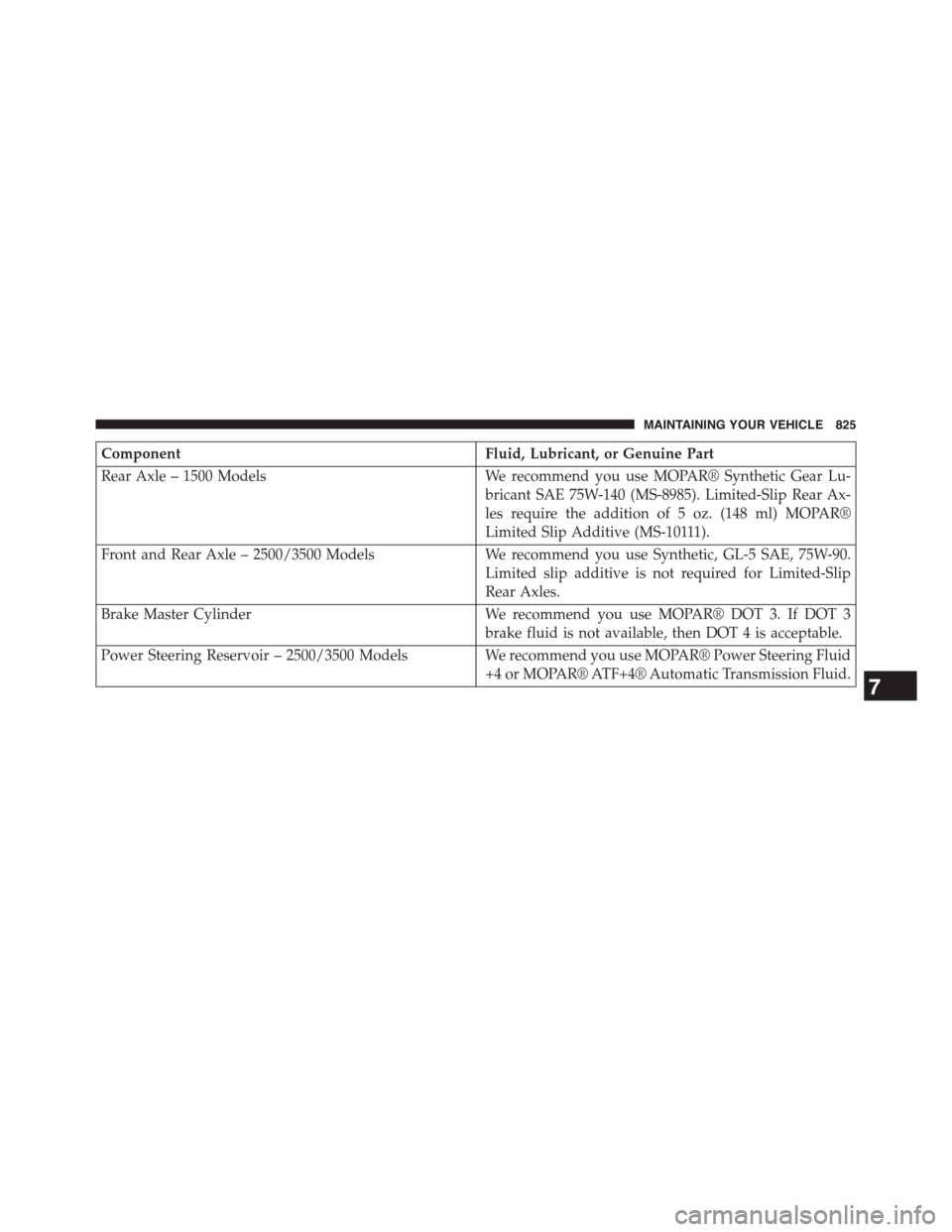
ComponentFluid, Lubricant, or Genuine Part
Rear Axle – 1500 ModelsWe recommend you use MOPAR® Synthetic Gear Lu-
bricant SAE 75W-140 (MS-8985). Limited-Slip Rear Ax-
les require the addition of 5 oz. (148 ml) MOPAR®
Limited Slip Additive (MS-10111).
Front and Rear Axle – 2500/3500 ModelsWe recommend you use Synthetic, GL-5 SAE, 75W-90.
Limited slip additive is not required for Limited-Slip
Rear Axles.
Brake Master CylinderWe recommend you use MOPAR® DOT 3. If DOT 3
brake fluid is not available, then DOT 4 is acceptable.
Power Steering Reservoir – 2500/3500 ModelsWe recommend you use MOPAR® Power Steering Fluid
+4 or MOPAR® ATF+4® Automatic Transmission Fluid.
7
MAINTAINING YOUR VEHICLE 825
Page 831 of 871
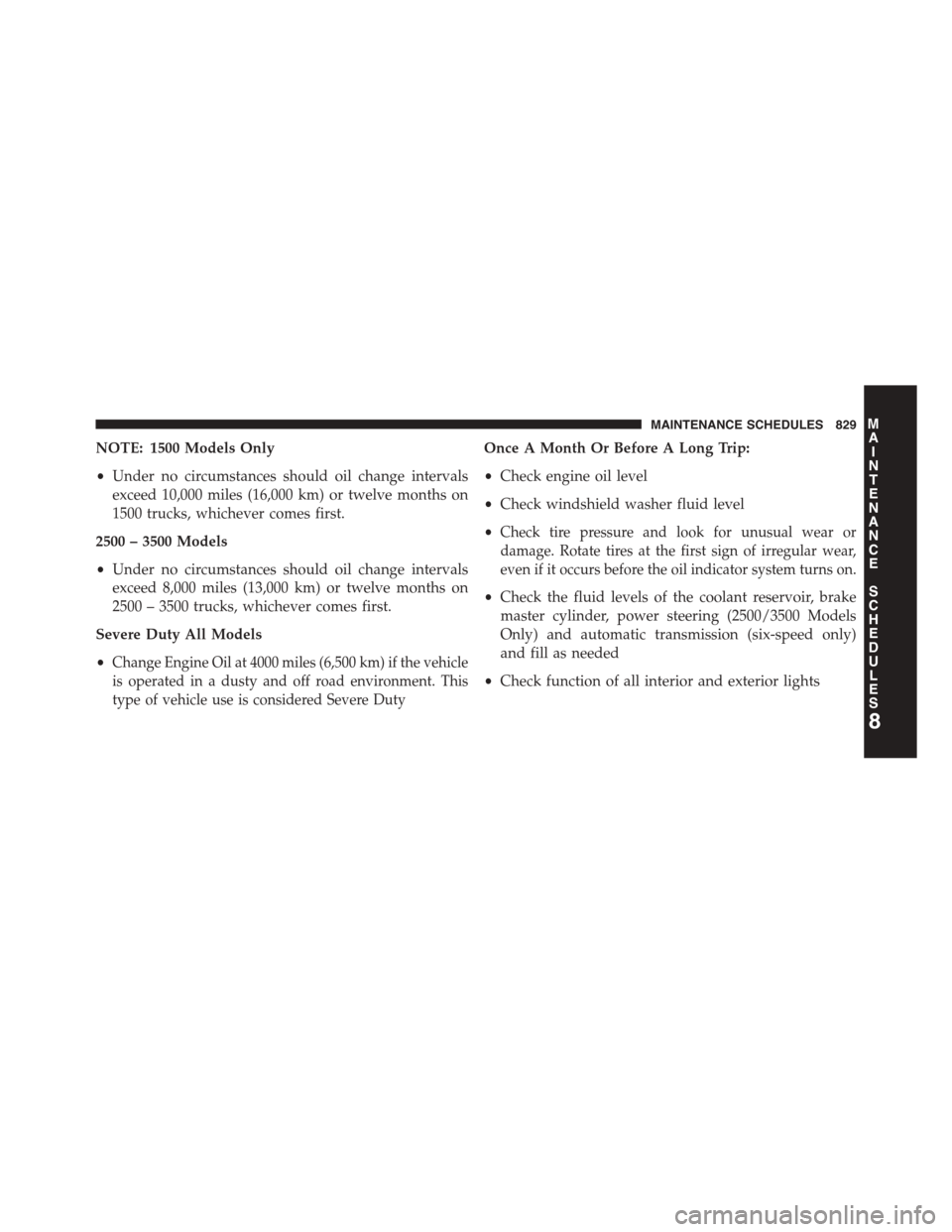
NOTE: 1500 Models Only
•Under no circumstances should oil change intervals
exceed 10,000 miles (16,000 km) or twelve months on
1500 trucks, whichever comes first.
2500 – 3500 Models
•Under no circumstances should oil change intervals
exceed 8,000 miles (13,000 km) or twelve months on
2500 – 3500 trucks, whichever comes first.
Severe Duty All Models
•Change Engine Oil at 4000 miles (6,500 km) if the vehicle
is operated in a dusty and off road environment. This
type of vehicle use is considered Severe Duty
Once A Month Or Before A Long Trip:
•Check engine oil level
•Check windshield washer fluid level
•Check tire pressure and look for unusual wear or
damage. Rotate tires at the first sign of irregular wear,
even if it occurs before the oil indicator system turns on.
•Check the fluid levels of the coolant reservoir, brake
master cylinder, power steering (2500/3500 Models
Only) and automatic transmission (six-speed only)
and fill as needed
•Check function of all interior and exterior lights
8
MAINTENANCE
SCHEDULES
MAINTENANCE SCHEDULES 829