tires Ram 1500 2015 Owner's Guide
[x] Cancel search | Manufacturer: RAM, Model Year: 2015, Model line: 1500, Model: Ram 1500 2015Pages: 871, PDF Size: 24.83 MB
Page 549 of 871
this process to clean the debris from the tread and
improve the traction. You want to create a rocking
motion with the vehicle. This helps build vehicle
momentum, which hopefully gets you out. Remember
to ease off and on the accelerator before and after the
shift. If after a few rock cycles your vehicle is not free,
stop and try another method of recovery. Continuous
rock cycling will only cause unnecessary damage to
your vehicle and the environment.
CAUTION!
Damage can occur when spinning your tires at an
excessive high speed. Do not spin your tires faster
than an indicated 30 mph (48 km/h).
•Using The Tow Hooks With A Tow Strap– Tow straps
are a quick and easy way to recover your vehicle from
minor situations if you have a secondary vehicle which
is not stuck. The tow hooks on your vehicle are
designed to take the abusive force generated during
vehicle recovery. Do not use the bumper or any other
vehicle component as an attachment point. Using tow
straps requires coordination between the two drivers.
Good communication and line of sight are required for
a safe recovery. First connect the tow strap to the
correct attachment points on both vehicles. There
should be a least 20 to 30 feet between the vehicles to
allow for a safe recovery. If necessary join two tow
straps together usinga1½inch hard wood dowel.
This will keep the straps from becoming knotted and is
safer than using a clevis pin if the strap breaks. Next
have the tow vehicle backup, leaving two to three feet
worth of slack in the strap. Then the tow vehicle, using
light throttle, should accelerate tightening the strap
providing the pulling force needed to free the vehicle.
The vehicle being recovered should assist in the recov-
ery, at the time of the snap, by slowly spinning the tires
in the same direction as the pulling vehicle. After the
5
STARTING AND OPERATING 547
Page 550 of 871
vehicle becomes free, the driver of the previously stuck
vehicle should signal they are free and should hit their
brakes stopping both vehicles. The driver of the pull-
ing vehicle should let off the throttle without using the
brakes, once signaled by the other driver. This se-
quence is important to avoid having the recovered
vehicle hit the pulling vehicle.
WARNING!
Never use tow straps with end hooks or link two
straps with a clevis pin. These heavy metal objects
could become projectiles if a strap breaks, which
could cause severe injury. Never leave more than two
or three feet of slack in the strap. More slack than this
greatly increases the risk of injury and vehicle dam-
age. Always keep everyone at least 30 feet away from
a strapping or winching situation.
•Winching (Refer To “Winch Operation” For Addi-
tional Information)–Winching is most commonly
used in the following situations: there is no support
vehicle available, a high controlled force is required to
recover the vehicle, there is a high risk of environmental
or vehicle damage, or where nothing else seems to work.
A winch can deliver a high pulling force with a great
deal of control. It allows you to walk the vehicle out of
the situation in a slow controlled manner. This control
works well for avoiding further vehicle damage. Once
you decide it is time to use the winch look for a good
anchor point. It needs to be strong enough to hold more
than the vehicle’s weight and provide a direction of pull
as straight as possible. Use block and tackle if necessary
to improve the angle of pull or increase the winch’s
pulling force. If the anchor point is a tree use a strap
around its base and hook the cable to the strap. If it is
another vehicle, then place that vehicle in PARK and
block the front tires. If you cannot find an anchor point
548 STARTING AND OPERATING
Page 551 of 871
within reach try using your spare tire by burying it.
Once you have determined an anchor point hook up the
cable, ensuring there are a least five wraps of cable left
on the drum, and place a floor mat or something else
over the strung out cable. Placing something over the
strung out cable helps keep the cable on the ground if it
breaks. Next, place the vehicle in first gear and apply a
very light throttle as you power the winch in. Be careful
not to allow slack in the cable as you recover the vehicle.
Do not try to guide the cable into the drum. If it starts to
bunch up on one end, let it. You can re-spool the cable
afterwards. Never use a winch cable as a tow strap and
always stand back while winching.
WARNING!
Winch cables are under high tension when in use and
can become a projectile if they fail. Never stand over
(Continued)
WARNING!(Continued)
or straddle the winch cable. Never jerk or overload
the winch cable. Never stand in front of the vehicle
while winching. Failure to follow these instructions
can result in serious or fatal injury.
After Driving Off-Road
Off-road operation puts more stress on your vehicle than
does most on-road driving. After going off-road, it is
always a good idea to check for damage. That way you
can get any problems taken care of right away and have
your vehicle ready when you need it.
•Completely inspect the underbody of your vehicle.
Check tires, body structure, steering, suspension, and
exhaust system for damage.
5
STARTING AND OPERATING 549
Page 554 of 871
when there is a difference in the surface traction under
the rear (driving) wheels.
WARNING!
Rapid acceleration on slippery surfaces is dangerous.
Unequal traction can cause sudden pulling of the rear
wheels. You could lose control of the vehicle and
possibly have a collision. Accelerate slowly and
carefully whenever there is likely to be poor traction
(ice, snow, wet mud, loose sand, etc.).
Traction
When driving on wet or slushy roads, it is possible for a
wedge of water to build up between the tire and road
surface. This is known as hydroplaning and may cause
partial or complete loss of vehicle control and stopping
ability. To reduce this possibility, the following precau-
tions should be observed:
•Slow down during rainstorms or when the roads are
slushy.
•Slow down if the road has standing water or puddles.
•Replace tires when tread wear indicators first become
visible.
•Keep tires properly inflated.
•Maintain sufficient distance between your vehicle and
the vehicle in front of you to avoid a collision in a
sudden stop.
Your vehicle may be equipped with a Limited Slip
Differential (LSD) that reduces, but does not eliminate,
the amount of wheel slip across a given axle for im-
proved handling.
552 STARTING AND OPERATING
Page 557 of 871
OFF-ROAD DRIVING TIPS
Care should be taken when attempting to climb steep
hills or driving diagonally across a hill or slope. If natural
obstacles force you to travel diagonally up or down a hill,
choose a mild angle and keep as little side tilt as possible.
Keep the vehicle moving and make turns slowly and
cautiously.
If you must back down a hill, back straight down using
REVERSE gear. Never back down in NEUTRAL or diago-
nally across the hill.
When driving over sand, mud, and other soft terrain,
shift to low gear and drive steadily. Apply the accelerator
slowly to avoid spinning the wheels.
Do not reduce the tire pressures for this type of driving.
After Driving Off-Road
Off-road operation puts more stress on your vehicle than
does most on-road driving. After going off-road, it is
always a good idea to check for damage. That way you
can get any problems taken care of right away and have
your vehicle ready when you need it.
•Completely inspect the underbody of your vehicle.
Check tires, body structure, steering, suspension, and
exhaust system for damage.
•Inspect the radiator for mud and debris and clean as
required.
•Check threaded fasteners for looseness, particularly on
the chassis, drivetrain components, steering, and sus-
pension. Retighten them, if required, and torque to the
values specified in the Service Manual.
•Check for accumulations of plants or brush. These
things could be a fire hazard. They might hide damage
to fuel lines, brake hoses, axle pinion seals, and
propeller shafts.
5
STARTING AND OPERATING 555
Page 584 of 871
with a separate computer to modulate hydraulic pressure
to prevent wheel lockup and help avoid skidding on
slippery surfaces.
The system’s pump motor runs during an ABS stop to
provide regulated hydraulic pressure. The pump motor
makes a low humming noise during operation. This is
normal.
The ABS conducts a low-speed selftest at about 10 mph
(16 km/h). If you have your foot lightly on the brake
while this test is occurring, you may feel slight pedal
movement. The movement can be more apparent on ice
and snow. This is normal.
When you are in a severe braking condition involving
use of the ABS, you will experience some pedal drop as
the vehicle comes to a complete stop. This is the result of
the system reverting to the base brake system and is
normal.
Engagement of the ABS may be accompanied by a
pulsing sensation. You may also hear a clicking noise.
These occurrences are normal, and indicate that the
system is functioning.
WARNING!
•Pumping of the anti-lock brakes will diminish
their effectiveness and may lead to a collision.
Pumping makes the stopping distance longer. Just
press firmly on your brake pedal when you need to
slow down or stop.
•The Anti-Lock Brake System (ABS) cannot prevent
the natural laws of physics from acting on the
vehicle, nor can it increase braking or steering
efficiency beyond that afforded by the condition of
the vehicle brakes and tires or the traction afforded.
(Continued)
582 STARTING AND OPERATING
Page 586 of 871
applies optimum pressure to the brakes in emergency
braking conditions. This can help reduce braking dis-
tances. The BAS complements the ABS. Applying the
brakes very quickly results in the best BAS assistance. To
receive the benefit of BAS, you must apply continuous
braking pressure during the stopping sequence. Do not
reduce brake pedal pressure unless braking is no longer
desired.
Once the brake pedal is released, the BAS is deactivated.
WARNING!
•The BAS cannot prevent the natural laws of phys-
ics from acting on the vehicle, nor can it increase
braking efficiency beyond that afforded by the
condition of the vehicle brakes and tires or the
traction afforded.
(Continued)
WARNING!(Continued)
•The BAS cannot prevent collisions, including those
resulting from excessive speed in turns, following
another vehicle too closely, or hydroplaning.
•The capabilities of a BAS-equipped vehicle must
never be exploited in a reckless or dangerous
manner which could jeopardize the user ’s safety or
the safety of others.
Hill Start Assist (HSA)
The HSA system is designed to assist the driver in
launching a vehicle on an incline. HSA will maintain the
level of brake pressure the driver inputs for a short
duration once the driver takes his foot off of the brake
pedal. If the driver does not apply the throttle during this
short duration, the system will release brake pressure
and the vehicle will roll down the incline. The system will
release brake pressure in proportion to the amount of
throttle applied.
584 STARTING AND OPERATING
Page 593 of 871
WARNING!
In the%ESC Full Off%mode, the engine torque reduc-
tion and stability features are disabled. Therefore,
the enhanced vehicle stability offered by ESC is
unavailable. In an emergency evasive maneuver the
ESC system will not engage to assist in maintaining
stability. “ESC Full Off” mode is intended for off-
highway or off-road use only.
ESC Activation/Malfunction Indicator Light And
ESC OFF Indicator Light
The “ESC Activation/Malfunction Indicator
Light” in the instrument cluster will come on
when the ignition switch is turned to the ON
position. It should go out with the engine
running. If the “ESC Activation/Malfunction Indicator
Light” comes on continuously with the engine running, a
malfunction has been detected in the ESC system. If this
light remains on after several ignition cycles, and the
vehicle has been driven several miles (kilometers) at
speeds greater than 30 mph (48 km/h), see your autho-
rized dealer as soon as possible to have the problem
diagnosed and corrected.
The “ESC Activation/Malfunction Indicator Light” (lo-
cated in the instrument cluster) starts to flash as soon as
the tires lose traction and the ESC system becomes active.
The “ESC Activation/Malfunction Indicator Light” also
flashes when TCS is active. If the “ESC Activation/
Malfunction Indicator Light” begins to flash during ac-
celeration, ease up on the accelerator and apply as little
throttle as possible. Be sure to adapt your speed and
driving to the prevailing road conditions.
5
STARTING AND OPERATING 591
Page 599 of 871
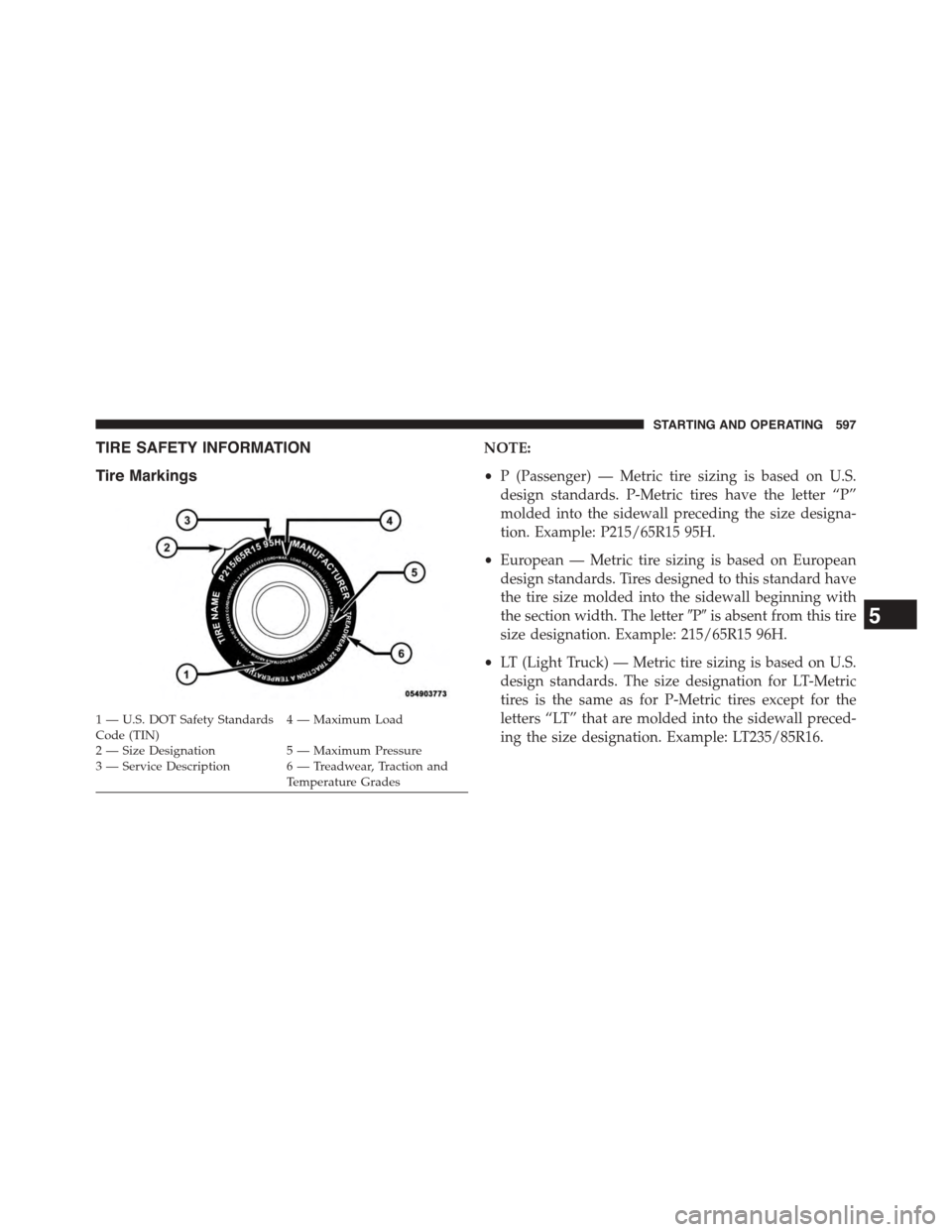
TIRE SAFETY INFORMATION
Tire Markings
NOTE:
•P (Passenger) — Metric tire sizing is based on U.S.
design standards. P-Metric tires have the letter “P”
molded into the sidewall preceding the size designa-
tion. Example: P215/65R15 95H.
•European — Metric tire sizing is based on European
design standards. Tires designed to this standard have
the tire size molded into the sidewall beginning with
the section width. The letter#P#is absent from this tire
size designation. Example: 215/65R15 96H.
•LT (Light Truck) — Metric tire sizing is based on U.S.
design standards. The size designation for LT-Metric
tires is the same as for P-Metric tires except for the
letters “LT” that are molded into the sidewall preced-
ing the size designation. Example: LT235/85R16.
1—U.S.DOTSafetyStandardsCode (TIN)4—MaximumLoad
2—SizeDesignation 5—MaximumPressure3 — Service Description 6 — Treadwear, Traction andTemperature Grades
5
STARTING AND OPERATING 597
Page 600 of 871
•Temporary spare tires are designed for temporary
emergency use only. Temporary high pressure com-
pact spare tires have the letter “T” or “S” molded into
the sidewall preceding the size designation. Example:
T145/80D18 103M.
•High flotation tire sizing is based on U.S. design
standards and it begins with the tire diameter molded
into the sidewall. Example: 31x10.5 R15 LT.
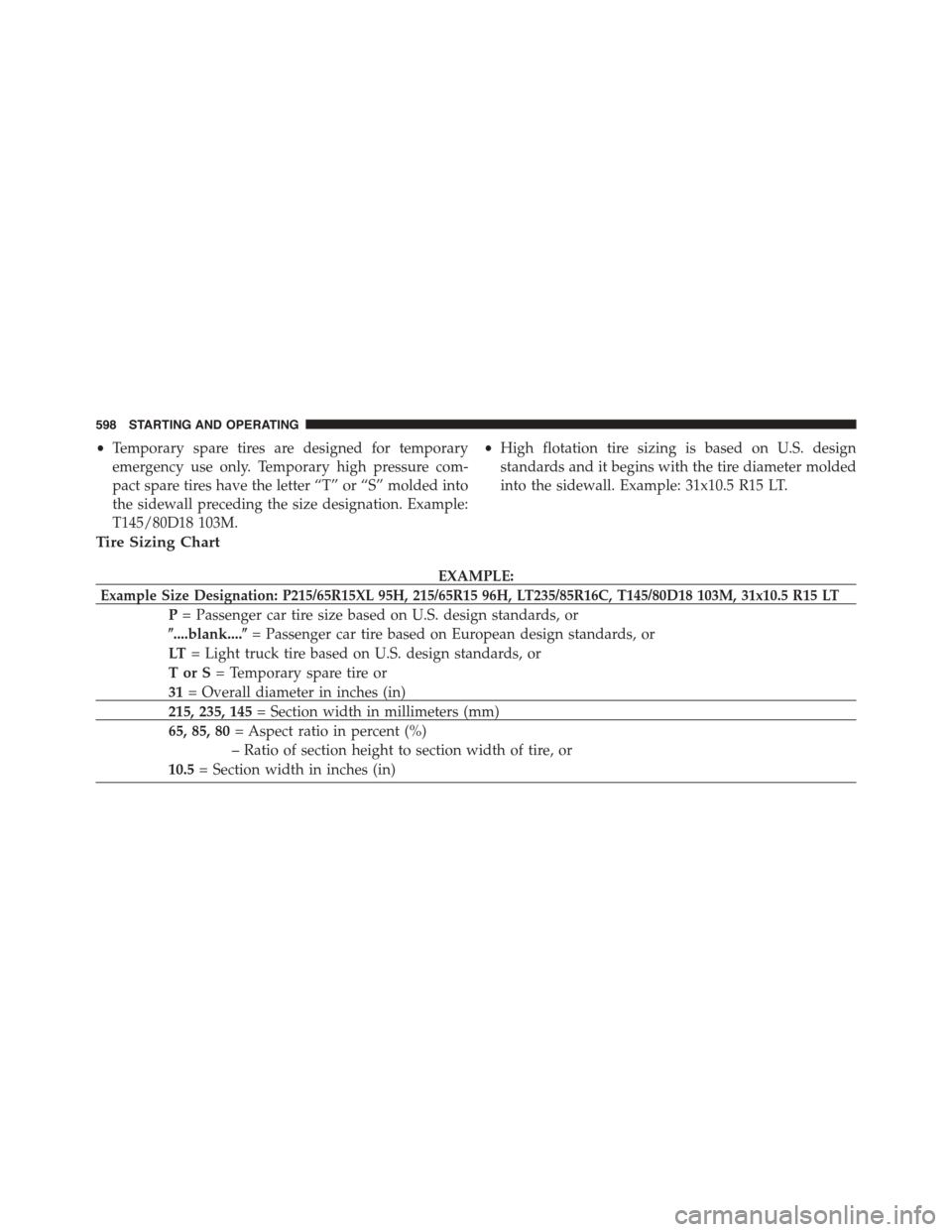
Tire Sizing Chart
EXAMPLE:
Example Size Designation: P215/65R15XL 95H, 215/65R15 96H, LT235/85R16C, T145/80D18 103M, 31x10.5 R15 LT
P= Passenger car tire size based on U.S. design standards, or
%....blank....%= Passenger car tire based on European design standards, or
LT= Light truck tire based on U.S. design standards, or
TorS= Temporary spare tire or
31= Overall diameter in inches (in)
215, 235, 145= Section width in millimeters (mm)
65, 85, 80= Aspect ratio in percent (%)
– Ratio of section height to section width of tire, or
10.5= Section width in inches (in)
598 STARTING AND OPERATING