height Ram 1500 2015 Owner's Guide
[x] Cancel search | Manufacturer: RAM, Model Year: 2015, Model line: 1500, Model: Ram 1500 2015Pages: 871, PDF Size: 24.83 MB
Page 534 of 871
WARNING!
Do not disconnect the stabilizer bar and drive on
hard surfaced roads or at speeds above 18 mph
(29 km/h), you may lose control of the vehicle, which
could result in serious injury or death. The front
stabilizer bar enhances vehicle stability and is nec-
essary for maintaining control of the vehicle. The
system monitors vehicle speed and will attempt to
reconnect the stabilizer bar at speeds over 18 mph
(29 km/h). This is indicated by a flashing off road
light and solid on road light. Once vehicle speed is
reduced below 14 mph (22 km/h), the system will
attempt to return to the Off-Road mode.
To disconnect the stabilizer/sway bar, shift to either 4HI
or 4LO as shown in “Four Wheel Drive Operation” and
press the right hand Off Road stabilizer/sway bar button
to obtain the Off-Road position. The amber indicator
light will flash until the stabilizer/sway bar has been
fully disconnected.
NOTE:The stabilizer/sway bar may be torque locked due
to left and right suspension height differences. This condi-
tion is due to driving surface differences or vehicle loading.
In order for the stabilizer/sway bar to disconnect/
reconnect, the right and left halves of the bar must be
aligned. This alignment may require that the vehicle be
driven onto level ground or rocked from side to side.
To return to the On-Road mode; press the left hand On
Road stabilizer/sway bar button .
WARNING!
If the stabilizer/sway bar will not return to On-Road
mode, vehicle stability is greatly reduced. Do not
(Continued)
532 STARTING AND OPERATING
Page 536 of 871
has an RTI of 510, which means you can articulate one
front wheel 26 inches in the air while the other three
wheels remain in contact with the ground.
Water Fording Characteristics
Water fording characteristic is the vehicle’s ability to
cross a body of still water, where the powertrain and
drivetrain are safe from water ingestion. This vehicle has
high water fording characteristics with the ability to cross
a pool of water, without stopping, 24 inches deep at a
maximum speed of 10 mph (16 km/h) and a pool of
water 30 inches deep at a maximum speed of 5 mph
(8 km/h), both with an entrance ramp angle of 1.3
degrees.
CAUTION!
The door sill height is 25 inches. Water may intrude
into the interior of the vehicle at greater depths.
Simultaneous Brake And Throttle Operation
Many off-road driving conditions require the simultane-
ous use of the brake and throttle (two footed driving).
When climbing rocks, logs, or other stepped objects,
using light brake pressure with light throttle will keep the
vehicle from jerking or lurching. This technique is also
used when you need to stop and restart a vehicle on a
steep incline.
The Basics Of Off-Road Driving
You will encounter many types of terrain driving off-
road. You should be familiar with the terrain and area
before proceeding. There are many types of surface
conditions: hard packed dirt, gravel, rocks, grass, sand,
mud, snow and ice. Every surface has a different effect on
your vehicle’s steering, handling and traction. Control-
ling your vehicle is one of the keys to successful off-road
driving, so always keep a firm grip on the steering wheel
and maintain a good driving posture. Avoid sudden
534 STARTING AND OPERATING
Page 600 of 871
•Temporary spare tires are designed for temporary
emergency use only. Temporary high pressure com-
pact spare tires have the letter “T” or “S” molded into
the sidewall preceding the size designation. Example:
T145/80D18 103M.
•High flotation tire sizing is based on U.S. design
standards and it begins with the tire diameter molded
into the sidewall. Example: 31x10.5 R15 LT.
Tire Sizing Chart
EXAMPLE:
Example Size Designation: P215/65R15XL 95H, 215/65R15 96H, LT235/85R16C, T145/80D18 103M, 31x10.5 R15 LT
P= Passenger car tire size based on U.S. design standards, or
%....blank....%= Passenger car tire based on European design standards, or
LT= Light truck tire based on U.S. design standards, or
TorS= Temporary spare tire or
31= Overall diameter in inches (in)
215, 235, 145= Section width in millimeters (mm)
65, 85, 80= Aspect ratio in percent (%)
– Ratio of section height to section width of tire, or
10.5= Section width in inches (in)
598 STARTING AND OPERATING
Page 652 of 871
Frontal Area
The frontal area is the maximum height multiplied by the
maximum width of the front of a trailer.
Trailer Sway Control
The trailer sway control can be a mechanical telescoping
link that can be installed between the hitch receiver and
the trailer tongue that typically provides adjustable fric-
tion associated with the telescoping motion to dampen
any unwanted trailer swaying motions while traveling.
If equipped, the electronic Trailer Sway Control (TSC)
recognizes a swaying trailer and automatically applies
individual wheel brakes and/or reduces engine power to
attempt to eliminate the trailer sway.
Weight-Carrying Hitch
A weight-carrying hitch supports the trailer tongue weight,
just as if it were luggage located at a hitch ball or some other
connecting point of the vehicle. These kinds of hitches are
the most popular on the market today and they are com-
monly used to tow small and medium sized trailers.
Weight-Distributing Hitch
A weight-distributing system works by applying lever-
age through spring (load) bars. They are typically used
for heavier loads to distribute trailer tongue weight to the
tow vehicle’s front axle and the trailer axle(s). When used
in accordance with the manufacturer’s directions, it pro-
vides for a more level ride, offering more consistent
steering and brake control, thereby enhancing towing
safety. The addition of a friction/hydraulic sway control
also dampens sway caused by traffic and crosswinds and
contributes positively to tow vehicle and trailer stability.
Trailer sway control and a weight distributing (load
equalizing) hitch are recommended for heavier Tongue
Weights (TW) and may be required depending on vehicle
and trailer configuration/loading to comply with GAWR
requirements.
650 STARTING AND OPERATING
Page 655 of 871
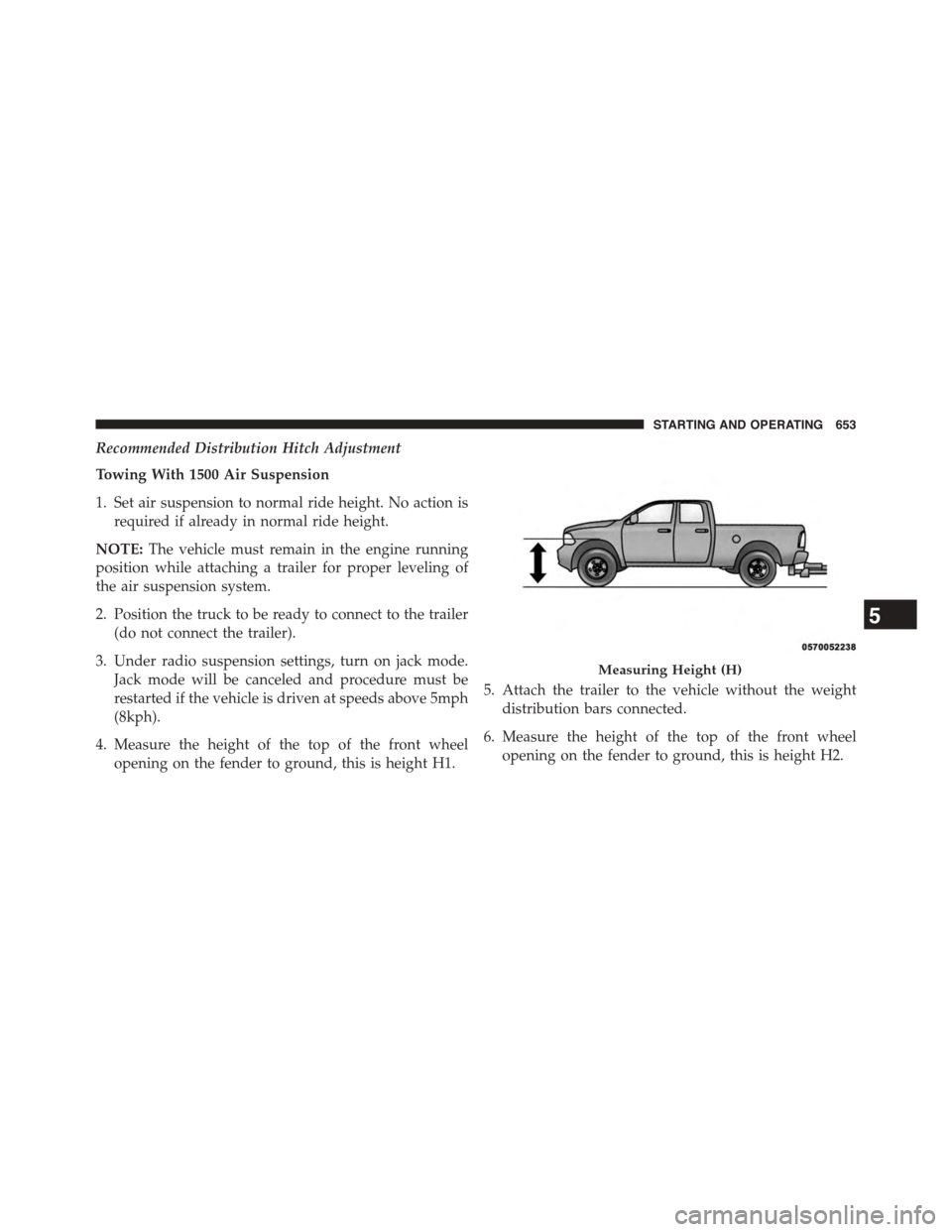
Recommended Distribution Hitch Adjustment
Towing With 1500 Air Suspension
1. Set air suspension to normal ride height. No action is
required if already in normal ride height.
NOTE:The vehicle must remain in the engine running
position while attaching a trailer for proper leveling of
the air suspension system.
2. Position the truck to be ready to connect to the trailer
(do not connect the trailer).
3. Under radio suspension settings, turn on jack mode.
Jack mode will be canceled and procedure must be
restarted if the vehicle is driven at speeds above 5mph
(8kph).
4. Measure the height of the top of the front wheel
opening on the fender to ground, this is height H1.
5. Attach the trailer to the vehicle without the weight
distribution bars connected.
6. Measure the height of the top of the front wheel
opening on the fender to ground, this is height H2.
Measuring Height (H)
5
STARTING AND OPERATING 653
Page 656 of 871
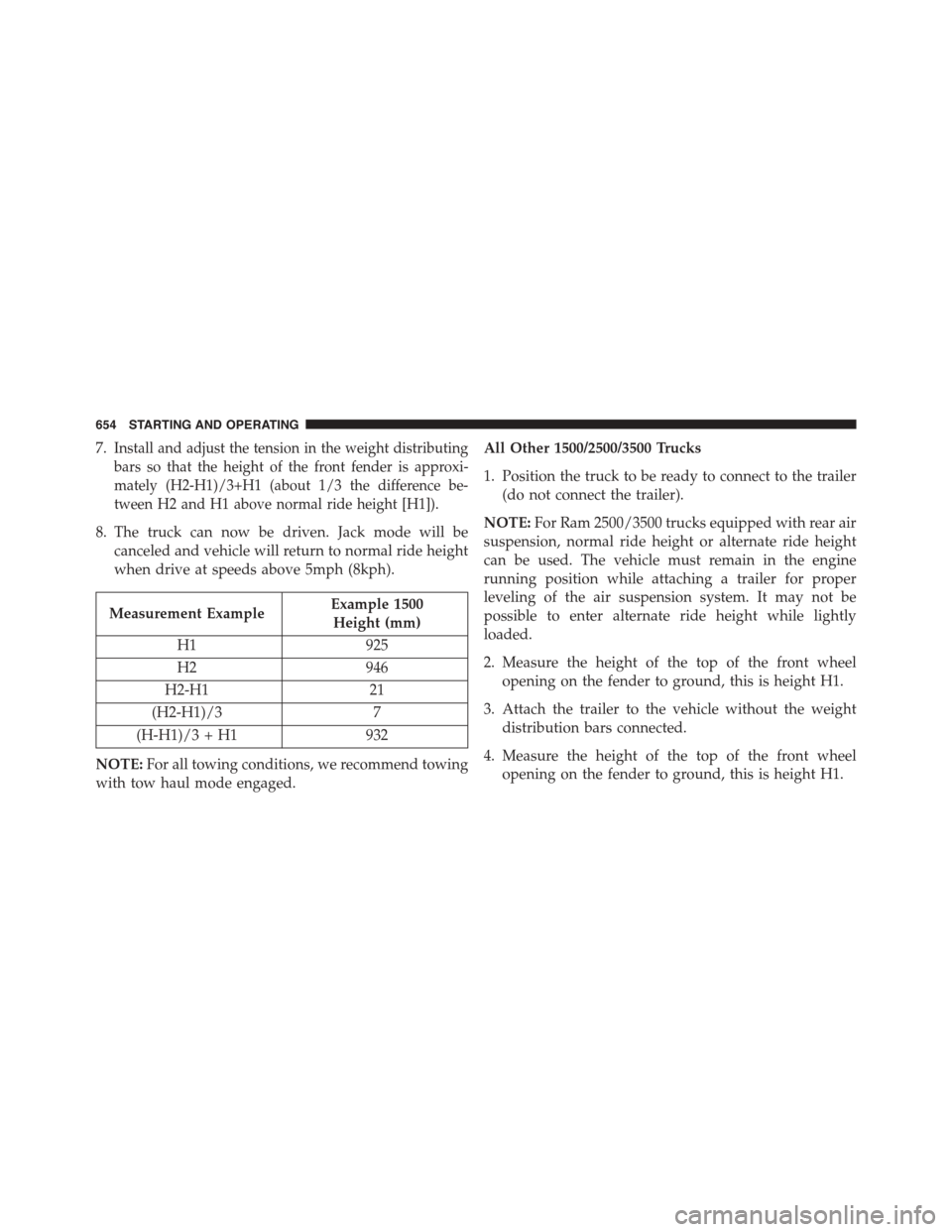
7.Install and adjust the tension in the weight distributing
bars so that the height of the front fender is approxi-
mately (H2-H1)/3+H1 (about 1/3 the difference be-
tween H2 and H1 above normal ride height [H1]).
8. The truck can now be driven. Jack mode will be
canceled and vehicle will return to normal ride height
when drive at speeds above 5mph (8kph).
Measurement ExampleExample 1500
Height (mm)
H1925
H2946
H2-H121
(H2-H1)/37
(H-H1)/3 + H1932
NOTE:For all towing conditions, we recommend towing
with tow haul mode engaged.
All Other 1500/2500/3500 Trucks
1. Position the truck to be ready to connect to the trailer
(do not connect the trailer).
NOTE:For Ram 2500/3500 trucks equipped with rear air
suspension, normal ride height or alternate ride height
can be used. The vehicle must remain in the engine
running position while attaching a trailer for proper
leveling of the air suspension system. It may not be
possible to enter alternate ride height while lightly
loaded.
2. Measure the height of the top of the front wheel
opening on the fender to ground, this is height H1.
3. Attach the trailer to the vehicle without the weight
distribution bars connected.
4. Measure the height of the top of the front wheel
opening on the fender to ground, this is height H1.
654 STARTING AND OPERATING
Page 657 of 871
5. Attach the trailer to the vehicle without the weight
distribution bars connected.
6. Measure the height of the top of the front wheel
opening on the fender to ground, this is height H2.
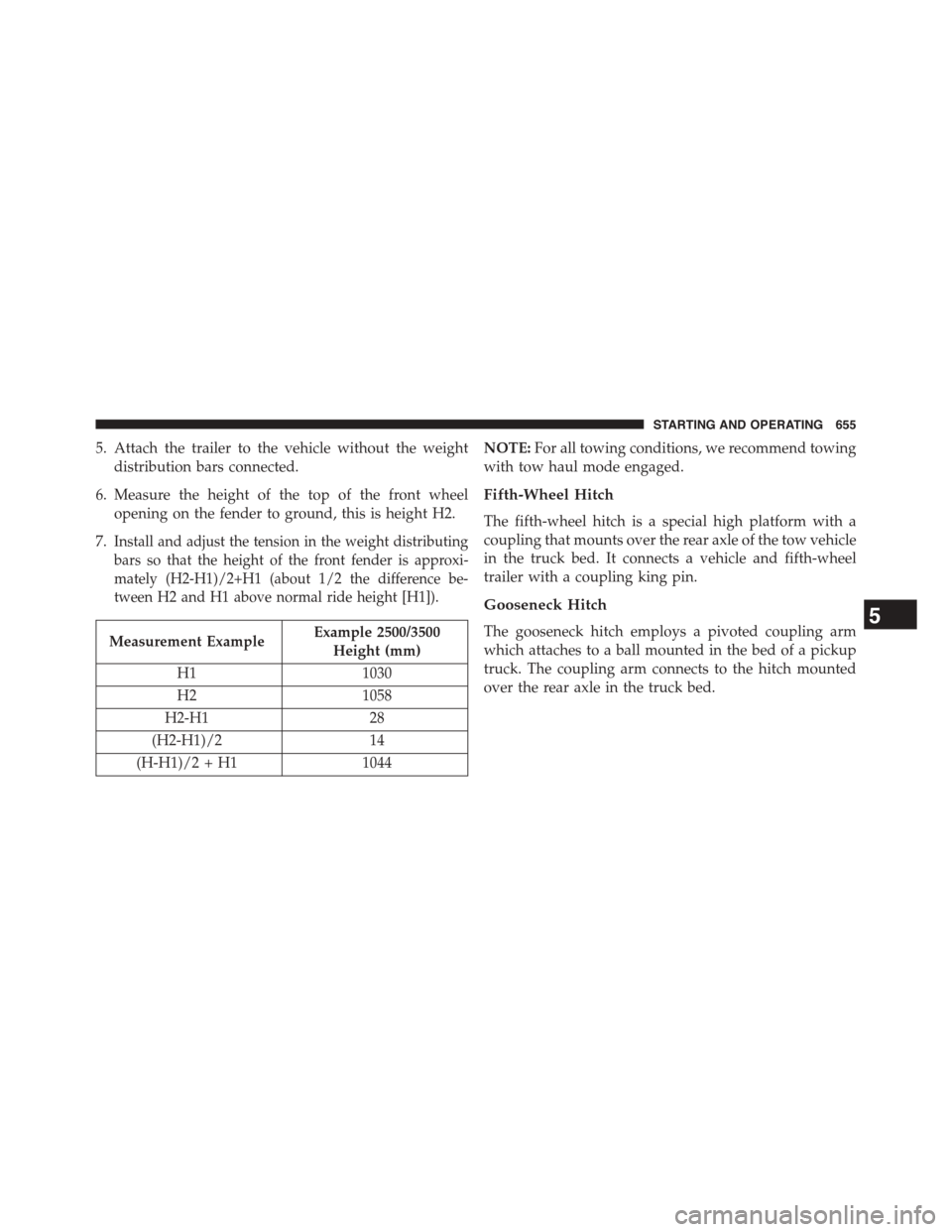
7.Install and adjust the tension in the weight distributing
bars so that the height of the front fender is approxi-
mately (H2-H1)/2+H1 (about 1/2 the difference be-
tween H2 and H1 above normal ride height [H1]).
Measurement ExampleExample 2500/3500
Height (mm)
H11030
H21058
H2-H128
(H2-H1)/214
(H-H1)/2 + H11044
NOTE:For all towing conditions, we recommend towing
with tow haul mode engaged.
Fifth-Wheel Hitch
The fifth-wheel hitch is a special high platform with a
coupling that mounts over the rear axle of the tow vehicle
in the truck bed. It connects a vehicle and fifth-wheel
trailer with a coupling king pin.
Gooseneck Hitch
The gooseneck hitch employs a pivoted coupling arm
which attaches to a ball mounted in the bed of a pickup
truck. The coupling arm connects to the hitch mounted
over the rear axle in the truck bed.
5
STARTING AND OPERATING 655
Page 676 of 871
NOTE:Vehicles equipped with air suspension must be
placed in Transport mode before tying them down (from
the body) on a trailer or flatbed truck. Refer to “Air
Suspension – If Equipped” for more information. If the
vehicle cannot be placed in Transport mode (for example,
engine will not run), tie-downs must be fastened to the
axles (not to the body). Failure to follow these instruc-
tions may cause fault codes to be set and/or cause loss of
proper tie-down tension.
Recreational Towing — Two-Wheel Drive Models
DO NOT flat tow this vehicle. Damage to the drivetrain
will result.
Recreational towing (for two-wheel drive models) is
allowedONLYif the rear wheels areOFFthe ground.
This may be accomplished using a tow dolly or vehicle
trailer. If using a tow dolly, follow this procedure:
1. Properly secure the dolly to the tow vehicle, following
the dolly manufacturer’s instructions.
NOTE:If vehicle is equipped with air suspension, ensure
the vehicle is set to Normal Ride Height.
2. Drive the rear wheels onto the tow dolly.
3. Firmly apply the parking brake. Place automatic trans-
mission in PARK, manual transmission in gear (not in
NEUTRAL).
4. Properly secure the rear wheels to the dolly, following
the dolly manufacturer’s instructions.
5. Turn the ignition switch to the OFF position and
remove the Key Fob.
6. Install a suitable clamping device, designed for tow-
ing, to secure the front wheels in the straight position.
674 STARTING AND OPERATING
Page 679 of 871

WARNING!(Continued)
the parking brake. The transfer case NEUTRAL (N)
position disengages both the front and rear drive-
shafts from the powertrain and will allow the vehicle
to roll, even if the transmission is in PARK. The
parking brake should always be applied when the
driver is not in the vehicle.
CAUTION!
It is necessary to follow these steps to be certain that
the transfer case is fully in NEUTRAL (N) before
recreational towing to prevent damage to internal
parts.
1. Bring the vehicle to a complete stop, with the engine
running. Firmly apply the parking brake.
2. Shift the transmission to NEUTRAL.
NOTE:If vehicle is equipped with air suspension, ensure
the vehicle is set to Normal Ride Height.
3. Press and hold the brake pedal.
4. Depress the clutch pedal on a manual transmission.
•With manual shift transfer case, shift the transfer
case lever into NEUTRAL (N).
•With electronic shift transfer case, press and hold the
transfer case NEUTRAL (N) button. Some models
have a small, recessed#N#button (at the center of the
transfer case switches) that must be pressed using a
ballpoint pen or similar object. Other models have a
rectangular NEUTRAL switch, below the rotary
transfer case control knob. The NEUTRAL (N) indi-
cator light will blink while the shift is in progress.
The light will stop blinking (stay on solid) when the
shift to NEUTRAL (N) is complete. After the shift is
completed and the NEUTRAL (N) light stays on,
release the NEUTRAL (N) button.
5
STARTING AND OPERATING 677
Page 681 of 871

•The ignition switch must be in the ON/RUN position
for a shift to take place and for the position indicator
lights to be operable. If the ignition switch is not in the
ON/RUN position, the shift will not take place and no
position indicator lights will be on or flashing.
•A flashing NEUTRAL (N) position indicator light
indicates that shift requirements have not been met.
•If the vehicle is equipped with air suspension, the
engine should be started and left running for a mini-
mum of 60 seconds (with all the doors closed) at least
once every 24 hours. This process allows the air
suspension to adjust the vehicle’s ride height to com-
pensate for temperature effects.
Shifting Out Of NEUTRAL (N)
Use the following procedure to prepare your vehicle for
normal usage.
1. Bring the vehicle to a complete stop, leaving it con-
nected to the tow vehicle.
2. Firmly apply the parking brake.
3. Press and hold the brake pedal.
4. Start the engine. Shift the transmission into NEU-
TRAL. Depress the clutch pedal on a manual trans-
mission.
•With manual shift transfer case, shift the transfer
case lever to the desired position.
•With electronic shift transfer case with rotary selector
switch, press and hold the transfer case NEUTRAL (N)
button until the NEUTRAL (N) indicator light turns
off. After the NEUTRAL (N) indicator light turns off,
release the NEUTRAL (N) button. After the NEUTRAL
5
STARTING AND OPERATING 679