brake light Ram 1500 2015 Workshop Manual
[x] Cancel search | Manufacturer: RAM, Model Year: 2015, Model line: 1500, Model: Ram 1500 2015Pages: 871, PDF Size: 24.83 MB
Page 666 of 871
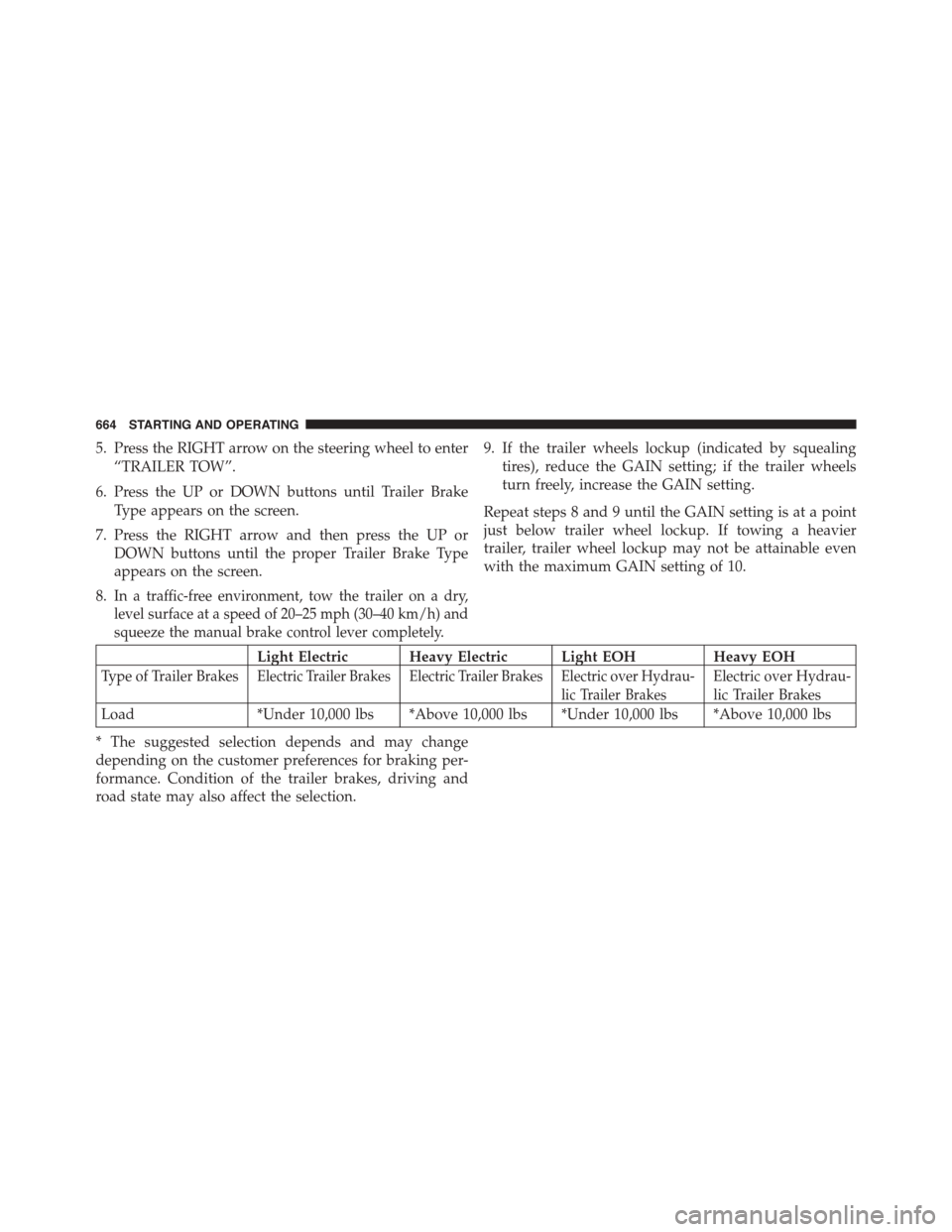
5. Press the RIGHT arrow on the steering wheel to enter
“TRAILER TOW”.
6. Press the UP or DOWN buttons until Trailer Brake
Type appears on the screen.
7. Press the RIGHT arrow and then press the UP or
DOWN buttons until the proper Trailer Brake Type
appears on the screen.
8.In a traffic-free environment, tow the trailer on a dry,
level surface at a speed of 20–25 mph (30–40 km/h) and
squeeze the manual brake control lever completely.
9. If the trailer wheels lockup (indicated by squealing
tires), reduce the GAIN setting; if the trailer wheels
turn freely, increase the GAIN setting.
Repeat steps 8 and 9 until the GAIN setting is at a point
just below trailer wheel lockup. If towing a heavier
trailer, trailer wheel lockup may not be attainable even
with the maximum GAIN setting of 10.
Light Electric Heavy Electric Light EOHHeavy EOH
Type of Trailer BrakesElectric Trailer Brakes Electric Trailer Brakes Electric over Hydrau-
lic Trailer Brakes
Electric over Hydrau-
lic Trailer Brakes
Load*Under 10,000 lbs *Above 10,000 lbs *Under 10,000 lbs *Above 10,000 lbs
* The suggested selection depends and may change
depending on the customer preferences for braking per-
formance. Condition of the trailer brakes, driving and
road state may also affect the selection.
664 STARTING AND OPERATING
Page 679 of 871

WARNING!(Continued)
the parking brake. The transfer case NEUTRAL (N)
position disengages both the front and rear drive-
shafts from the powertrain and will allow the vehicle
to roll, even if the transmission is in PARK. The
parking brake should always be applied when the
driver is not in the vehicle.
CAUTION!
It is necessary to follow these steps to be certain that
the transfer case is fully in NEUTRAL (N) before
recreational towing to prevent damage to internal
parts.
1. Bring the vehicle to a complete stop, with the engine
running. Firmly apply the parking brake.
2. Shift the transmission to NEUTRAL.
NOTE:If vehicle is equipped with air suspension, ensure
the vehicle is set to Normal Ride Height.
3. Press and hold the brake pedal.
4. Depress the clutch pedal on a manual transmission.
•With manual shift transfer case, shift the transfer
case lever into NEUTRAL (N).
•With electronic shift transfer case, press and hold the
transfer case NEUTRAL (N) button. Some models
have a small, recessed#N#button (at the center of the
transfer case switches) that must be pressed using a
ballpoint pen or similar object. Other models have a
rectangular NEUTRAL switch, below the rotary
transfer case control knob. The NEUTRAL (N) indi-
cator light will blink while the shift is in progress.
The light will stop blinking (stay on solid) when the
shift to NEUTRAL (N) is complete. After the shift is
completed and the NEUTRAL (N) light stays on,
release the NEUTRAL (N) button.
5
STARTING AND OPERATING 677
Page 680 of 871
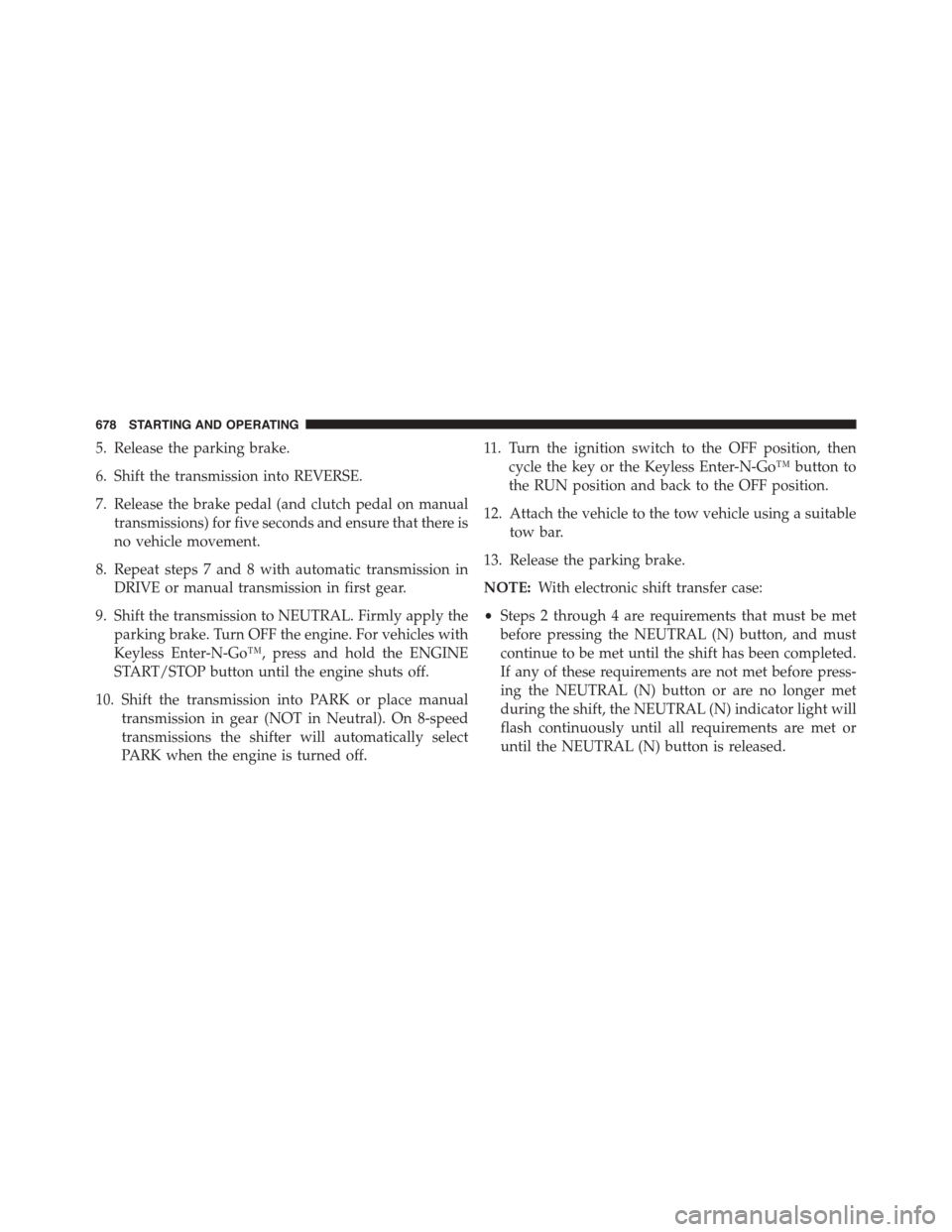
5. Release the parking brake.
6. Shift the transmission into REVERSE.
7. Release the brake pedal (and clutch pedal on manual
transmissions) for five seconds and ensure that there is
no vehicle movement.
8. Repeat steps 7 and 8 with automatic transmission in
DRIVE or manual transmission in first gear.
9. Shift the transmission to NEUTRAL. Firmly apply the
parking brake. Turn OFF the engine. For vehicles with
Keyless Enter-N-Go™, press and hold the ENGINE
START/STOP button until the engine shuts off.
10. Shift the transmission into PARK or place manual
transmission in gear (NOT in Neutral). On 8-speed
transmissions the shifter will automatically select
PARK when the engine is turned off.
11. Turn the ignition switch to the OFF position, then
cycle the key or the Keyless Enter-N-Go™ button to
the RUN position and back to the OFF position.
12. Attach the vehicle to the tow vehicle using a suitable
tow bar.
13. Release the parking brake.
NOTE:With electronic shift transfer case:
•Steps 2 through 4 are requirements that must be met
before pressing the NEUTRAL (N) button, and must
continue to be met until the shift has been completed.
If any of these requirements are not met before press-
ing the NEUTRAL (N) button or are no longer met
during the shift, the NEUTRAL (N) indicator light will
flash continuously until all requirements are met or
until the NEUTRAL (N) button is released.
678 STARTING AND OPERATING
Page 681 of 871

•The ignition switch must be in the ON/RUN position
for a shift to take place and for the position indicator
lights to be operable. If the ignition switch is not in the
ON/RUN position, the shift will not take place and no
position indicator lights will be on or flashing.
•A flashing NEUTRAL (N) position indicator light
indicates that shift requirements have not been met.
•If the vehicle is equipped with air suspension, the
engine should be started and left running for a mini-
mum of 60 seconds (with all the doors closed) at least
once every 24 hours. This process allows the air
suspension to adjust the vehicle’s ride height to com-
pensate for temperature effects.
Shifting Out Of NEUTRAL (N)
Use the following procedure to prepare your vehicle for
normal usage.
1. Bring the vehicle to a complete stop, leaving it con-
nected to the tow vehicle.
2. Firmly apply the parking brake.
3. Press and hold the brake pedal.
4. Start the engine. Shift the transmission into NEU-
TRAL. Depress the clutch pedal on a manual trans-
mission.
•With manual shift transfer case, shift the transfer
case lever to the desired position.
•With electronic shift transfer case with rotary selector
switch, press and hold the transfer case NEUTRAL (N)
button until the NEUTRAL (N) indicator light turns
off. After the NEUTRAL (N) indicator light turns off,
release the NEUTRAL (N) button. After the NEUTRAL
5
STARTING AND OPERATING 679
Page 682 of 871

(N) button has been released, the transfer case will
shift to the position indicated by the selector switch.
•With electronic shift transfer case with pushbutton
selector switch, press and hold the switch for the
desired transfer case position, until the NEUTRAL
(N) indicator light turns off and the desired position
indicator light turns on.
NOTE:When shifting out of transfer case NEUTRAL (N),
turning the engine OFF is not required, but may be
helpful to avoid gear clash. With the 8-speed automatic
transmission, the engine must remain running, since
turning the engine OFF will shift the transmission to
PARK (and the transmission must be in NEUTRAL for
the transfer case to shift out of NEUTRAL).
5. Turn the engine OFF. Shift automatic transmission into
PARK. On 8-speed transmissions the shifter will auto-
matically select PARK when the engine is turned off.
6. Release the brake pedal (and clutch pedal on a manual
transmission).
7. Disconnect vehicle from the tow vehicle.
8. Start the engine.
9. Press and hold the brake pedal.
10. Release the parking brake.
11. Shift the transmission into gear, release the brake
pedal (and clutch pedal on manual transmissions),
and check that the vehicle operates normally.
NOTE:With electronic shift transfer case:
•Steps 3 and 4 are requirements that must be met before
pressing the button to shift out of NEUTRAL (N), and
must continue to be met until the shift has been
completed. If any of these requirements are not met
before pressing the button or are no longer met during
680 STARTING AND OPERATING
Page 791 of 871

NOTE:If it is necessary to check the transmissionbelow
the operating temperature, the fluid level should be
between the two “COLD” (lower) holes on the dipstick
with the fluid at 60-70°F / 16-21°C. Only use the COLD
region of the dipstick as a rough reference when setting
the fluid level after a transmission service or fluid
change. Re-check the fluid level, and adjust as required,
once the transmission reaches normal operating tempera-
ture.
CAUTION!
If the fluid temperature is below 50°F (10°C) it may
not register on the dipstick. Do not add fluid until
the temperature is elevated enough to produce an
accurate reading. Run the engine at idle, in PARK, to
warm the fluid.
8. Reinsert the dipstick. Check for leaks. Release the
parking brake.
NOTE:To prevent dirt and water from entering the
transmission after checking or replenishing fluid, make
sure that the dipstick cap is properly reseated. It is
normal for the dipstick cap to spring back slightly from
its fully seated position, as long as its seal remains
engaged in the dipstick tube.
Fluid And Filter Changes — Eight-Speed
Transmission
Under normal operating conditions, the fluid installed at
the factory will provide satisfactory lubrication for the
life of the vehicle.
Routine fluid and filter changes are not required. How-
ever, change the fluid and filter if the fluid becomes
contaminated (with water, etc.), or if the transmission is
disassembled for any reason.
7
MAINTAINING YOUR VEHICLE 789
Page 802 of 871
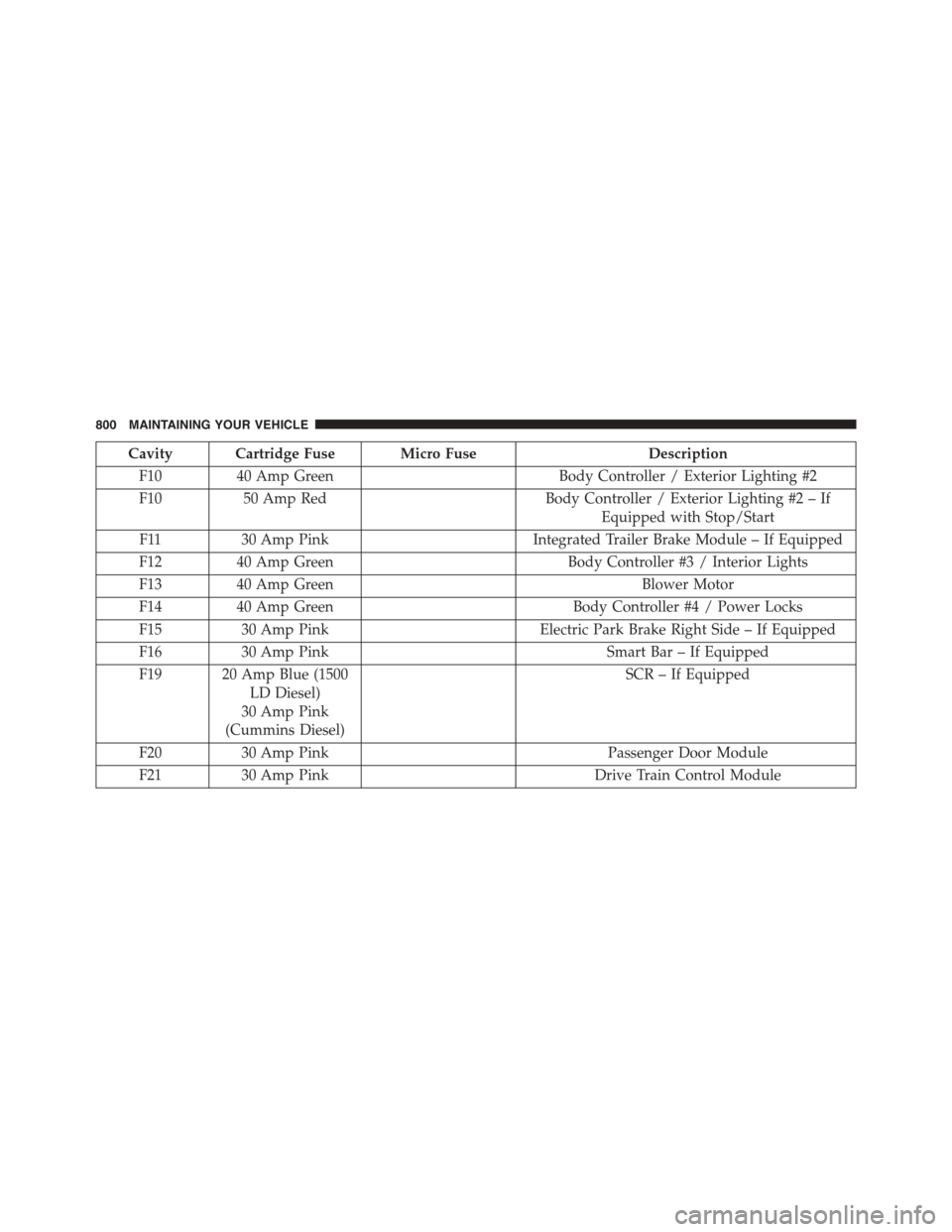
Cavity Cartridge Fuse Micro FuseDescription
F1040 Amp GreenBody Controller / Exterior Lighting #2
F1050 Amp RedBody Controller / Exterior Lighting #2 – If
Equipped with Stop/Start
F1130 Amp PinkIntegrated Trailer Brake Module – If Equipped
F1240 Amp GreenBody Controller #3 / Interior Lights
F1340 Amp GreenBlower Motor
F1440 Amp GreenBody Controller #4 / Power Locks
F1530 Amp PinkElectric Park Brake Right Side – If Equipped
F1630 Amp PinkSmart Bar – If Equipped
F19 20 Amp Blue (1500
LD Diesel)
30 Amp Pink
(Cummins Diesel)
SCR – If Equipped
F2030 Amp PinkPassenger Door Module
F2130 Amp PinkDrive Train Control Module
800 MAINTAINING YOUR VEHICLE
Page 803 of 871
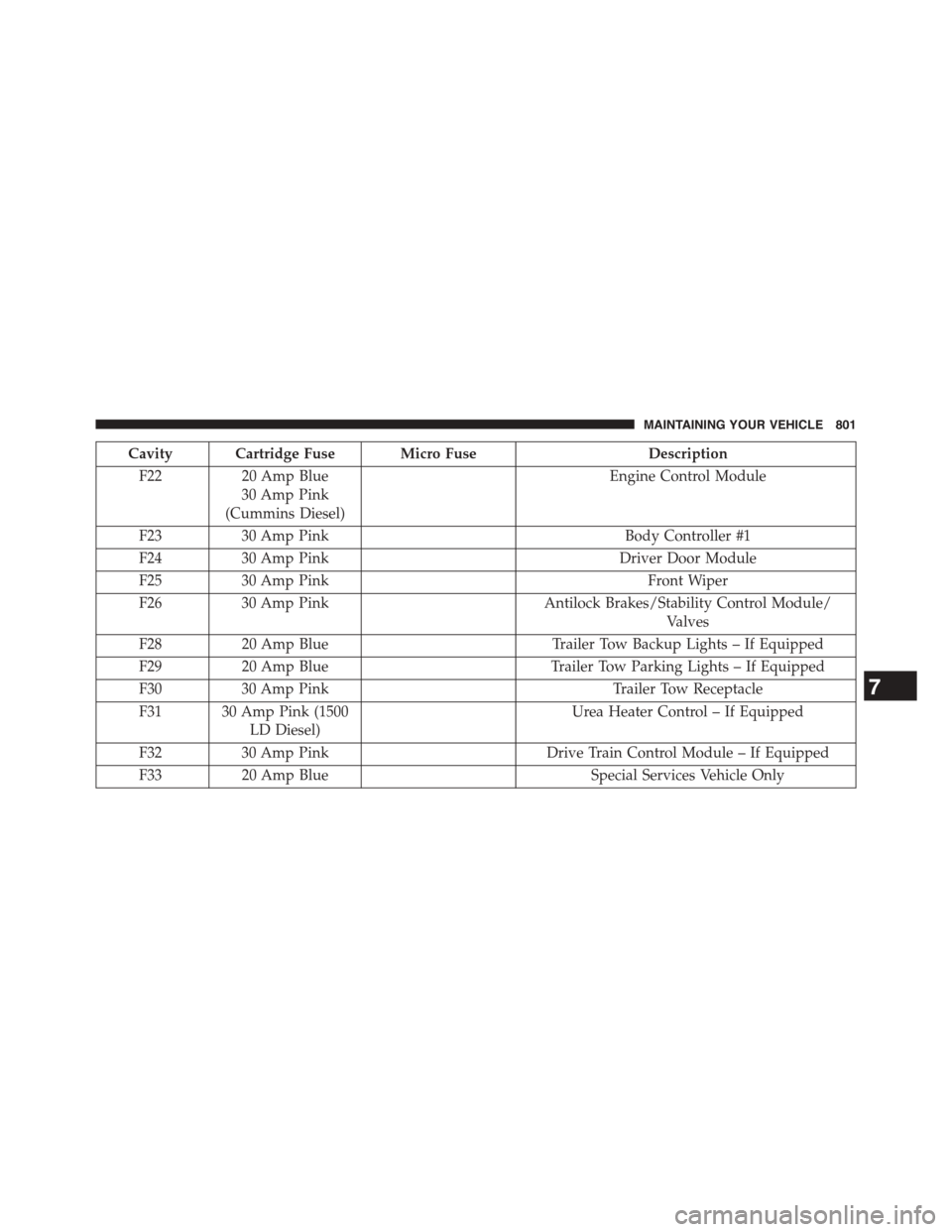
Cavity Cartridge Fuse Micro FuseDescription
F2220 Amp Blue
30 Amp Pink
(Cummins Diesel)
Engine Control Module
F2330 Amp PinkBody Controller #1
F2430 Amp PinkDriver Door Module
F2530 Amp PinkFront Wiper
F2630 Amp PinkAntilock Brakes/Stability Control Module/
Valves
F2820 Amp BlueTrailer Tow Backup Lights – If Equipped
F2920 Amp BlueTrailer Tow Parking Lights – If Equipped
F3030 Amp PinkTrailer Tow Receptacle
F31 30 Amp Pink (1500
LD Diesel)
Urea Heater Control – If Equipped
F3230 Amp PinkDrive Train Control Module – If Equipped
F3320 Amp BlueSpecial Services Vehicle Only
7
MAINTAINING YOUR VEHICLE 801
Page 807 of 871
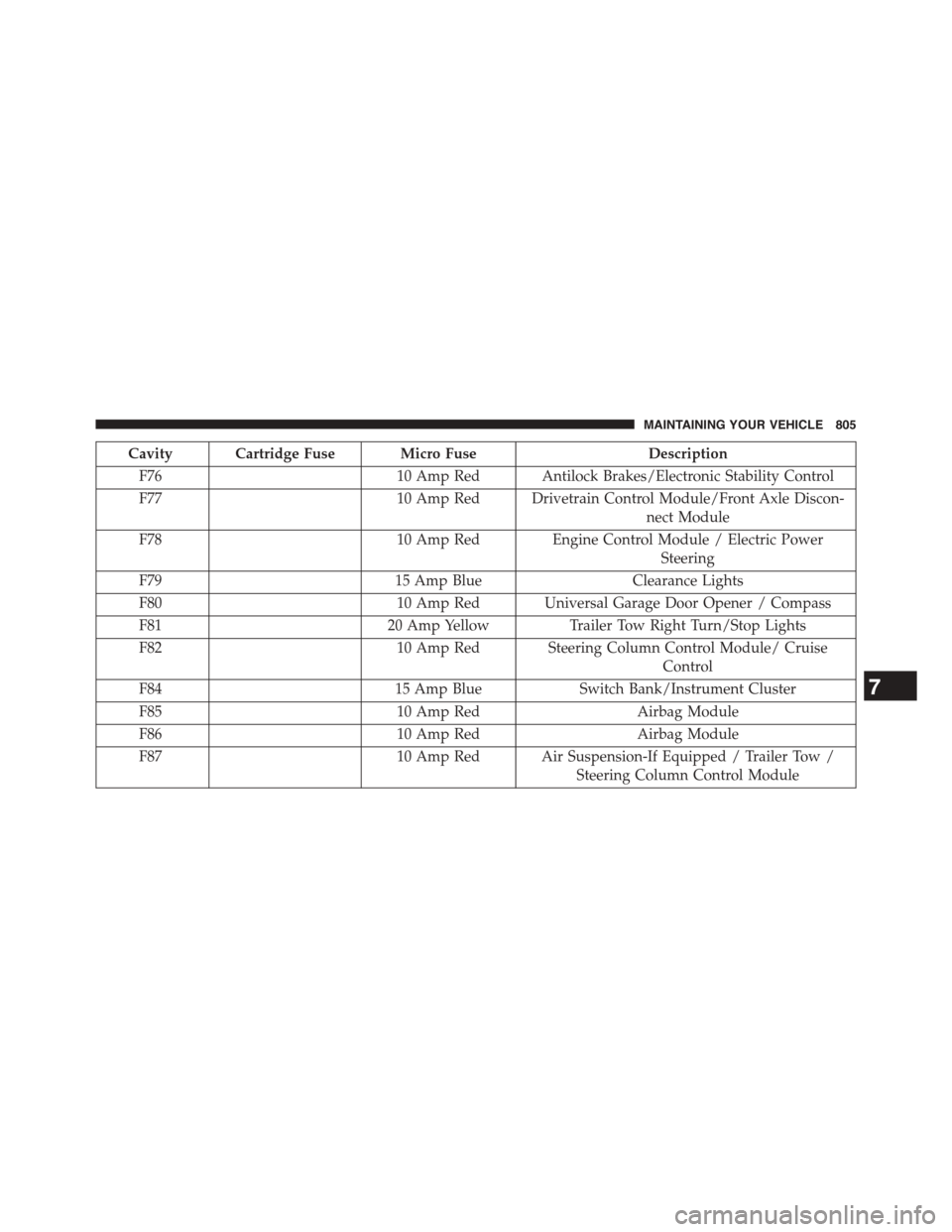
Cavity Cartridge Fuse Micro FuseDescription
F7610 Amp Red Antilock Brakes/Electronic Stability Control
F7710 Amp Red Drivetrain Control Module/Front Axle Discon-
nect Module
F7810 Amp Red Engine Control Module / Electric Power
Steering
F7915 Amp BlueClearance Lights
F8010 Amp Red Universal Garage Door Opener / Compass
F8120 Amp YellowTrailer Tow Right Turn/Stop Lights
F8210 Amp Red Steering Column Control Module/ Cruise
Control
F8415 Amp BlueSwitch Bank/Instrument Cluster
F8510 Amp RedAirbag Module
F8610 Amp RedAirbag Module
F8710 Amp Red Air Suspension-If Equipped / Trailer Tow /
Steering Column Control Module
7
MAINTAINING YOUR VEHICLE 805
Page 831 of 871
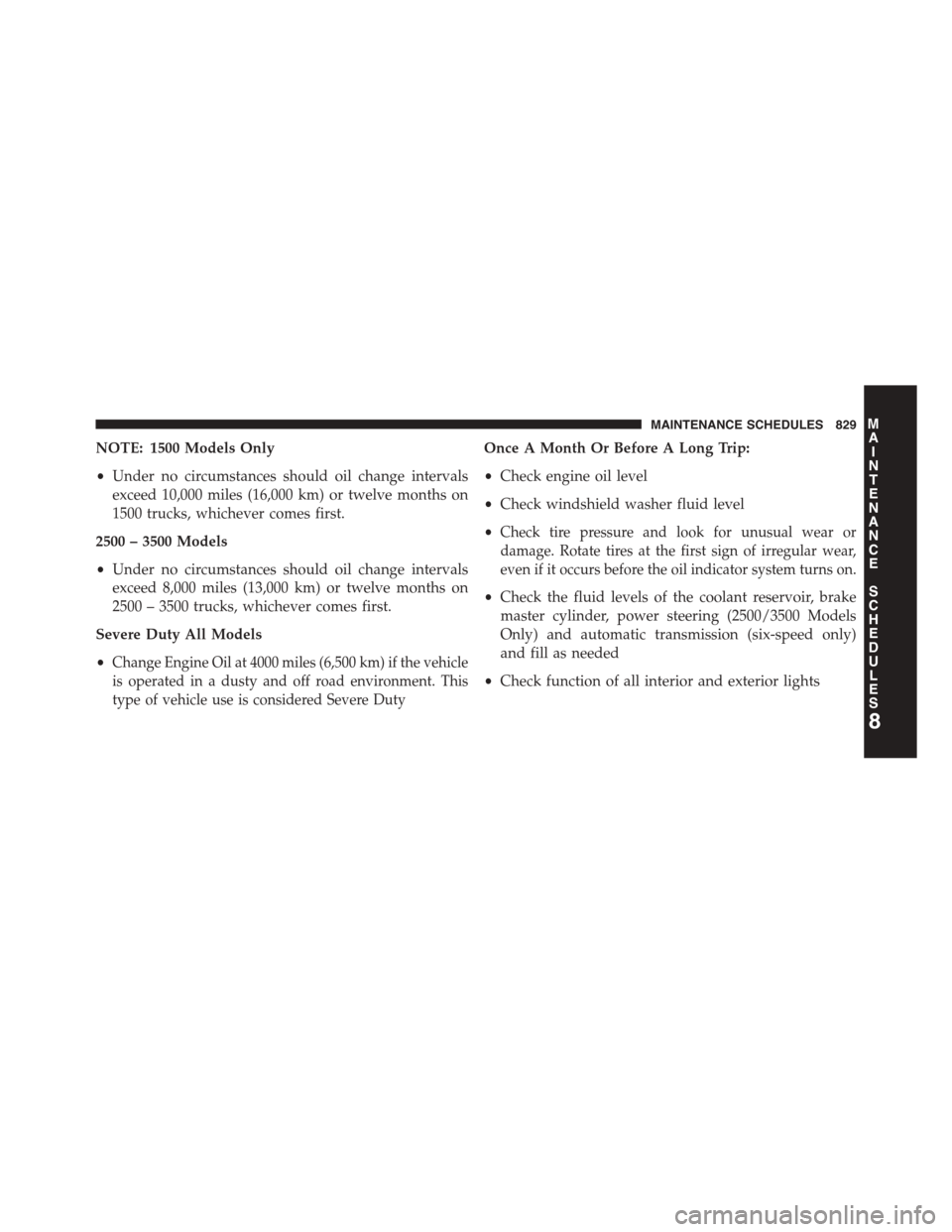
NOTE: 1500 Models Only
•Under no circumstances should oil change intervals
exceed 10,000 miles (16,000 km) or twelve months on
1500 trucks, whichever comes first.
2500 – 3500 Models
•Under no circumstances should oil change intervals
exceed 8,000 miles (13,000 km) or twelve months on
2500 – 3500 trucks, whichever comes first.
Severe Duty All Models
•Change Engine Oil at 4000 miles (6,500 km) if the vehicle
is operated in a dusty and off road environment. This
type of vehicle use is considered Severe Duty
Once A Month Or Before A Long Trip:
•Check engine oil level
•Check windshield washer fluid level
•Check tire pressure and look for unusual wear or
damage. Rotate tires at the first sign of irregular wear,
even if it occurs before the oil indicator system turns on.
•Check the fluid levels of the coolant reservoir, brake
master cylinder, power steering (2500/3500 Models
Only) and automatic transmission (six-speed only)
and fill as needed
•Check function of all interior and exterior lights
8
MAINTENANCE
SCHEDULES
MAINTENANCE SCHEDULES 829