tire pressure Ram 1500 2015 Workshop Manual
[x] Cancel search | Manufacturer: RAM, Model Year: 2015, Model line: 1500, Model: Ram 1500 2015Pages: 871, PDF Size: 24.83 MB
Page 662 of 871
Towing Requirements — Tires
•Do not attempt to tow a trailer while using a compact
spare tire.
•Proper tire inflation pressures are essential to the safe
and satisfactory operation of your vehicle. Refer to
“Tires – General Information” in “Starting and Oper-
ating” for proper tire inflation procedures.
•Check the trailer tires for proper tire inflation pres-
sures before trailer usage.
•Check for signs of tire wear or visible tire damage
before towing a trailer. Refer to “Tires – General
Information” in “Starting and Operating” for the
proper inspection procedure.
•When replacing tires, refer to “Tires – General Infor-
mation” in “Starting and Operating” for proper tire
replacement procedures. Replacing tires with a higher
load carrying capacity will not increase the vehicle’s
GVWR and GAWR limits.
Towing Requirements — Trailer Brakes
WARNING!
•Do not connect trailer brakes to your vehicle’s
hydraulic brake lines. It can overload your brake
system and cause it to fail. You might not have
brakes when you need them and could have an
accident.
•Towing any trailer will increase your stopping
distance. When towing you should allow for addi-
tional space between your vehicle and the vehicle
in front of you. Failure to do so could result in an
accident.
660 STARTING AND OPERATING
Page 688 of 871
CAUTION!
Driving with a hot cooling system could damage
your vehicle. If the temperature gauge reads HOT
(H), pull over and stop the vehicle. Idle the vehicle
with the air conditioner turned off until the pointer
drops back into the normal range. If the pointer
remains on HOT (H), and you hear continuous
chimes, turn the engine off immediately and call for
service.
WARNING!
You or others can be badly burned by hot engine
coolant (antifreeze) or steam from your radiator. If
you see or hear steam coming from under the hood,
do not open the hood until the radiator has had time
to cool. Never try to open a cooling system pressure
cap when the radiator or coolant bottle is hot.
WHEEL AND TIRE TORQUE SPECIFICATIONS
Proper lug nut/bolt torque is very important to ensure
that the wheel is properly mounted to the vehicle. Any
time a wheel has been removed and reinstalled on the
vehicle the lug nuts/bolts should be torqued using a
properly calibrated torque wrench.
Torque Specifications
Lug Nut/Bolt
Torque
Lug Nut/
Bolt
Type
**Lug
Nut/Bolt
Size
Lug Nut/
Bolt
Socket
Size
130 Ft-Lbs (176
N·m)
Cone M14 x
1.50
22 mm
140 Ft-Lbs (190
N·m)
Flanged
**Use only Chrysler recommended lug nuts/bolts and
clean or remove any dirt or oil before tightening.
686 WHAT TO DO IN EMERGENCIES
Page 704 of 871

each nut has been tightened twice. For the correct lug
nut torque refer to “Torque Specifications” in this
section. If in doubt about the correct tightness, have
them checked with a torque wrench by you authorized
dealer or service station.
WARNING!
A loose tire or jack thrown forward in a collision or
hard stop could injure someone in the vehicle. Al-
ways stow the jack parts and the extra tire and wheel
in the places provided.
7. Install the wheel center cap and remove the wheel
blocks. Do not install chrome or aluminum wheel
center caps on the spare wheel. This may result in cap
damage.
8. Lower the jack to its fully closed position. If the bottle
jack will not lower by turning the dial (thumbwheel)
by hand, it may be necessary to use the jack drive tube
in order to lower the jack. Stow the replaced tire, jack,
and tools as previously described.
9. Adjust the tire pressure when possible.
NOTE:Do not oil wheel studs. For chrome wheels, do
not substitute with chrome plated wheel nuts.
To Stow The Flat Or Spare
NOTE:Vehicles equipped with aluminum wheels can-
not be stored under the vehicle because the wheel
retainer will not fit through the wheel pilot hole. Secure
the flat tire in the bed of the truck.Have the flat tire
repaired or replaced immediately.
702 WHAT TO DO IN EMERGENCIES
Page 725 of 871
9. Adjust the tire pressure when possible.
NOTE:Do not oil wheel studs. For chrome wheels, do
not substitute with chrome plated wheel nuts.
To Stow The Flat Or Spare
NOTE: Have the flat tire repaired or replaced immedi-
ately.
WARNING!
A loose tire thrown forward in a collision or hard
stop could injure the occupants in the vehicle. Have
the deflated (flat) tire repaired or replaced immedi-
ately.
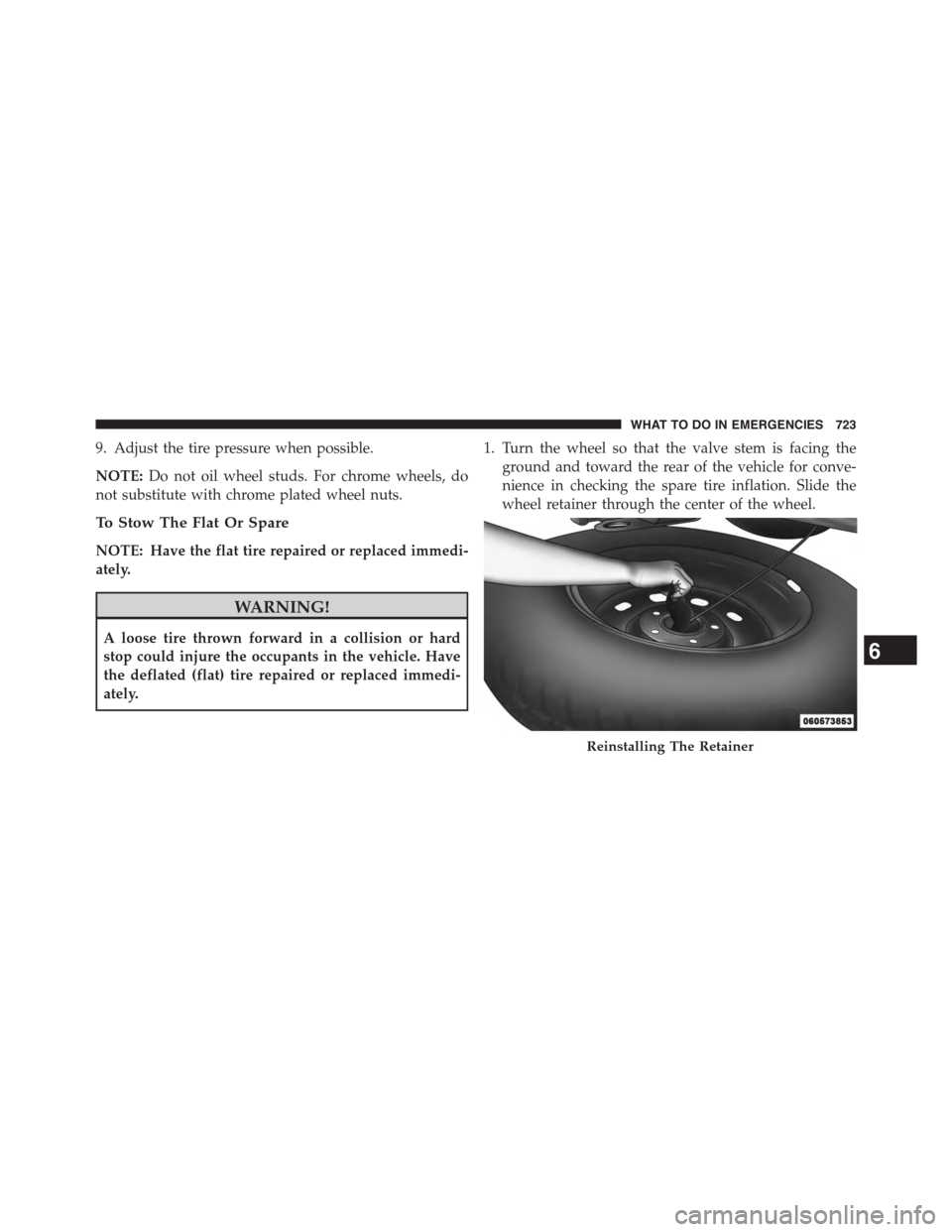
1. Turn the wheel so that the valve stem is facing the
ground and toward the rear of the vehicle for conve-
nience in checking the spare tire inflation. Slide the
wheel retainer through the center of the wheel.
Reinstalling The Retainer
6
WHAT TO DO IN EMERGENCIES 723
Page 777 of 871
Engine Coolant Checks
Check the engine coolant (antifreeze) protection every 12
months (before the onset of freezing weather, where
applicable). If the engine coolant (antifreeze) is dirty or
rusty in appearance, the system should be drained,
flushed and refilled with fresh coolant. Check the front of
the A/C condenser (if equipped) or radiator for any
accumulation of bugs, leaves, etc. If dirty, clean by gently
spraying water from a garden hose vertically down the
face of the A/C condenser (if equipped) or the back of the
radiator core.
Check the engine cooling system hoses for brittle rubber,
cracking, tears, cuts and tightness of the connection at the
coolant recovery bottle and radiator. Inspect the entire
system for leaks.
With the engine at normal operating temperature (but
not running), check the cooling system pressure cap for
proper vacuum sealing by draining a small amount of
engine coolant (antifreeze) from the radiator drain cock.
The radiator drain cock is located in the lower radiator
tank. If the cap is sealing properly, the engine coolant
(antifreeze) will begin to drain from the coolant expan-
sion bottle. DO NOT REMOVE THE COOLANT PRES-
SURE CAP WHEN THE COOLING SYSTEM IS HOT.
Cooling System — Drain Flush And Refill
If the engine coolant (antifreeze) is dirty or contains a
considerable amount of sediment, clean and flush with a
reliable cooling system cleaner. Follow with a thorough
rinsing to remove all deposits and chemicals. Properly
dispose of old engine coolant (antifreeze).
Refer to the “Maintenance Schedule” for the proper
maintenance intervals.
7
MAINTAINING YOUR VEHICLE 775
Page 804 of 871
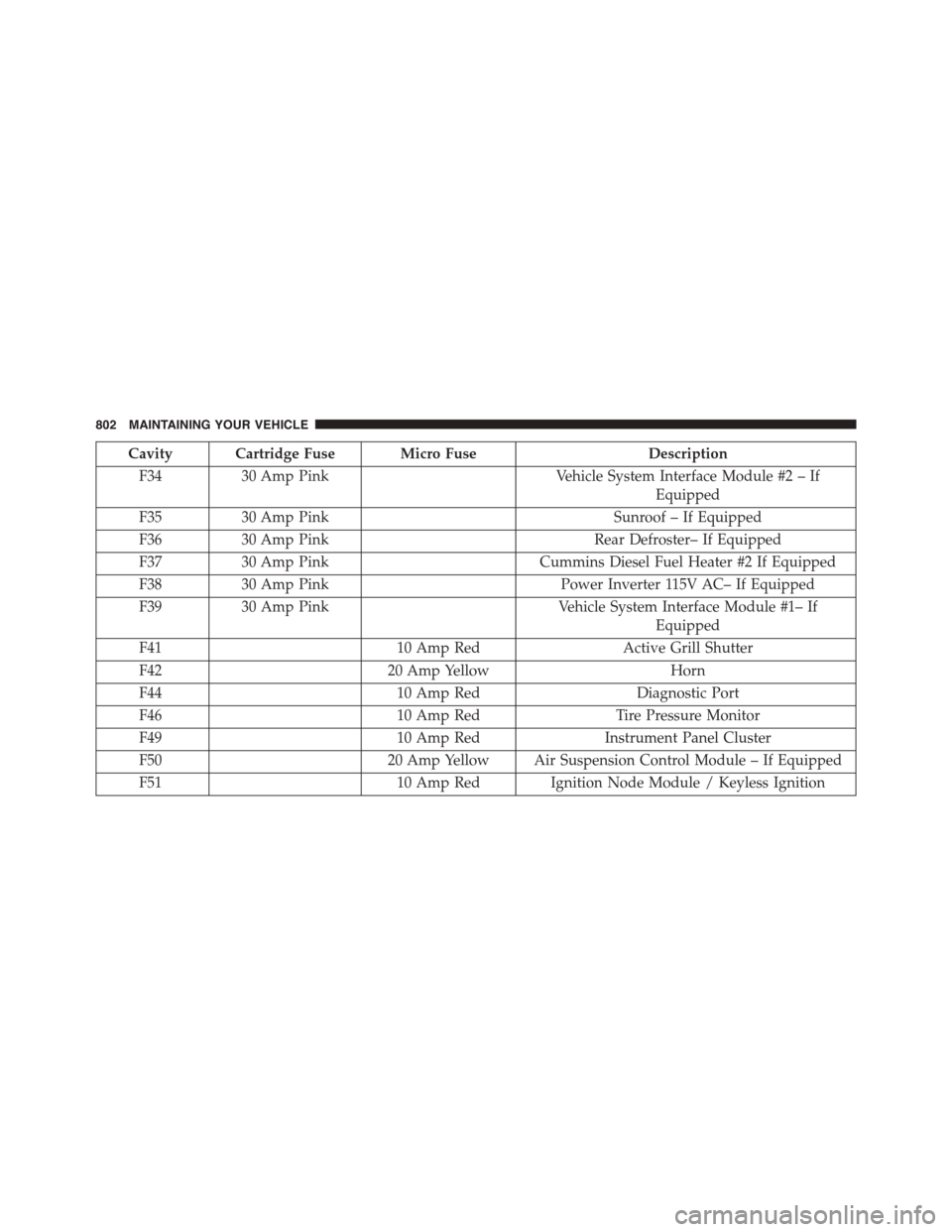
Cavity Cartridge Fuse Micro FuseDescription
F3430 Amp PinkVehicle System Interface Module #2 – If
Equipped
F3530 Amp PinkSunroof – If Equipped
F3630 Amp PinkRear Defroster– If Equipped
F3730 Amp PinkCummins Diesel Fuel Heater #2 If Equipped
F3830 Amp PinkPower Inverter 115V AC– If Equipped
F3930 Amp PinkVehicle System Interface Module #1– If
Equipped
F4110 Amp RedActive Grill Shutter
F4220 Amp YellowHorn
F4410 Amp RedDiagnostic Port
F4610 Amp RedTire Pressure Monitor
F4910 Amp RedInstrument Panel Cluster
F5020 Amp Yellow Air Suspension Control Module – If Equipped
F5110 Amp Red Ignition Node Module / Keyless Ignition
802 MAINTAINING YOUR VEHICLE
Page 831 of 871
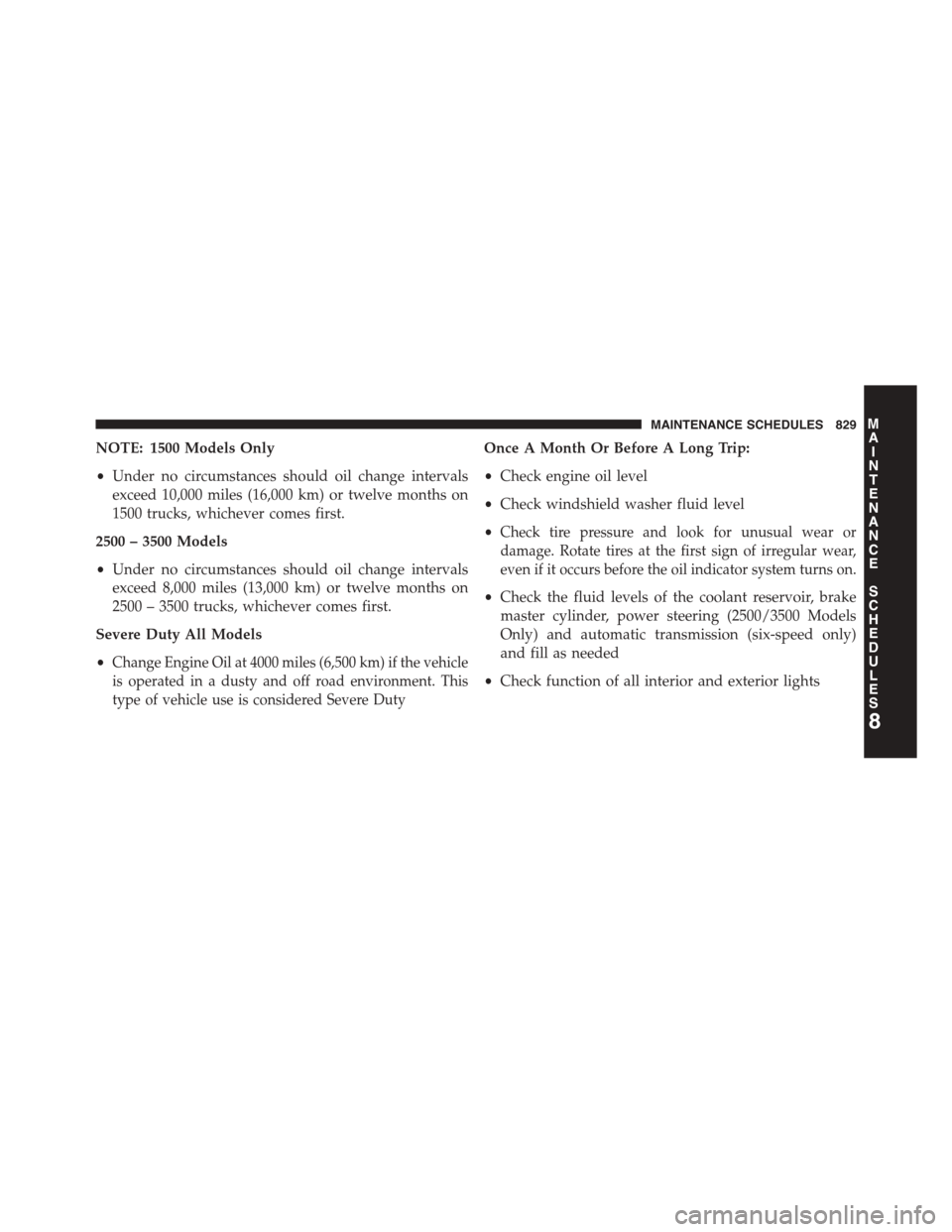
NOTE: 1500 Models Only
•Under no circumstances should oil change intervals
exceed 10,000 miles (16,000 km) or twelve months on
1500 trucks, whichever comes first.
2500 – 3500 Models
•Under no circumstances should oil change intervals
exceed 8,000 miles (13,000 km) or twelve months on
2500 – 3500 trucks, whichever comes first.
Severe Duty All Models
•Change Engine Oil at 4000 miles (6,500 km) if the vehicle
is operated in a dusty and off road environment. This
type of vehicle use is considered Severe Duty
Once A Month Or Before A Long Trip:
•Check engine oil level
•Check windshield washer fluid level
•Check tire pressure and look for unusual wear or
damage. Rotate tires at the first sign of irregular wear,
even if it occurs before the oil indicator system turns on.
•Check the fluid levels of the coolant reservoir, brake
master cylinder, power steering (2500/3500 Models
Only) and automatic transmission (six-speed only)
and fill as needed
•Check function of all interior and exterior lights
8
MAINTENANCE
SCHEDULES
MAINTENANCE SCHEDULES 829
Page 850 of 871
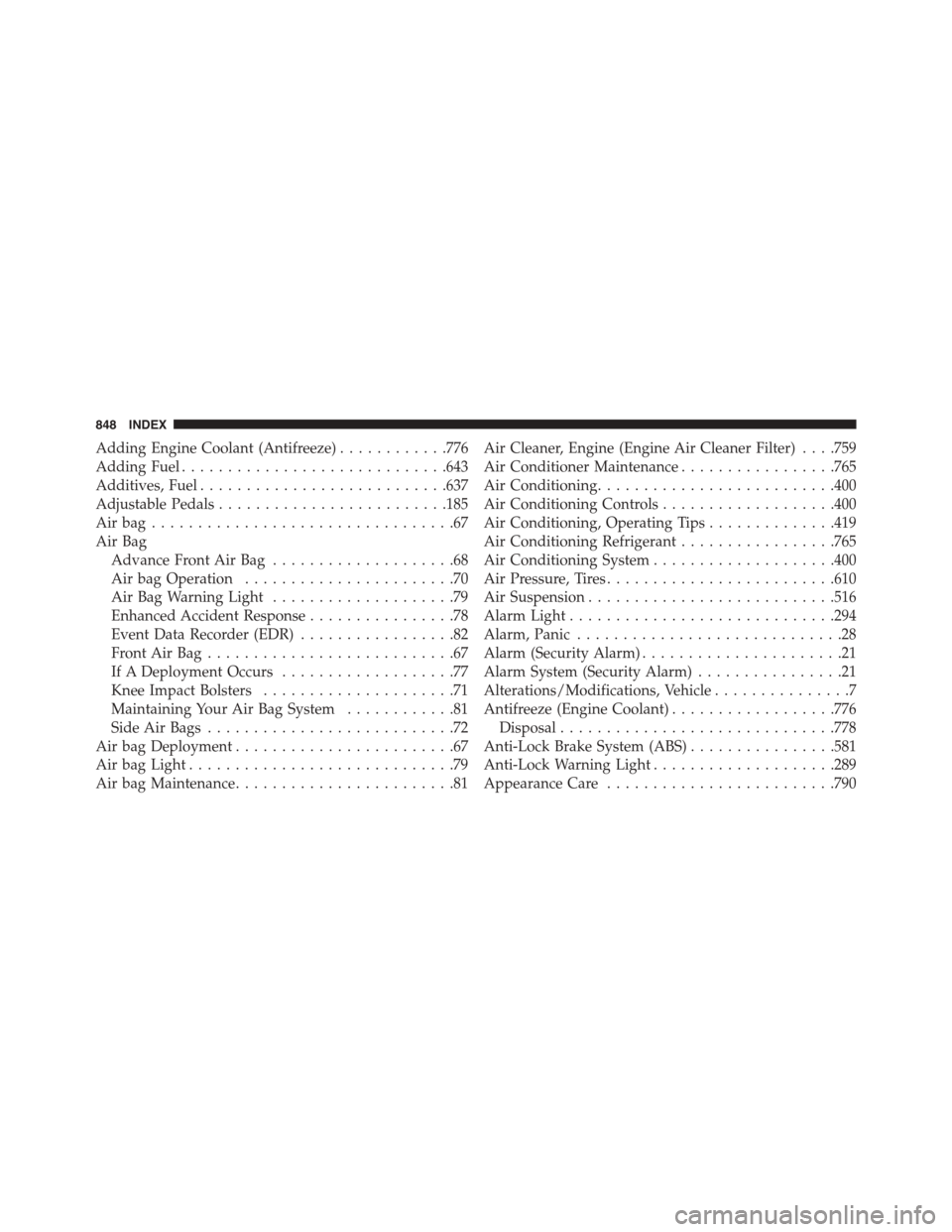
Adding Engine Coolant (Antifreeze)............776
Adding Fuel.............................643
Additives, Fuel...........................637
Adjustable Pedals.........................185
Air bag . . . . . . . . . . . . . . . . . . . . . . . . . . . . . . . . .67
Air Bag
Advance Front Air Bag....................68
Air bag Operation.......................70
Air Bag Warning Light....................79
Enhanced Accident Response................78
Event Data Recorder (EDR).................82
Front Air Bag . . . . . . . . . . . . . . . . . . . . . . . . . . .67
If A Deployment Occurs...................77
Knee Impact Bolsters.....................71
Maintaining Your Air Bag System............81
Side Air Bags...........................72
Air bag Deployment........................67
Air bag Light.............................79
Air bag Maintenance........................81
Air Cleaner, Engine (Engine Air Cleaner Filter) . . . .759
Air Conditioner Maintenance.................765
Air Conditioning..........................400
Air Conditioning Controls...................400
Air Conditioning, Operating Tips..............419
Air Conditioning Refrigerant.................765
Air Conditioning System....................400
Air Pressure, Tires.........................610
Air Suspension...........................516
Alarm Light.............................294
Alarm, Panic.............................28
Alarm (Security Alarm)......................21
Alarm System (Security Alarm)................21
Alterations/Modifications, Vehicle...............7
Antifreeze (Engine Coolant)..................776
Disposal..............................778
Anti-Lock Brake System (ABS)................581
Anti-Lock Warning Light....................289
Appearance Care.........................790
848 INDEX
Page 852 of 871
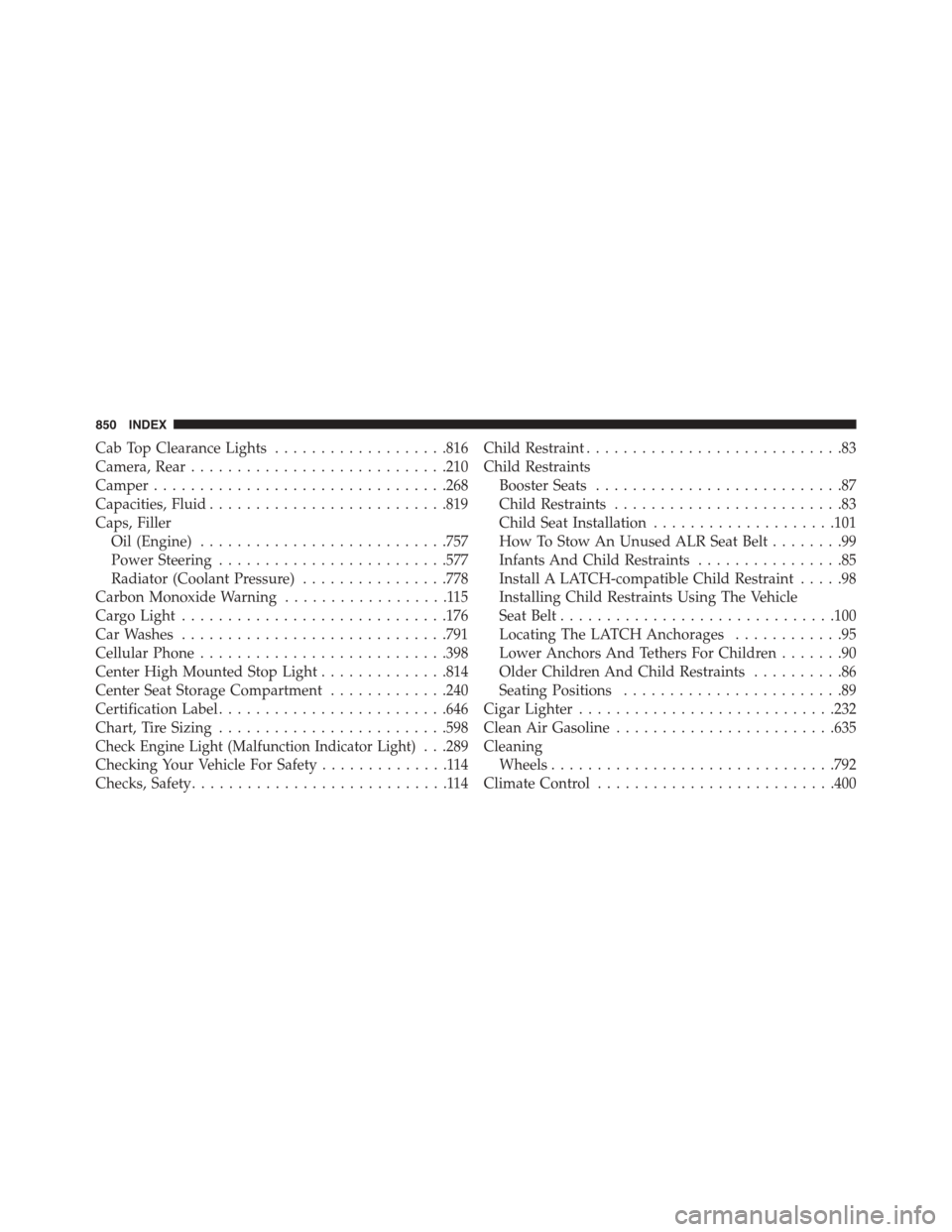
Cab Top Clearance Lights...................816
Camera, Rear............................210
Camper................................268
Capacities, Fluid..........................819
Caps, Filler
Oil (Engine)...........................757
Power Steering.........................577
Radiator (Coolant Pressure)................778
Carbon Monoxide Warning..................115
Cargo Light.............................176
Car Washes.............................791
Cellular Phone...........................398
Center High Mounted Stop Light..............814
Center Seat Storage Compartment.............240
Certification Label.........................646
Chart, Tire Sizing.........................598
Check Engine Light (Malfunction Indicator Light). . .289
Checking Your Vehicle For Safety..............114
Checks, Safety............................114
Child Restraint............................83
Child Restraints
Booster Seats...........................87
Child Restraints.........................83
Child Seat Installation....................101
How To Stow An Unused ALR Seat Belt........99
Infants And Child Restraints................85
Install A LATCH-compatible Child Restraint.....98
Installing Child Restraints Using The Vehicle
Seat Belt..............................100
Locating The LATCH Anchorages............95
Lower Anchors And Tethers For Children.......90
Older Children And Child Restraints..........86
Seating Positions........................89
Cigar Lighter............................232
Clean Air Gasoline........................635
Cleaning
Wheels...............................792
Climate Control..........................400
850 INDEX
Page 853 of 871
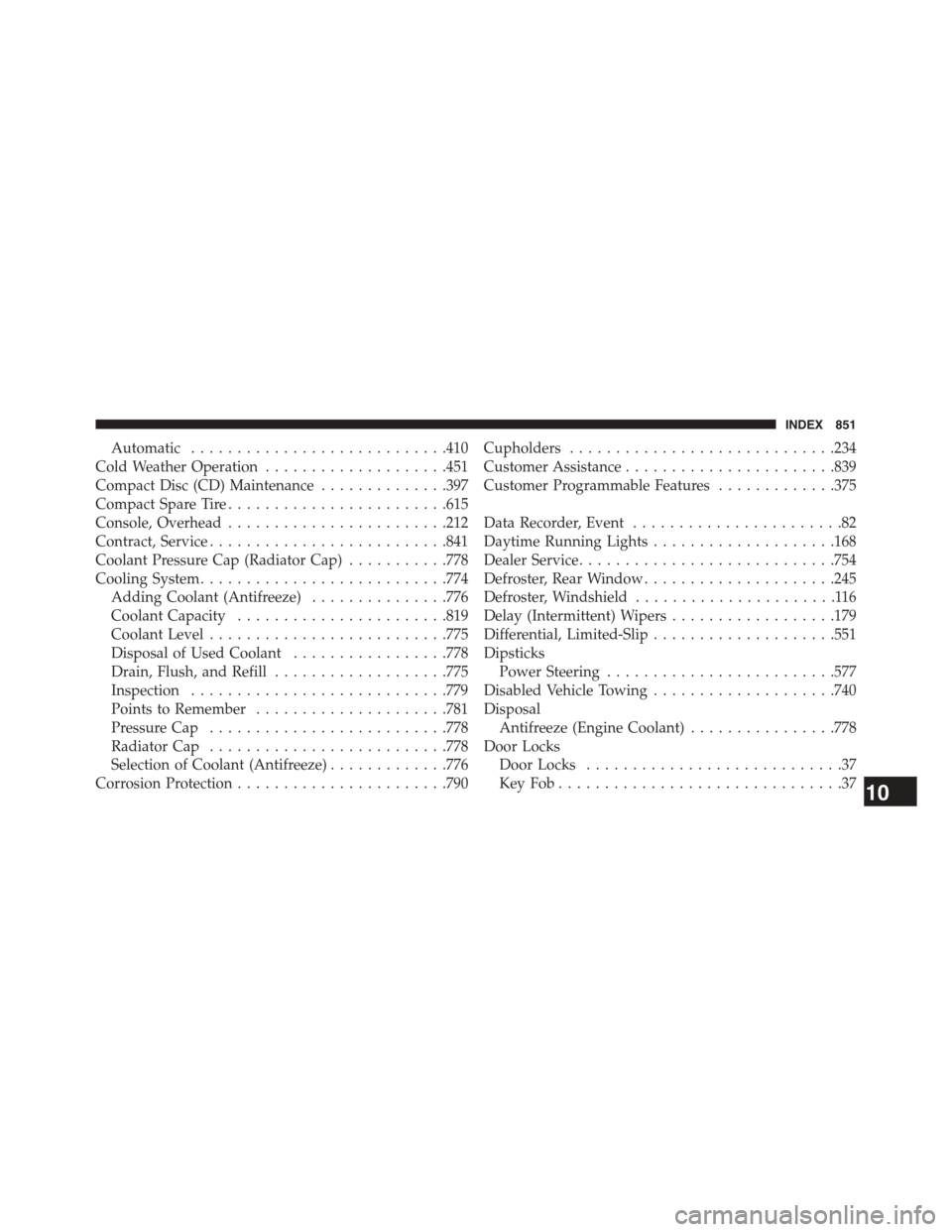
Automatic............................410
Cold Weather Operation....................451
Compact Disc (CD) Maintenance..............397
Compact Spare Tire........................615
Console, Overhead........................212
Contract, Service..........................841
Coolant Pressure Cap (Radiator Cap)...........778
Cooling System...........................774
Adding Coolant (Antifreeze)...............776
Coolant Capacity.......................819
Coolant Level..........................775
Disposal of Used Coolant.................778
Drain, Flush, and Refill...................775
Inspection............................779
Points to Remember.....................781
Pressure Cap..........................778
Radiator Cap..........................778
Selection of Coolant (Antifreeze).............776
Corrosion Protection.......................790
Cupholders.............................234
Customer Assistance.......................839
Customer Programmable Features.............375
Data Recorder, Event.......................82
Daytime Running Lights....................168
Dealer Service............................754
Defroster, Rear Window.....................245
Defroster, Windshield......................116
Delay (Intermittent) Wipers..................179
Differential, Limited-Slip....................551
Dipsticks
Power Steering.........................577
Disabled Vehicle Towing....................740
Disposal
Antifreeze (Engine Coolant)................778
Door Locks
Door Locks............................37
Key Fob . . . . . . . . . . . . . . . . . . . . . . . . . . . . . . .3710
INDEX 851