brake Ram 1500 2015 Manual Online
[x] Cancel search | Manufacturer: RAM, Model Year: 2015, Model line: 1500, Model: Ram 1500 2015Pages: 871, PDF Size: 24.83 MB
Page 544 of 871
soils. If possible transverse the incline at an angle
heading slightly up or down.
WARNING!
Driving across an incline increases the risk of a
rollover , which may result in severe injury.
•If You Stall Or Begin To Lose Headway– If you stall
or begin to lose headway while climbing a steep hill,
allow your vehicle to come to a stop and immediately
apply the brake. Restart the engine and shift into
REVERSE. Back slowly down the hill allowing the
compression braking of the engine and transmission to
help regulate your speed. If the brakes are required to
control vehicle speed, apply them lightly and avoid
locking or skidding the tires.
WARNING!
If the engine stalls or you lose headway or cannot
make it to the top of a steep hill or grade, never attempt
to turn around. To do so may result in tipping and
rolling the vehicle, which may result in severe injury.
Always back carefully straight down a hill in RE-
VERSE. Never back down a hill in NEUTRAL using
only the vehicle brakes. Never drive diagonally across
a hill, always drive straight up or down.
Driving Through Water
Extreme care should be taken crossing any type of water.
Water crossings should be avoided if possible and only
be attempted when necessary, in a safe responsible
manner. You should only drive through areas which are
designated and approved. You should tread lightly and
avoid damage to the environment. You should know
your vehicle’s abilities and be able to recover it if
542 STARTING AND OPERATING
Page 545 of 871
something goes wrong. You should never stop or shut a
vehicle off when crossing deep water unless you ingested
water into the engine air intake. If the engine stalls do not
attempt to restart it. Determine if it has ingested water
first. The key to any crossing is low and slow. You want
to use first gear in 4L (Low Range) and proceed very
slowly with a constant slow speed (3-5 mph [5–8 km/h]
maximum) and light throttle. Keep the vehicle moving;
do not try to accelerate through the crossing. After
crossing any water higher than the bottom of the axle
differentials, you should inspect all of the vehicle fluids
for signs of water ingestion.
CAUTION!
Water ingestion into the axles, transmission, transfer
case, engine or vehicle interior can occur if you drive
too fast or through too deep of water. Water can cause
(Continued)
CAUTION!(Continued)
permanent damage to engine, driveline or other
vehicle components and your brakes will be less
effective once wet and/or muddy.
•Before You Cross Any Type Of Water–Asyou
approach any type of water you need to determine if
you can cross it safely and responsibly. If necessary, get
out and walk through the water or probe it with a
stick. You need to be sure of its depth, approach angle,
current and bottom condition. Be careful of murky or
muddy waters, check for hidden obstacles. Make sure
you will not be intruding on any wildlife and you can
recover the vehicle if necessary. The key to a safe
crossing is the water depth, current and bottom con-
ditions. On soft bottoms the vehicle will sink in,
effectively increasing the water level on the vehicle. Be
sure to consider this when determining the depth and
the ability to safely cross.
5
STARTING AND OPERATING 543
Page 550 of 871
vehicle becomes free, the driver of the previously stuck
vehicle should signal they are free and should hit their
brakes stopping both vehicles. The driver of the pull-
ing vehicle should let off the throttle without using the
brakes, once signaled by the other driver. This se-
quence is important to avoid having the recovered
vehicle hit the pulling vehicle.
WARNING!
Never use tow straps with end hooks or link two
straps with a clevis pin. These heavy metal objects
could become projectiles if a strap breaks, which
could cause severe injury. Never leave more than two
or three feet of slack in the strap. More slack than this
greatly increases the risk of injury and vehicle dam-
age. Always keep everyone at least 30 feet away from
a strapping or winching situation.
•Winching (Refer To “Winch Operation” For Addi-
tional Information)–Winching is most commonly
used in the following situations: there is no support
vehicle available, a high controlled force is required to
recover the vehicle, there is a high risk of environmental
or vehicle damage, or where nothing else seems to work.
A winch can deliver a high pulling force with a great
deal of control. It allows you to walk the vehicle out of
the situation in a slow controlled manner. This control
works well for avoiding further vehicle damage. Once
you decide it is time to use the winch look for a good
anchor point. It needs to be strong enough to hold more
than the vehicle’s weight and provide a direction of pull
as straight as possible. Use block and tackle if necessary
to improve the angle of pull or increase the winch’s
pulling force. If the anchor point is a tree use a strap
around its base and hook the cable to the strap. If it is
another vehicle, then place that vehicle in PARK and
block the front tires. If you cannot find an anchor point
548 STARTING AND OPERATING
Page 552 of 871
•Inspect the radiator for mud and debris and clean as
required.
•Check threaded fasteners for looseness, particularly on
the chassis, drivetrain components, steering, and sus-
pension. Retighten them, if required, and torque to the
values specified in the Service Manual.
•Check for accumulations of plants or brush. These
things could be a fire hazard. They might hide damage
to fuel lines, brake hoses, axle pinion seals, and
propeller shafts.
•After extended operation in mud, sand, water, or
similar dirty conditions, have the radiator, fan, brake
rotors, wheels, brake linings, and axle yokes inspected
and cleaned as soon as possible.
WARNING!
Abrasive material in any part of the brakes may cause
excessive wear or unpredictable braking. You might
not have full braking power when you need it to
prevent a collision. If you have been operating your
vehicle in dirty conditions, get your brakes checked
and cleaned as necessary.
•If you experience unusual vibration after driving in
mud, slush or similar conditions, check the wheels for
impacted material. Impacted material can cause a
wheel imbalance and freeing the wheels of it will
correct the situation.
550 STARTING AND OPERATING
Page 553 of 871
LIMITED-SLIP DIFFERENTIAL
The limited-slip differential provides additional traction
on snow, ice, mud, sand and gravel, particularly when
there is a difference between the traction characteristics
of the surface under the right and left rear wheels. During
normal driving and cornering, the limited-slip unit per-
forms similarly to a conventional differential. On slip-
pery surfaces, however, the differential delivers more of
the driving effort to the rear wheel having the better
traction.
The limited-slip differential is especially helpful during
slippery driving conditions. With both rear wheels on a
slippery surface, a slight application of the accelerator
will supply maximum traction. When starting with only
one rear wheel on an excessively slippery surface, slight
momentary application of the parking brake may be
necessary to gain maximum traction.
WARNING!
On vehicles equipped with a limited-slip differential
never run the engine with one rear wheel off the
ground since the vehicle may drive through the rear
wheel remaining on the ground. You could lose
control of the vehicle.
Care should be taken to avoid sudden accelerations when
both rear wheels are on a slippery surface. This could
cause both rear wheels to spin, and allow the vehicle to
slide sideways on the crowned surface of a road or in a
turn.
DRIVING ON SLIPPERY SURFACES
Acceleration
Rapid acceleration on snow covered, wet, or other slip-
pery surfaces may cause the driving wheels to pull
erratically to the right or left. This phenomenon occurs
5
STARTING AND OPERATING 551
Page 555 of 871
DRIVING THROUGH WATER
Driving through water more than a few inches/
centimeters deep will require extra caution to ensure
safety and prevent damage to your vehicle.
Flowing/Rising Water
WARNING!
Do not drive on or across a road or path where water
is flowing and/or rising (as in storm run-off). Flow-
ing water can wear away the road or path’s surface
and cause your vehicle to sink into deeper water.
Furthermore, flowing and/or rising water can carry
your vehicle away swiftly. Failure to follow this
warning may result in injuries that are serious or
fatal to you, your passengers, and others around you.
Shallow Standing Water
Although your vehicle is capable of driving through
shallow standing water, consider the following Cautions
and Warnings before doing so.
WARNING!
•Driving through standing water limits your vehi-
cle’s traction capabilities. Do not exceed 5 mph
(8 km/h) when driving through standing water.
•Driving through standing water limits your vehi-
cle’s braking capabilities, which increases stopping
distances. Therefore, after driving through stand-
ing water, drive slowly and lightly press on the
brake pedal several times to dry the brakes.
•Failure to follow these warnings may result in
injuries that are serious or fatal to you, your pas-
sengers, and others around you.
5
STARTING AND OPERATING 553
Page 557 of 871
OFF-ROAD DRIVING TIPS
Care should be taken when attempting to climb steep
hills or driving diagonally across a hill or slope. If natural
obstacles force you to travel diagonally up or down a hill,
choose a mild angle and keep as little side tilt as possible.
Keep the vehicle moving and make turns slowly and
cautiously.
If you must back down a hill, back straight down using
REVERSE gear. Never back down in NEUTRAL or diago-
nally across the hill.
When driving over sand, mud, and other soft terrain,
shift to low gear and drive steadily. Apply the accelerator
slowly to avoid spinning the wheels.
Do not reduce the tire pressures for this type of driving.
After Driving Off-Road
Off-road operation puts more stress on your vehicle than
does most on-road driving. After going off-road, it is
always a good idea to check for damage. That way you
can get any problems taken care of right away and have
your vehicle ready when you need it.
•Completely inspect the underbody of your vehicle.
Check tires, body structure, steering, suspension, and
exhaust system for damage.
•Inspect the radiator for mud and debris and clean as
required.
•Check threaded fasteners for looseness, particularly on
the chassis, drivetrain components, steering, and sus-
pension. Retighten them, if required, and torque to the
values specified in the Service Manual.
•Check for accumulations of plants or brush. These
things could be a fire hazard. They might hide damage
to fuel lines, brake hoses, axle pinion seals, and
propeller shafts.
5
STARTING AND OPERATING 555
Page 558 of 871
•After extended operation in mud, sand, water, or
similar dirty conditions, have the radiator, fan, brake
rotors, wheels, brake linings, and axle yokes inspected
and cleaned as soon as possible.
WARNING!
Abrasive material in any part of the brakes may cause
excessive wear or unpredictable braking. You might
not have full braking power when you need it to
prevent a collision. If you have been operating your
vehicle in dirty conditions, get your brakes checked
and cleaned as necessary.
•If you experience unusual vibration after driving in
mud, slush or similar conditions, check the wheels for
impacted material. Impacted material can cause a
wheel imbalance and freeing the wheels of it will
correct the situation.
WINCH USAGE — POWER WAGON ONLY — (IF
EQUIPPED)
Things To Know Before Using Your Winch
General Winch Information
Your vehicle is equipped with an electric vehicle recovery
winch. This winch uses the electrical power from the
vehicle charging system to power a motor that winds
wire rope into the winch drum via planetary gear reduc-
tion. By nature, a winch is capable of generating very
high forces and should be used with care. Do not operate
the winch without reading and understanding the com-
plete winch owner’s manual.
Tensioning The Wire Rope
The winch rope must be properly tensioned before use.
Follow the instructions below to tension the rope:
1. Un-spool the wire rope leaving five wraps of rope on
the winch drum.
556 STARTING AND OPERATING
Page 561 of 871
1.Motor:The winch motor is powered by the vehicle
charging system and features a thermal protection
switch that automatically stops motor function in the
power-in direction if the motor gets too hot.
2.Remote Socket:The remote socket allows the remote
control to be attached to the control pack to allow the
winch to function.
3.Winch Drum With Integral Brake:The winch drum
allows the wire rope to be stored on the winch and
transmits force to the wire rope. The winch is
equipped with an integral brake that will stop rotation
of the winch drum if the winch motor is stopped.
4.3-Stage Planetary Gear Set:Provides balance between
speed and pulling power.
5.Wire Rope:The wire rope allows the winch to be
connected to an anchor to provide a pulling force.
6.Clutch Lever:The clutch lever allows the winch drum
to be disconnected from the winch motor to allow the
wire rope to be pulled from the winch by hand.
7.Remote Control:The remote control provides the
interface between the winch operator and the winch.
The remote control provides the ability to power the
winch in, out, and stop the winch. To operate the
winch, the toggle switch is pressed down to power the
winch in and up to power the winch out. The winch
will stop if the switch is left in the neutral (center)
position.
CAUTION!
If not installed, the hook strap must be placed on the
hook.
Fairlead:The fairlead acts as a guide for the wire rope
and minimizes damage to the rope.
5
STARTING AND OPERATING 559
Page 568 of 871
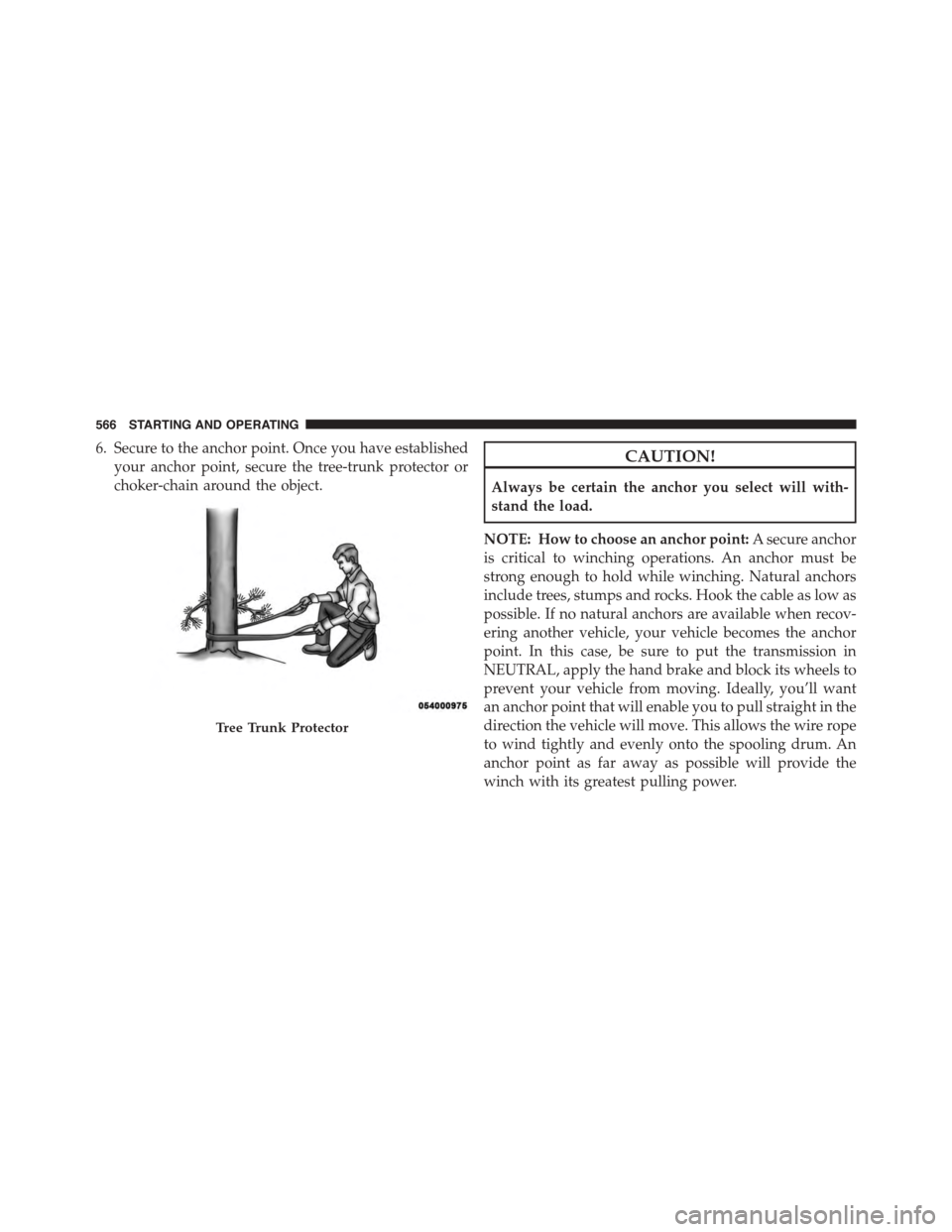
6. Secure to the anchor point. Once you have established
your anchor point, secure the tree-trunk protector or
choker-chain around the object.
CAUTION!
Always be certain the anchor you select will with-
stand the load.
NOTE: How to choose an anchor point:A secure anchor
is critical to winching operations. An anchor must be
strong enough to hold while winching. Natural anchors
include trees, stumps and rocks. Hook the cable as low as
possible. If no natural anchors are available when recov-
ering another vehicle, your vehicle becomes the anchor
point. In this case, be sure to put the transmission in
NEUTRAL, apply the hand brake and block its wheels to
prevent your vehicle from moving. Ideally, you’ll want
an anchor point that will enable you to pull straight in the
direction the vehicle will move. This allows the wire rope
to wind tightly and evenly onto the spooling drum. An
anchor point as far away as possible will provide the
winch with its greatest pulling power.
Tree Trunk Protector
566 STARTING AND OPERATING