oil pressure Ram 1500 2016 Diesel Supplement
[x] Cancel search | Manufacturer: RAM, Model Year: 2016, Model line: 1500, Model: Ram 1500 2016Pages: 338, PDF Size: 1.63 MB
Page 207 of 338
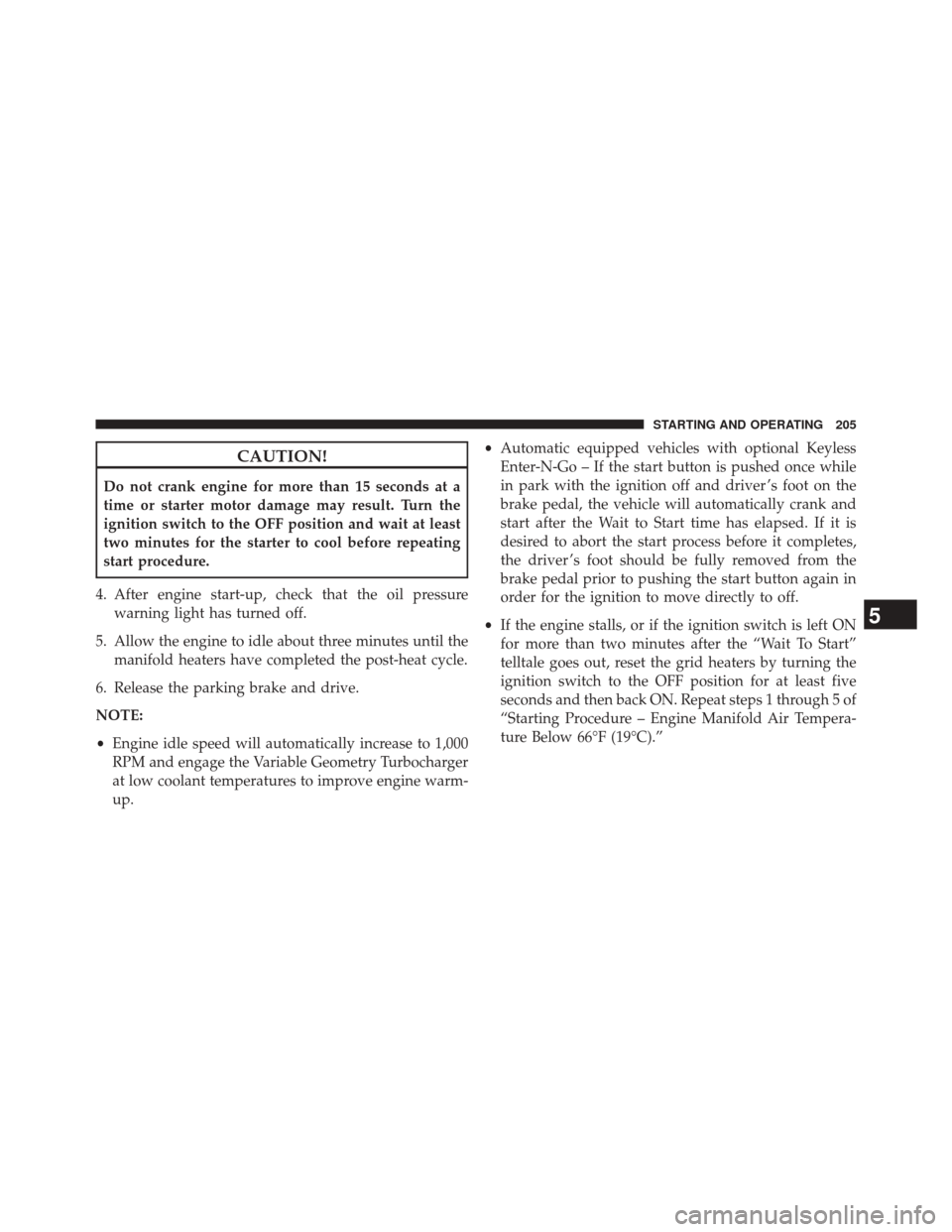
CAUTION!
Do not crank engine for more than 15 seconds at a
time or starter motor damage may result. Turn the
ignition switch to the OFF position and wait at least
two minutes for the starter to cool before repeating
start procedure.
4. After engine start-up, check that the oil pressure warning light has turned off.
5. Allow the engine to idle about three minutes until the manifold heaters have completed the post-heat cycle.
6. Release the parking brake and drive.
NOTE:
• Engine idle speed will automatically increase to 1,000
RPM and engage the Variable Geometry Turbocharger
at low coolant temperatures to improve engine warm-
up. •
Automatic equipped vehicles with optional Keyless
Enter-N-Go – If the start button is pushed once while
in park with the ignition off and driver ’s foot on the
brake pedal, the vehicle will automatically crank and
start after the Wait to Start time has elapsed. If it is
desired to abort the start process before it completes,
the driver ’s foot should be fully removed from the
brake pedal prior to pushing the start button again in
order for the ignition to move directly to off.
• If the engine stalls, or if the ignition switch is left ON
for more than two minutes after the “Wait To Start”
telltale goes out, reset the grid heaters by turning the
ignition switch to the OFF position for at least five
seconds and then back ON. Repeat steps 1 through 5 of
“Starting Procedure – Engine Manifold Air Tempera-
ture Below 66°F (19°C).”
5
STARTING AND OPERATING 205
Page 210 of 338
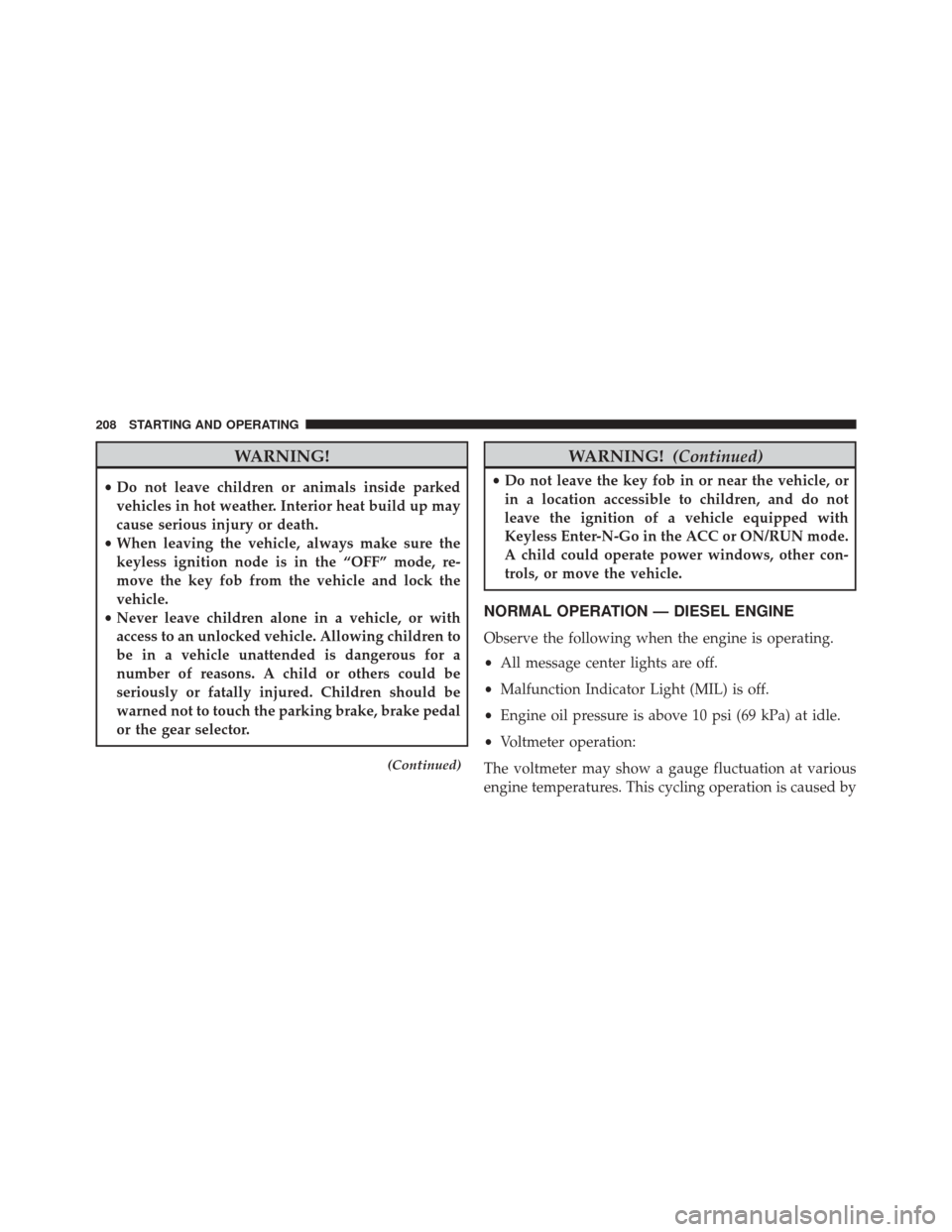
WARNING!
•Do not leave children or animals inside parked
vehicles in hot weather. Interior heat build up may
cause serious injury or death.
• When leaving the vehicle, always make sure the
keyless ignition node is in the “OFF” mode, re-
move the key fob from the vehicle and lock the
vehicle.
• Never leave children alone in a vehicle, or with
access to an unlocked vehicle. Allowing children to
be in a vehicle unattended is dangerous for a
number of reasons. A child or others could be
seriously or fatally injured. Children should be
warned not to touch the parking brake, brake pedal
or the gear selector.
(Continued)
WARNING! (Continued)
•Do not leave the key fob in or near the vehicle, or
in a location accessible to children, and do not
leave the ignition of a vehicle equipped with
Keyless Enter-N-Go in the ACC or ON/RUN mode.
A child could operate power windows, other con-
trols, or move the vehicle.
NORMAL OPERATION — DIESEL ENGINE
Observe the following when the engine is operating.
• All message center lights are off.
• Malfunction Indicator Light (MIL) is off.
• Engine oil pressure is above 10 psi (69 kPa) at idle.
• Voltmeter operation:
The voltmeter may show a gauge fluctuation at various
engine temperatures. This cycling operation is caused by
208 STARTING AND OPERATING
Page 213 of 338
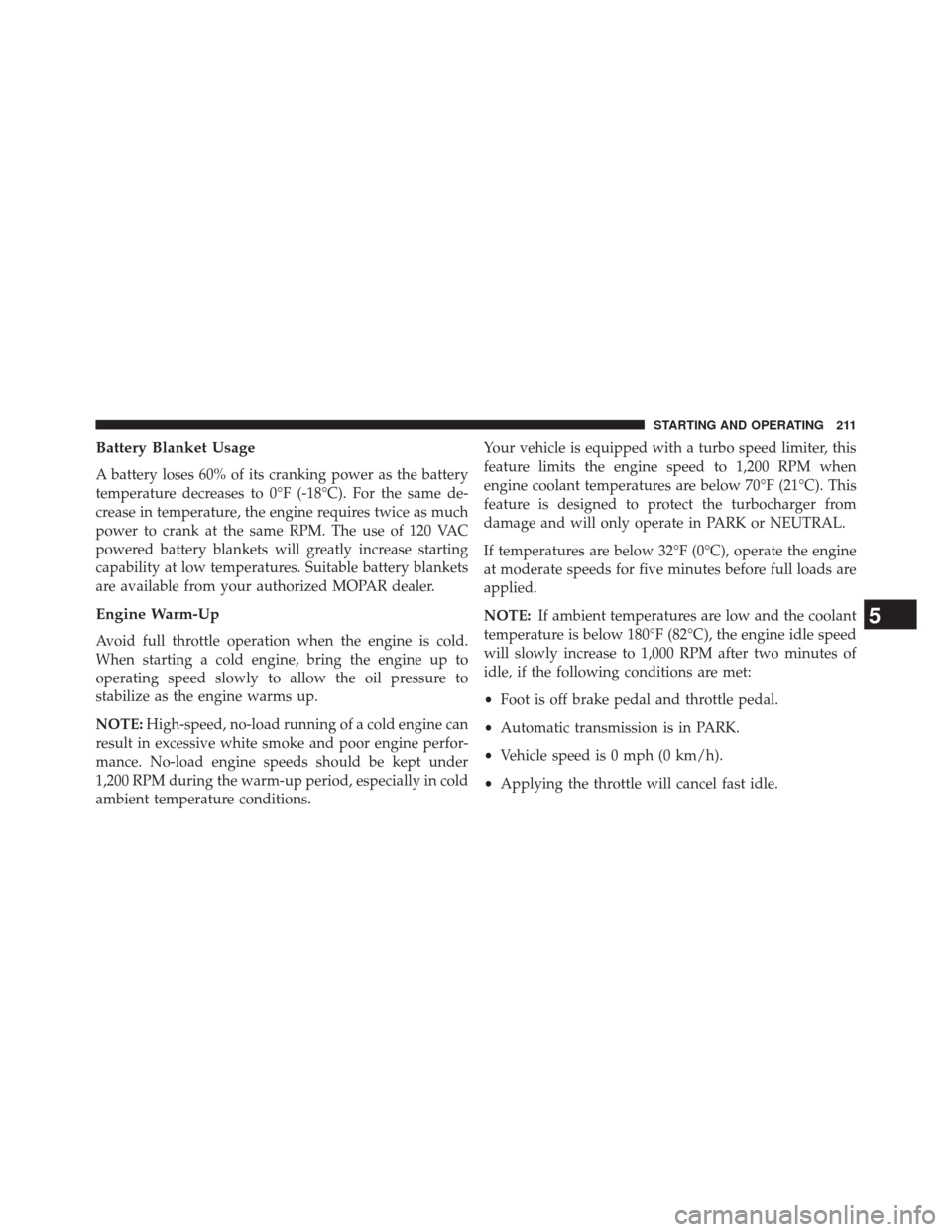
Battery Blanket Usage
A battery loses 60% of its cranking power as the battery
temperature decreases to 0°F (-18°C). For the same de-
crease in temperature, the engine requires twice as much
power to crank at the same RPM. The use of 120 VAC
powered battery blankets will greatly increase starting
capability at low temperatures. Suitable battery blankets
are available from your authorized MOPAR dealer.
Engine Warm-Up
Avoid full throttle operation when the engine is cold.
When starting a cold engine, bring the engine up to
operating speed slowly to allow the oil pressure to
stabilize as the engine warms up.
NOTE:High-speed, no-load running of a cold engine can
result in excessive white smoke and poor engine perfor-
mance. No-load engine speeds should be kept under
1,200 RPM during the warm-up period, especially in cold
ambient temperature conditions. Your vehicle is equipped with a turbo speed limiter, this
feature limits the engine speed to 1,200 RPM when
engine coolant temperatures are below 70°F (21°C). This
feature is designed to protect the turbocharger from
damage and will only operate in PARK or NEUTRAL.
If temperatures are below 32°F (0°C), operate the engine
at moderate speeds for five minutes before full loads are
applied.
NOTE:
If ambient temperatures are low and the coolant
temperature is below 180°F (82°C), the engine idle speed
will slowly increase to 1,000 RPM after two minutes of
idle, if the following conditions are met:
• Foot is off brake pedal and throttle pedal.
• Automatic transmission is in PARK.
• Vehicle speed is 0 mph (0 km/h).
• Applying the throttle will cancel fast idle.
5
STARTING AND OPERATING 211
Page 217 of 338
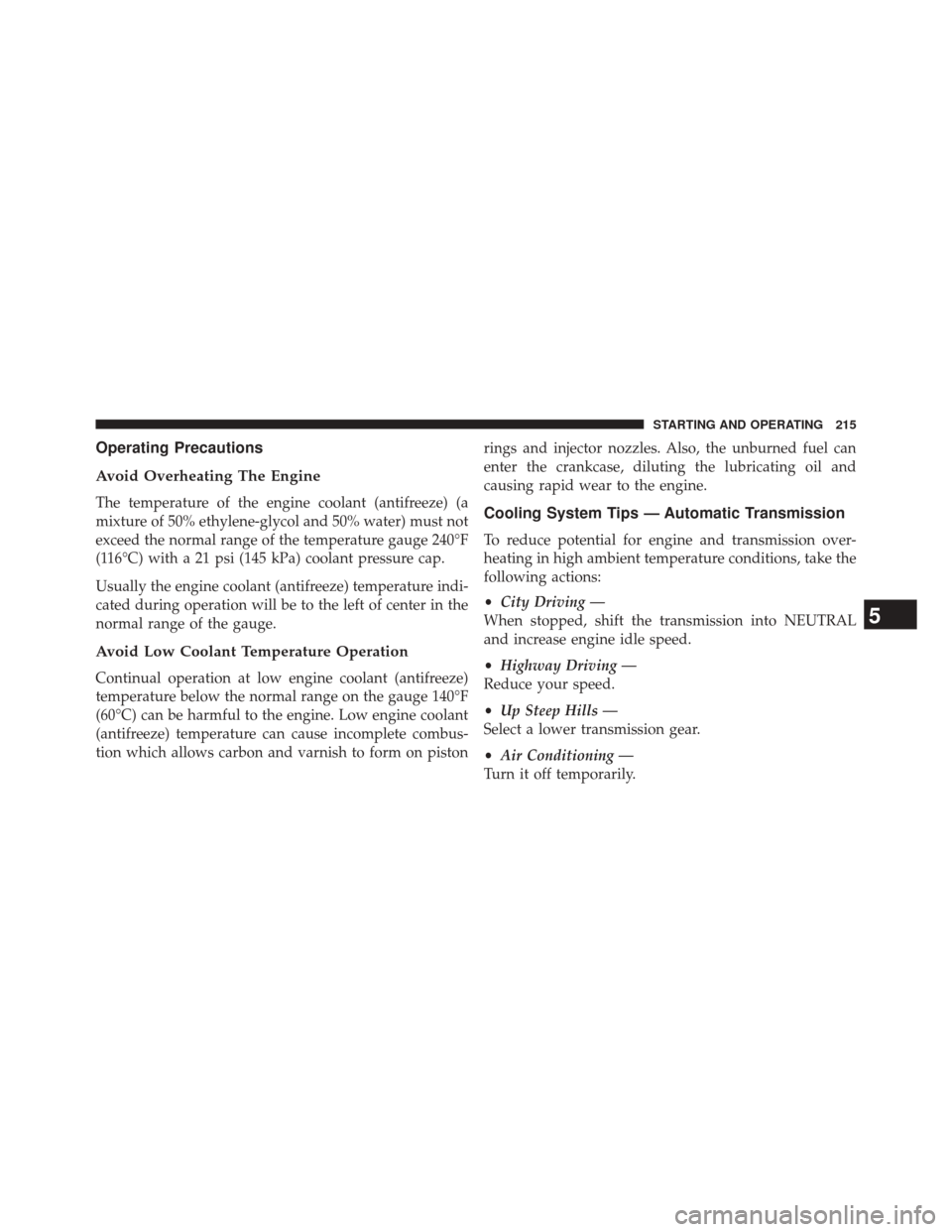
Operating Precautions
Avoid Overheating The Engine
The temperature of the engine coolant (antifreeze) (a
mixture of 50% ethylene-glycol and 50% water) must not
exceed the normal range of the temperature gauge 240°F
(116°C) with a 21 psi (145 kPa) coolant pressure cap.
Usually the engine coolant (antifreeze) temperature indi-
cated during operation will be to the left of center in the
normal range of the gauge.
Avoid Low Coolant Temperature Operation
Continual operation at low engine coolant (antifreeze)
temperature below the normal range on the gauge 140°F
(60°C) can be harmful to the engine. Low engine coolant
(antifreeze) temperature can cause incomplete combus-
tion which allows carbon and varnish to form on pistonrings and injector nozzles. Also, the unburned fuel can
enter the crankcase, diluting the lubricating oil and
causing rapid wear to the engine.
Cooling System Tips — Automatic Transmission
To reduce potential for engine and transmission over-
heating in high ambient temperature conditions, take the
following actions:
•
City Driving —
When stopped, shift the transmission into NEUTRAL
and increase engine idle speed.
• Highway Driving —
Reduce your speed.
• Up Steep Hills —
Select a lower transmission gear.
• Air Conditioning —
Turn it off temporarily.
5
STARTING AND OPERATING 215
Page 218 of 338
Do Not Operate The Engine With Low Oil
Pressure
When the engine is at normal operating temperature, the
minimum oil pressures required are:
Idle 700 to 800 RPM 10 psi (69 kPa)
Full speed and load 30 psi (207 kPa)
CAUTION!
If oil pressure falls to less than normal readings, shut
the engine off immediately. Failure to do so could
result in immediate and severe engine damage.
Do Not Operate The Engine With Failed Parts
All engine failures give some warning before the parts
fail. Be on the alert for changes in performance, sounds,
and visual evidence that the engine requires service.
Some important clues are:
•Engine misfiring or vibrating severely.
• Sudden loss of power.
• Unusual engine noises.
• Fuel, oil or coolant leaks.
• Sudden change, outside the normal operating range, in
the engine operating temperature.
• Excessive smoke.
• Oil pressure drop.
216 STARTING AND OPERATING
Page 275 of 338
only when the level on the dipstick is below the “ADD”
mark. The total capacity from the ADD mark to the Full
mark is 2 qts (1.9L).
CAUTION!
Overfilling or underfilling the crankcase will cause
oil aeration or loss of oil pressure. This could damage
your engine.
Never operate the engine with oil level below the “ADD”
mark or above the upper “SAFE” mark.
Change Engine Oil
Refer to the “Maintenance Schedule” for the proper
maintenance intervals.
Engine Oil Selection
For best performance and maximum protection under all
types of operating conditions, the manufacturer only recommends engine oils that are API CJ-4 certified and
meet the requirements of FCA LLC. Use MOPAR or an
equivalent oil meeting FCA Material Standard MS-10902.
Products meeting Cummins CES 20081 may also be used.
The identification of these engine oils are typically lo-
cated on the back of the oil container.
American Petroleum Institute (API) Engine Oil
Identification Symbol
This symbol means that the oil has
been certified by the American Petro-
leum Institute (API). The manufac-
turer only recommends API Certified
engine oils.
Oils with a high ash content may produce damaging
deposits on cylinder head valves and/or aftertreatment
7
MAINTAINING YOUR VEHICLE 273
Page 288 of 338
5. Remove lid using a socket or strap wrench. Rotatecounterclockwise for removal. Remove used o-ring
and discard it.
6. Remove the used filter cartridge from the housing and dispose of according to your local regulations.
7. Wipe clean the sealing surfaces of the lid and housing.
8. Install new o-ring back into ring groove on the filter housing and lubricate with clean engine oil.
NOTE: WIF sensor is re-usable. Service kit comes with
new o-ring for filter canister and WIF sensor.Priming If The Engine Has Run Out Of Fuel
WARNING!
Do not open the high pressure fuel system with the
engine running. Engine operation causes high fuel
pressure. High pressure fuel spray can cause serious
injury or death.
1. Add a substantial amount of fuel to the tank, approxi- mately 2 to 5 gal (8L to 19L).
2. Turn ignition switch to the start position to engage starter for one second, return ignition switch to run
position. This will activate in tank fuel pump for
approximately 15 seconds. Repeat this process twice.
3. Start the engine using the “Normal Starting” proce- dure. Refer to “Starting Procedures” in “Starting and
Operating” for further information.
286 MAINTAINING YOUR VEHICLE
Page 328 of 338
Adding Engine Coolant (Antifreeze)............106
Adding Fuel ..............................80
Air Cleaner, Engine (Engine Air Cleaner Filter) .....94
Antifreeze (Engine Coolant) ..................105
Capacities .............................113
Disposal ............................. .108
Automatic Transmission Fluid Type ............................118
Axle Fluid ..............................118
Battery ................................ .103
Brake Fluid ..............................118
Brake System ............................110
Fluid Check ...........................110
Master Cylinder ........................110
Capacities, Antifreeze (Engine Coolant) ..........113
Capacities, Fluid ..........................113 Caps, Filler
Oil (Engine) ............................93
Radiator (Coolant Pressure) ................108
Charge Air Cooler .........................110
Coolant Pressure Cap (Radiator Cap) ...........108
Cooling System .......................... .104
Adding Coolant (Antifreeze) ...............106
Coolant Capacity .......................113
Coolant Level ......................... .104
Disposal Of Used Coolant .................108
Drain, Flush, And Refill ...................105
Points To Remember .....................109
Pressure Cap ......................... .108
Radiator Cap ......................... .108
Selection Of Coolant (Antifreeze) ........105 , 114
Diesel Fuel ...............................73
Diesel Fuel Requirements ....................73
Bulk Storage Of .........................83
326 INDEX - RAM 1500
Page 330 of 338
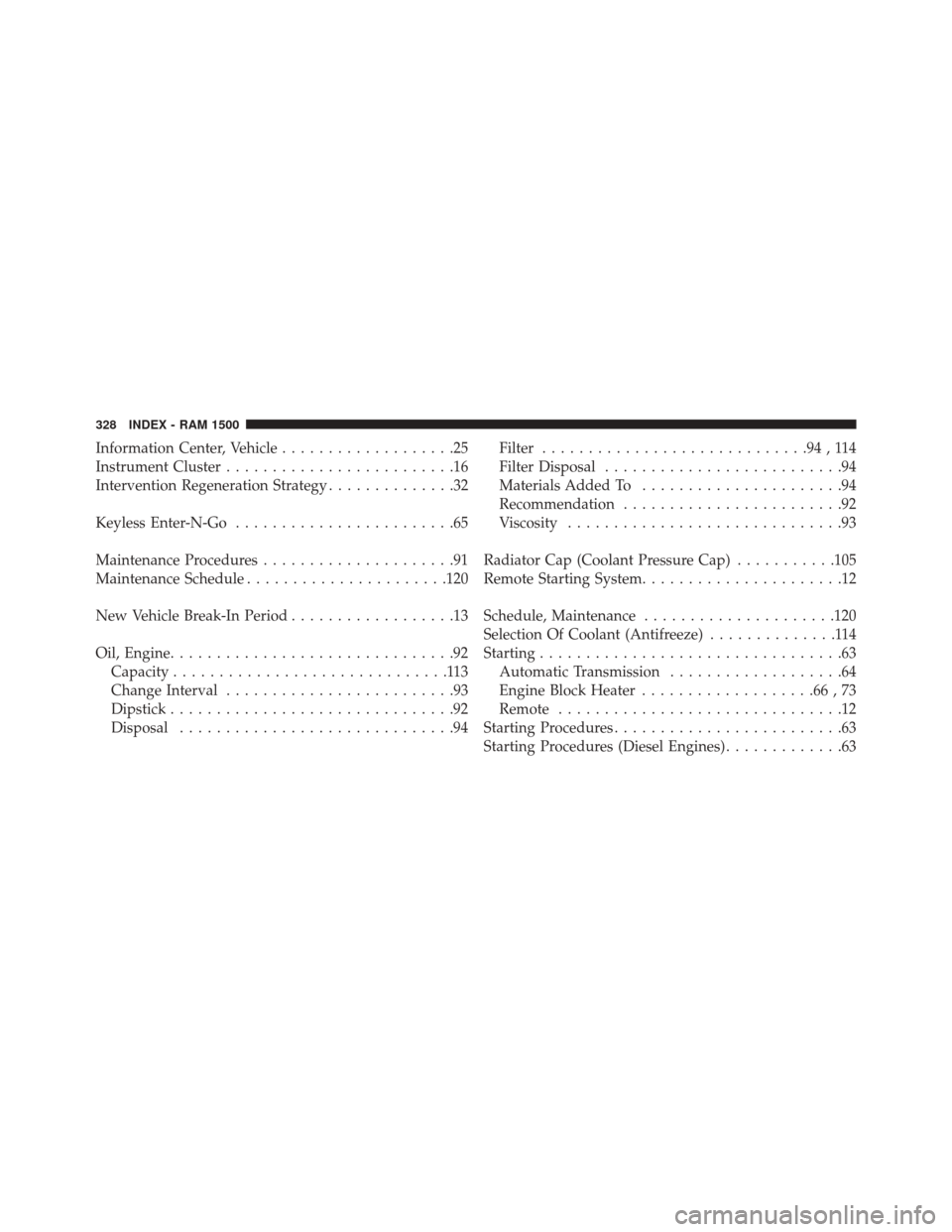
Information Center, Vehicle...................25
Instrument Cluster .........................16
Intervention Regeneration Strategy ..............32
Keyless Enter-N-Go ........................65
Maintenance Procedures .....................91
Maintenance Schedule ..................... .120
New Vehicle Break-In Period ..................13
Oil, Engine ...............................92
Capacity ..............................113
Change Interval .........................93
Dipstick ...............................92
Disposal ..............................94 Filter
.............................94,114
Filter Disposal ..........................94
Materials Added To ......................94
Recommendation ........................92
Viscosity ..............................93
Radiator Cap (Coolant Pressure Cap) ...........105
Remote Starting System ......................12
Schedule, Maintenance .....................120
Selection Of Coolant (Antifreeze) ..............114
Starting .................................63
Automatic Transmission ...................64
Engine Block Heater ...................66,73
Remote ...............................12
Starting Procedures .........................63
Starting Procedures (Diesel Engines) .............63
328 INDEX - RAM 1500
Page 332 of 338
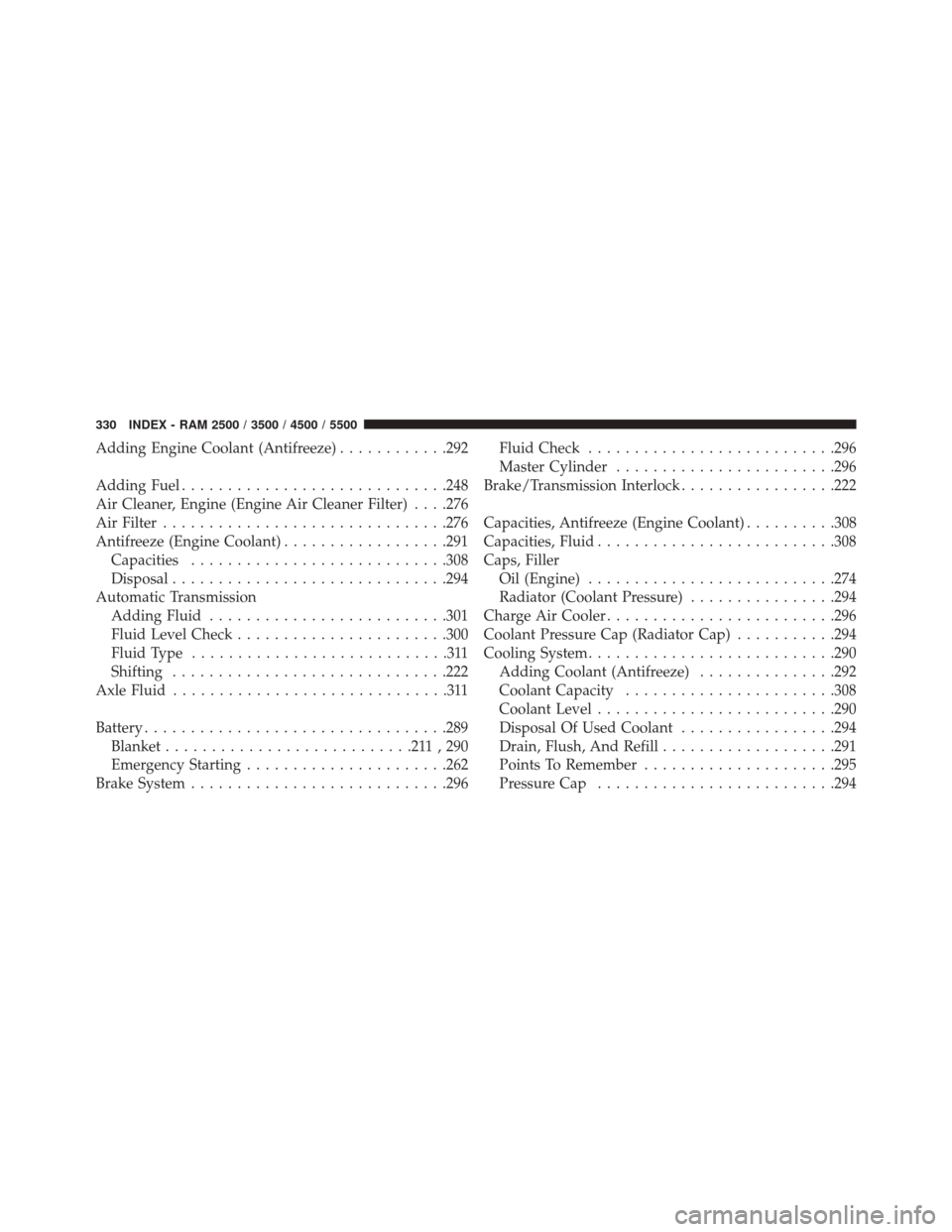
Adding Engine Coolant (Antifreeze)............292
Adding Fuel ............................ .248
Air Cleaner, Engine (Engine Air Cleaner Filter) . . . .276
Air Filter .............................. .276
Antifreeze (Engine Coolant) ..................291
Capacities ........................... .308
Disposal ............................. .294
Automatic Transmission Adding Fluid ......................... .301
Fluid Level Check ...................... .300
Fluid Type ............................311
Shifting ............................. .222
Axle Fluid ..............................311
Battery ................................ .289
Blanket ...........................211,290
Emergency Starting ..................... .262
Brake System ........................... .296Fluid Check
.......................... .296
Master Cylinder ....................... .296
Brake/Transmission Interlock .................222
Capacities, Antifreeze (Engine Coolant) ..........308
Capacities, Fluid ......................... .308
Caps, Filler Oil (Engine) .......................... .274
Radiator (Coolant Pressure) ................294
Charge Air Cooler ........................ .296
Coolant Pressure Cap (Radiator Cap) ...........294
Cooling System .......................... .290
Adding Coolant (Antifreeze) ...............292
Coolant Capacity ...................... .308
Coolant Level ......................... .290
Disposal Of Used Coolant .................294
Drain, Flush, And Refill ...................291
Points To Remember .....................295
Pressure Cap ......................... .294
330 INDEX - RAM 2500 / 3500 / 4500 / 5500