parking brake Ram 1500 2016 Diesel Supplement
[x] Cancel search | Manufacturer: RAM, Model Year: 2016, Model line: 1500, Model: Ram 1500 2016Pages: 338, PDF Size: 1.63 MB
Page 243 of 338
be used respectively. To disengage PTO operation and
return to “standard vehicle operation” simply toggle the
PTO switch to the OFF position.
The torque converter clutch (TCC) will automatically
engage at engine speeds above 1,200 RPM (engine speed)
in PTO stationary mode. Once engaged, the TCC will
remain applied and will not disengage until the engine
speed falls below 1,000 RPM. TCC engagement is desir-
able for certain types of PTO applications (Automatic
Transmission Only).
To operate the PTO via a remote switch, the customer
must make sure the above conditions are met. It is vital
for proper operation that the PTO and remote have been
installed correctly, paying special attention to ensure the
vehicle provided wiring has been connected properly.
This is the responsibility of the installer of the PTO and
switches/remote system. It is the responsibility of the
PTO manufacturer to ensure that their electrical (switchesand remote) system is compatible with the vehicle’s
electrical architecture and software functionality.
NOTE:
Single set speed can be programmed via the PTO
menu on the EVIC/DID screen. Further details are avail-
able at the Ram Truck Bodybuilders web site located
at
www.rambodybuilder.com.
Mobile Mode
To operate the PTO in this mode the vehicle must meet
the following conditions:
• Mobile mode is activated via the menu on the EVIC/
DID screen.
• (ON/OFF) switch has been activated.
• Vehicles with automatic transmission must be in PARK
or DRIVE.
• Parking brake must not be applied.5
STARTING AND OPERATING 241
Page 264 of 338
JUMP STARTING
WARNING!
•To prevent personal injury or damage to clothing,
do not allow battery fluid to contact eyes, skin or
fabrics. Do not lean over a battery when connecting
jumper cables or allow cable clamps to touch each
other. Keep open flames or sparks away from
battery vent holes. Always wear eye protection
when working with batteries.
• Do not use a booster battery or any other booster
source that has a greater than 12 Volt system, i.e., do
not use a 24 Volt power source.
NOTE: Replacement batteries should both be of equal
size to prevent damage to the vehicle’s charging system.
Your vehicle is equipped with two 12 Volt batteries. If it
becomes necessary to use a booster battery with jumper cables to start a vehicle’s engine because its batteries are
discharged, the following procedure should be used:
Set the parking brake and place an automatic transmis-
sion in PARK (or NEUTRAL for a manual transmission).
Turn off lights, heater and other electrical loads. Observe
charge indicator (if equipped) in both batteries. If the
indicator (if equipped) is light or yellow on either battery,
replace that battery.
CAUTION!
Use the jump start procedure only when the charge
indicator (if equipped) in both batteries is dark in the
center. Do not attempt jump starting when either
battery charge indicator (if equipped) is bright or
yellow. If the charge indicator (if equipped) has a
green dot in the center, failure to start is not due to a
discharged battery and cranking system should be
checked.
262 WHAT TO DO IN EMERGENCIES
Page 302 of 338
of special dyes for diagnosing fluid leaks. Avoid using
transmission sealers as they may adversely affect seals.
CAUTION!
Do not use chemical flushes in your transmission as
the chemicals can damage your transmission compo-
nents. Such damage is not covered by the New
Vehicle Limited Warranty.
Fluid Level Check
It is best to check the fluid level when the transmission is
at normal operating temperature (170-180°F / 77-82°C for
68RFE transmission, or 158-176°F / 70-80°C for AS69RC
transmission). This normally occurs after at least 15 miles
(25 km) of driving. At normal operating temperature the
fluid cannot be held comfortably between the fingertips.
You can read the transmission sump temperature in theEVIC/DID screen (refer to “Electronic Vehicle Informa-
tion Center [EVIC]” or “Driver Information Display
[DID]” for further information).
Use the following procedure to check the transmission
fluid level properly:
1. Monitor the transmission temperature using the
EVIC/DID screen, and operate the vehicle as required
to reach the normal operating temperature. If the
transmission is not functioning properly, or the vehicle
cannot be driven, see the NOTE and CAUTION below
about checking the fluid level at colder temperatures.
2. Park the vehicle on level ground.
3. Run the engine at normal idle speed for at least 60 seconds, and leave the engine running for the rest of
this procedure.
4. Fully apply the parking brake and press the brake pedal.
300 MAINTAINING YOUR VEHICLE
Page 304 of 338
NOTE:If it is necessary to check the transmission below
the operating temperature, the fluid level should be
between the two “COLD” (lower) holes on the dipstick
with the fluid at 60-70°F / 16-21°C for 68RFE transmis-
sion, or 68-86°F / 20-30°C for AS69RC transmission. Only
use the COLD region of the dipstick as a rough reference
when setting the fluid level after a transmission service
or fluid change. Re-check the fluid level, and adjust as
required, once the transmission reaches normal operating
temperature.
CAUTION!
If the fluid temperature is below 50°F (10°C) it may
not register on the dipstick. Do not add fluid until
the temperature is elevated enough to produce an
accurate reading. Run the engine at idle, in PARK, to
warm the fluid. 8. Reinsert the dipstick. Check for leaks. Release the
parking brake.
NOTE: To prevent dirt and water from entering the
transmission after checking or replenishing fluid, make
sure that the dipstick cap is properly reseated. It is
normal for the dipstick cap to spring back slightly from
its fully seated position, as long as its seal remains
engaged in the dipstick tube.
Fluid And Filter Changes
Refer to the “Maintenance Schedule” for the proper
maintenance intervals.
In addition, change the fluid and filter(s) if the fluid
becomes contaminated (with water, etc.), or if the trans-
mission is disassembled for any reason.
302 MAINTAINING YOUR VEHICLE
Page 320 of 338
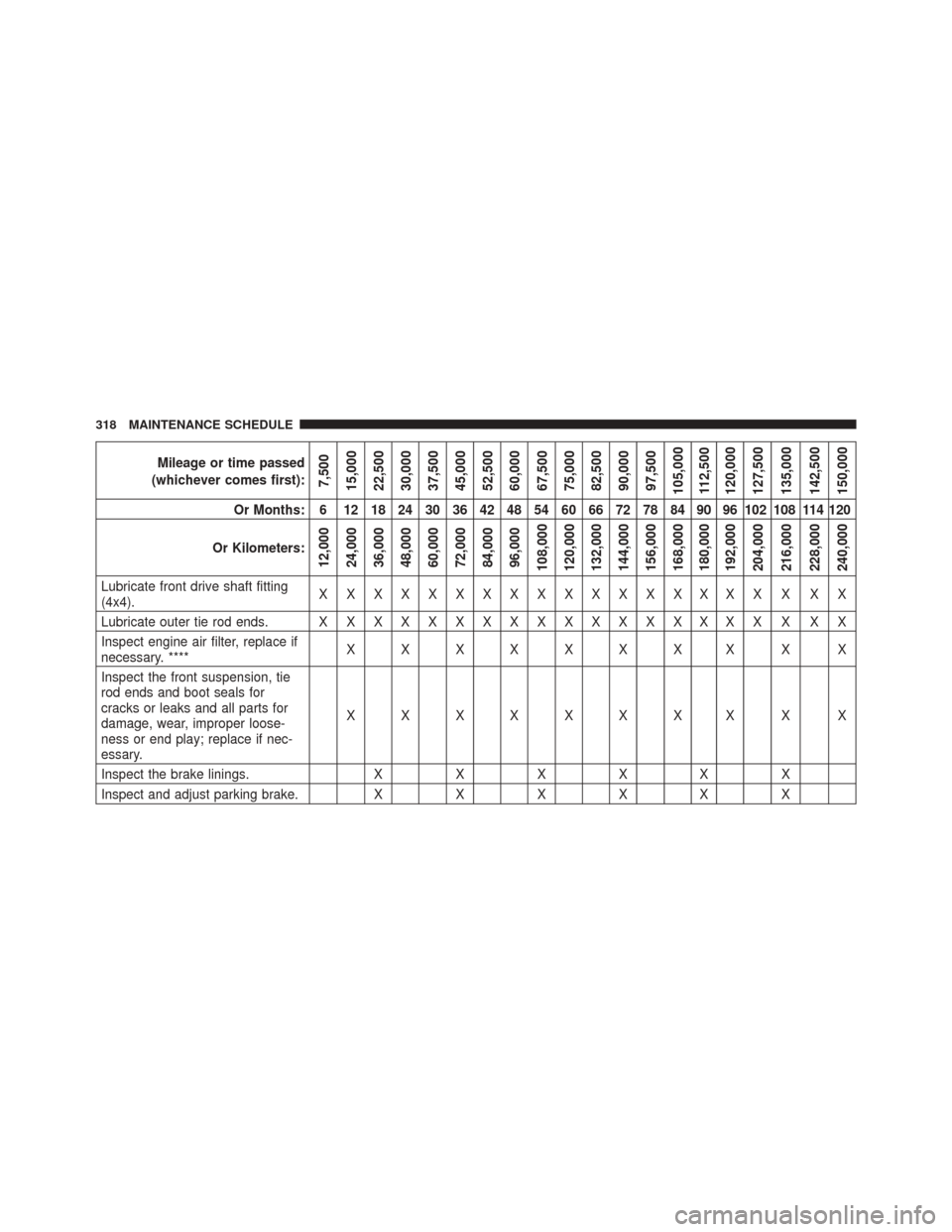
Mileage or time passed
(whichever comes first):
7,500
15,000
22,500
30,000
37,500
45,000
52,500
60,000
67,500
75,000
82,500
90,000
97,500
105,000 112,500
120,000
127,500
135,000
142,500
150,000
Or Months: 6 12 18 24 30 36 42 48 54 60 66 72 78 84 90 96 102 108 114 120
Or Kilometers:
12,000
24,000
36,000
48,000
60,000
72,000
84,000
96,000
108,000
120,000
132,000
144,000
156,000
168,000
180,000
192,000
204,000
216,000
228,000
240,000
Lubricate front drive shaft fitting
(4x4). XXXXXXXXXXXXXXXXX X XX
Lubricate outer tie rod ends. X X X X X X X X X X X X X X X X X X X X
Inspect engine air filter, replace if
necessary. **** XXXXXXXX X X
Inspect the front suspension, tie
rod ends and boot seals for
cracks or leaks and all parts for
damage, wear, improper loose-
ness or end play; replace if nec-
essary. XXXXXXXX X X
Inspect the brake linings. XXXXX X
Inspect and adjust parking brake. XXXXX X
318 MAINTENANCE SCHEDULE