instrument cluster Ram 1500 2016 Diesel Supplement
[x] Cancel search | Manufacturer: RAM, Model Year: 2016, Model line: 1500, Model: Ram 1500 2016Pages: 338, PDF Size: 1.63 MB
Page 233 of 338
To exit ERS mode, simply push and hold the ERS (+)
switch until the gear limit display disappears from the
instrument cluster.
WARNING!
Do not downshift for additional engine braking on a
slippery surface. The drive wheels could lose their
grip and the vehicle could skid, causing a collision or
personal injury.
Transmission
Gear Limit Dis-
play12 3 456D
Actual Gear(s)
Allowed 1 1-2 1-3 1-4 1-5 1-6 1-6
NOTE: To select the proper gear position for maximum
deceleration (engine braking), simply push and hold the
ERS (-) switch. The transmission will shift to the range
from which the vehicle can best be slowed down.
Column Shift Lever
5
STARTING AND OPERATING 231
Page 235 of 338
The “TOW/HAUL Indicator Light” will illuminate in the
instrument cluster to indicate that TOW/HAUL mode has
been activated. Pressing the switch a second time restores
normal operation. Normal operation is always the default at
engine start-up. If TOW/HAUL mode is desired, the switch
must be pressed each time the engine is started.
WARNING!
Do not use the “TOW/HAUL” feature when driving
in icy or slippery conditions. The increased engine
braking could cause the rear wheels to slide, and the
vehicle to swing around with the possible loss of
vehicle control, which could cause an accident possi-
bly resulting in personal injury or death.
Torque Converter Clutch
A feature designed to improve fuel economy has been
included in the automatic transmission on your vehicle.
A clutch within the torque converter engages automati-
cally at calibrated speeds. This may result in a slightly
different feeling or response during normal operation in
the upper gears. When the vehicle speed drops or during
some accelerations, the clutch automatically disengages.
TOW/HAUL Switch
5
STARTING AND OPERATING 233
Page 256 of 338
Adding Diesel Exhaust Fluid
The DEF gauge (located on the instrument cluster) will
display the level of DEF remaining in the tank. Refer to
“Instrument Cluster” and “Instrument Cluster Descrip-
tions” in “Understanding Your Instrument Panel” for
further information.
NOTE:Driving conditions (altitude, vehicle speed, load,
etc.) will effect the amount of DEF that is used in your
vehicle.
Another factor is that outside temperature can affect DEF
consumption. In cold conditions, 12° F (-11° C) and
below, the DEF gauge needle can stay on a fixed position
and may not move for extended periods of time. This is
a normal function of the system.
DEF Fill Procedure
NOTE: Refer to “Fluids, Lubricants, and Genuine Parts”
in “Maintaining Your Vehicle” for the correct fluid type. 1. Remove cap from DEF tank (located on drivers side of
the vehicle or in fuel door).
DEF Filler Cap Chassis Cab Models
254 STARTING AND OPERATING
Page 259 of 338
4. Reinstall cap onto DEF tank.
Filling The Def Tank In Cold Climates
Since DEF will begin to freeze at 12°F (-11°C), your
vehicle is equipped with an automatic DEF heating
system. This allows the DEF injection system to operate
properly at temperatures below 12°F (-11°C). If your
vehicle is not in operation for an extended period of time
with temperatures below 12°F (-11°C), the DEF in the
tank may freeze. If the tank is overfilled and freezes, it
could be damaged. Therefore, do not overfill the DEF
tank.
The DEF tank on these vehicles is designed with a large
amount of full reserve. So the level sensor will indicate a
Full reading even before the tank is completely full. To
put it another way, there’s additional storage capacity in
the tank above the Full mark that’s not represented in the
gauge. You may not see any movement in the reading –
even after driving up to 2,000 miles in some cases.The difference this makes varies by vehicle. Heavy-duty
pickup trucks have a 5.7-gallon tank that will display a
Full reading when about 90 percent full. This means that
drivers can consume at least 10 percent of a truly full DEF
tank without seeing any visible change in the gauge
reading. Chassis cabs have a larger 9-gallon tank, and
will display a Full reading when about 75 percent full. So
drivers can consume 25 percent of a truly full DEF tank
without seeing any visible change in the gauge reading.
Extra care should be taken when filling with portable
containers to avoid overfilling. Note the level of the DEF
gauge in your instrument cluster. On pickup applica-
tions, you may safely add a maximum of 2 gallons of DEF
from portable containers when your DEF gauge is read-
ing ½ full. On Chassis Cab applications a maximum of
2 gallons may be added when the DEF gauge is reading
¾ full.
5
STARTING AND OPERATING 257
Page 330 of 338
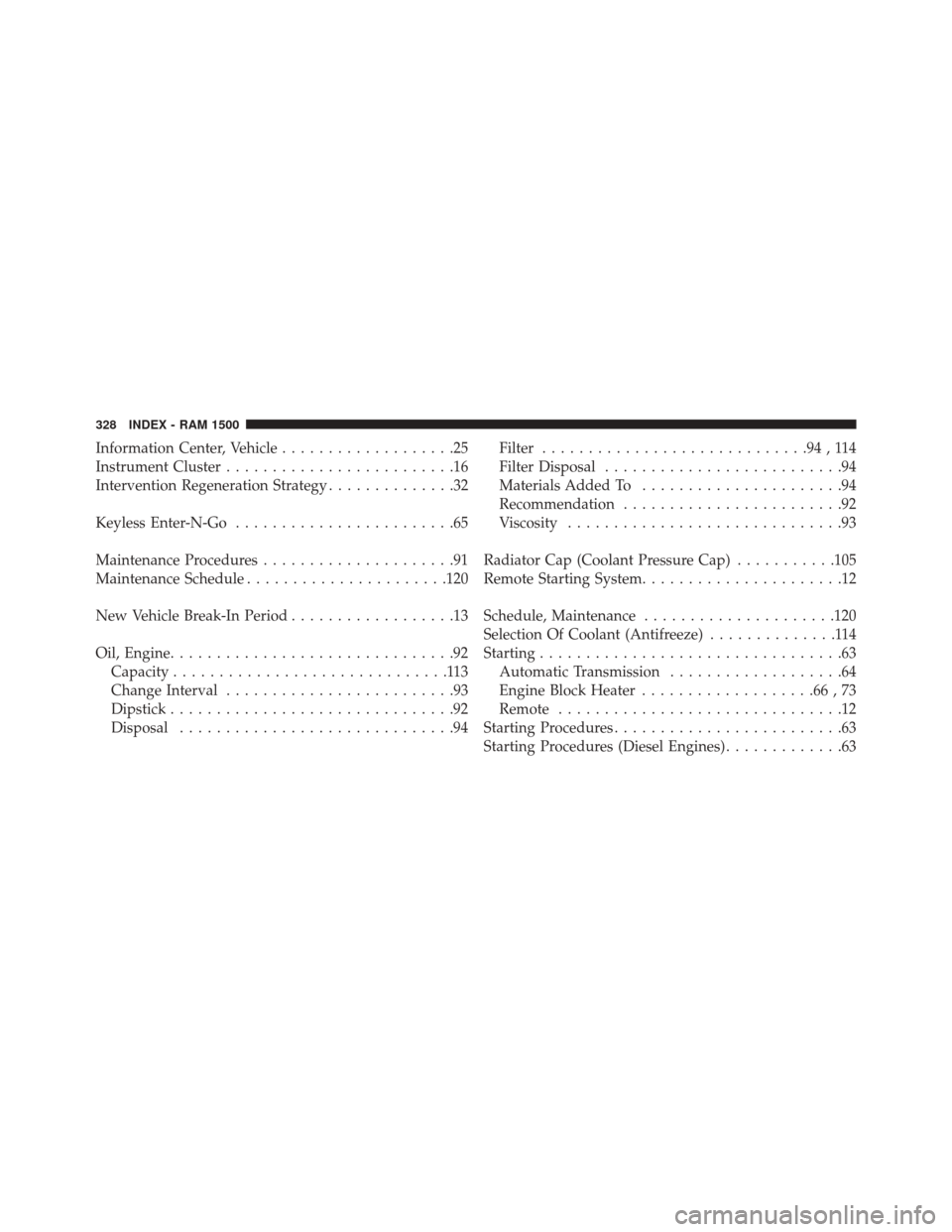
Information Center, Vehicle...................25
Instrument Cluster .........................16
Intervention Regeneration Strategy ..............32
Keyless Enter-N-Go ........................65
Maintenance Procedures .....................91
Maintenance Schedule ..................... .120
New Vehicle Break-In Period ..................13
Oil, Engine ...............................92
Capacity ..............................113
Change Interval .........................93
Dipstick ...............................92
Disposal ..............................94 Filter
.............................94,114
Filter Disposal ..........................94
Materials Added To ......................94
Recommendation ........................92
Viscosity ..............................93
Radiator Cap (Coolant Pressure Cap) ...........105
Remote Starting System ......................12
Schedule, Maintenance .....................120
Selection Of Coolant (Antifreeze) ..............114
Starting .................................63
Automatic Transmission ...................64
Engine Block Heater ...................66,73
Remote ...............................12
Starting Procedures .........................63
Starting Procedures (Diesel Engines) .............63
328 INDEX - RAM 1500
Page 334 of 338
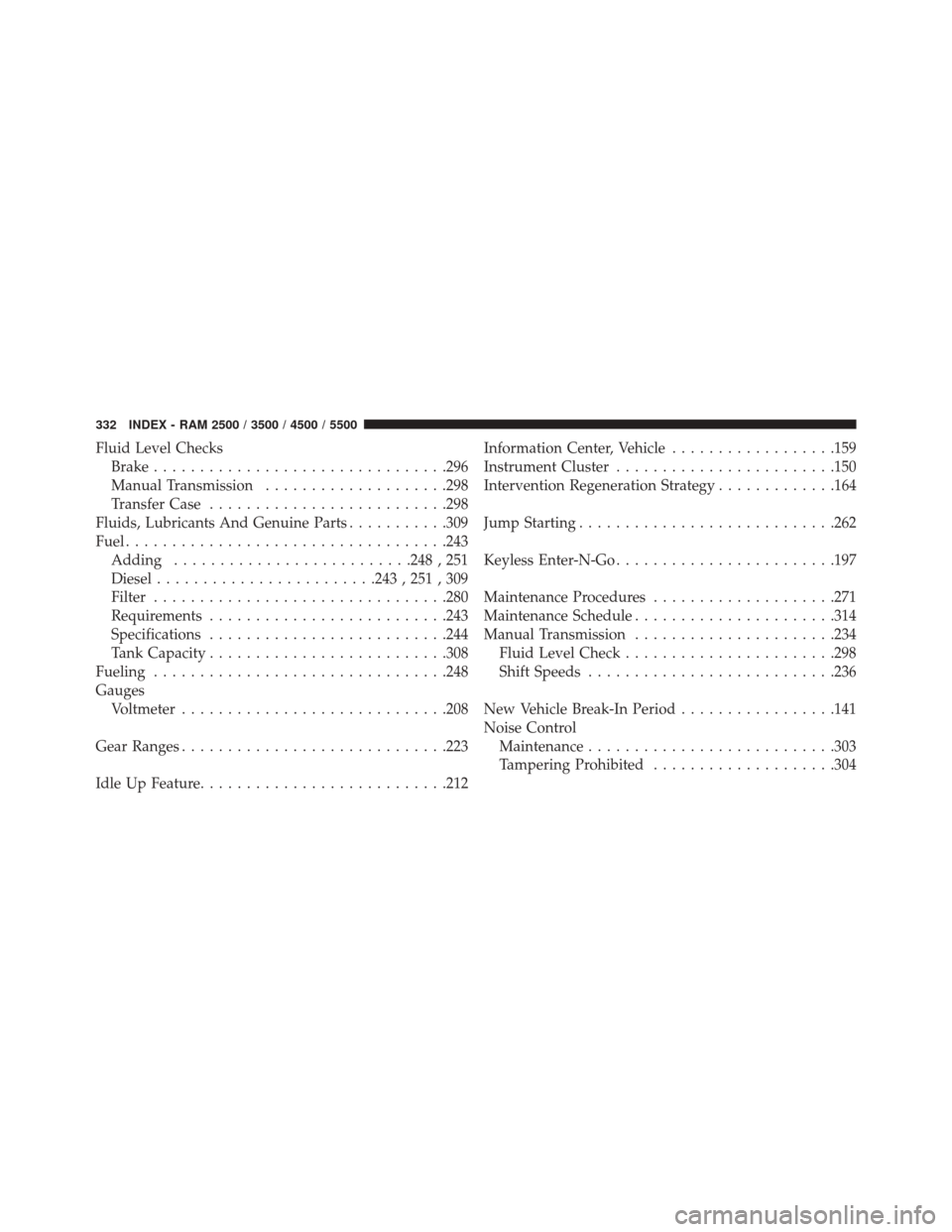
Fluid Level ChecksBrake ............................... .296
Manual Transmission ....................298
Transfer Case ......................... .298
Fluids, Lubricants And Genuine Parts ...........309
Fuel .................................. .243
Adding ......................... .248 , 251
Diesel ....................... .243 , 251 , 309
Filter ............................... .280
Requirements ......................... .243
Specifications ......................... .244
Tank Capacity ......................... .308
Fueling ............................... .248
Gauges Voltmeter ............................ .208
Gear Ranges ............................ .223
Idle Up Feature .......................... .212Information Center, Vehicle
..................159
Instrument Cluster ....................... .150
Intervention Regeneration Strategy .............164
Jump Starting ........................... .262
Keyless Enter-N-Go ....................... .197
Maintenance Procedures ....................271
Maintenance Schedule ..................... .314
Manual Transmission ..................... .234
Fluid Level Check ...................... .298
Shift Speeds .......................... .236
New Vehicle Break-In Period .................141
Noise Control Maintenance .......................... .303
Tampering Prohibited ....................304
332 INDEX - RAM 2500 / 3500 / 4500 / 5500