fuel pressure Ram 1500 2016 User Guide
[x] Cancel search | Manufacturer: RAM, Model Year: 2016, Model line: 1500, Model: Ram 1500 2016Pages: 916, PDF Size: 7.55 MB
Page 650 of 916
WARNING!(Continued)
•Unequal tire pressures from one side of the vehicle
to the other can cause the vehicle to drift to the
right or left.
•Always drive with each tire inflated to the recom-
mended cold tire inflation pressure.
Both under-inflation and over-inflation affect the stability
of the vehicle and can produce a feeling of sluggish
response or over responsiveness in the steering.
NOTE:
•Unequal tire pressures from side to side may cause
erratic and unpredictable steering response.
•Unequal tire pressure from side to side may cause the
vehicle to drift left or right.
Fuel Economy
Underinflated tires will increase tire rolling resistance
resulting in higher fuel consumption.
Tread Wear
Improper cold tire inflation pressures can cause abnor-
mal wear patterns and reduced tread life, resulting in the
need for earlier tire replacement.
Ride Comfort And Vehicle Stability
Proper tire inflation contributes to a comfortable ride.
Over-inflation produces a jarring and uncomfortable
ride.
Tire Inflation Pressures
The proper cold tire inflation pressure is listed on the
driver’s side B-Pillar or rear edge of the driver’s side
door.
648 STARTING AND OPERATING
Page 669 of 916
CAUTION!(Continued)
moisture and dirt from entering the valve stem,
which could damage the TPMS sensor.
NOTE:
•The TPMS is not intended to replace normal tire care
and maintenance or to provide warning of a tire failure
or condition.
•The TPMS should not be used as a tire pressure gauge
while adjusting your tire pressure.
•Driving on a significantly under-inflated tire causes
the tire to overheat and can lead to tire failure.
Under-inflation also reduces fuel efficiency and tire
tread life, and may affect the vehicle’s handling and
stopping ability.
•The TPMS is not a substitute for proper tire mainte-
nance, and it is the driver ’s responsibility to maintaincorrect tire pressure using an accurate tire pressure
gauge, even if under-inflation has not reached the level
to trigger illumination of the “Tire Pressure Monitor-
ing Telltale Light.”
•Seasonal temperature changes will affect tire pressure,
and the TPMS will monitor the actual tire pressure in
the tire.
Premium System
The Tire Pressure Monitor System (TPMS) uses wireless
technology with wheel rim mounted electronic sensors to
monitor tire pressure levels. Sensors mounted to each
wheel as part of the valve stem transmit tire pressure
readings to the receiver module.
NOTE:It is particularly important for you to check the
tire pressure in all of the tires on your vehicle monthly
and to maintain the proper pressure.
5
STARTING AND OPERATING 667
Page 689 of 916
Tire Size
The tire size on the Vehicle Certification Label represents
the actual tire size on your vehicle. Replacement tires
must be equal to the load capacity of this tire size.
Rim Size
This is the rim size that is appropriate for the tire size
listed.
Inflation Pressure
This is the cold tire inflation pressure for your vehicle for
all loading conditions up to full GAWR.
Curb Weight
The curb weight of a vehicle is defined as the total weight
of the vehicle with all fluids, including vehicle fuel, at full
capacity conditions, and with no occupants or cargo
loaded into the vehicle. The front and rear curb weightvalues are determined by weighing your vehicle on a
commercial scale before any occupants or cargo are
added.
Loading
The actual total weight and the weight of the front and
rear of your vehicle at the ground can best be determined
by weighing it when it is loaded and ready for operation.
The entire vehicle should first be weighed on a commer-
cial scale to insure that the GVWR has not been exceeded.
The weight on the front and rear of the vehicle should
then be determined separately to be sure that the load is
properly distributed over the front and rear axle. Weigh-
ing the vehicle may show that the GAWR of either the
front or rear axles has been exceeded but the total load is
within the specified GVWR. If so, weight must be shifted
from front to rear or rear to front as appropriate until the
specified weight limitations are met. Store the heavier
5
STARTING AND OPERATING 687
Page 797 of 916
CAUTION!(Continued)
•Your vehicle has been built with improved fluids
that protect the performance and durability of your
vehicle and also allow extended maintenance inter-
vals. Do not use chemical flushes in these compo-
nents as the chemicals can damage your engine,
transmission, or air conditioning. Such damage is
not covered by the New Vehicle Limited Warranty.
If a flush is needed because of component malfunc-
tion, use only the specified fluid for the flushing
procedure.
Engine Oil
Checking Oil Level
To assure proper lubrication of your vehicle’s engine, the
engine oil must be maintained at the correct level. Check
the oil level at regular intervals, such as every fuel stop.The best time to check the engine oil level is about five
minutes after a fully warmed up engine is shut off.
Checking the oil while the vehicle is on level ground will
improve the accuracy of the oil level readings. Always
maintain the oil level within the SAFE zone on the
dipstick. Adding one quart of oil when the reading is at
the bottom of the SAFE zone will result in a reading at the
top of the safe zone on these engines.
CAUTION!
Overfilling or underfilling the crankcase will cause
oil aeration or loss of oil pressure. This could damage
your engine.7
MAINTAINING YOUR VEHICLE 795
Page 894 of 916
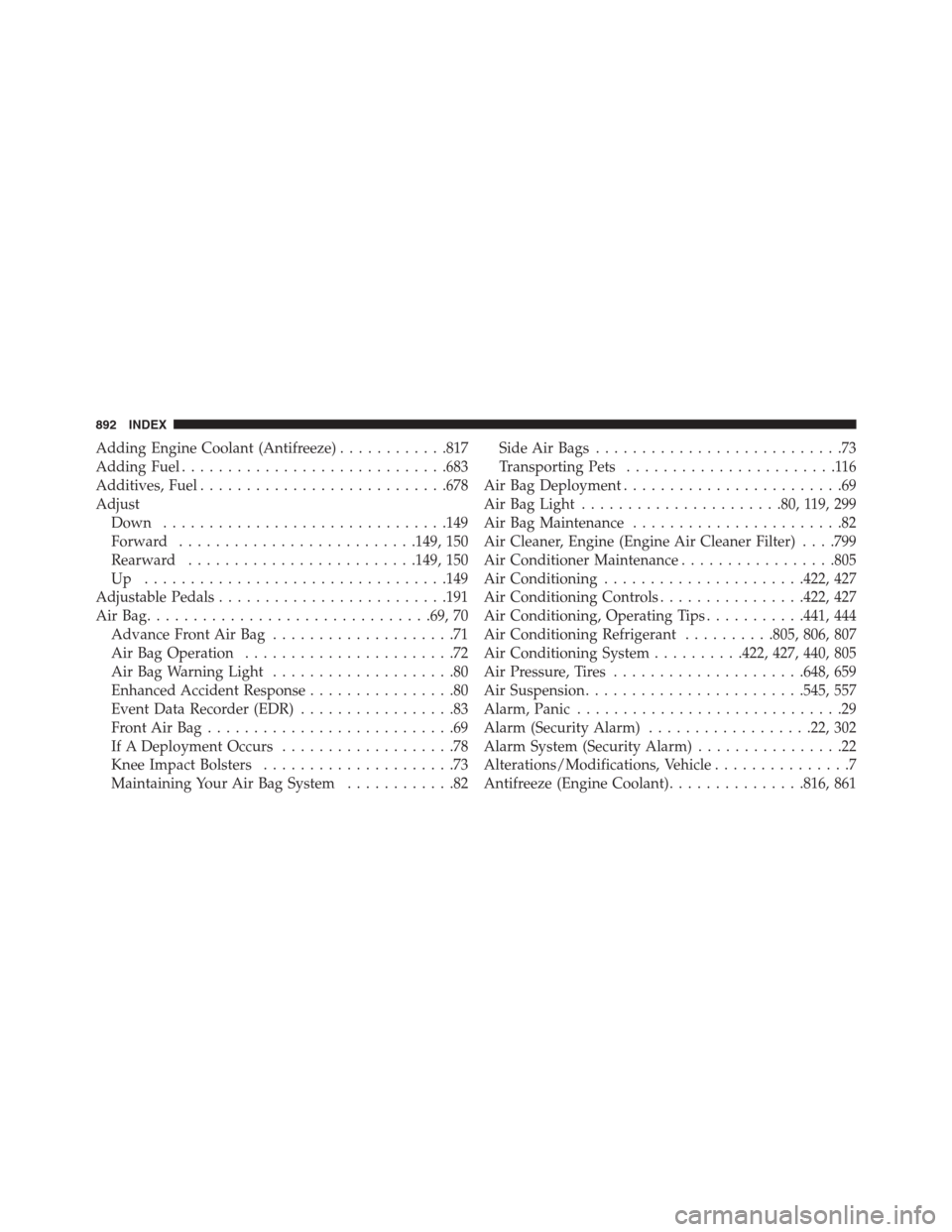
Adding Engine Coolant (Antifreeze)............817
Adding Fuel.............................683
Additives, Fuel...........................678
Adjust
Down...............................149
Forward..........................149, 150
Rearward.........................149, 150
Up .................................149
Adjustable Pedals.........................191
AirBag...............................69, 70
Advance Front Air Bag....................71
Air Bag Operation.......................72
Air Bag Warning Light....................80
Enhanced Accident Response................80
Event Data Recorder (EDR).................83
FrontAirBag...........................69
If A Deployment Occurs...................78
Knee Impact Bolsters.....................73
Maintaining Your Air Bag System............82Side Air Bags...........................73
Transporting Pets.......................116
Air Bag Deployment........................69
Air Bag Light......................80, 119, 299
Air Bag Maintenance.......................82
Air Cleaner, Engine (Engine Air Cleaner Filter). . . .799
Air Conditioner Maintenance.................805
Air Conditioning......................422, 427
Air Conditioning Controls................422, 427
Air Conditioning, Operating Tips...........441, 444
Air Conditioning Refrigerant..........805, 806, 807
Air Conditioning System..........422, 427, 440, 805
Air Pressure, Tires.....................648, 659
Air Suspension........................545, 557
Alarm, Panic.............................29
Alarm (Security Alarm)..................22, 302
Alarm System (Security Alarm)................22
Alterations/Modifications, Vehicle...............7
Antifreeze (Engine Coolant)...............816, 861
892 INDEX
Page 905 of 916
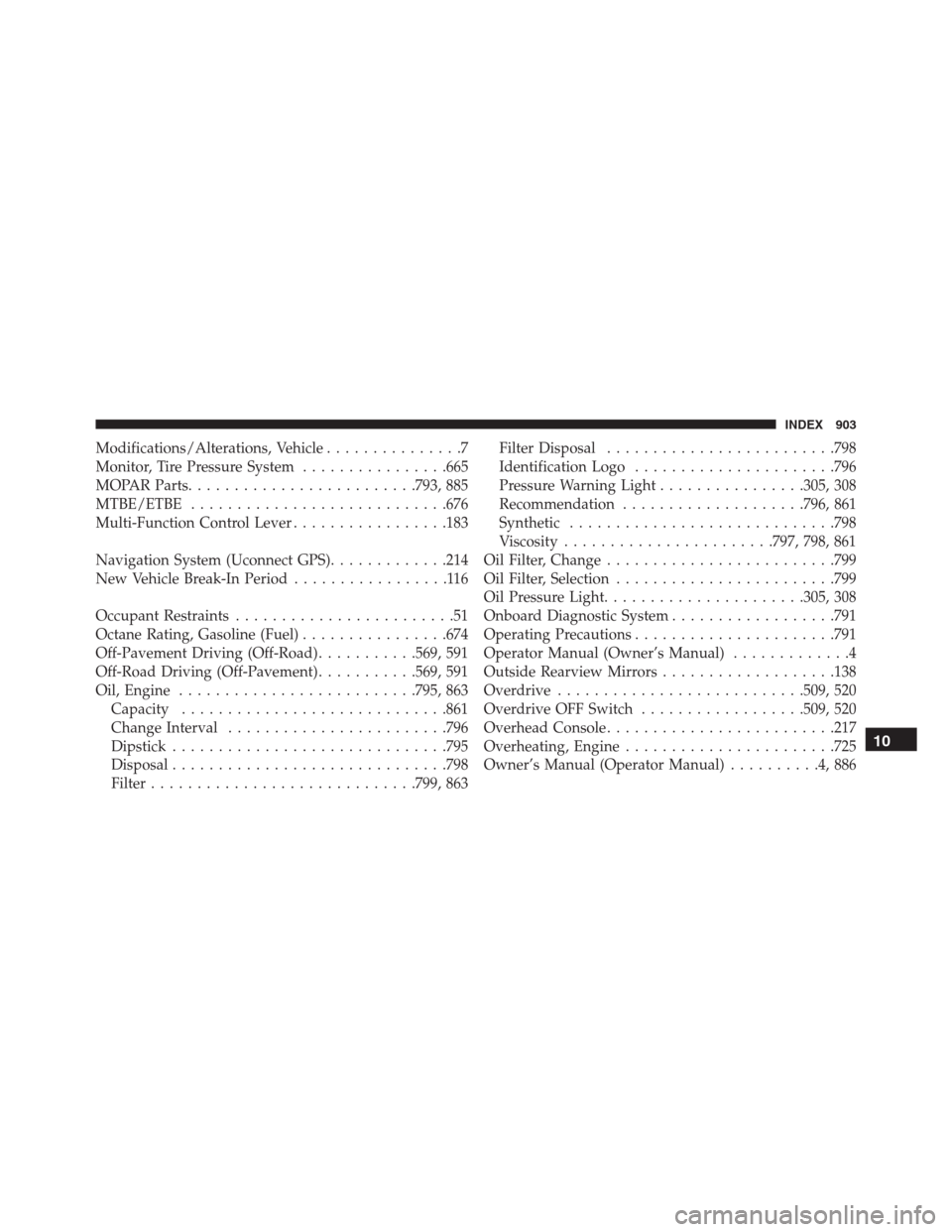
Modifications/Alterations, Vehicle...............7
Monitor, Tire Pressure System................665
MOPAR Parts.........................793, 885
MTBE/ETBE............................676
Multi-Function Control Lever.................183
Navigation System (Uconnect GPS).............214
New Vehicle Break-In Period.................116
Occupant Restraints........................51
Octane Rating, Gasoline (Fuel)................674
Off-Pavement Driving (Off-Road)...........569, 591
Off-Road Driving (Off-Pavement)...........569, 591
Oil, Engine..........................795, 863
Capacity.............................861
Change Interval........................796
Dipstick..............................795
Disposal..............................798
Filter.............................799, 863Filter Disposal.........................798
Identification Logo......................796
Pressure Warning Light................305, 308
Recommendation....................796, 861
Synthetic.............................798
Viscosity.......................797, 798, 861
Oil Filter, Change.........................799
Oil Filter, Selection........................799
Oil Pressure Light......................305, 308
Onboard Diagnostic System..................791
Operating Precautions......................791
Operator Manual (Owner’s Manual).............4
Outside Rearview Mirrors...................138
Overdrive...........................509, 520
Overdrive OFF Switch..................509, 520
Overhead Console.........................217
Overheating, Engine.......................725
Owner’s Manual (Operator Manual)..........4,886
10
INDEX 903