open hood Ram 1500 2016 User Guide
[x] Cancel search | Manufacturer: RAM, Model Year: 2016, Model line: 1500, Model: Ram 1500 2016Pages: 916, PDF Size: 7.55 MB
Page 485 of 916
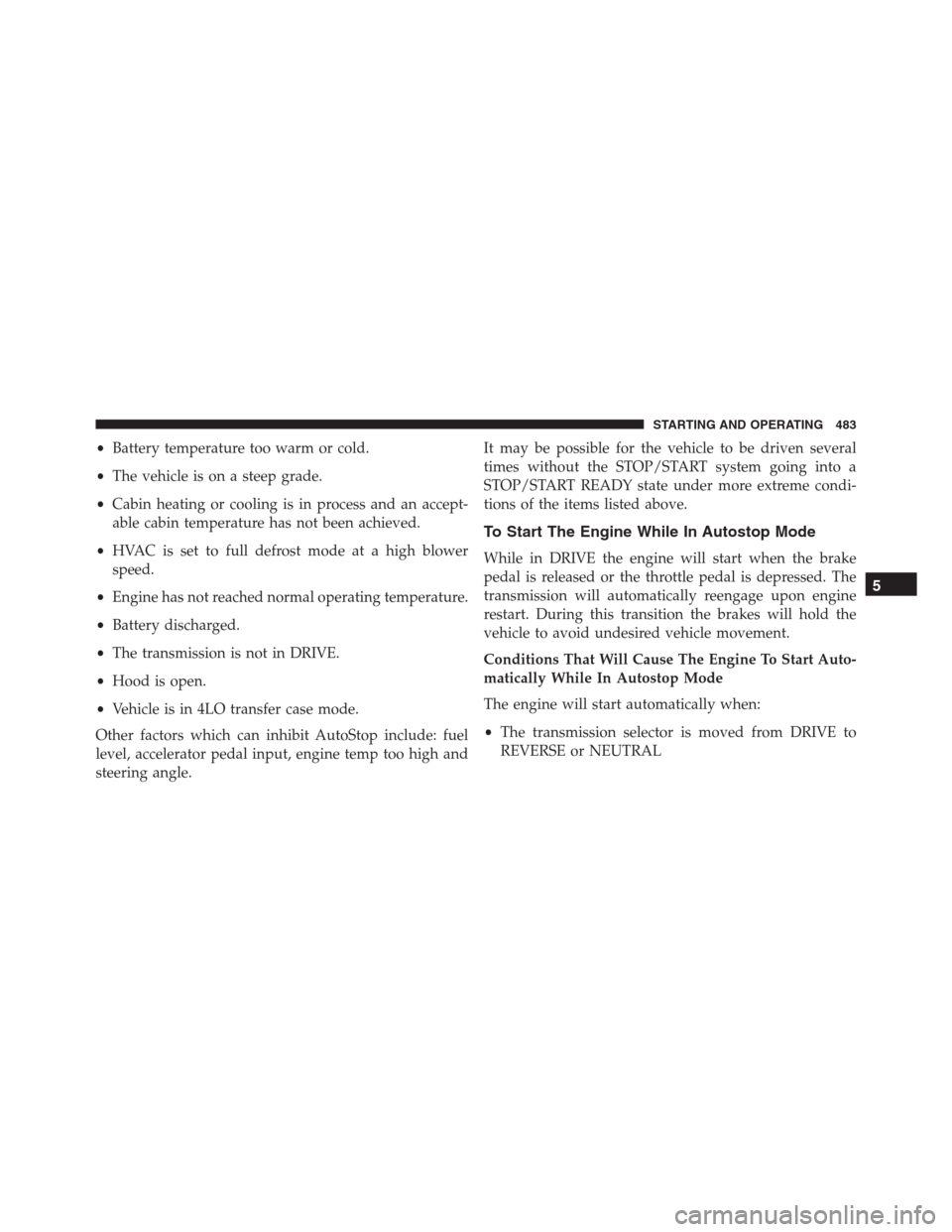
•Battery temperature too warm or cold.
•The vehicle is on a steep grade.
•Cabin heating or cooling is in process and an accept-
able cabin temperature has not been achieved.
•HVAC is set to full defrost mode at a high blower
speed.
•Engine has not reached normal operating temperature.
•Battery discharged.
•The transmission is not in DRIVE.
•Hood is open.
•Vehicle is in 4LO transfer case mode.
Other factors which can inhibit AutoStop include: fuel
level, accelerator pedal input, engine temp too high and
steering angle.It may be possible for the vehicle to be driven several
times without the STOP/START system going into a
STOP/START READY state under more extreme condi-
tions of the items listed above.
To Start The Engine While In Autostop Mode
While in DRIVE the engine will start when the brake
pedal is released or the throttle pedal is depressed. The
transmission will automatically reengage upon engine
restart. During this transition the brakes will hold the
vehicle to avoid undesired vehicle movement.
Conditions That Will Cause The Engine To Start Auto-
matically While In Autostop Mode
The engine will start automatically when:
•The transmission selector is moved from DRIVE to
REVERSE or NEUTRAL
5
STARTING AND OPERATING 483
Page 486 of 916
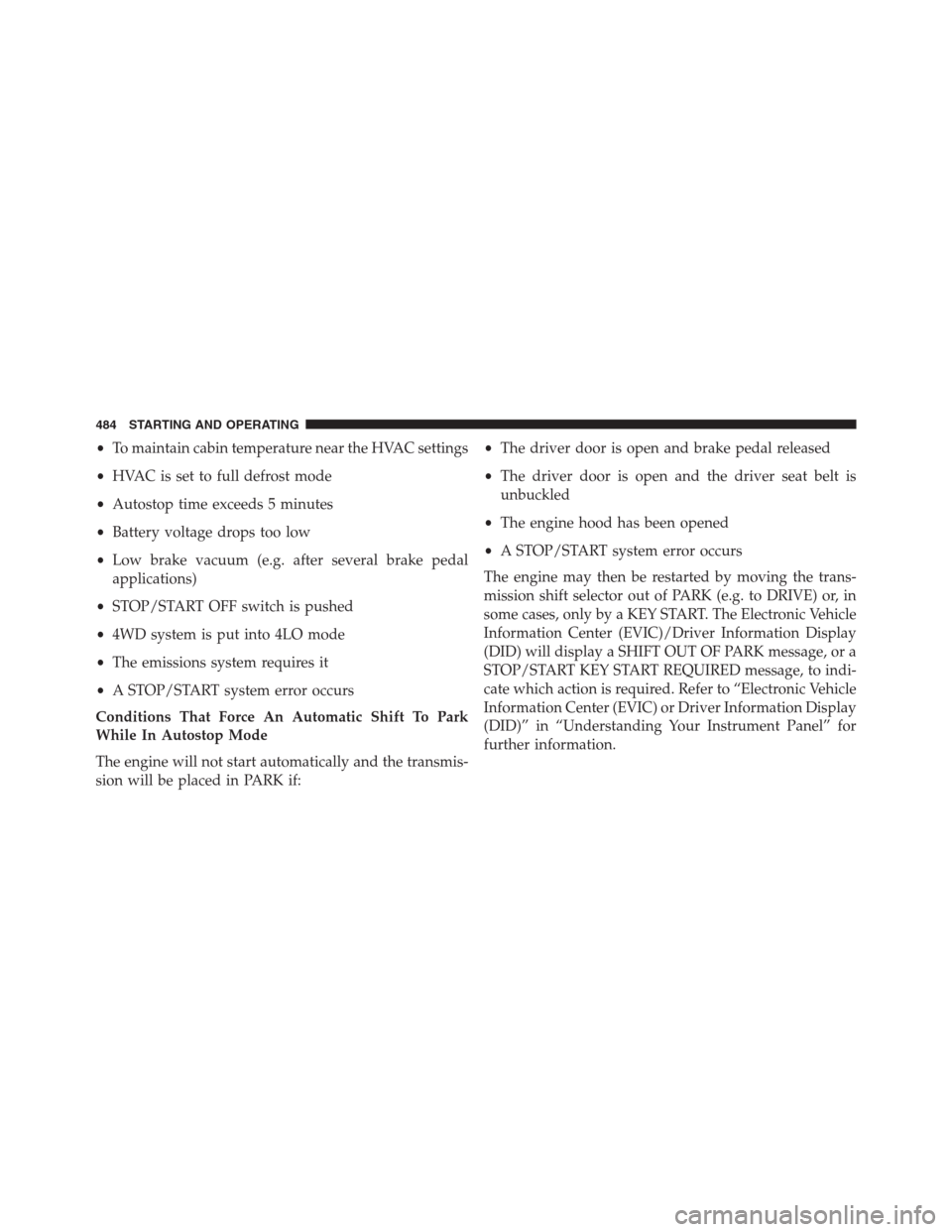
•To maintain cabin temperature near the HVAC settings
•HVAC is set to full defrost mode
•Autostop time exceeds 5 minutes
•Battery voltage drops too low
•Low brake vacuum (e.g. after several brake pedal
applications)
•STOP/START OFF switch is pushed
•4WD system is put into 4LO mode
•The emissions system requires it
•A STOP/START system error occurs
Conditions That Force An Automatic Shift To Park
While In Autostop Mode
The engine will not start automatically and the transmis-
sion will be placed in PARK if:•The driver door is open and brake pedal released
•The driver door is open and the driver seat belt is
unbuckled
•The engine hood has been opened
•A STOP/START system error occurs
The engine may then be restarted by moving the trans-
mission shift selector out of PARK (e.g. to DRIVE) or, in
some cases, only by a KEY START. The Electronic Vehicle
Information Center (EVIC)/Driver Information Display
(DID) will display a SHIFT OUT OF PARK message, or a
STOP/START KEY START REQUIRED message, to indi-
cate which action is required. Refer to “Electronic Vehicle
Information Center (EVIC) or Driver Information Display
(DID)” in “Understanding Your Instrument Panel” for
further information.
484 STARTING AND OPERATING
Page 728 of 916
CAUTION!
Driving with a hot cooling system could damage
your vehicle. If the temperature gauge reads HOT
(H), pull over and stop the vehicle. Idle the vehicle
with the air conditioner turned off until the pointer
drops back into the normal range. If the pointer
remains on HOT (H), and you hear continuous
chimes, turn the engine off immediately and call for
service.
WARNING!
You or others can be badly burned by hot engine
coolant (antifreeze) or steam from your radiator. If
you see or hear steam coming from under the hood,
do not open the hood until the radiator has had time
to cool. Never try to open a cooling system pressure
cap when the radiator or coolant bottle is hot.
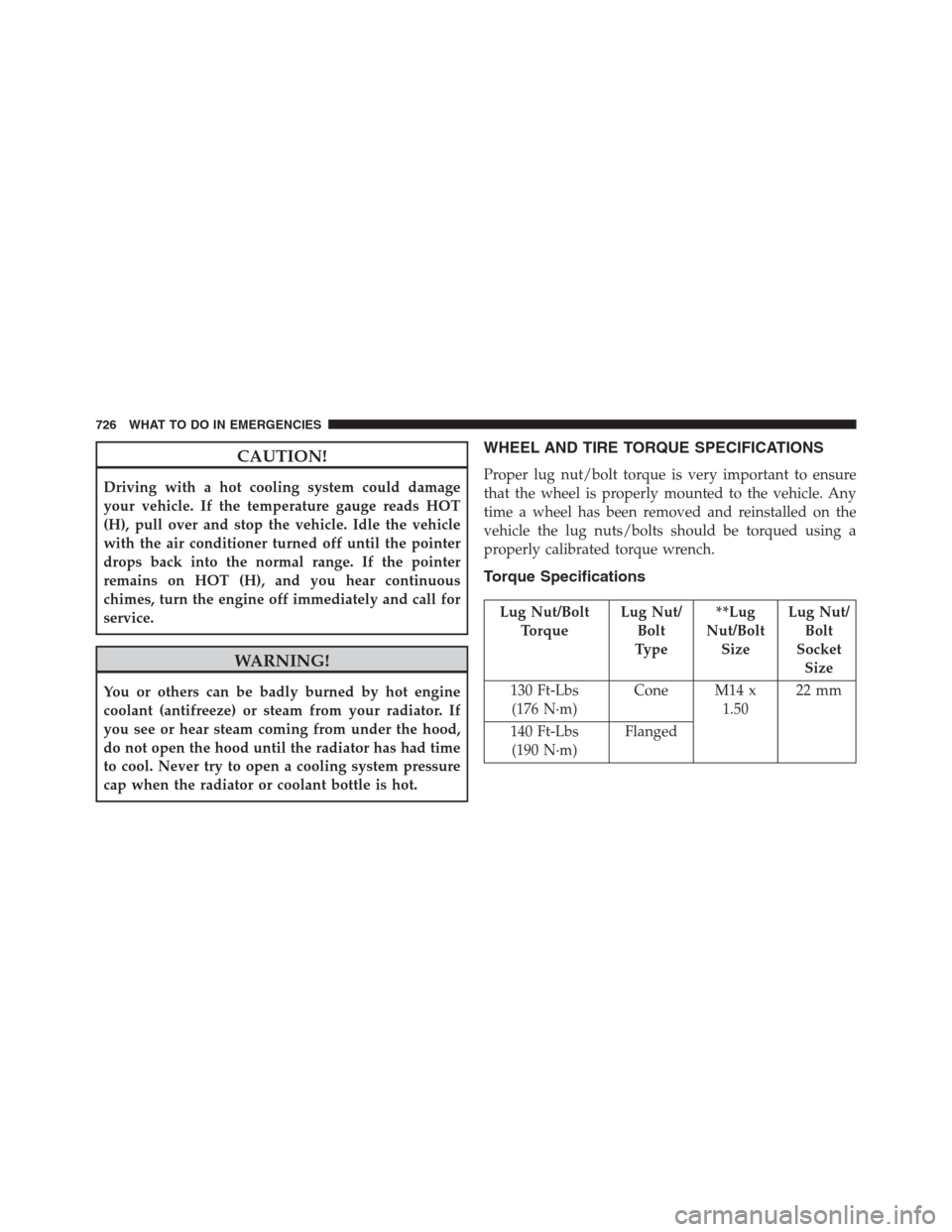
WHEEL AND TIRE TORQUE SPECIFICATIONS
Proper lug nut/bolt torque is very important to ensure
that the wheel is properly mounted to the vehicle. Any
time a wheel has been removed and reinstalled on the
vehicle the lug nuts/bolts should be torqued using a
properly calibrated torque wrench.
Torque Specifications
Lug Nut/Bolt
TorqueLug Nut/
Bolt
Type**Lug
Nut/Bolt
SizeLug Nut/
Bolt
Socket
Size
130 Ft-Lbs
(176 N·m)Cone M14 x
1.5022 mm
140 Ft-Lbs
(190 N·m)Flanged
726 WHAT TO DO IN EMERGENCIES
Page 774 of 916
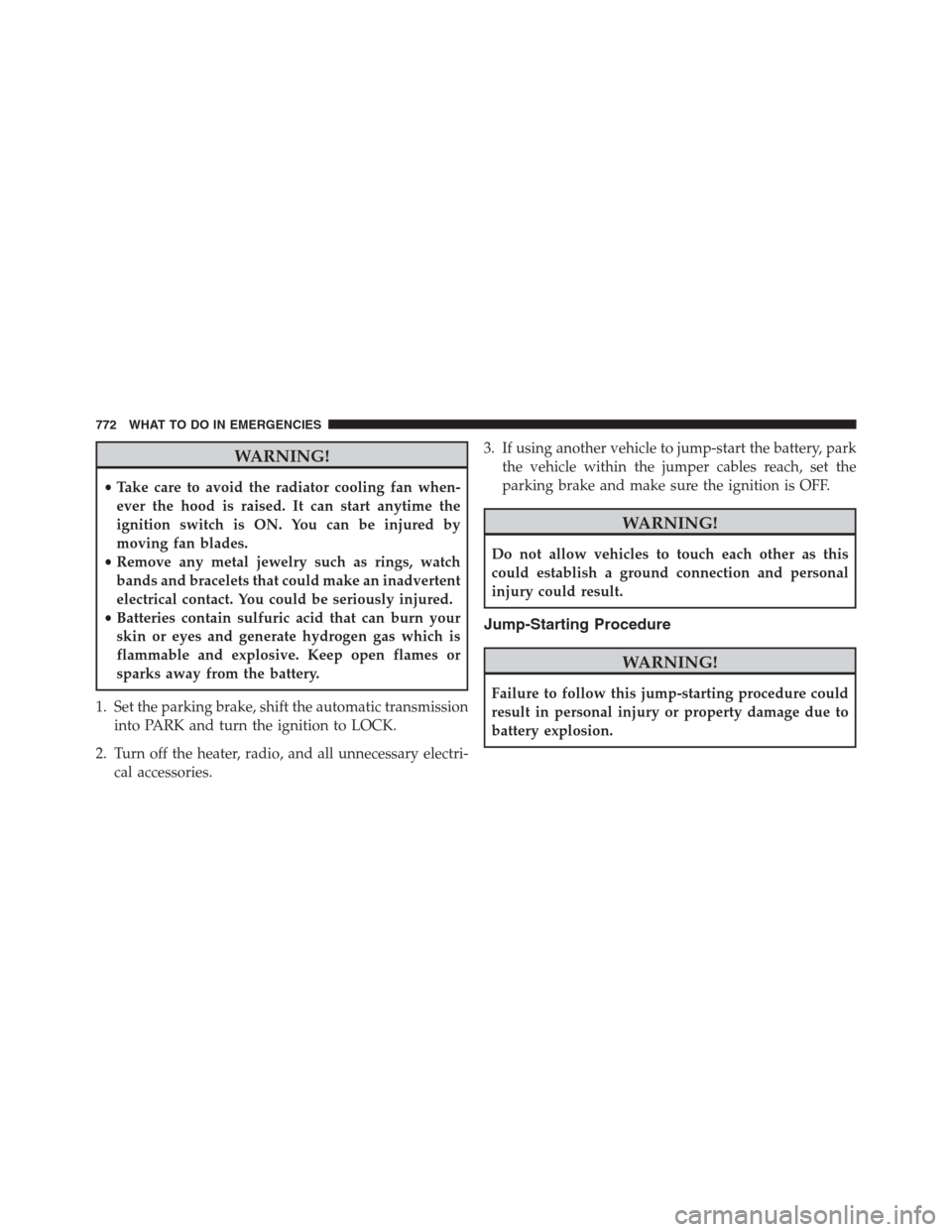
WARNING!
•Take care to avoid the radiator cooling fan when-
ever the hood is raised. It can start anytime the
ignition switch is ON. You can be injured by
moving fan blades.
•Remove any metal jewelry such as rings, watch
bands and bracelets that could make an inadvertent
electrical contact. You could be seriously injured.
•Batteries contain sulfuric acid that can burn your
skin or eyes and generate hydrogen gas which is
flammable and explosive. Keep open flames or
sparks away from the battery.
1. Set the parking brake, shift the automatic transmission
into PARK and turn the ignition to LOCK.
2. Turn off the heater, radio, and all unnecessary electri-
cal accessories.3. If using another vehicle to jump-start the battery, park
the vehicle within the jumper cables reach, set the
parking brake and make sure the ignition is OFF.
WARNING!
Do not allow vehicles to touch each other as this
could establish a ground connection and personal
injury could result.
Jump-Starting Procedure
WARNING!
Failure to follow this jump-starting procedure could
result in personal injury or property damage due to
battery explosion.
772 WHAT TO DO IN EMERGENCIES
Page 813 of 916
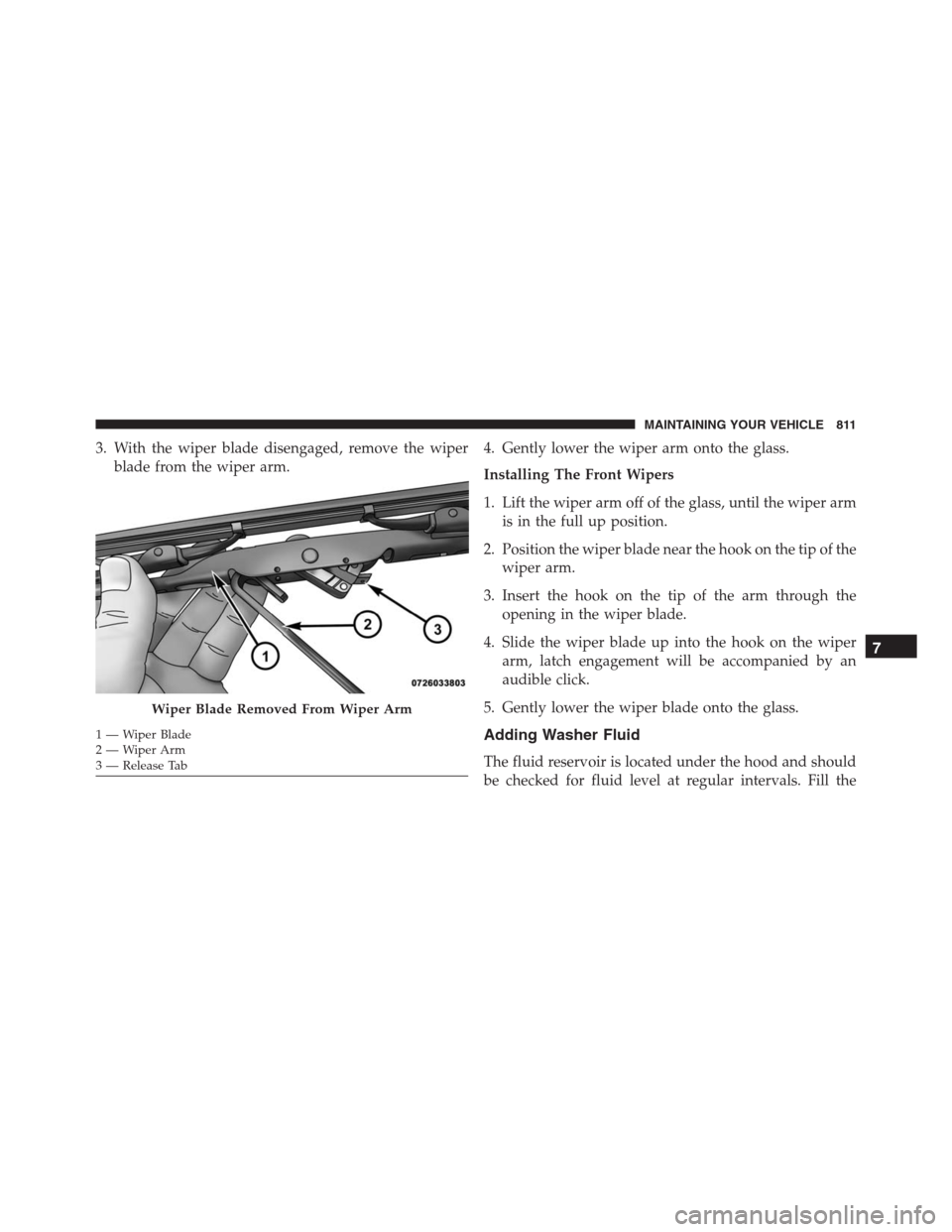
3. With the wiper blade disengaged, remove the wiper
blade from the wiper arm.4. Gently lower the wiper arm onto the glass.
Installing The Front Wipers
1. Lift the wiper arm off of the glass, until the wiper arm
is in the full up position.
2. Position the wiper blade near the hook on the tip of the
wiper arm.
3. Insert the hook on the tip of the arm through the
opening in the wiper blade.
4. Slide the wiper blade up into the hook on the wiper
arm, latch engagement will be accompanied by an
audible click.
5. Gently lower the wiper blade onto the glass.
Adding Washer Fluid
The fluid reservoir is located under the hood and should
be checked for fluid level at regular intervals. Fill the
Wiper Blade Removed From Wiper Arm
1—WiperBlade
2—WiperArm
3 — Release Tab
7
MAINTAINING YOUR VEHICLE 811
Page 817 of 916
Cooling System
WARNING!
You or others can be badly burned by hot engine
coolant (antifreeze) or steam from your radiator. If
you see or hear steam coming from under the hood,
do not open the hood until the radiator has had time
to cool. Never try to open a cooling system pressure
cap when the radiator is hot.
Engine Coolant Checks
Check the engine coolant (antifreeze) protection every 12
months (before the onset of freezing weather, where
applicable). If the engine coolant (antifreeze) is dirty or
rusty in appearance, the system should be drained,
flushed and refilled with fresh coolant. Check the front of
the A/C condenser (if equipped) or radiator for any
accumulation of bugs, leaves, etc. If dirty, clean by gentlyspraying water from a garden hose vertically down the
face of the A/C condenser (if equipped) or the back of the
radiator core.
Check the engine cooling system hoses for brittle rubber,
cracking, tears, cuts and tightness of the connection at the
coolant recovery bottle and radiator. Inspect the entire
system for leaks.
With the engine at normal operating temperature (but
not running), check the cooling system pressure cap for
proper vacuum sealing by draining a small amount of
engine coolant (antifreeze) from the radiator drain cock.
The radiator drain cock is located in the lower radiator
tank. If the cap is sealing properly, the engine coolant
(antifreeze) will begin to drain from the coolant expan-
sion bottle. DO NOT REMOVE THE COOLANT PRES-
SURE CAP WHEN THE COOLING SYSTEM IS HOT.
7
MAINTAINING YOUR VEHICLE 815
Page 853 of 916
Base Quad / Premium Bi-Halogen: Low Beam
Headlamp, High Beam Headlamp, Front Park And
Turn — If Equipped
1. Open the hood.
2. Disconnect and isolate the negative battery cable.
3. Remove the six plastic push-in fasteners that secure
the upper radiator seal to the grille support and both
fender ledges.
4. Remove the two plastic push-in rivets that secure the
upper radiator seal to the radiator.
5. Remove the upper radiator seal from the vehicle.
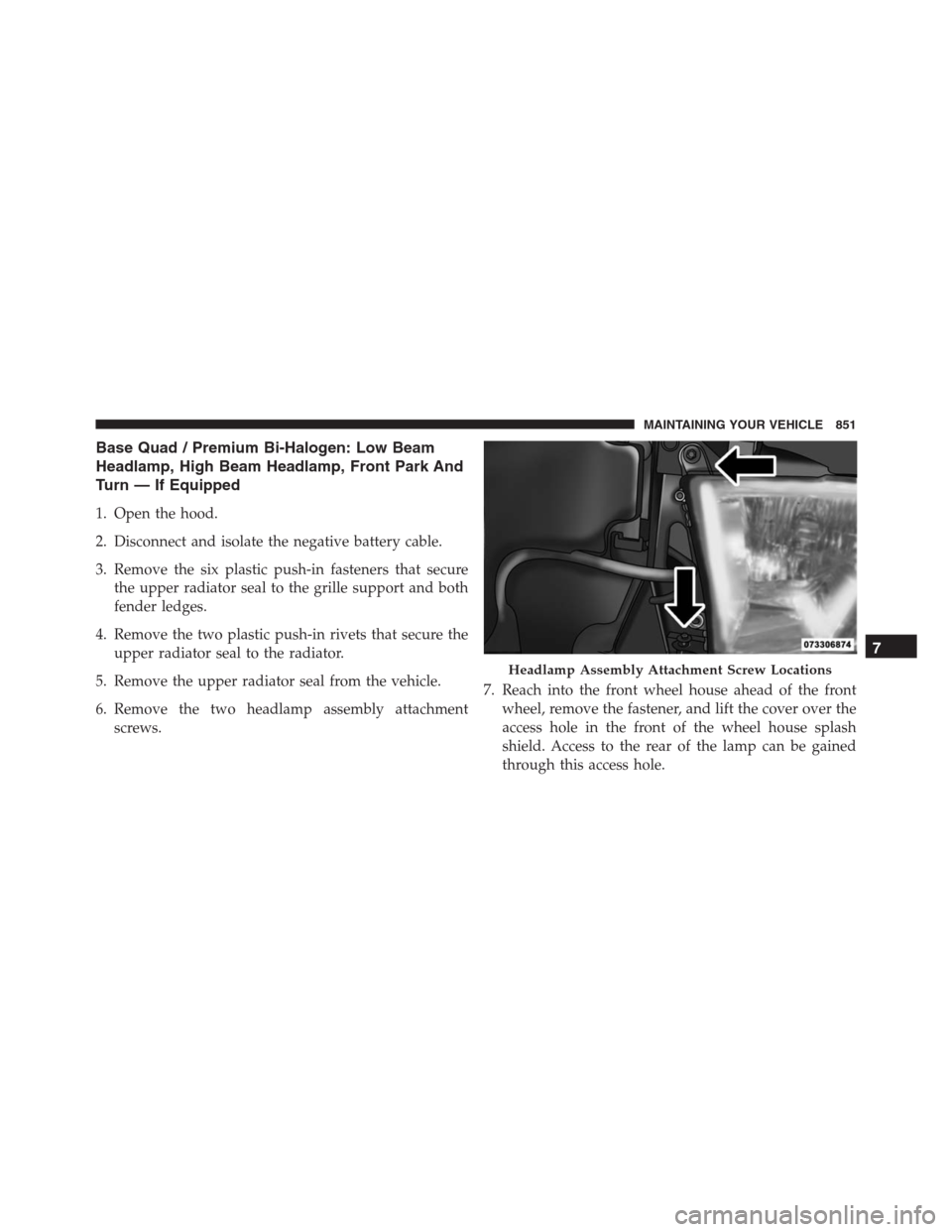
6. Remove the two headlamp assembly attachment
screws.7. Reach into the front wheel house ahead of the front
wheel, remove the fastener, and lift the cover over the
access hole in the front of the wheel house splash
shield. Access to the rear of the lamp can be gained
through this access hole.
Headlamp Assembly Attachment Screw Locations
7
MAINTAINING YOUR VEHICLE 851
Page 902 of 916
Hitches
Trailer Towing.........................696
Hoisting................................769
HomeLink (Garage Door Opener)..............219
Hood Release............................170
Hub Caps...............................768
Ignition.................................16
Key ...............................12, 16
Ignition Key Removal.......................16
Illuminated Entry..........................24
Immobilizer (Sentry Key)....................19
Inflation Pressure Tires.....................659
Information Center, Vehicle...............334, 355
Inside Rearview Mirror..............130, 131, 138
Instrument Cluster..................291, 303, 329
Instrument Panel And Controls...............290
Instrument Panel Lens Cleaning...............836
Integrated Trailer Brake Controls..............702Interior Appearance Care....................834
Interior Lights...........................179
Intermittent Wipers (Delay Wipers).............185
Introduction..............................4
Inverter Outlet (115V)......................237
Jack Location.........................729, 749
Jump Starting............................770
Key Fob
Programming Additional Key Fobs...........21
Programming Additional Transmitters.........21
Key-In Reminder..........................18
Keyless Enter-N-Go.....................43, 478
Lock The Vehicle’s Doors..............388, 408
Passive Entry...........................43
Passive Entry Programming..........43, 388, 408
Keyless Entry System.......................25
Key, Replacement..........................20
900 INDEX