ECO Ram 1500 2016 Owner's Manual
[x] Cancel search | Manufacturer: RAM, Model Year: 2016, Model line: 1500, Model: Ram 1500 2016Pages: 916, PDF Size: 7.55 MB
Page 693 of 916
Weight-Distributing Hitch
A weight-distributing system works by applying lever-
age through spring (load) bars. They are typically used
for heavier loads to distribute trailer tongue weight to the
tow vehicle’s front axle and the trailer axle(s). When used
in accordance with the manufacturer’s directions, it pro-
vides for a more level ride, offering more consistent
steering and brake control, thereby enhancing towing
safety. The addition of a friction/hydraulic sway control
also dampens sway caused by traffic and crosswinds and
contributes positively to tow vehicle and trailer stability.
Trailer sway control and a weight distributing (load
equalizing) hitch are recommended for heavier Tongue
Weights (TW) and may be required depending on vehicle
and trailer configuration/loading to comply with GAWR
requirements.
WARNING!
•An improperly adjusted weight distributing hitch
system may reduce handling, stability and braking
performance and could result in a collision.
•Weight distributing systems may not be compat-
ible with surge brake couplers. Consult with your
hitch and trailer manufacturer or a reputable Rec-
reational Vehicle dealer for additional information.
5
STARTING AND OPERATING 691
Page 695 of 916
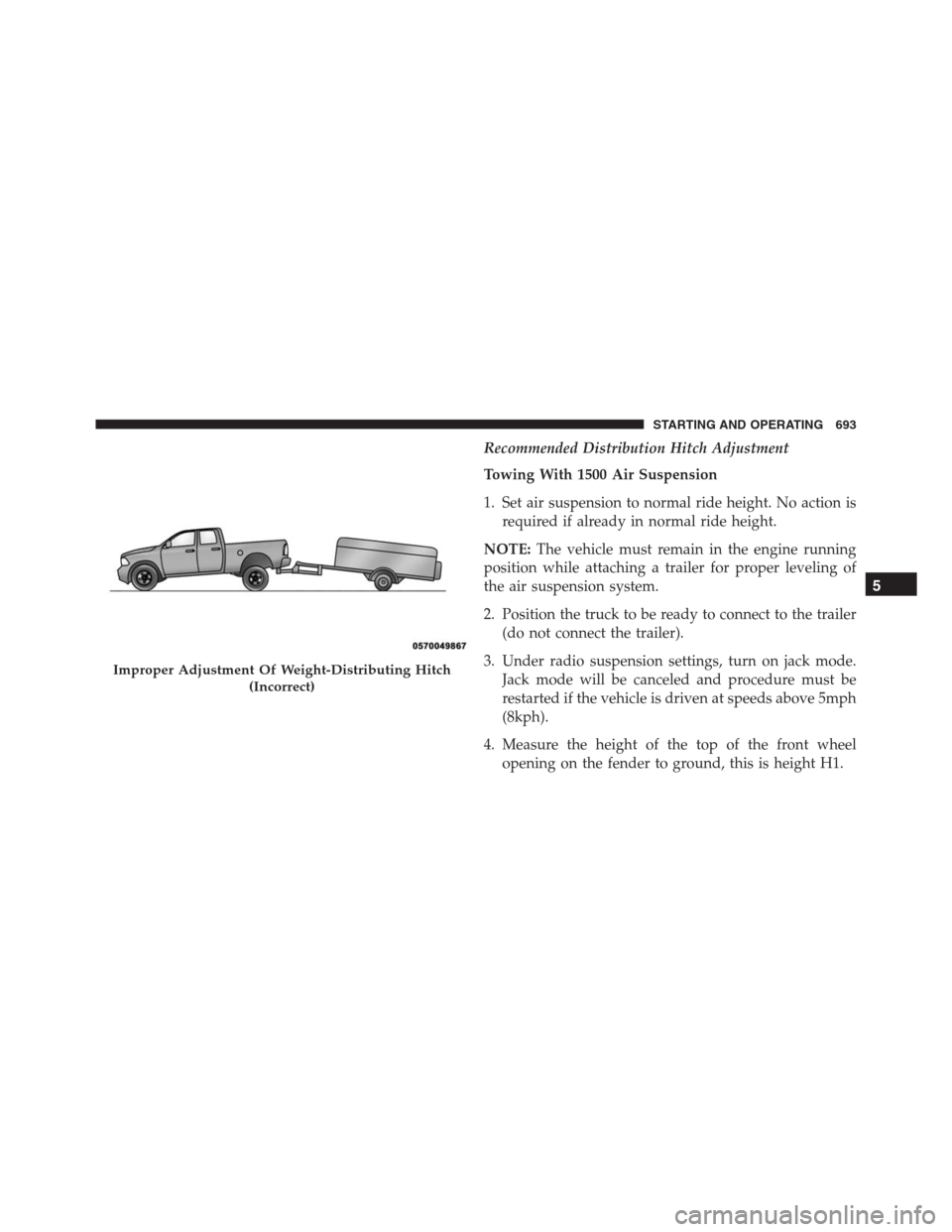
Recommended Distribution Hitch Adjustment
Towing With 1500 Air Suspension
1. Set air suspension to normal ride height. No action is
required if already in normal ride height.
NOTE:The vehicle must remain in the engine running
position while attaching a trailer for proper leveling of
the air suspension system.
2. Position the truck to be ready to connect to the trailer
(do not connect the trailer).
3. Under radio suspension settings, turn on jack mode.
Jack mode will be canceled and procedure must be
restarted if the vehicle is driven at speeds above 5mph
(8kph).
4. Measure the height of the top of the front wheel
opening on the fender to ground, this is height H1.
Improper Adjustment Of Weight-Distributing Hitch
(Incorrect)
5
STARTING AND OPERATING 693
Page 697 of 916
NOTE:For all towing conditions, we recommend towing
with tow haul mode engaged.
All Other 1500(Non-Air Suspension)/2500/3500 Trucks
1. Position the truck to be ready to connect to the trailer
(do not connect the trailer).
NOTE:For Ram 2500/3500 trucks equipped with rear air
suspension, normal ride height or alternate ride height
can be used. The vehicle must remain in the engine
running position while attaching a trailer for proper
leveling of the air suspension system. It may not be
possible to enter alternate ride height while lightly
loaded.
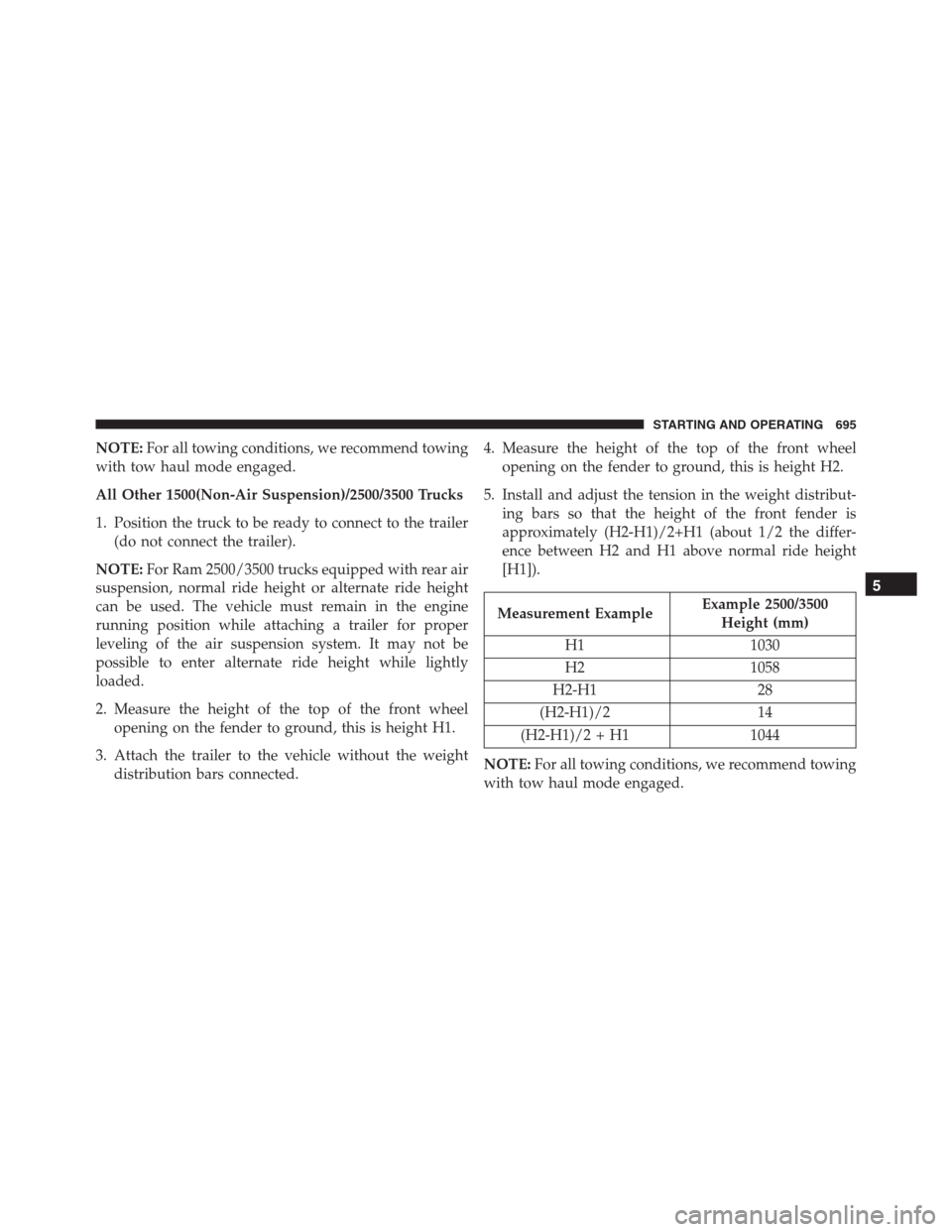
2. Measure the height of the top of the front wheel
opening on the fender to ground, this is height H1.
3. Attach the trailer to the vehicle without the weight
distribution bars connected.4. Measure the height of the top of the front wheel
opening on the fender to ground, this is height H2.
5. Install and adjust the tension in the weight distribut-
ing bars so that the height of the front fender is
approximately (H2-H1)/2+H1 (about 1/2 the differ-
ence between H2 and H1 above normal ride height
[H1]).
Measurement ExampleExample 2500/3500
Height (mm)
H1 1030
H2 1058
H2-H1 28
(H2-H1)/2 14
(H2-H1)/2 + H1 1044
NOTE:For all towing conditions, we recommend towing
with tow haul mode engaged.
5
STARTING AND OPERATING 695
Page 700 of 916
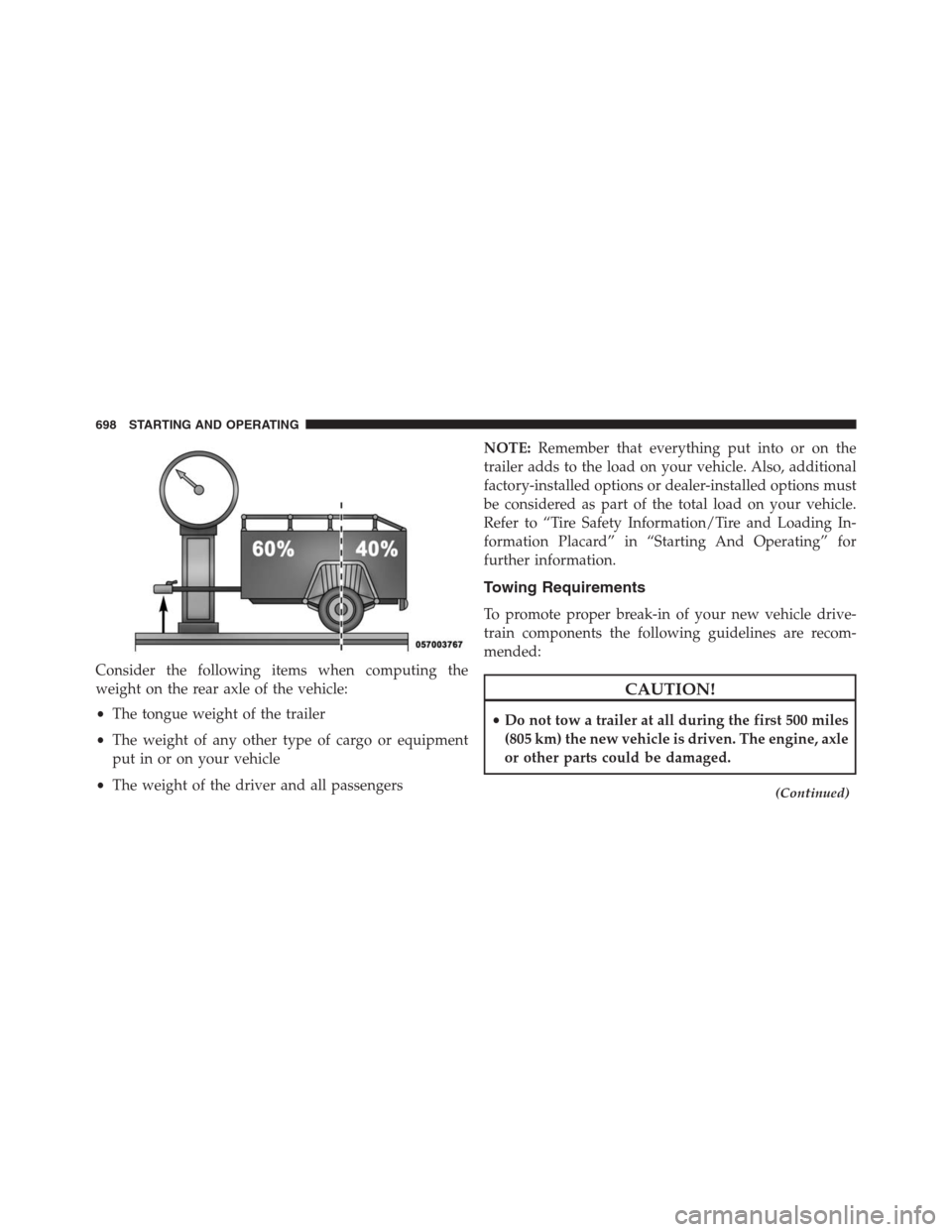
Consider the following items when computing the
weight on the rear axle of the vehicle:
•The tongue weight of the trailer
•The weight of any other type of cargo or equipment
put in or on your vehicle
•The weight of the driver and all passengersNOTE:Remember that everything put into or on the
trailer adds to the load on your vehicle. Also, additional
factory-installed options or dealer-installed options must
be considered as part of the total load on your vehicle.
Refer to “Tire Safety Information/Tire and Loading In-
formation Placard” in “Starting And Operating” for
further information.
Towing Requirements
To promote proper break-in of your new vehicle drive-
train components the following guidelines are recom-
mended:
CAUTION!
•Do not tow a trailer at all during the first 500 miles
(805 km) the new vehicle is driven. The engine, axle
or other parts could be damaged.
(Continued)
698 STARTING AND OPERATING
Page 704 of 916
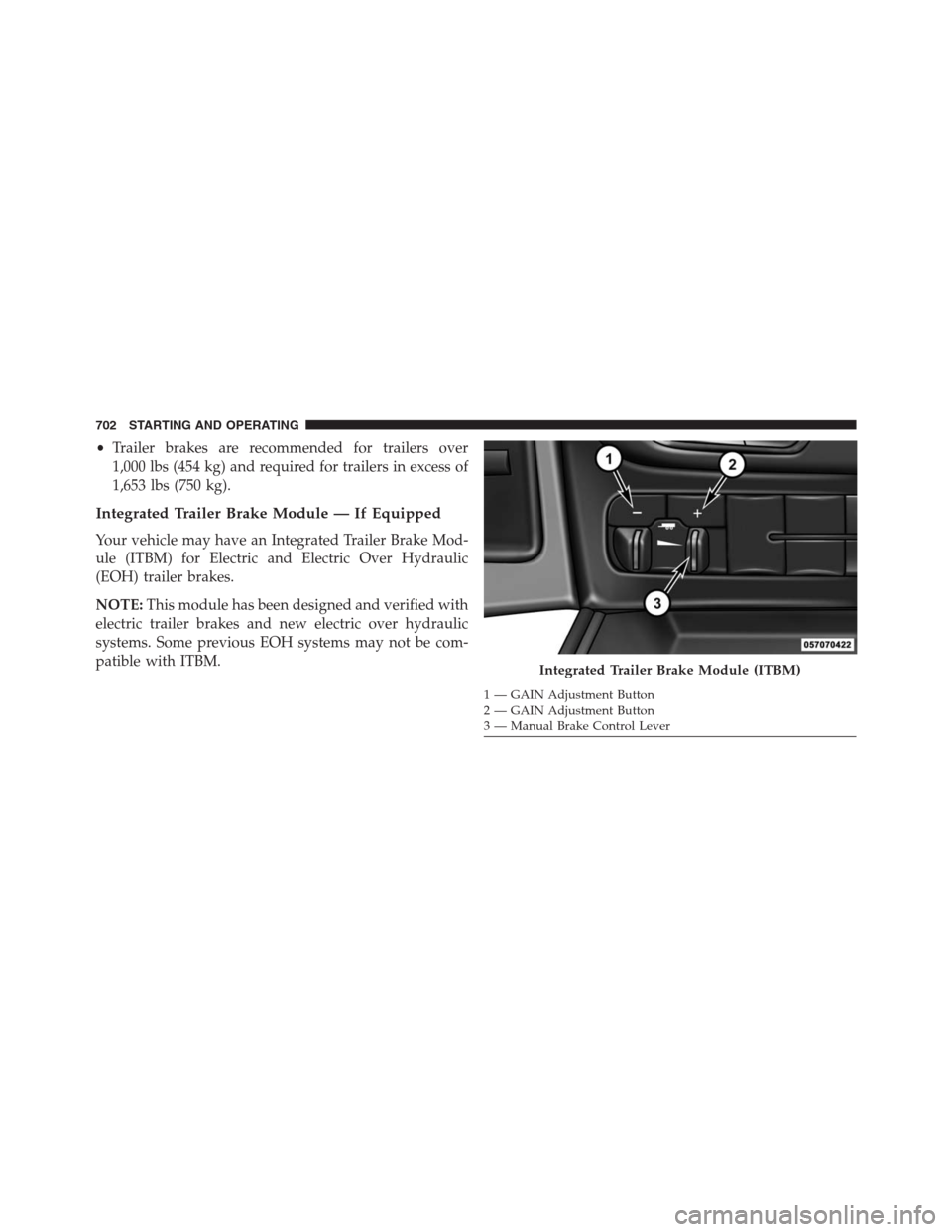
•Trailer brakes are recommended for trailers over
1,000 lbs (454 kg) and required for trailers in excess of
1,653 lbs (750 kg).
Integrated Trailer Brake Module — If Equipped
Your vehicle may have an Integrated Trailer Brake Mod-
ule (ITBM) for Electric and Electric Over Hydraulic
(EOH) trailer brakes.
NOTE:This module has been designed and verified with
electric trailer brakes and new electric over hydraulic
systems. Some previous EOH systems may not be com-
patible with ITBM.
Integrated Trailer Brake Module (ITBM)
1 — GAIN Adjustment Button
2 — GAIN Adjustment Button
3 — Manual Brake Control Lever 702 STARTING AND OPERATING
Page 705 of 916
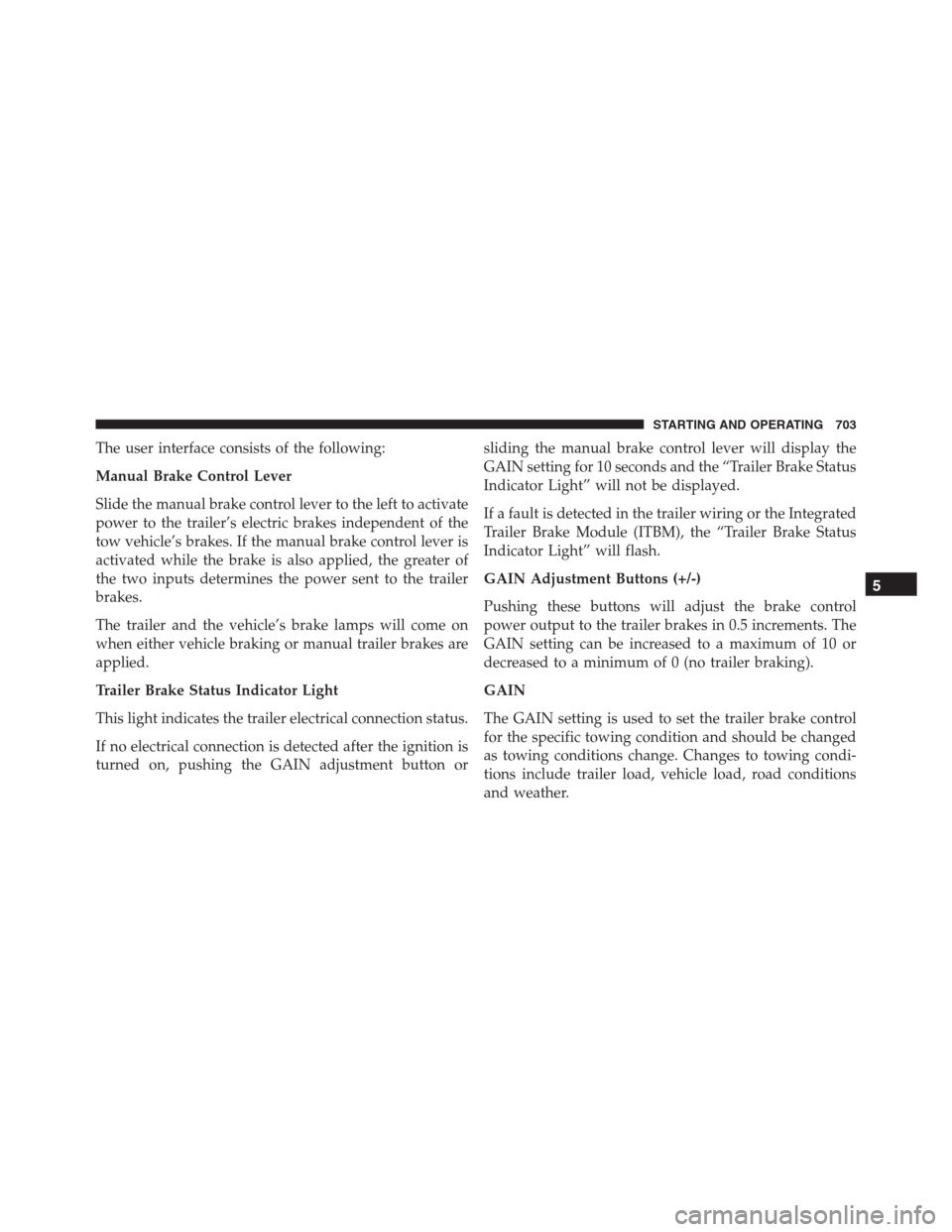
The user interface consists of the following:
Manual Brake Control Lever
Slide the manual brake control lever to the left to activate
power to the trailer’s electric brakes independent of the
tow vehicle’s brakes. If the manual brake control lever is
activated while the brake is also applied, the greater of
the two inputs determines the power sent to the trailer
brakes.
The trailer and the vehicle’s brake lamps will come on
when either vehicle braking or manual trailer brakes are
applied.
Trailer Brake Status Indicator Light
This light indicates the trailer electrical connection status.
If no electrical connection is detected after the ignition is
turned on, pushing the GAIN adjustment button orsliding the manual brake control lever will display the
GAIN setting for 10 seconds and the “Trailer Brake Status
Indicator Light” will not be displayed.
If a fault is detected in the trailer wiring or the Integrated
Trailer Brake Module (ITBM), the “Trailer Brake Status
Indicator Light” will flash.
GAIN Adjustment Buttons (+/-)
Pushing these buttons will adjust the brake control
power output to the trailer brakes in 0.5 increments. The
GAIN setting can be increased to a maximum of 10 or
decreased to a minimum of 0 (no trailer braking).
GAIN
The GAIN setting is used to set the trailer brake control
for the specific towing condition and should be changed
as towing conditions change. Changes to towing condi-
tions include trailer load, vehicle load, road conditions
and weather.
5
STARTING AND OPERATING 703
Page 706 of 916
Adjusting GAIN
NOTE:This should only be performed in a traffic free
environment at speeds of approximately 20–25 mph
(30–40 km/h).
1. Make sure the trailer brakes are in good working
condition, functioning normally and properly ad-
justed. See your trailer dealer if necessary.
2. Hook up the trailer and make the electrical connec-
tions according to the trailer manufacturer’s instruc-
tions.
3. When a trailer with electric/EOH brakes is plugged
in, the trailer connected message should appear in the
EVIC/DID (if the connection is not recognized by the
ITBM, braking functions will not be available), the
GAIN setting will illuminate and the correct type of
trailer must be selected from the EVIC/DID options.4. Push the UP or DOWN button on the steering wheel
until “TRAILER TOW” appears on the screen.
5. Push the RIGHT arrow on the steering wheel to enter
“TRAILER TOW”.
6. Push the UP or DOWN buttons until Trailer Brake
Type appears on the screen.
7. Push the RIGHT arrow and then push the UP or
DOWN buttons until the proper Trailer Brake Type
appears on the screen.
8. In a traffic-free environment, tow the trailer on a dry,
level surface at a speed of 20–25 mph (30–40 km/h)
and squeeze the manual brake control lever com-
pletely.
9. If the trailer wheels lockup (indicated by squealing
tires), reduce the GAIN setting; if the trailer wheels
turn freely, increase the GAIN setting.
704 STARTING AND OPERATING
Page 713 of 916
WARNING!(Continued)
Do not expect that the airbag will perform as de-
scribed earlier in this manual.
2500/3500 Models Only
Snowplow Prep Packages are available as a factory
installed option. These packages include components
necessary to equip your vehicle with a snowplow.
NOTE:Before installation of a snowplow it is highly
recommended that the owner/installer obtain and follow
the recommendations contained within the current Body
Builders Guide. See your authorized dealer, installer or
snowplow manufacturer for this information. There are
unique electrical systems that must be connected to
properly assure operator safety and prevent overloading
vehicle systems.
WARNING!
Attaching a snowplow to this vehicle could adversely
affect performance of the airbag system in a collision.
Do not expect that the airbag will perform as de-
scribed earlier in this manual.
CAUTION!
The “Lamp Out” indicator could illuminate if exte-
rior lamps are not properly installed.
Before Plowing
•Check the hydraulic system for leaks and proper fluid
level.
•Check the mounting bolts and nuts for proper tight-
ness.
5
STARTING AND OPERATING 711
Page 715 of 916
Maintain and operate your vehicle and snowplow equip-
ment following the recommendations provided by the
specific snowplow manufacturer.
Over The Road Operation With Snowplow
Attached
The blade restricts air flow to the radiator and causes the
engine to operate at higher than normal temperatures.
Therefore, when transporting the plow, angle the blade
completely and position it as low as road or surface
conditions permit. Do not exceed 40 mph (64 km/h). The
operator should always maintain a safe stopping distance
and allow adequate passing clearance.
Operating Tips
Under ideal snow plowing conditions, 20 mph (32 km/h)
should be maximum operating speed. The operator
should be familiar with the area and surface to be
cleaned. Reduce speed and use extreme caution when
plowing unfamiliar areas or under poor visibility.
General Maintenance
Snowplows should be maintained in accordance with the
plow manufacturer’s instructions.
Keep all snowplow electrical connections and battery
terminals clean and free of corrosion.
When plowing snow, to avoid transmission and drivetrain
damage, the following precautions should be observed.
•Operate with transfer case in 4L when plowing small or
congested areas where speeds are not likely to exceed
15 mph (24 km/h). At higher speeds operate in 4H.
•Vehicles with automatic transmissions should use 4L
range when plowing deep or heavy snow for extended
periods of time to avoid transmission overheating.
•Do not shift the transmission unless the engine has
returned to idle and wheels have stopped. Make a
practice of stepping on the brake pedal while shifting
the transmission.
5
STARTING AND OPERATING 713
Page 721 of 916

shift to NEUTRAL (N) is complete. After the shift is
completed and the NEUTRAL (N) light stays on,
release the NEUTRAL (N) button.
6. Release the parking brake.
7. Shift the transmission into REVERSE.
8. Release the brake pedal (and clutch pedal on manual
transmissions) for five seconds and ensure that there is
no vehicle movement.
9. Repeat steps 7 and 8 with automatic transmission in
DRIVE or manual transmission in first gear.
10. Shift the transmission to NEUTRAL. Firmly apply
the parking brake. Turn OFF the engine. For vehicles
with Keyless Enter-N-Go, push and hold the EN-
GINE START/STOP button until the engine shuts off.11. Shift the transmission into PARK or place manual
transmission in gear (NOT in Neutral). On 8-speed
transmissions the shifter will automatically select
PARK when the engine is turned off.
12. Turn the ignition switch to the OFF position, then
cycle the Key or the Keyless Enter-N-Go button to the
RUN position and back to the OFF position. Remove
the Key Fob from the ignition switch.
13. Attach the vehicle to the tow vehicle using a suitable
tow bar.
14. Release the parking brake.
NOTE:With electronic shift transfer case:
•Steps 2 through 4 are requirements that must be met
before pushing the NEUTRAL (N) button, and must
continue to be met until the shift has been completed.
If any of these requirements are not met before push-
ing the NEUTRAL (N) button or are no longer met
5
STARTING AND OPERATING 719