cooling system Ram 1500 2016 Owner's Guide
[x] Cancel search | Manufacturer: RAM, Model Year: 2016, Model line: 1500, Model: Ram 1500 2016Pages: 916, PDF Size: 7.55 MB
Page 821 of 916
WARNING!
•Do not open hot engine cooling system. Never add
engine coolant (antifreeze) when the engine is
overheated. Do not loosen or remove the cap to cool
an overheated engine. Heat causes pressure to
build up in the cooling system. To prevent scalding
or injury, do not remove the pressure cap while the
system is hot or under pressure.
•Do not use a pressure cap other than the one
specified for your vehicle. Personal injury or en-
gine damage may result.
Disposal Of Used Engine Coolant
Used ethylene glycol-based engine coolant (antifreeze) is
a regulated substance requiring proper disposal. Check
with your local authorities to determine the disposal
rules for your community. To prevent ingestion by ani-
mals or children, do not store ethylene glycol-based
engine coolant (antifreeze) in open containers or allow it
to remain in puddles on the ground. If ingested by a child
or pet, seek emergency assistance immediately. Clean up
any ground spills immediately.
7
MAINTAINING YOUR VEHICLE 819
Page 824 of 916
bottle need only be checked once a month. When addi-
tional engine coolant (antifreeze) is needed to maintain
the proper level, it should be added to the coolant bottle.
Do not overfill.
Points To Remember
NOTE:When the vehicle is stopped after a few miles/
kilometers of operation, you may observe vapor coming
from the front of the engine compartment. This is nor-
mally a result of moisture from rain, snow, or high
humidity accumulating on the radiator and being vapor-
ized when the thermostat opens, allowing hot engine
coolant (antifreeze) to enter the radiator.
If an examination of your engine compartment shows no
evidence of radiator or hose leaks, the vehicle may be
safely driven. The vapor will soon dissipate.
•Do not overfill the coolant expansion bottle.•Check the coolant freeze point in the radiator and in
the coolant expansion bottle. If engine coolant (anti-
freeze) needs to be added, the contents of the coolant
expansion bottle must also be protected against freez-
ing.
•If frequent engine coolant (antifreeze) additions are
required, the cooling system should be pressure tested
for leaks.
•Maintain engine coolant (antifreeze) concentration at a
minimum of 50% OAT coolant (conforming to
MS.90032) and distilled water for proper corrosion
protection of your engine which contains aluminum
components.
•Make sure that the coolant expansion bottle overflow
hoses are not kinked or obstructed.
•Keep the front of the radiator clean. If your vehicle is
equipped with air conditioning, keep the front of the
condenser clean.
822 MAINTAINING YOUR VEHICLE
Page 864 of 916
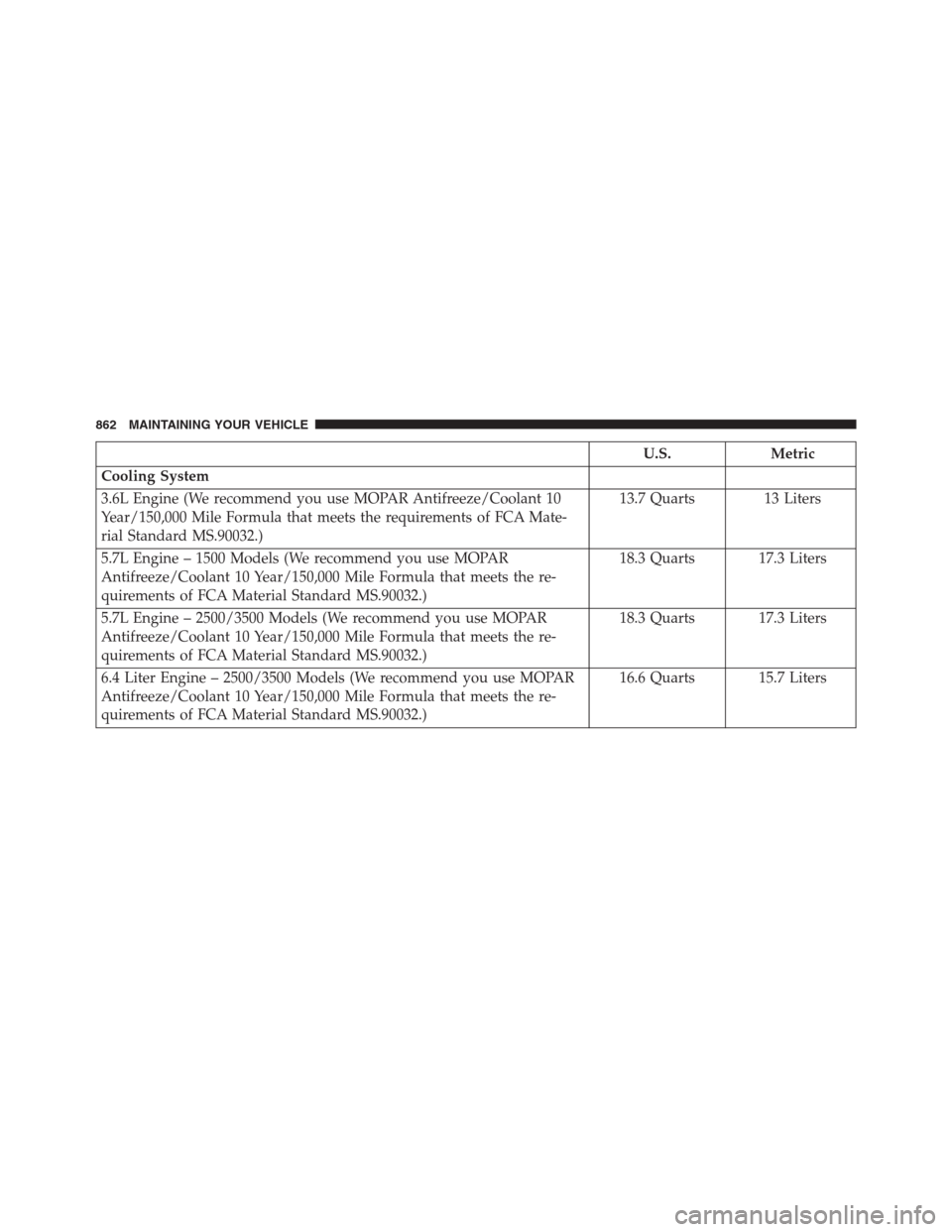
U.S. Metric
Cooling System
3.6L Engine (We recommend you use MOPAR Antifreeze/Coolant 10
Year/150,000 Mile Formula that meets the requirements of FCA Mate-
rial Standard MS.90032.)13.7 Quarts 13 Liters
5.7L Engine – 1500 Models (We recommend you use MOPAR
Antifreeze/Coolant 10 Year/150,000 Mile Formula that meets the re-
quirements of FCA Material Standard MS.90032.)18.3 Quarts 17.3 Liters
5.7L Engine – 2500/3500 Models (We recommend you use MOPAR
Antifreeze/Coolant 10 Year/150,000 Mile Formula that meets the re-
quirements of FCA Material Standard MS.90032.)18.3 Quarts 17.3 Liters
6.4 Liter Engine – 2500/3500 Models (We recommend you use MOPAR
Antifreeze/Coolant 10 Year/150,000 Mile Formula that meets the re-
quirements of FCA Material Standard MS.90032.)16.6 Quarts 15.7 Liters
862 MAINTAINING YOUR VEHICLE
Page 868 of 916
CAUTION!
•Mixing of engine coolant (antifreeze) other than
specified Organic Additive Technology (OAT) en-
gine coolant (antifreeze), may result in engine
damage and may decrease corrosion protection.
Organic Additive Technology (OAT) engine cool-
ant is different and should not be mixed with
Hybrid Organic Additive Technology (HOAT) en-
gine coolant (antifreeze) or any “globally compat-
ible” coolant (antifreeze). If a non-OAT engine
coolant (antifreeze) is introduced into the cooling
system in an emergency, the cooling system will
need to be drained, flushed, and refilled with fresh
OAT coolant (conforming to MS.90032), by an au-
thorized dealer as soon as possible.
(Continued)
CAUTION!(Continued)
•Do not use water alone or alcohol-based engine
coolant (antifreeze) products. Do not use additional
rust inhibitors or antirust products, as they may not
be compatible with the radiator engine coolant and
may plug the radiator.
•This vehicle has not been designed for use with
propylene glycol-based engine coolant (antifreeze).
Use of propylene glycol-based engine coolant (an-
tifreeze) is not recommended.
866 MAINTAINING YOUR VEHICLE
Page 874 of 916
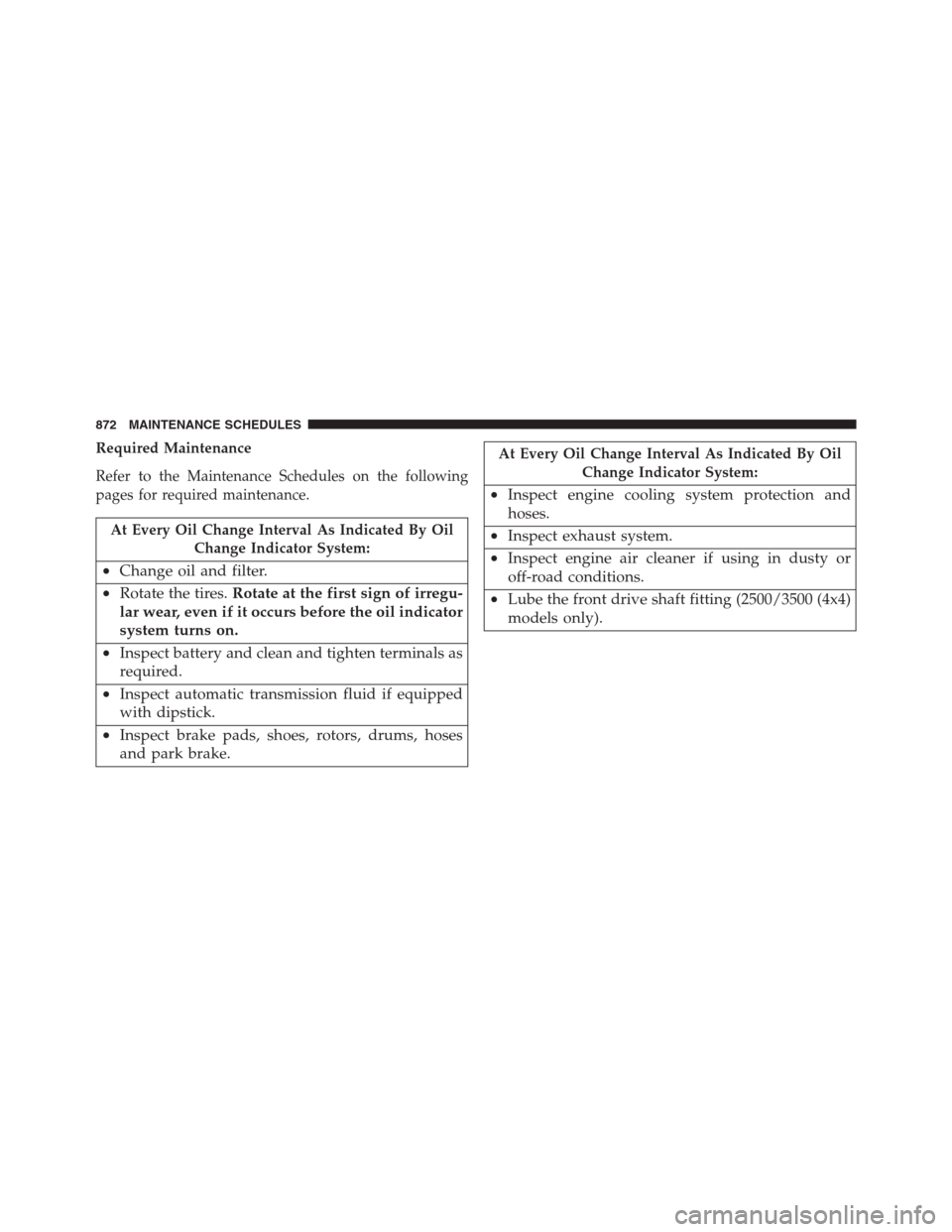
Required Maintenance
Refer to the Maintenance Schedules on the following
pages for required maintenance.
At Every Oil Change Interval As Indicated By Oil
Change Indicator System:
•Change oil and filter.
•Rotate the tires.Rotate at the first sign of irregu-
lar wear, even if it occurs before the oil indicator
system turns on.
•Inspect battery and clean and tighten terminals as
required.
•Inspect automatic transmission fluid if equipped
with dipstick.
•Inspect brake pads, shoes, rotors, drums, hoses
and park brake.
At Every Oil Change Interval As Indicated By Oil
Change Indicator System:
•Inspect engine cooling system protection and
hoses.
•Inspect exhaust system.
•Inspect engine air cleaner if using in dusty or
off-road conditions.
•Lube the front drive shaft fitting (2500/3500 (4x4)
models only).
872 MAINTENANCE SCHEDULES
Page 897 of 916
Cleaning
Wheels...............................833
Climate Control.......................422, 432
Automatic............................432
Cold Weather Operation....................480
Compact Disc (CD) Maintenance..............419
Compact Spare Tire........................654
Console, Overhead........................217
Contract, Service..........................883
Coolant Pressure Cap (Radiator Cap)...........818
Cooling System...........................815
Adding Coolant (Antifreeze)...............817
Coolant Capacity.......................861
Coolant Level...................815, 820, 821
Disposal Of Used Coolant.................819
Drain, Flush, And Refill...................816
Inspection.........................820, 821
Points To Remember.....................822
Pressure Cap..........................818Radiator Cap..........................818
Selection Of Coolant (Antifreeze)......816, 861, 863
Corrosion Protection.......................830
Cruise Light..........................330, 332
Cupholders.............................239
Customer Assistance.......................881
Customer Programmable Features.............398
Data Recorder, Event.......................83
Daytime Running Lights....................174
Dealer Service............................794
Defroster, Rear Window.....................249
Defroster, Windshield...................119,425
Delay (Intermittent) Wipers..................185
Differential, Limited-Slip....................587
Dipsticks
Power Steering.........................615
Disabled Vehicle Towing...................
.781
10
INDEX 895
Page 911 of 916
Dual.............................663, 726
General Information..................647, 653
High Speed...........................650
Inflation Pressures.......................648
Life Of Tires...........................657
Load Capacity......................642, 643
Pressure Monitor System (TPMS)............665
Pressure Warning Light...................314
Quality Grading........................887
Radial...............................650
Replacement...........................657
Rotation..............................662
Safety............................636, 647
Sizes................................637
Snow Tires............................652
Spare Tire.........................653, 655
Spinning.............................656
Tread Wear Indicators....................656
Tire Safety Information.....................636Tongue Weight/Trailer Weight................697
Tonneau Cover...........................837
Tonneau Cover Cleaning....................837
Torque Converter Clutch.................510, 521
Tow Hooks, Emergency.....................776
Towing.............................688, 781
Disabled Vehicle........................781
Guide...............................697
Recreational...........................714
Weight...............................697
Towing Vehicle Behind A Motorhome...........714
Traction................................588
Traction Control..........................625
Trailer Sway Control (TSC)..................632
Trailer Towing..........................
.688
Cooling System Tips.....................709
Hitches..............................696
Minimum Requirements..................698
Mirrors..............................144
10
INDEX 909