def Ram 1500 2016 Service Manual
[x] Cancel search | Manufacturer: RAM, Model Year: 2016, Model line: 1500, Model: Ram 1500 2016Pages: 916, PDF Size: 7.55 MB
Page 485 of 916
•Battery temperature too warm or cold.
•The vehicle is on a steep grade.
•Cabin heating or cooling is in process and an accept-
able cabin temperature has not been achieved.
•HVAC is set to full defrost mode at a high blower
speed.
•Engine has not reached normal operating temperature.
•Battery discharged.
•The transmission is not in DRIVE.
•Hood is open.
•Vehicle is in 4LO transfer case mode.
Other factors which can inhibit AutoStop include: fuel
level, accelerator pedal input, engine temp too high and
steering angle.It may be possible for the vehicle to be driven several
times without the STOP/START system going into a
STOP/START READY state under more extreme condi-
tions of the items listed above.
To Start The Engine While In Autostop Mode
While in DRIVE the engine will start when the brake
pedal is released or the throttle pedal is depressed. The
transmission will automatically reengage upon engine
restart. During this transition the brakes will hold the
vehicle to avoid undesired vehicle movement.
Conditions That Will Cause The Engine To Start Auto-
matically While In Autostop Mode
The engine will start automatically when:
•The transmission selector is moved from DRIVE to
REVERSE or NEUTRAL
5
STARTING AND OPERATING 483
Page 486 of 916
•To maintain cabin temperature near the HVAC settings
•HVAC is set to full defrost mode
•Autostop time exceeds 5 minutes
•Battery voltage drops too low
•Low brake vacuum (e.g. after several brake pedal
applications)
•STOP/START OFF switch is pushed
•4WD system is put into 4LO mode
•The emissions system requires it
•A STOP/START system error occurs
Conditions That Force An Automatic Shift To Park
While In Autostop Mode
The engine will not start automatically and the transmis-
sion will be placed in PARK if:•The driver door is open and brake pedal released
•The driver door is open and the driver seat belt is
unbuckled
•The engine hood has been opened
•A STOP/START system error occurs
The engine may then be restarted by moving the trans-
mission shift selector out of PARK (e.g. to DRIVE) or, in
some cases, only by a KEY START. The Electronic Vehicle
Information Center (EVIC)/Driver Information Display
(DID) will display a SHIFT OUT OF PARK message, or a
STOP/START KEY START REQUIRED message, to indi-
cate which action is required. Refer to “Electronic Vehicle
Information Center (EVIC) or Driver Information Display
(DID)” in “Understanding Your Instrument Panel” for
further information.
484 STARTING AND OPERATING
Page 501 of 916
the default at engine start-up. If TOW/HAUL mode is
desired, the switch must be pushed each time the engine
is started.
Six-Speed Automatic Transmission — 1500
Models Only (If Equipped)
The transmission gear position display (located in the
instrument cluster) indicates the transmission gear range.
The shift lever is mounted either on the right side of the
steering column (if equipped) or on the console (if
equipped). You must press the brake pedal to move the
shift lever out of PARK (refer to “Brake/Transmission
Shift Interlock System” in this section). To drive, move
the shift lever from PARK or NEUTRAL to the DRIVE
position. Pull the shift lever toward you when shifting
into REVERSE or PARK, or when shifting out of PARK
(column shift only).
The electronically-controlled transmission provides a
precise shift schedule. The transmission electronics areself-calibrating; therefore, the first few shifts on a new
vehicle may be somewhat abrupt. This is a normal
condition, and precision shifts will develop within a few
hundred miles (kilometers).
Only shift from DRIVE to PARK or REVERSE when the
accelerator pedal is released and the vehicle is stopped.
Be sure to keep your foot on the brake pedal when
shifting between these gears.
The transmission shift lever has only PARK, REVERSE,
NEUTRAL, and DRIVE shift positions. Manual down-
shifts can be made using the Electronic Range Select
(ERS) shift control (refer to “Electronic Range Select (ERS)
Operation” in this section for further information). Press-
ing the ERS (-/+) switches (column shift) or moving the
shift lever to the left or right (-/+) (console shift) while in
the DRIVE position will select the highest available
transmission gear, and will display that gear limit in the
instrument cluster as 1, 2, 3, etc. Models with the Driver
5
STARTING AND OPERATING 499
Page 512 of 916
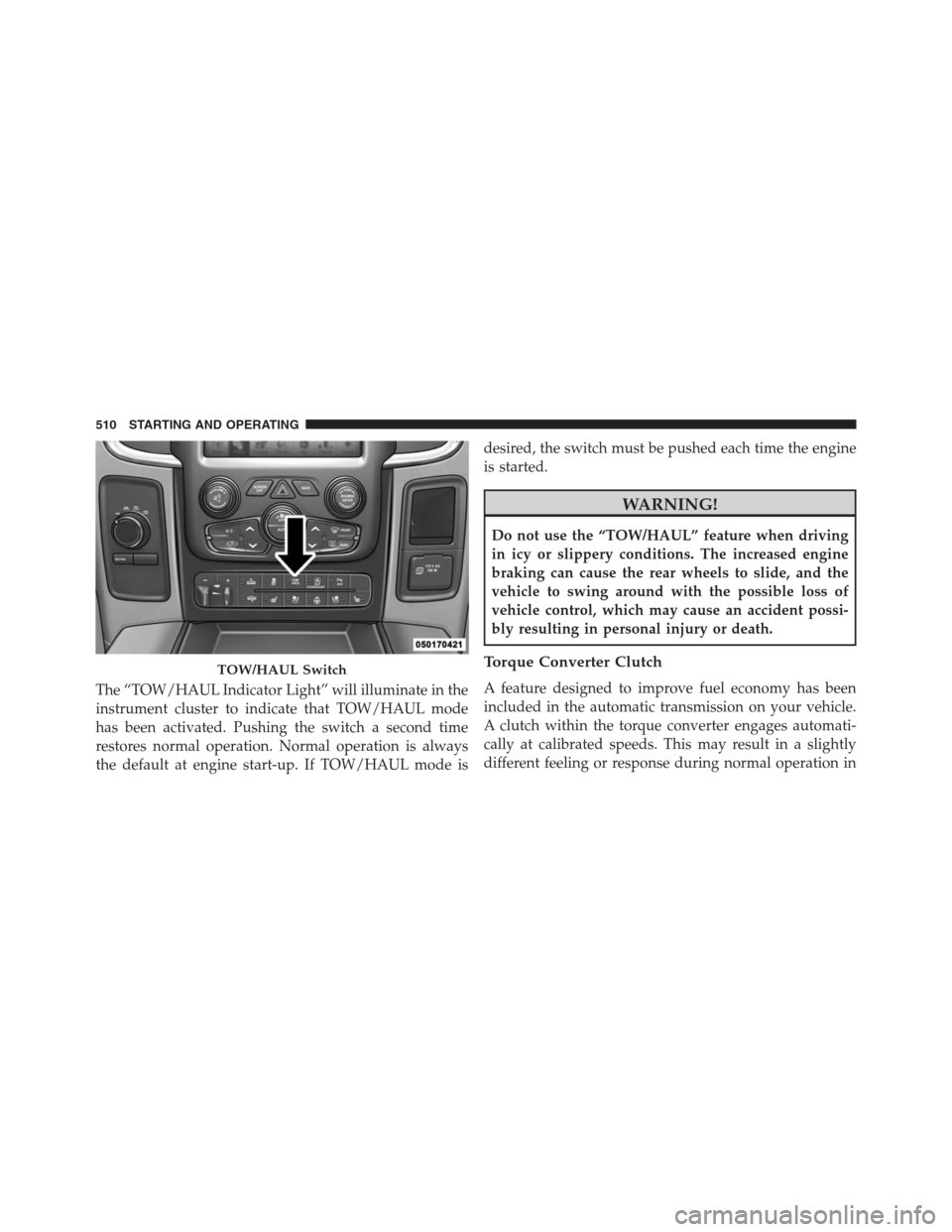
The “TOW/HAUL Indicator Light” will illuminate in the
instrument cluster to indicate that TOW/HAUL mode
has been activated. Pushing the switch a second time
restores normal operation. Normal operation is always
the default at engine start-up. If TOW/HAUL mode isdesired, the switch must be pushed each time the engine
is started.
WARNING!
Do not use the “TOW/HAUL” feature when driving
in icy or slippery conditions. The increased engine
braking can cause the rear wheels to slide, and the
vehicle to swing around with the possible loss of
vehicle control, which may cause an accident possi-
bly resulting in personal injury or death.
Torque Converter Clutch
A feature designed to improve fuel economy has been
included in the automatic transmission on your vehicle.
A clutch within the torque converter engages automati-
cally at calibrated speeds. This may result in a slightly
different feeling or response during normal operation in
TOW/HAUL Switch
510 STARTING AND OPERATING
Page 523 of 916
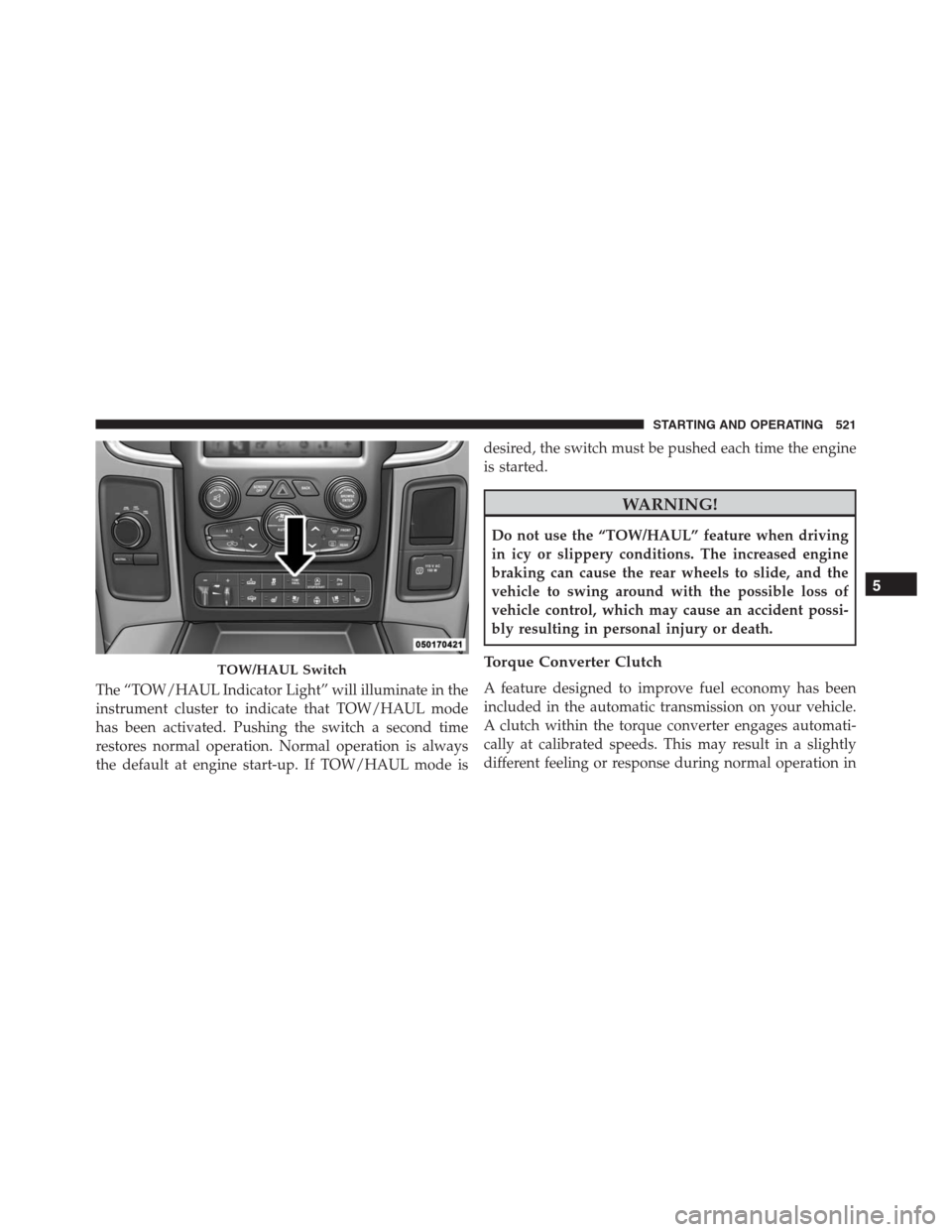
The “TOW/HAUL Indicator Light” will illuminate in the
instrument cluster to indicate that TOW/HAUL mode
has been activated. Pushing the switch a second time
restores normal operation. Normal operation is always
the default at engine start-up. If TOW/HAUL mode isdesired, the switch must be pushed each time the engine
is started.
WARNING!
Do not use the “TOW/HAUL” feature when driving
in icy or slippery conditions. The increased engine
braking can cause the rear wheels to slide, and the
vehicle to swing around with the possible loss of
vehicle control, which may cause an accident possi-
bly resulting in personal injury or death.
Torque Converter Clutch
A feature designed to improve fuel economy has been
included in the automatic transmission on your vehicle.
A clutch within the torque converter engages automati-
cally at calibrated speeds. This may result in a slightly
different feeling or response during normal operation in
TOW/HAUL Switch
5
STARTING AND OPERATING 521
Page 617 of 916

system. This noise should be considered normal, and it
does not in any way damage the steering system.
CAUTION!
Prolonged operation of the steering system at the end
of the steering wheel travel will increase the steering
fluid temperature and it should be avoided when
possible. Damage to the power steering pump may
occur.
Power Steering Fluid Check — 2500/3500 Models
Checking the power steering fluid level at a defined
service interval is not required. The fluid should only be
checked if a leak is suspected, abnormal noises are
apparent, and/or the system is not functioning as antici-
pated. Coordinate inspection efforts through an autho-
rized dealer.
CAUTION!
Do not use chemical flushes in your power steering
system as the chemicals can damage your power
steering components. Such damage is not covered by
the New Vehicle Limited Warranty.
WARNING!
Fluid level should be checked on a level surface and
with the engine off to prevent injury from moving
parts and to ensure accurate fluid level reading. Do
not overfill. Use only manufacturer’s recommended
power steering fluid.
If necessary, add fluid to restore to the proper indicated
level. With a clean cloth, wipe any spilled fluid from all
surfaces. Refer to “Fluids, Lubricants, And Genuine
Parts” in “Maintaining Your Vehicle” for further informa-
tion.
5
STARTING AND OPERATING 615
Page 643 of 916
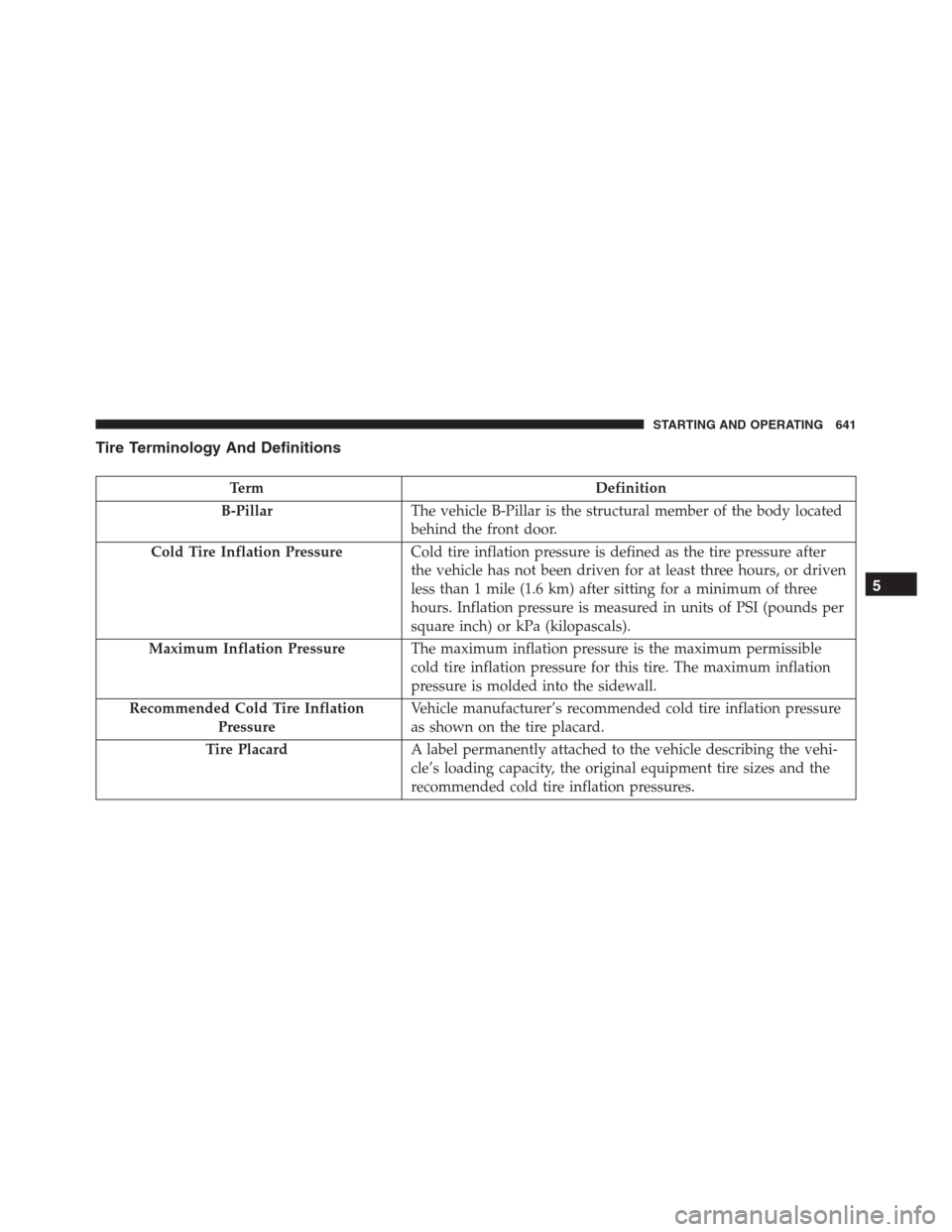
Tire Terminology And Definitions
Term Definition
B-PillarThe vehicle B-Pillar is the structural member of the body located
behind the front door.
Cold Tire Inflation PressureCold tire inflation pressure is defined as the tire pressure after
the vehicle has not been driven for at least three hours, or driven
less than 1 mile (1.6 km) after sitting for a minimum of three
hours. Inflation pressure is measured in units of PSI (pounds per
square inch) or kPa (kilopascals).
Maximum Inflation PressureThe maximum inflation pressure is the maximum permissible
cold tire inflation pressure for this tire. The maximum inflation
pressure is molded into the sidewall.
Recommended Cold Tire Inflation
PressureVehicle manufacturer’s recommended cold tire inflation pressure
as shown on the tire placard.
Tire PlacardA label permanently attached to the vehicle describing the vehi-
cle’s loading capacity, the original equipment tire sizes and the
recommended cold tire inflation pressures.
5
STARTING AND OPERATING 641
Page 651 of 916
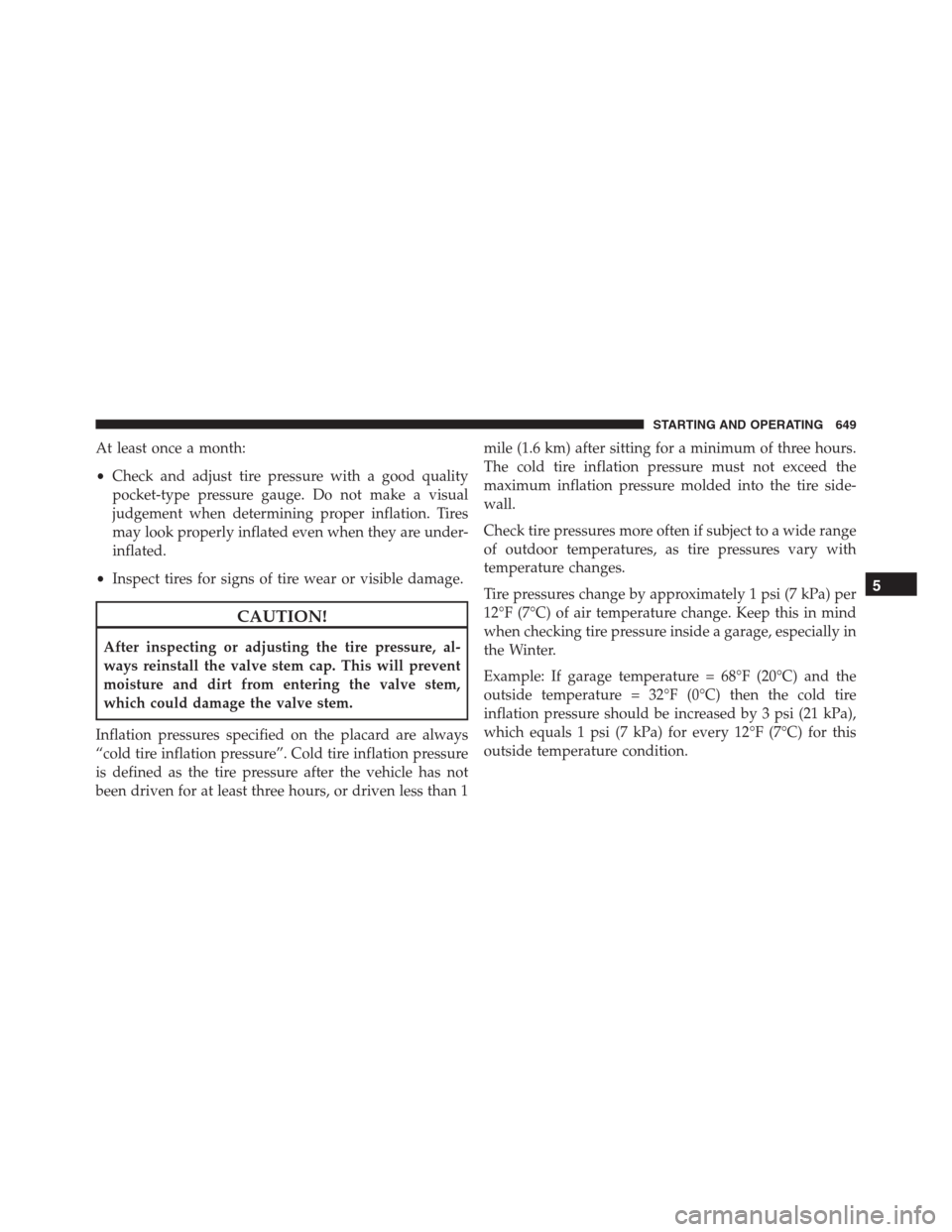
At least once a month:
•Check and adjust tire pressure with a good quality
pocket-type pressure gauge. Do not make a visual
judgement when determining proper inflation. Tires
may look properly inflated even when they are under-
inflated.
•Inspect tires for signs of tire wear or visible damage.
CAUTION!
After inspecting or adjusting the tire pressure, al-
ways reinstall the valve stem cap. This will prevent
moisture and dirt from entering the valve stem,
which could damage the valve stem.
Inflation pressures specified on the placard are always
“cold tire inflation pressure”. Cold tire inflation pressure
is defined as the tire pressure after the vehicle has not
been driven for at least three hours, or driven less than 1mile (1.6 km) after sitting for a minimum of three hours.
The cold tire inflation pressure must not exceed the
maximum inflation pressure molded into the tire side-
wall.
Check tire pressures more often if subject to a wide range
of outdoor temperatures, as tire pressures vary with
temperature changes.
Tire pressures change by approximately 1 psi (7 kPa) per
12°F (7°C) of air temperature change. Keep this in mind
when checking tire pressure inside a garage, especially in
the Winter.
Example: If garage temperature = 68°F (20°C) and the
outside temperature = 32°F (0°C) then the cold tire
inflation pressure should be increased by 3 psi (21 kPa),
which equals 1 psi (7 kPa) for every 12°F (7°C) for this
outside temperature condition.
5
STARTING AND OPERATING 649
Page 661 of 916
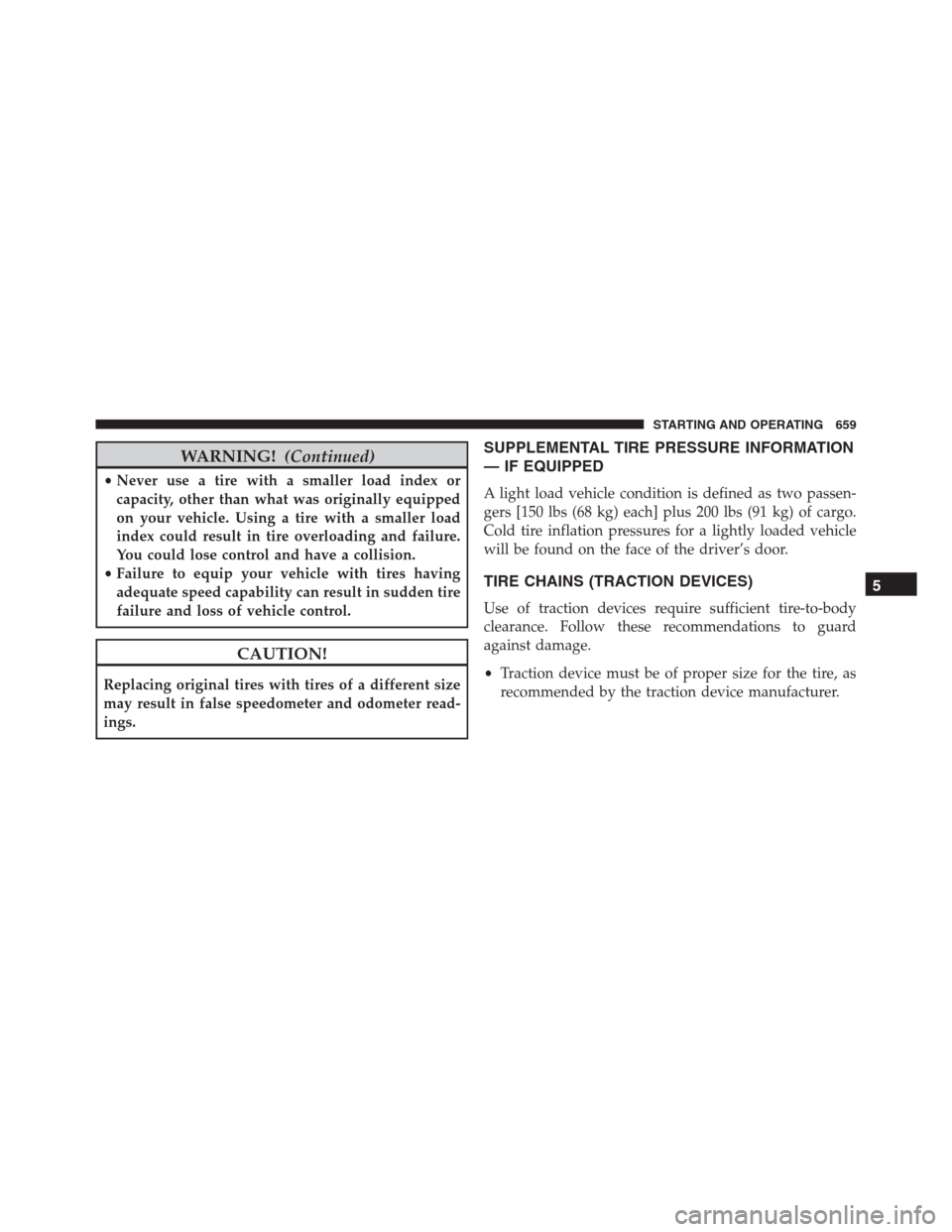
WARNING!(Continued)
•Never use a tire with a smaller load index or
capacity, other than what was originally equipped
on your vehicle. Using a tire with a smaller load
index could result in tire overloading and failure.
You could lose control and have a collision.
•Failure to equip your vehicle with tires having
adequate speed capability can result in sudden tire
failure and loss of vehicle control.
CAUTION!
Replacing original tires with tires of a different size
may result in false speedometer and odometer read-
ings.
SUPPLEMENTAL TIRE PRESSURE INFORMATION
— IF EQUIPPED
A light load vehicle condition is defined as two passen-
gers [150 lbs (68 kg) each] plus 200 lbs (91 kg) of cargo.
Cold tire inflation pressures for a lightly loaded vehicle
will be found on the face of the driver’s door.
TIRE CHAINS (TRACTION DEVICES)
Use of traction devices require sufficient tire-to-body
clearance. Follow these recommendations to guard
against damage.
•Traction device must be of proper size for the tire, as
recommended by the traction device manufacturer.
5
STARTING AND OPERATING 659
Page 667 of 916
TIRE PRESSURE MONITOR SYSTEM (TPMS)
The Tire Pressure Monitor System (TPMS) will warn the
driver of a low tire pressure based on the vehicle recom-
mended cold placard pressure.
The tire pressure will vary with temperature by about 1
psi (7 kPa) for every 12°F (6.5°C). This means that when
the outside temperature decreases, the tire pressure will
decrease. Tire pressure should always be set based on
cold inflation tire pressure. This is defined as the tire
pressure after the vehicle has not been driven for at least
three hours, or driven less than 1 mile (1.6 km) after a
three hour period. The cold tire inflation pressure must
not exceed the maximum inflation pressure molded into
the tire sidewall. Refer to “Tires – General Information”
in “Starting And Operating” for information on how to
properly inflate the vehicle’s tires. The tire pressure willalso increase as the vehicle is driven - this is normal and
there should be no adjustment for this increased pres-
sure.
The TPMS will warn the driver of a low tire pressure if
the tire pressure falls below the low-pressure warning
limit for any reason, including low temperature effects
and natural pressure loss through the tire.
The TPMS will continue to warn the driver of low tire
pressure as long as the condition exists, and will not turn
off until the tire pressure is at or above the recommended
cold placard pressure. Once the low tire pressure warn-
ing (Tire Pressure Monitoring [TPM] Telltale Light) illu-
minates, you must increase the tire pressure to the
recommended cold placard pressure in order for the “Tire
Pressure Monitoring Telltale Light” to turn off. The
system will automatically update and the “Tire Pressure
Monitoring Telltale Light” will turn off once the system
receives the updated tire pressures. The vehicle may need
5
STARTING AND OPERATING 665