fuel Ram 1500 2017 Diesel Supplement
[x] Cancel search | Manufacturer: RAM, Model Year: 2017, Model line: 1500, Model: Ram 1500 2017Pages: 228, PDF Size: 1.35 MB
Page 44 of 228
•Commercially available fuel additives are not necessary
for the proper operation of your diesel engine.
• No. 1 Ultra Low Sulfur diesel fuel should only be used
where extended arctic conditions (-10°F or -23°C) exist.
Biodiesel Fuel Requirements
A maximum blend of 5% biodiesel meeting ASTM specifi-
cation D975 is recommended for use with your diesel
engine. If frequent operation with biodiesel blends that are
between 6% and 20% (B6–B20) is desired, the maintenance
schedule is subject to shorter intervals.
The oil and filter change along with fuel filter replacement
is subject to shorter intervals when operating your engine
on biodiesel greater than 5%. Do not use biodiesel greater
than 20%.
For regular use of biodiesel blends between 6% and 20%
(B6–B20) it is important that you understand and comply
with these requirements. Refer to the “Maintenance Chart”
in the “Maintenance Schedules” section for further direc-
tion.
CAUTION!
Failure to comply with Oil Change requirements for
vehicles operating on biodiesel blends between 6%
and 20% (B6–B20) will result in premature engine wear.
Such wear is not covered by the New Vehicle Limited
Warranty.
Biodiesel is a fuel produced from renewable resources
typically derived from animal fat, rapeseed oil (Rapeseed
Methyl Ester (RME) base), or soybean oil (Soy Methyl Ester
(SME or SOME) base).
Biodiesel fuel has inherent limitations which require that
you understand and adhere to the following requirements
if you use blends of biodiesel between 6% and 20%
(B6–B20). There are no unique restrictions for the use of B5.
CAUTION!
Use of blends greater than 20% is not approved. Use of
blends greater than 20% can result in engine damage.
Such damage is not covered by the New Vehicle
Limited Warranty.
42 STARTING AND OPERATING
Page 45 of 228
Biodiesel Fuel Properties — Low Ambient
Temperatures
Biodiesel fuel may gel or solidify at low ambient tempera-
tures, which may pose problems for both storage and
operation. Precautions can be necessary at low ambient
temperatures, such as storing the fuel in a heated building
or a heated storage tank, or using cold temperature addi-
tives.
Fuel Quality — Must Comply With ASTM
Standards
The quality of biodiesel fuel may vary widely. Only fuel
produced by a BQ9000 supplier to the following specifica-
tions may be blended to meet biodiesel blend B6 – B20 fuel
meeting ASTM specification D-7467:
•Petrodiesel fuel meeting ASTM specification D-975 and
biodiesel fuel (B100) meeting ASTM specification D-6751
Fuel Oxidation Stability — Must Use Fuel Within
Six Months Of Manufacture
Biodiesel fuel has poor oxidation stability which can result
in long term storage problems. Fuel produced to approved
ASTM standards, if stored properly, provides for protec-
tion against fuel oxidation for up to six months.
Fuel Water Separation — Must Use MOPAR
Approved Fuel Filter Elements
Biodiesel fuel has a natural affinity to water and water
accelerates microbial growth. Your MOPAR filtration sys-
tem is designed to provide adequate fuel water separation
capabilities.
Fuel In Oil Dilution — Must Adhere To Required
Oil Change Interval
Fuel dilution of lubricating oil has been observed with the
use of biodiesel fuel. Fuel in oil must not exceed 5%. To
ensure this limit is met your oil change interval must be
maintained with in the suggested schedule. The regular
use of biodiesel between 6% and 20% requires intervals
shorter than the outlined 10,000 miles and must not exceed
the suggested schedule. When routinely operating on
biodiesel between 6% and 20%, oil and filter replacement
intervals must not exceed 8,000 Miles or 6 months, which
ever comes first.
Biodiesel Fuel Filter Change Intervals
The use of biodiesel requires intervals shorter than the
outlined 30,000 miles (48,280 km) and must not exceed the
4
STARTING AND OPERATING 43
Page 46 of 228
suggested schedule. When operating on biodiesel between
6% and 20%, fuel filter replacement intervals must not
exceed 20,000 Miles (40,233 km).
NOTE:Under no circumstances should oil change inter-
vals exceed 8,000 miles (12,875 km) or 6 months, if regular
operation occurs with 6% - 20% biodiesel blends. Under no
circumstances should fuel filter intervals exceed 20,000
miles (40,233 km), if regular operation occurs with 6% -
20% biodiesel blends. Failure to comply with these Oil
Change and fuel filter requirements for vehicles operating
on biodiesel blends up to B20 may result in premature
engine wear. Such wear is not covered by the New Vehicle
Limited Warranty. The engine may suffer severe damage if
operated with concentrations of biodiesel higher than 20%.
DIESEL EXHAUST FLUID
Your vehicle is equipped with a Selective Catalytic Reduc-
tion system to meet the very stringent diesel emissions
standards required by the Environmental Protection
Agency.
The purpose of the SCR system is to reduce levels of NOx
(oxides of nitrogen emitted from engines) that are harmful
to our health and the environment to a near-zero level.
Small quantities of Diesel Exhaust Fluid (DEF) is injected into the exhaust upstream of a catalyst where, when
vaporized, it converts smog-forming nitrogen oxides
(NOx) into harmless nitrogen (N2) and water vapor (H2O),
two natural components of the air we breathe. You can
operate with the comfort that your vehicle is contributing
to a cleaner, healthier world environment for this and
generations to come.
System Overview
This vehicle is equipped with a Diesel Exhaust Fluid (DEF)
injection system and a Selective Catalytic Reduction (SCR)
catalyst to meet the emission requirements.
The DEF injection system consists of the following compo-
nents:
•
DEF tank
• DEF pump
• DEF injector
• Electronically-heated DEF lines
• NOx sensors
• Temperature sensors
• SCR catalyst
44 STARTING AND OPERATING
Page 47 of 228
The DEF injection system and SCR catalyst enable the
achievement of diesel emissions requirements; while main-
taining outstanding fuel economy, drivability, torque and
power ratings.
Refer to “Instrument Cluster Display” in “Understanding
Your Instrument Panel” for system messages and warn-
ings.
NOTE:
•Your vehicle is equipped with a DEF injection system.
You may occasionally hear an audible clicking noise
from under the vehicle at a stop. This is normal opera-
tion.
• The DEF pump will run for a period of time after engine
shutdown to purge the DEF system. This is normal
operation and may be audible from the rear of the
vehicle.
ADDING FUEL — 1500 DIESEL MODELS
1. Open the fuel filler door. NOTE:
There is no fuel filler cap. A flapper door inside the
filler pipe seals the system.
2. Insert the fuel nozzle fully into the filler pipe – the nozzle opens and holds the flapper door while refuel-
ing.
Diesel Fuel And Diesel Exhaust Fluid Fill Location
1 — Diesel Exhaust Fluid Fill Location
2 — Diesel Fuel Fill Location
4
STARTING AND OPERATING 45
Page 48 of 228
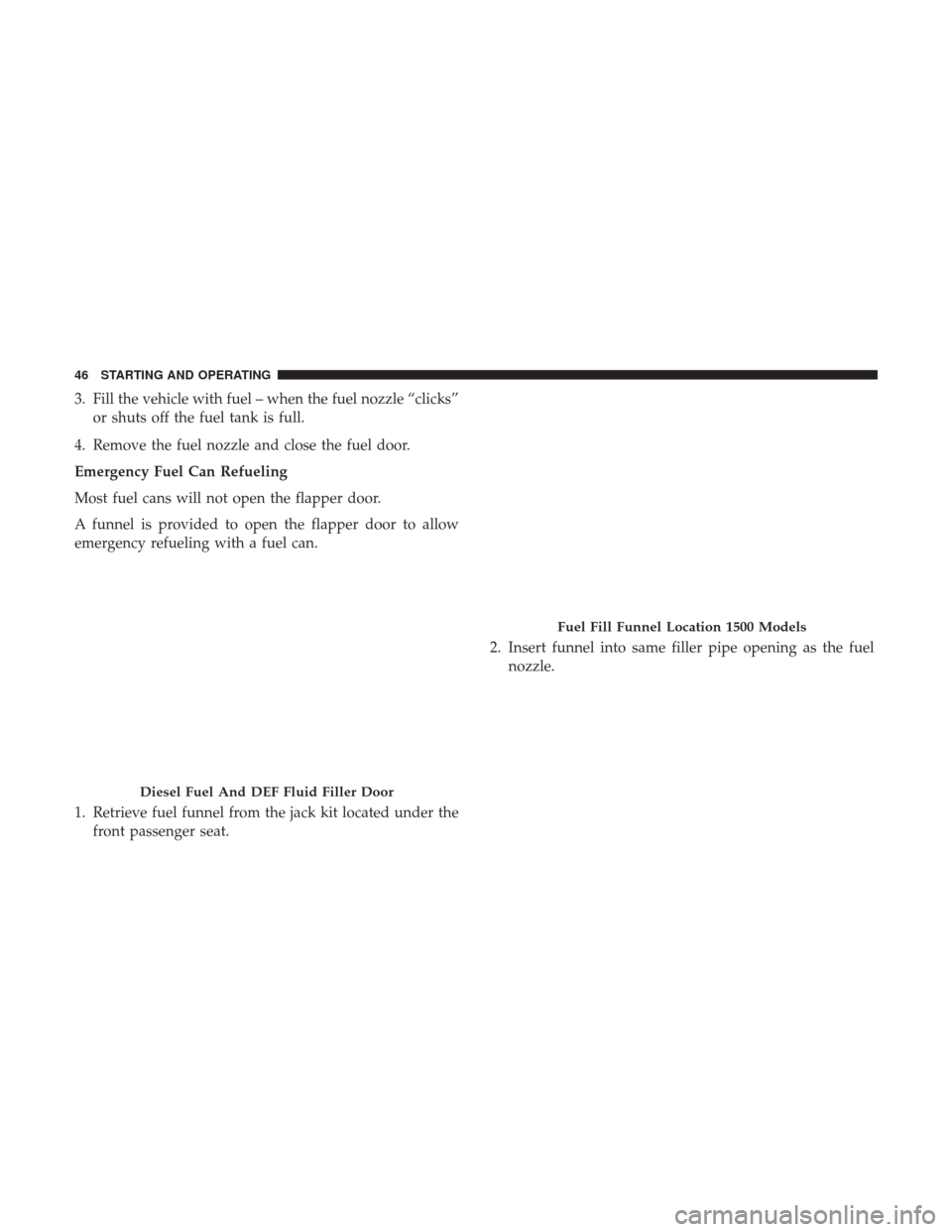
3. Fill the vehicle with fuel – when the fuel nozzle “clicks”or shuts off the fuel tank is full.
4. Remove the fuel nozzle and close the fuel door.
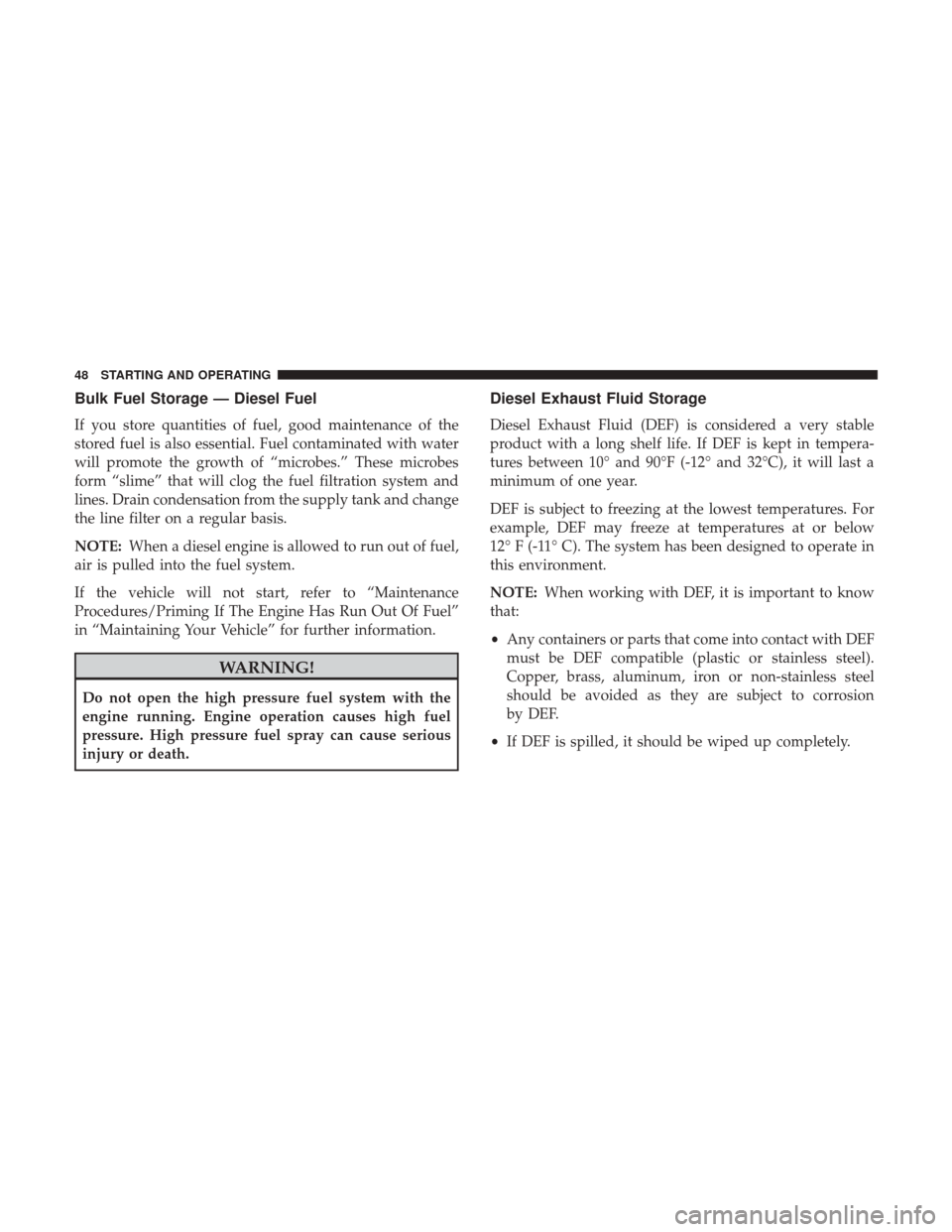
Emergency Fuel Can Refueling
Most fuel cans will not open the flapper door.
A funnel is provided to open the flapper door to allow
emergency refueling with a fuel can.
1. Retrieve fuel funnel from the jack kit located under the front passenger seat. 2. Insert funnel into same filler pipe opening as the fuel
nozzle.
Diesel Fuel And DEF Fluid Filler Door
Fuel Fill Funnel Location 1500 Models
46 STARTING AND OPERATING
Page 49 of 228
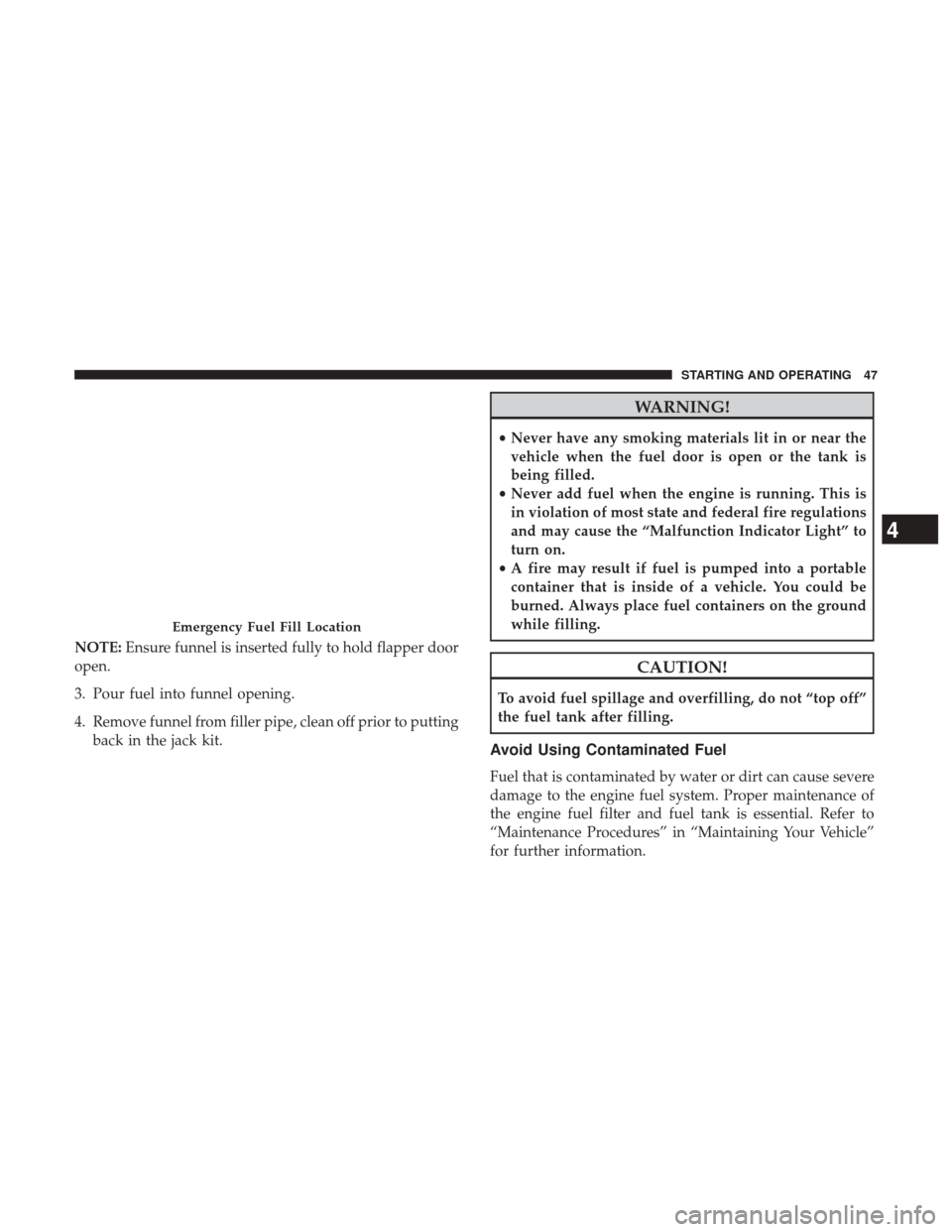
NOTE:Ensure funnel is inserted fully to hold flapper door
open.
3. Pour fuel into funnel opening.
4. Remove funnel from filler pipe, clean off prior to putting back in the jack kit.
WARNING!
•Never have any smoking materials lit in or near the
vehicle when the fuel door is open or the tank is
being filled.
• Never add fuel when the engine is running. This is
in violation of most state and federal fire regulations
and may cause the “Malfunction Indicator Light” to
turn on.
• A fire may result if fuel is pumped into a portable
container that is inside of a vehicle. You could be
burned. Always place fuel containers on the ground
while filling.
CAUTION!
To avoid fuel spillage and overfilling, do not “top off”
the fuel tank after filling.
Avoid Using Contaminated Fuel
Fuel that is contaminated by water or dirt can cause severe
damage to the engine fuel system. Proper maintenance of
the engine fuel filter and fuel tank is essential. Refer to
“Maintenance Procedures” in “Maintaining Your Vehicle”
for further information.
Emergency Fuel Fill Location
4
STARTING AND OPERATING 47
Page 50 of 228
Bulk Fuel Storage — Diesel Fuel
If you store quantities of fuel, good maintenance of the
stored fuel is also essential. Fuel contaminated with water
will promote the growth of “microbes.” These microbes
form “slime” that will clog the fuel filtration system and
lines. Drain condensation from the supply tank and change
the line filter on a regular basis.
NOTE:When a diesel engine is allowed to run out of fuel,
air is pulled into the fuel system.
If the vehicle will not start, refer to “Maintenance
Procedures/Priming If The Engine Has Run Out Of Fuel”
in “Maintaining Your Vehicle” for further information.
WARNING!
Do not open the high pressure fuel system with the
engine running. Engine operation causes high fuel
pressure. High pressure fuel spray can cause serious
injury or death.
Diesel Exhaust Fluid Storage
Diesel Exhaust Fluid (DEF) is considered a very stable
product with a long shelf life. If DEF is kept in tempera-
tures between 10° and 90°F (-12° and 32°C), it will last a
minimum of one year.
DEF is subject to freezing at the lowest temperatures. For
example, DEF may freeze at temperatures at or below
12° F (-11° C). The system has been designed to operate in
this environment.
NOTE: When working with DEF, it is important to know
that:
• Any containers or parts that come into contact with DEF
must be DEF compatible (plastic or stainless steel).
Copper, brass, aluminum, iron or non-stainless steel
should be avoided as they are subject to corrosion
by DEF.
• If DEF is spilled, it should be wiped up completely.
48 STARTING AND OPERATING
Page 51 of 228
Adding Diesel Exhaust Fluid
The DEF gauge (located on the instrument cluster) will
display the level of DEF remaining in the tank. Refer to
“Instrument Cluster” and “Instrument Cluster Descrip-
tions” in “Understanding Your Instrument Panel” for fur-
ther information.
NOTE:
•Driving conditions (altitude, vehicle speed, load, etc.)
will effect the amount of DEF that is used in your
vehicle.
• Another factor is that outside temperature can affect
DEF consumption. In cold conditions, 12° F (-11° C) and
below, the DEF gauge needle can stay on a fixed position
and may not move for extended periods of time. This is
a normal function of the system.
• There is an electric heater inside the DEF tank that
automatically works when necessary. And if the DEF
supply does freeze, the truck will operate normally until
it thaws.
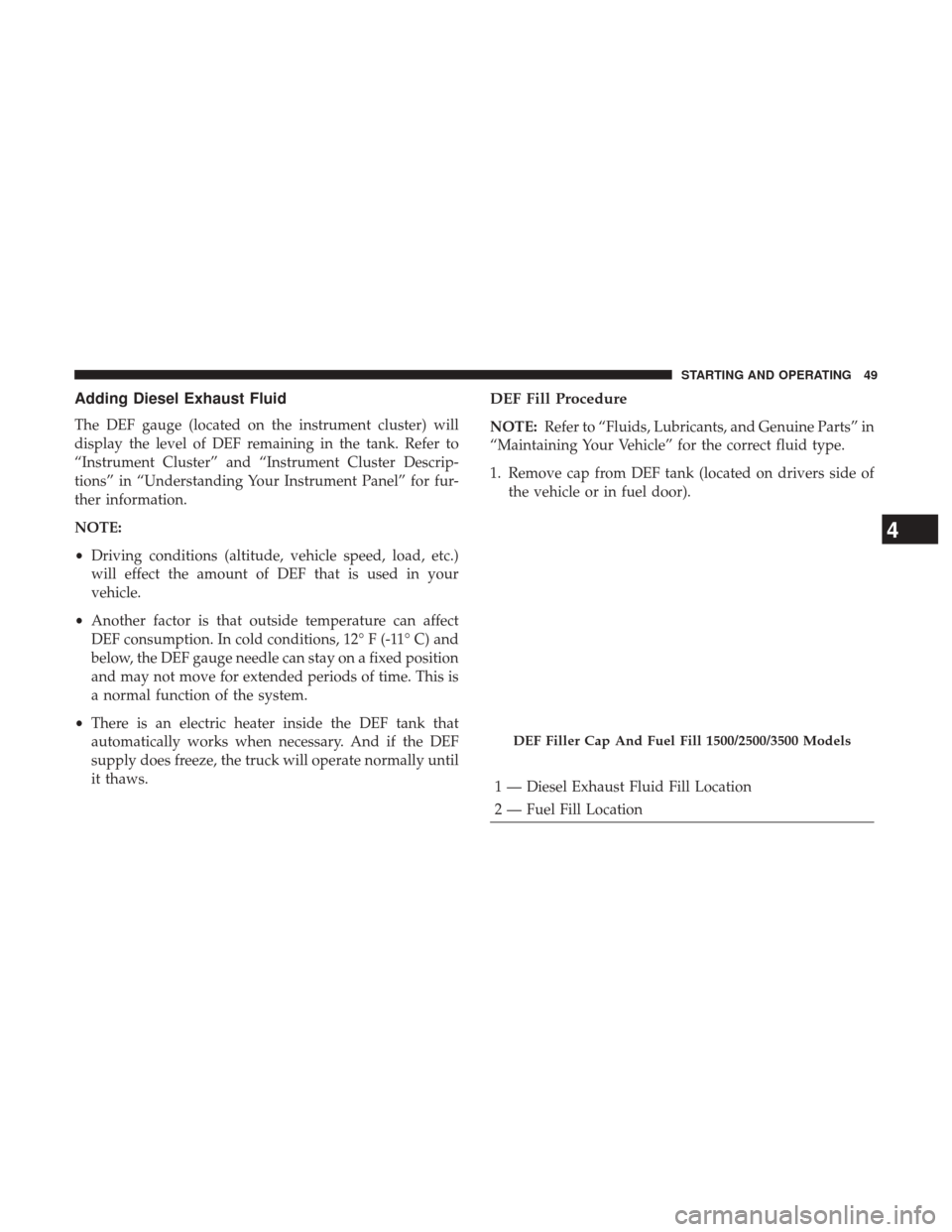
DEF Fill Procedure
NOTE: Refer to “Fluids, Lubricants, and Genuine Parts” in
“Maintaining Your Vehicle” for the correct fluid type.
1. Remove cap from DEF tank (located on drivers side of the vehicle or in fuel door).
DEF Filler Cap And Fuel Fill 1500/2500/3500 Models
1 — Diesel Exhaust Fluid Fill Location
2 — Fuel Fill Location
4
STARTING AND OPERATING 49
Page 52 of 228
2. Insert DEF fill adapter/nozzle into DEF tank filler neck.
NOTE:
•The DEF gauge may take up to five seconds to update
after adding a gallon or more of Diesel Exhaust Fluid
(DEF) to the DEF tank. If you have a fault related to the
DEF system, the gauge may not update to the new level.
See your authorized dealer for service.
• The DEF gauge may also not immediately update after a
refill if the temperature of the DEF fluid is below 12F
(-11C). The DEF line heater will possibly warm up the
DEF fluid and allow the gauge to update after a period
of run time. Under very cold conditions, it is possible
that the gauge may not reflect the new fill level for
several drives.CAUTION!
• To avoid DEF spillage, and possible damage to the
DEF tank from overfilling, do not “top off” the DEF
tank after filling.
• DO NOT OVERFILL. DEF will freeze below 12ºF
(-11ºC). The DEF system is designed to work in
temperatures below the DEF freezing point, how-
ever, if the tank is overfilled and freezes, the system
could be damaged.
• When DEF is spilled, clean the area immediately
with water and use an absorbent material to soak up
the spills on the ground.
• Do not attempt to start your engine if DEF is acci-
dentally added to the diesel fuel tank as it can result
in severe damage to your engine, including but not
limited to failure of the fuel pump and injectors.
(Continued)
50 STARTING AND OPERATING
Page 53 of 228
CAUTION!(Continued)
•Never add anything other than DEF to the tank –
especially any form of hydrocarbon such as diesel
fuel, fuel system additives, gasoline, or any other
petroleum-based product. Even a very small amount
of these, less than 100 parts per million or less than
1 oz. per 78 gallons (295 liters) will contaminate the
entire DEF system and will require replacement. If
owners use a container, funnel or nozzle when refill-
ing the tank, it should either be new or one that is
has only been used for adding DEF. MOPAR pro-
vides an attachable nozzle with its DEF for this
purpose.
3. Stop filling the DEF tank immediately when any of the following happen: DEF stops flowing from the fill bottle
into the DEF tank, DEF splashes out the filler neck, or a
DEF pump nozzle automatically shuts off.
4. Reinstall cap onto DEF tank. Filling The Def Tank In Cold Climates
Since DEF will begin to freeze at 12°F (-11°C), your vehicle
is equipped with an automatic DEF heating system. This
allows the DEF injection system to operate properly at
temperatures below 12°F (-11°C). If your vehicle is not in
operation for an extended period of time with tempera-
tures below 12°F (-11°C), the DEF in the tank may freeze. If
the tank is overfilled and freezes, it could be damaged.
Therefore, do not overfill the DEF tank.
Extra care should be taken when filling with portable
containers to avoid overfilling. Note the level of the DEF
gauge in your instrument cluster. You may safely add a
maximum of 2 gallons (7.5 Liters) of DEF from portable
containers when your DEF gauge is reading ½ full.
4
STARTING AND OPERATING 51