oil pressure Ram 1500 2017 User Guide
[x] Cancel search | Manufacturer: RAM, Model Year: 2017, Model line: 1500, Model: Ram 1500 2017Pages: 734, PDF Size: 7.3 MB
Page 583 of 734
WARNING!
You or others can be badly burned by hot engine
coolant (antifreeze) or steam from your radiator. If you
see or hear steam coming from under the hood, do not
open the hood until the radiator has had time to cool.
Never try to open a cooling system pressure cap when
the radiator or coolant bottle is hot.
CAUTION!
Driving with a hot cooling system could damage your
vehicle. If the temperature gauge reads HOT (H), pull
over and stop the vehicle. Idle the vehicle with the air
conditioner turned off until the pointer drops back
into the normal range. If the pointer remains on HOT
(H), and you hear continuous chimes, turn the engine
off immediately and call for service.
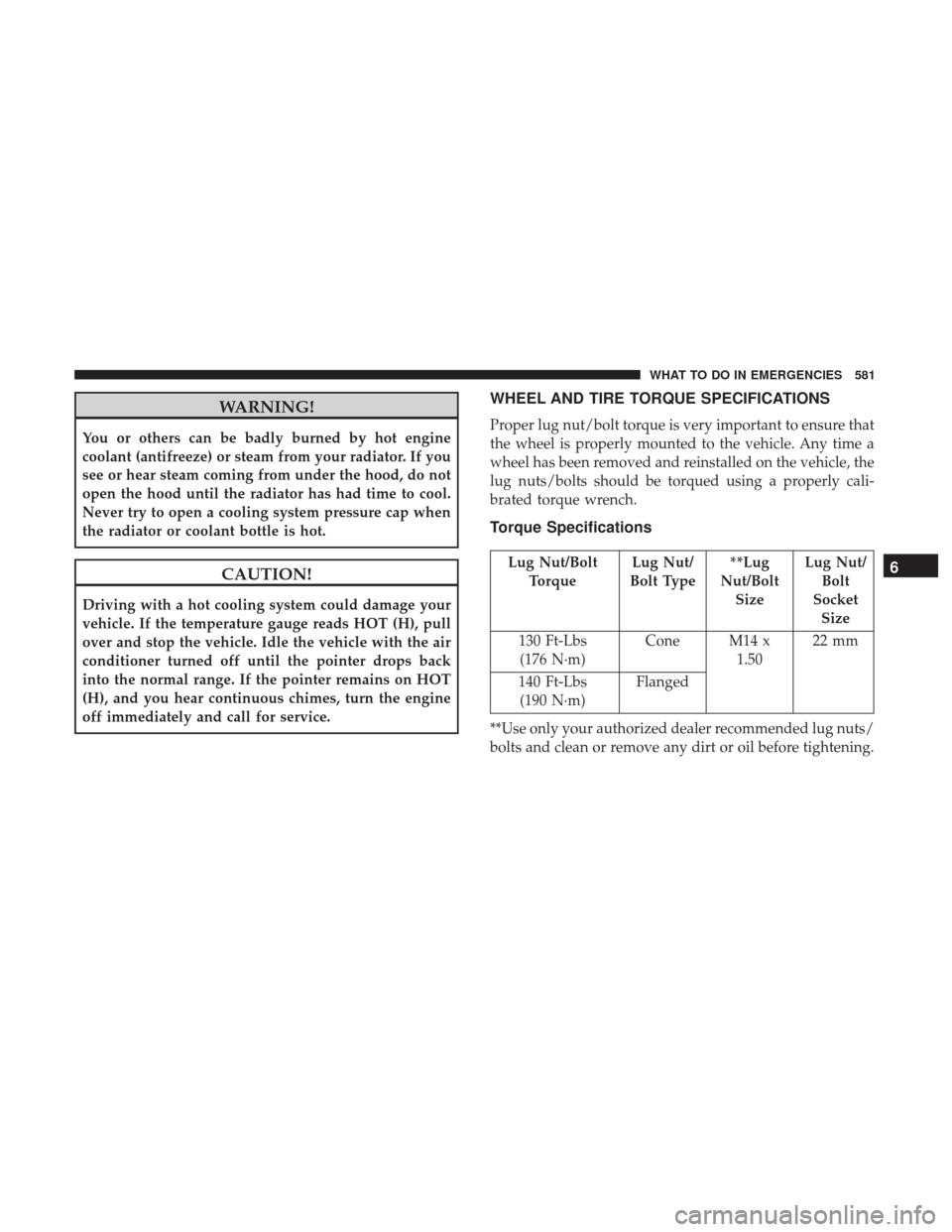
WHEEL AND TIRE TORQUE SPECIFICATIONS
Proper lug nut/bolt torque is very important to ensure that
the wheel is properly mounted to the vehicle. Any time a
wheel has been removed and reinstalled on the vehicle, the
lug nuts/bolts should be torqued using a properly cali-
brated torque wrench.
Torque Specifications
Lug Nut/BoltTorque Lug Nut/
Bolt Type **Lug
Nut/Bolt Size Lug Nut/
Bolt
Socket Size
130 Ft-Lbs (176 N·m) Cone M14 x
1.5022 mm
140 Ft-Lbs (190 N·m) Flanged
**Use only your authorized dealer recommended lug nuts/
bolts and clean or remove any dirt or oil before tightening.6
WHAT TO DO IN EMERGENCIES 581
Page 598 of 734
9. Adjust the tire pressure when possible.
NOTE:Do not oil wheel studs. For chrome wheels, do not
substitute with chrome plated wheel nuts.
To Stow The Flat Or Spare
NOTE: Vehicles equipped with aluminum wheels cannot
be stored under the vehicle because the wheel retainer will
not fit through the wheel pilot hole. Secure the flat tire in
the bed of the truck. Have the flat tire repaired or replaced
immediately.
WARNING!
A loose tire thrown forward in a collision or hard stop
could injure the occupants in the vehicle. Have the
deflated (flat) tire repaired or replaced immediately. 1. Turn the wheel so that the valve stem is facing the
ground and toward the rear of the vehicle for conve-
nience in checking the spare tire inflation. Slide the
wheel retainer through the center of the wheel.
Reinstalling The Retainer
596 WHAT TO DO IN EMERGENCIES
Page 614 of 734

6. Finish tightening the lug nuts. Push down on thewrench while at the end of the handle for increased
leverage. Tighten the lug nuts in a star pattern until each
nut has been tightened twice. For the correct lug nut
torque refer to “Torque Specifications” in this section. If
in doubt about the correct tightness, have them checked
with a torque wrench by you authorized dealer or
service station.
WARNING!
A loose tire or jack thrown forward in a collision or
hard stop could injure someone in the vehicle. Always
stow the jack parts and the extra tire and wheel in the
places provided.
7. Install the wheel center cap and remove the wheel blocks. Do not install chrome or aluminum wheel center
caps on the spare wheel. This may result in cap damage.
8. Lower the jack to its fully closed position. Stow the replaced tire, jack, and tools as previously described.
NOTE: If the bottle jack will not lower by turning the dial
(thumbwheel) by hand, it may be necessary to use the jack
drive tube in order to lower the jack.
9. Adjust the tire pressure when possible.
NOTE: Do not oil wheel studs. For chrome wheels, do not
substitute with chrome plated wheel nuts.
Dual Rear Wheel Placement
612 WHAT TO DO IN EMERGENCIES
Page 635 of 734
ENGINE COMPARTMENT — 3.6L
1 — Air Cleaner Filter
2 — Engine Oil Dipstick
3 — Engine Oil Fill
4 — Brake Fluid Reservoir
5 — Battery6 — Washer Fluid Reservoir
7 — Power Distribution Center (Fuses)
8 — Coolant Pressure Cap
9 — Engine Coolant Reservoir
7
MAINTAINING YOUR VEHICLE 633
Page 636 of 734
ENGINE COMPARTMENT — 5.7L
1 — Air Cleaner Filter7 — Washer Fluid Reservoir
2 — Automatic Transmission Dipstick (6-Speed Trans Only) 8 — Power Distribution Center (Fuses)
3 — Engine Oil Fill 9 — Power Steering Fluid Reservoir (2500/3500 Models Only)
4 — Engine Oil Dipstick 10 — Coolant Pressure Cap
5 — Brake Fluid Reservoir 11 — Engine Coolant Reservoir
6 — Battery 634 MAINTAINING YOUR VEHICLE
Page 637 of 734
ENGINE COMPARTMENT — 6.4L
1 — Coolant Pressure Bottle6 — Battery
2 — Transmission Dipstick 7 — Power Distribution Center (Fuses)
3 — Engine Oil Fill 8 — Washer Solvent
4 — Engine Oil Dipstick 9 — Power Steering Fluid Reservoir
5 — Brake Fluid Reservoir 10 — Air Cleaner Filter
7
MAINTAINING YOUR VEHICLE 635
Page 642 of 734
CAUTION!(Continued)
have potential malfunctions examined by an autho-
rized dealer or qualified repair center.
• Your vehicle has been built with improved fluids
that protect the performance and durability of your
vehicle and also allow extended maintenance inter-
vals. Do not use chemical flushes in these compo-
nents as the chemicals can damage your engine,
transmission, or air conditioning. Such damage is not
covered by the New Vehicle Limited Warranty. If a
flush is needed because of component malfunction,
use only the specified fluid for the flushing proce-
dure.
Engine Oil
Checking Oil Level
To assure proper lubrication of your vehicle’s engine, the
engine oil must be maintained at the correct level. Check
the oil level at regular intervals, such as every fuel stop.
The best time to check the engine oil level is about five
minutes after a fully warmed up engine is shut off. Checking the oil while the vehicle is on level ground will
improve the accuracy of the oil level readings. Always
maintain the oil level within the SAFE zone on the dipstick.
Adding one quart of oil when the reading is at the bottom
of the SAFE zone will result in a reading at the top of the
safe zone on these engines.
CAUTION!
Overfilling or underfilling the crankcase will cause oil
aeration or loss of oil pressure. This could damage your
engine.
Change Engine Oil
The oil change indicator system will remind you that it is
time to take your vehicle in for scheduled maintenance.
Refer to the “Maintenance Schedule” for further informa-
tion.
1500 Models Only
NOTE:
Under no circumstances should oil change inter-
vals exceed 10,000 miles (16,000 km), twelve months or 350
hours of engine run time, whichever comes first. The 350
hours of engine run or idle time is generally only a concern
for fleet customers.
640 MAINTAINING YOUR VEHICLE
Page 651 of 734
Air Conditioner Maintenance
For best possible performance, your air conditioner should
be checked and serviced by an authorized dealer at the
start of each warm season. This service should include
cleaning of the condenser fins and a performance test.
Drive belt tension should also be checked at this time.
WARNING!
•Use only refrigerants and compressor lubricants ap-
proved by the manufacturer for your air conditioning
system. Some unapproved refrigerants are flam-
mable and can explode, injuring you. Other unap-
proved refrigerants or lubricants can cause the sys-
tem to fail, requiring costly repairs. Refer to
Warranty Information Book, located on the DVD, for
further warranty information.
• The air conditioning system contains refrigerant un-
der high pressure. To avoid risk of personal injury or
damage to the system, adding refrigerant or any
repair requiring lines to be disconnected should be
done by an experienced technician.
CAUTION!
Do not use chemical flushes in your air conditioning
system as the chemicals can damage your air condition-
ing components. Such damage is not covered by the
New Vehicle Limited Warranty.
Refrigerant Recovery And Recycling R134a —
If Equipped
R-134a Air Conditioning Refrigerant is a hydrofluoro-
carbon (HFC) that is endorsed by the Environmental
Protection Agency and is an ozone-saving product. How-
ever, the manufacturer recommends that air conditioning
service be performed by authorized dealer or other service
facilities using recovery and recycling equipment.
NOTE: Use only manufacturer approved A/C system PAG
compressor oil and refrigerants.
7
MAINTAINING YOUR VEHICLE 649
Page 707 of 734
Once A Month Or Before A Long Trip:
•Check engine oil level
• Check windshield washer fluid level
• Check tire pressure and look for unusual wear or
damage. Rotate tires at the first sign of irregular wear,
even if it occurs before the oil indicator system turns on.
• Check the fluid levels of the coolant reservoir, brake
master cylinder, power steering (2500/3500 Models
Only) and automatic transmission (six-speed only) and
fill as needed
• Check function of all interior and exterior lights
Maintenance Chart
Required Maintenance
Refer to the Maintenance Schedules on the following pages
for required maintenance.
At Every Oil Change Interval As Indicated By Oil
Change Indicator System:
•Change oil and filter.
• Rotate the tires. Rotate at the first sign of irregular
wear, even if it occurs before the oil indicator
system turns on.
• Inspect battery and clean and tighten terminals as
required.
• Inspect automatic transmission fluid if equipped
with dipstick.
• Inspect brake pads, shoes, rotors, drums, hoses and
park brake.
• Inspect engine cooling system protection and hoses.
• Inspect exhaust system.
• Inspect engine air cleaner if using in dusty or
off-road conditions.
• Lube the front drive shaft fitting (2500/3500 (4x4)
models only). 8
MAINTENANCE SCHEDULES 705
Page 719 of 734
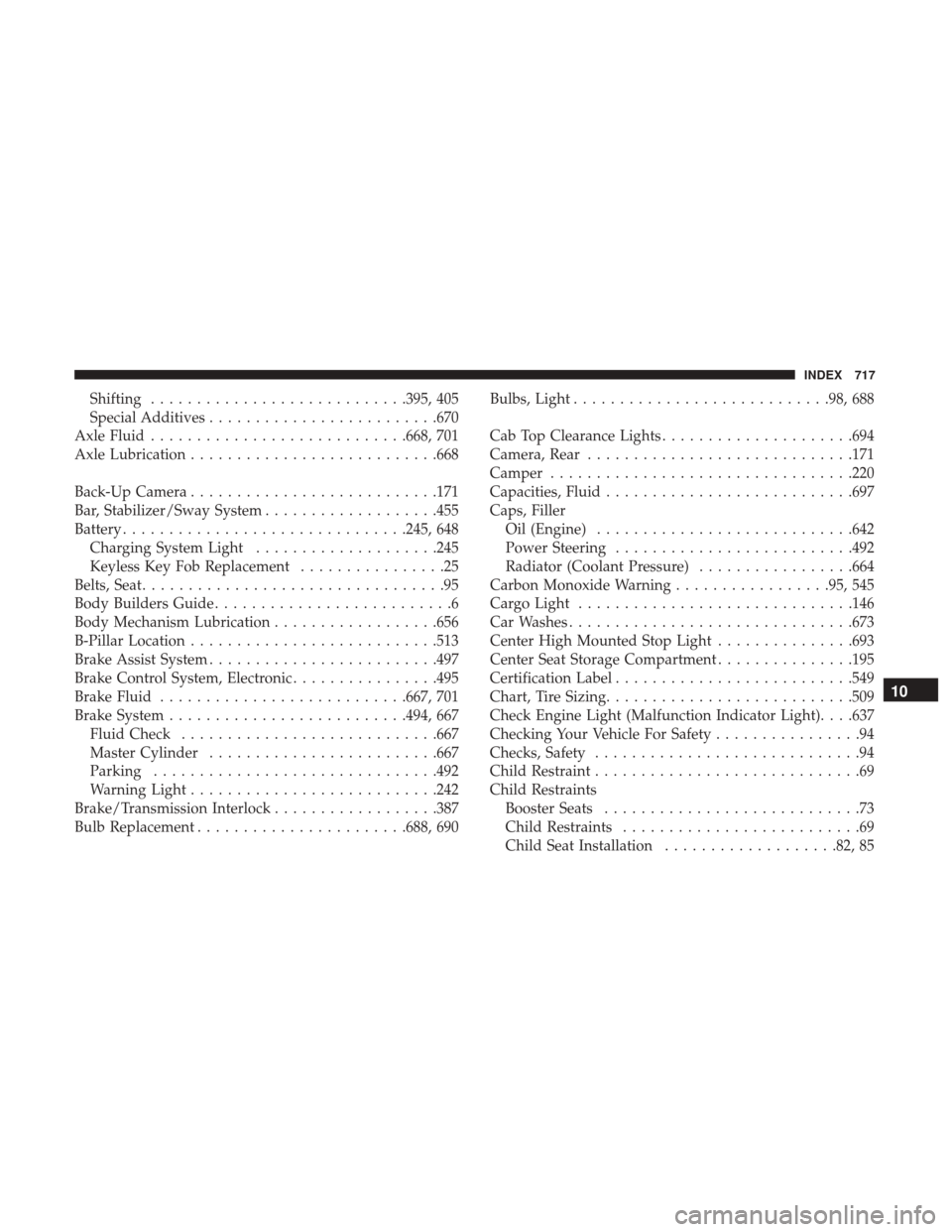
Shifting........................... .395, 405
Special Additives ........................ .670
Axle Fluid ........................... .668, 701
Axle Lubrication .......................... .668
Back-Up Camera .......................... .171
Bar, Stabilizer/Sway System ...................455
Battery .............................. .245, 648
Charging System Light ....................245
Keyless Key Fob Replacement ................25
Belts, Seat .................................95
Body Builders Guide ..........................6
Body Mechanism Lubrication ..................656
B-Pillar Location .......................... .513
Brake Assist System ........................ .497
Brake Control System, Electronic ................495
Brake Fluid .......................... .667, 701
Brake System ......................... .494, 667
Fluid Check ........................... .667
Master Cylinder ........................ .667
Parking .............................. .492
Warning Light .......................... .242
Brake/Transmission Interlock ..................387
Bulb Replacement ...................... .688, 690Bulbs, Light
........................... .98, 688
Cab Top Clearance Lights .....................694
Camera, Rear ............................ .171
Camper ................................ .220
Capacities, Fluid .......................... .697
Caps, Filler Oil (Engine) ........................... .642
Power Steering ......................... .492
Radiator (Coolant Pressure) .................664
Carbon Monoxide Warning .................95, 545
Cargo Light ............................. .146
Car Washes .............................. .673
Center High Mounted Stop Light ...............693
Center
Seat Storage Compartment ...............195
Certification Label ......................... .549
Chart, Tire Sizing .......................... .509
Check Engine Light (Malfunction Indicator Light). . . .637
Checking Your Vehicle For Safety ................94
Checks, Safety .............................94
Child Restraint .............................69
Child Restraints Booster Seats ............................73
Child Restraints ..........................69
Child Seat Installation ...................82, 85
10
INDEX 717