Angle Ram 1500 2018 Owner's Guide
[x] Cancel search | Manufacturer: RAM, Model Year: 2018, Model line: 1500, Model: Ram 1500 2018Pages: 700, PDF Size: 8.86 MB
Page 437 of 700
Over The Road Operation With Snowplow Attached
The blade restricts air flow to the radiator and causes the
engine to operate at higher than normal temperatures.
Therefore, when transporting the plow, angle the blade
completely and position it as low as road or surface
conditions permit. Do not exceed 40 mph (64 km/h). The
operator should always maintain a safe stopping distance
and allow adequate passing clearance.
Operating Tips
Under ideal snow plowing conditions, 20 mph (32 km/h)
should be maximum operating speed. The operator should
be familiar with the area and surface to be cleaned. Reduce
speed and use extreme caution when plowing unfamiliar
areas or under poor visibility.
General Maintenance
Snowplows should be maintained in accordance with the
plow manufacturer’s instructions.
Keep all snowplow electrical connections and battery ter-
minals clean and free of corrosion.When plowing snow, to avoid transmission and drivetrain
damage, the following precautions should be observed.
•
Operate with transfer case in 4LO when plowing small
or congested areas where speeds are not likely to exceed
15 mph (24 km/h). At higher speeds operate in 4HI.
• Vehicles with automatic transmissions should use 4LO
range when plowing deep or heavy snow for extended
periods of time to avoid transmission overheating.
• Do not shift the transmission unless the engine has
returned to idle and wheels have stopped. Make a
practice of stepping on the brake pedal while shifting the
transmission.
6
STARTING AND OPERATING 435
Page 445 of 700
WARNING!(Continued)
•Failure to follow these warnings may result in inju-
ries that are serious or fatal to you, your passengers,
and others around you.
CAUTION!
•Always check the depth of the standing water before
driving through it. Never drive through standing
water that is deeper than the bottom of the tire rims
mounted on the vehicle.
• Determine the condition of the road or the path that
is under water and if there are any obstacles in the
way before driving through the standing water.
• Do not exceed 5 mph (8 km/h) when driving through
standing water. This will minimize wave effects.
• Driving through standing water may cause damage
to your vehicle’s drivetrain components. Always in-
spect your vehicle’s fluids (i.e., engine oil, transmis-
sion, axle, etc.) for signs of contamination (i.e., fluid
that is milky or foamy in appearance) after driving
through standing water. Do not continue to operate
the vehicle if any fluid appears contaminated, as this
(Continued)
CAUTION! (Continued)
may result in further damage. Such damage is not
covered by the New Vehicle Limited Warranty.
• Getting water inside your vehicle’s engine can cause
it to lock up and stall out, and cause serious internal
damage to the engine. Such damage is not covered by
the New Vehicle Limited Warranty.
Off-Road Driving Tips
Care should be taken when attempting to climb steep hills
or driving diagonally across a hill or slope. If natural
obstacles force you to travel diagonally up or down a hill,
choose a mild angle and keep as little side tilt as possible.
Keep the vehicle moving and make turns slowly and
cautiously.
If you must back down a hill, back straight down using
REVERSE gear. Never back down in NEUTRAL or diago-
nally across the hill.
When driving over sand, mud, and other soft terrain, shift
to low gear and drive steadily. Apply the accelerator slowly
to avoid spinning the wheels.
Do not reduce the tire pressures for this type of driving.
6
STARTING AND OPERATING 443
Page 474 of 700
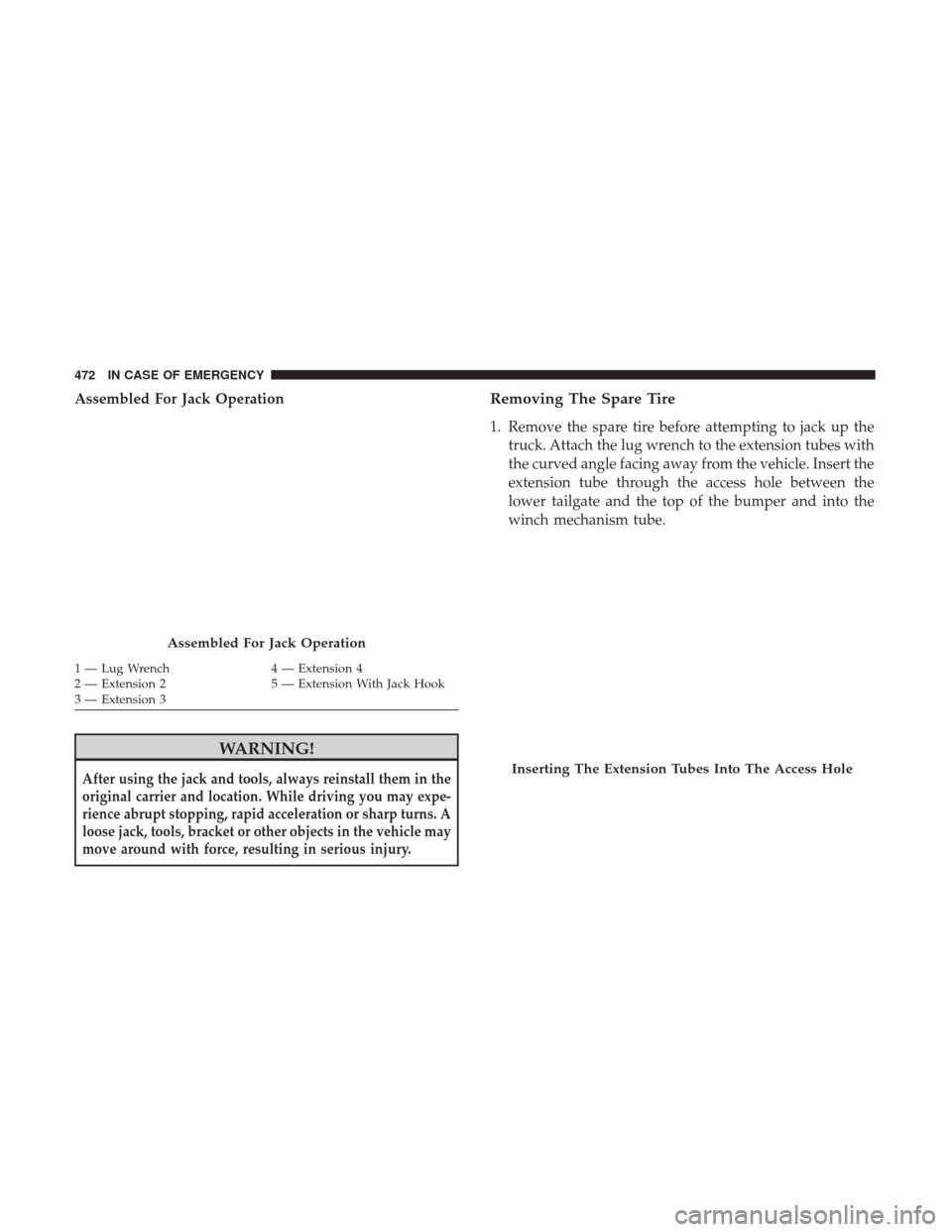
Assembled For Jack Operation
WARNING!
After using the jack and tools, always reinstall them in the
original carrier and location. While driving you may expe-
rience abrupt stopping, rapid acceleration or sharp turns. A
loose jack, tools, bracket or other objects in the vehicle may
move around with force, resulting in serious injury.
Removing The Spare Tire
1. Remove the spare tire before attempting to jack up thetruck. Attach the lug wrench to the extension tubes with
the curved angle facing away from the vehicle. Insert the
extension tube through the access hole between the
lower tailgate and the top of the bumper and into the
winch mechanism tube.
Assembled For Jack Operation
1 — Lug Wrench 4 — Extension 4
2 — Extension 2 5 — Extension With Jack Hook
3 — Extension 3
Inserting The Extension Tubes Into The Access Hole
472 IN CASE OF EMERGENCY
Page 484 of 700
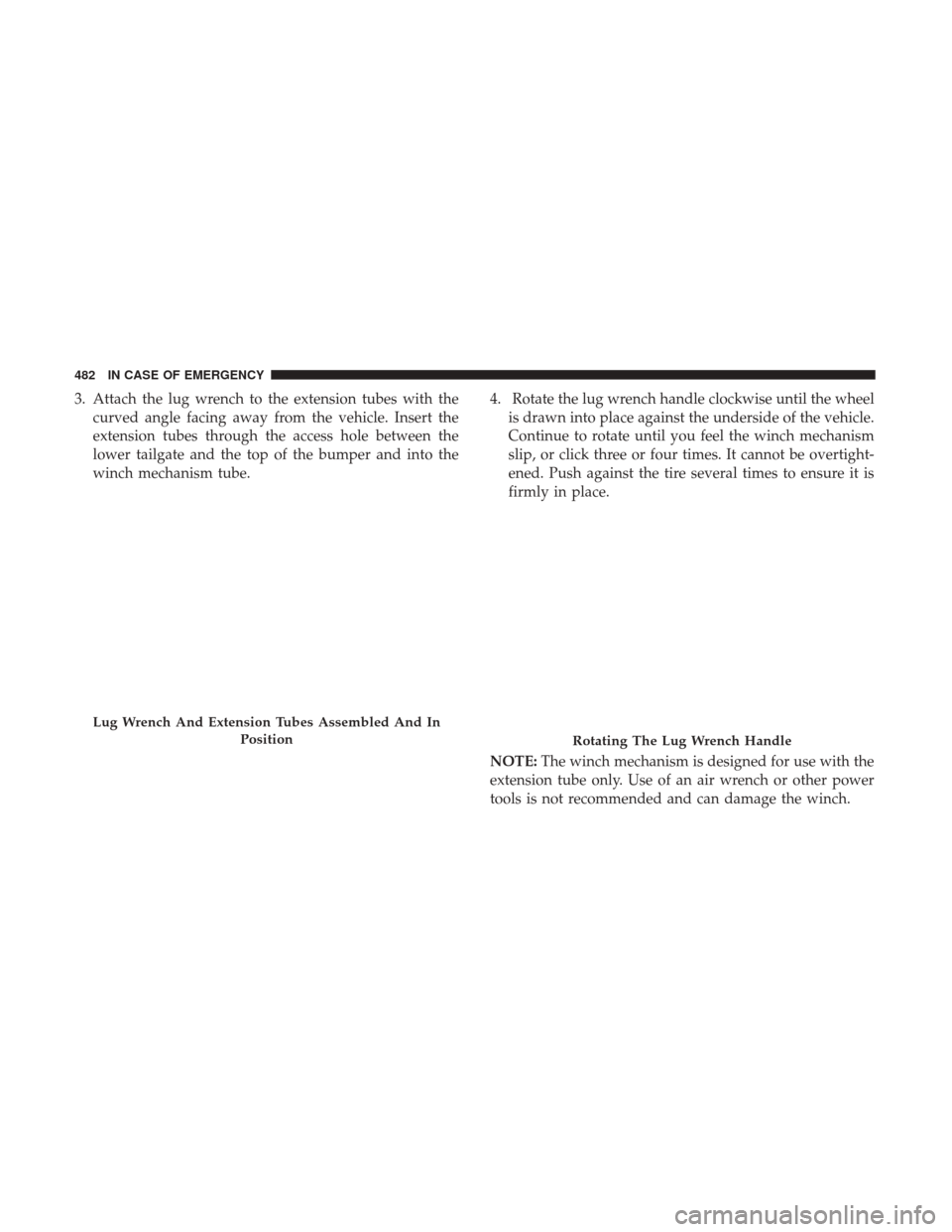
3. Attach the lug wrench to the extension tubes with thecurved angle facing away from the vehicle. Insert the
extension tubes through the access hole between the
lower tailgate and the top of the bumper and into the
winch mechanism tube. 4. Rotate the lug wrench handle clockwise until the wheel
is drawn into place against the underside of the vehicle.
Continue to rotate until you feel the winch mechanism
slip, or click three or four times. It cannot be overtight-
ened. Push against the tire several times to ensure it is
firmly in place.
NOTE: The winch mechanism is designed for use with the
extension tube only. Use of an air wrench or other power
tools is not recommended and can damage the winch.
Lug Wrench And Extension Tubes Assembled And In
Position
Rotating The Lug Wrench Handle
482 IN CASE OF EMERGENCY
Page 490 of 700
WARNING!
After using the jack and tools, always reinstall them in
the original carrier and location. While driving you
may experience abrupt stopping, rapid acceleration or
sharp turns. A loose jack, tools, bracket or other objects
in the vehicle may move around with force, resulting
in serious injury.
Removing The Spare Tire
1. Remove the spare tire before attempting to jack up thetruck. Attach the lug wrench to the extension tubes with
the curved angle facing away from the vehicle. Insert the
extension tube through the access hole between the
lower tailgate and the top of the bumper and into the
winch mechanism tube.
Inserting The Extension Tubes Into The Access Hole
488 IN CASE OF EMERGENCY
Page 500 of 700
2. Lift the spare tire with one hand to give clearance to tiltthe retainer at the end of the cable and position it
properly across the wheel opening. 3. Attach the lug wrench to the extension tubes with the
curved angle facing away from the vehicle. Insert the
extensions through the access hole between the lower
tailgate and the top of the bumper and into the winch
mechanism tube.
Reinstalling The RetainerPushing The Retainer Through The Center Of The Wheel
And Positioning It
498 IN CASE OF EMERGENCY
Page 640 of 700
Setting NameSelectable Options
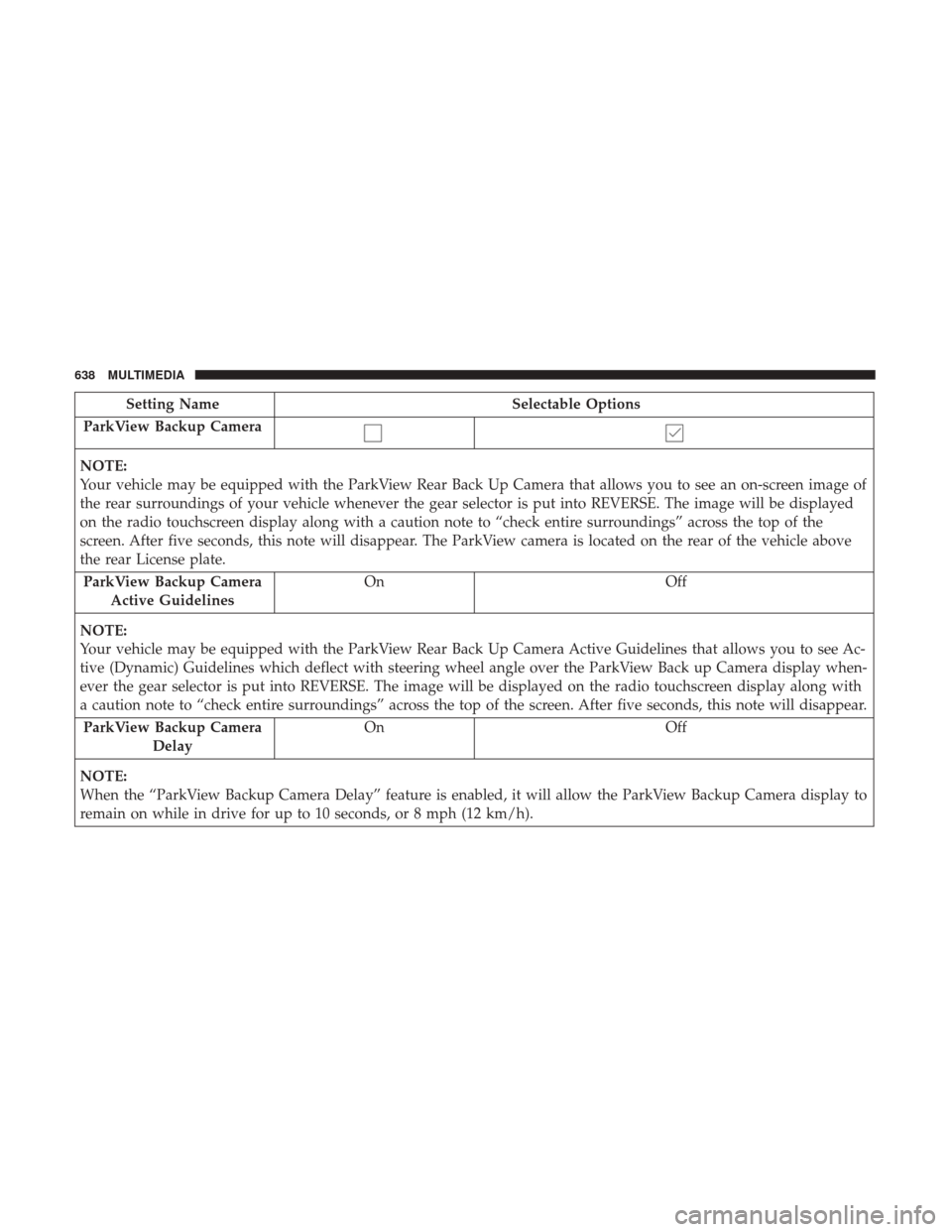
ParkView Backup Camera
NOTE:
Your vehicle may be equipped with the ParkView Rear Back Up Camera that allows you to see an on-screen image of
the rear surroundings of your vehicle whenever the gear selector is put into REVERSE. The image will be displayed
on the radio touchscreen display along with a caution note to “check entire surroundings” across the top of the
screen. After five seconds, this note will disappear. The ParkView camera is located on the rear of the vehicle above
the rear License plate. ParkView Backup Camera Active Guidelines On
Off
NOTE:
Your vehicle may be equipped with the ParkView Rear Back Up Camera Active Guidelines that allows you to see Ac-
tive (Dynamic) Guidelines which deflect with steering wheel angle over the ParkView Back up Camera display when-
ever the gear selector is put into REVERSE. The image will be displayed on the radio touchscreen display along with
a caution note to “check entire surroundings” across the top of the screen. After five seconds, this note will disappear. ParkView Backup Camera Delay On
Off
NOTE:
When the “ParkView Backup Camera Delay” feature is enabled, it will allow the ParkView Backup Camera display to
remain on while in drive for up to 10 seconds, or 8 mph (12 km/h).
638 MULTIMEDIA