coolant temperature Ram 1500 2019 User Guide
[x] Cancel search | Manufacturer: RAM, Model Year: 2019, Model line: 1500, Model: Ram 1500 2019Pages: 698, PDF Size: 9.04 MB
Page 515 of 698
To minimize the possibility of catalytic converter damage:
•Do not interrupt the ignition when the transmission is in
gear and the vehicle is in motion.
• Do not try to start the vehicle by pushing or towing the
vehicle.
• Do not idle the engine with any ignition components
disconnected or removed, such as when diagnostic
testing, or for prolonged periods during very rough idle
or malfunctioning operating conditions.
Cooling System
WARNING!
• You or others can be badly burned by hot engine
coolant (antifreeze) or steam from your radiator. If
you see or hear steam coming from under the hood,
do not open the hood until the radiator has had time
to cool. Never open a cooling system pressure cap
when the radiator or coolant bottle is hot.
• Keep hands, tools, clothing, and jewelry away from
the radiator cooling fan when the hood is raised. The
fan starts automatically and may start at any time,
whether the engine is running or not.
(Continued)
WARNING! (Continued)
•When working near the radiator cooling fan, discon-
nect the fan motor lead or turn the ignition to the
OFF mode. The fan is temperature controlled and can
start at any time the ignition is in the ON mode.
Engine Coolant Checks
Check the engine coolant (antifreeze) protection every 12
months (before the onset of freezing weather, where appli-
cable). If the engine coolant (antifreeze) is dirty or rusty in
appearance, the system should be drained, flushed and
refilled with fresh coolant. Check the front of the A/C
condenser (if equipped) or radiator for any accumulation
of bugs, leaves, etc. If dirty, clean by gently spraying water
from a garden hose vertically down the face of the A/C
condenser (if equipped) or the back of the radiator core.
Check the engine cooling system hoses for brittle rubber,
cracking, tears, cuts and tightness of the connection at the
coolant recovery bottle and radiator. Inspect the entire
system for leaks.
DO NOT REMOVE THE COOLANT PRESSURE CAP
WHEN THE COOLING SYSTEM IS HOT.
8
SERVICING AND MAINTENANCE 513
Page 517 of 698
•Some vehicles require special tools to add coolant prop-
erly. Failure to fill these systems properly could lead to
severe internal engine damage. If any coolant is needed
to be added to the system please contact an authorized
dealer.
Adding Coolant
Your vehicle has been built with an improved engine
coolant (OAT coolant conforming to MS.90032) that allows
extended maintenance intervals. This engine coolant (anti-
freeze) can be used up to ten years or 150,000 miles
(240,000 km) before replacement. To prevent reducing this
extended maintenance period, it is important that you use
the same engine coolant (OAT coolant conforming to
MS.90032) throughout the life of your vehicle.
Please review these recommendations for using Organic
Additive Technology (OAT) engine coolant (antifreeze)
that meets the requirements of FCA Material Standard
MS.90032. When adding engine coolant (antifreeze):
• We recommend using Mopar Antifreeze/Coolant 10
Year/150,000 Mile (240,000 km) Formula OAT (Organic
Additive Technology) that meets the requirements of
FCA Material Standard MS.90032. •
Mix a minimum solution of 50% OAT engine coolant
that meets the requirements of FCA Material Standard
MS.90032 and distilled water. Use higher concentrations
(not to exceed 70%) if temperatures below 34°F (37°C)
are anticipated. Please contact an authorized dealer for
assistance.
• Use only high purity water such as distilled or deionized
water when mixing the water/engine coolant (anti-
freeze) solution. The use of lower quality water will
reduce the amount of corrosion protection in the engine
cooling system.
NOTE:
• It is the owner’s responsibility to maintain the proper
level of protection against freezing according to the
temperatures occurring in the area where the vehicle is
operated.
• Some vehicles require special tools to add coolant prop-
erly. Failure to fill these systems properly could lead to
severe internal engine damage. If any coolant is needed
to be added to the system, please contact a local autho-
rized dealer.
8
SERVICING AND MAINTENANCE 515
Page 518 of 698
•Mixing engine coolant (antifreeze) types is not recom-
mended and can result in cooling system damage. If
HOAT and OAT coolant are mixed in an emergency,
have a authorized dealer drain, flush, and refill with
OAT coolant (conforming to MS.90032) as soon as pos-
sible.
Cooling System Pressure Cap
The cap must be fully tightened to prevent loss of engine
coolant (antifreeze), and to ensure that engine coolant
(antifreeze) will return to the radiator from the coolant
expansion bottle/recovery tank if so equipped.
The cap should be inspected and cleaned if there is any
accumulation of foreign material on the sealing surfaces.
WARNING!
• Do not open hot engine cooling system. Never add
engine coolant (antifreeze) when the engine is over-
heated. Do not loosen or remove the cap to cool an
overheated engine. Heat causes pressure to build up
in the cooling system. To prevent scalding or injury,
do not remove the pressure cap while the system is
hot or under pressure.
(Continued)
WARNING! (Continued)
•Do not use a pressure cap other than the one speci-
fied for your vehicle. Personal injury or engine
damage may result.
Disposal Of Used Coolant
Used ethylene glycol-based coolant (antifreeze) is a regu-
lated substance requiring proper disposal. Check with your
local authorities to determine the disposal rules for your
community. To prevent ingestion by animals or children,
do not store ethylene glycol-based coolant in open contain-
ers or allow it to remain in puddles on the ground. If
ingested by a child or pet, seek emergency assistance
immediately. Clean up any ground spills immediately.
Checking Coolant Level — 3.6L Engine
The level of the coolant in the pressurized coolant bottle
should be between the “MIN” and “MAX” range on the
bottle when the engine is cold.
The radiator normally remains completely full, so there is
no need to remove the cap unless checking for coolant
freeze point or replacing engine coolant (antifreeze). Ad-
vise your service attendant of this. As long as the engine
operating temperature is satisfactory, the coolant bottle
516 SERVICING AND MAINTENANCE
Page 519 of 698
need only be checked once a month. When additional
engine coolant (antifreeze) is needed to maintain the
proper level, it should be added to the coolant bottle. Do
not overfill.
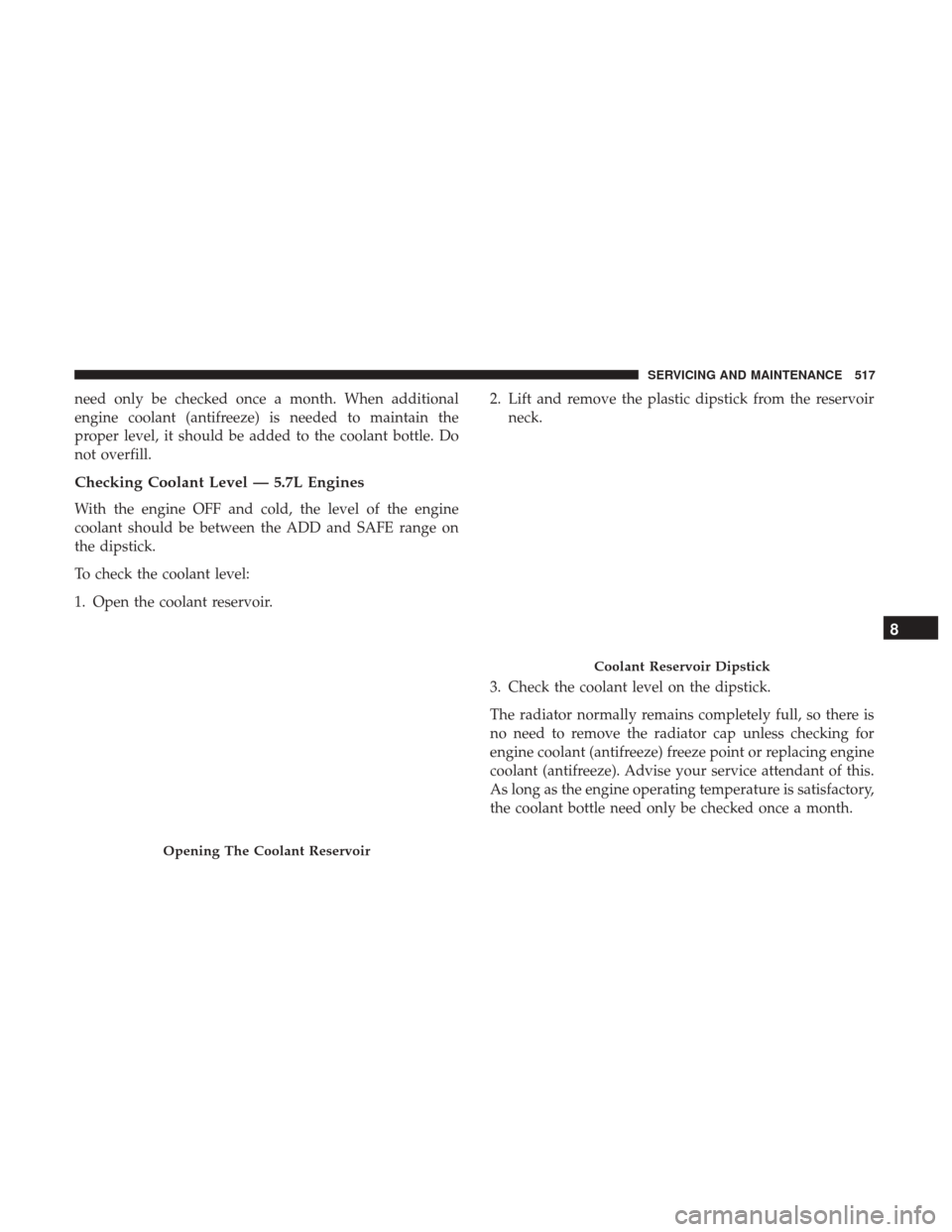
Checking Coolant Level — 5.7L Engines
With the engine OFF and cold, the level of the engine
coolant should be between the ADD and SAFE range on
the dipstick.
To check the coolant level:
1. Open the coolant reservoir.2. Lift and remove the plastic dipstick from the reservoir
neck.
3. Check the coolant level on the dipstick.
The radiator normally remains completely full, so there is
no need to remove the radiator cap unless checking for
engine coolant (antifreeze) freeze point or replacing engine
coolant (antifreeze). Advise your service attendant of this.
As long as the engine operating temperature is satisfactory,
the coolant bottle need only be checked once a month.
Opening The Coolant Reservoir
Coolant Reservoir Dipstick
8
SERVICING AND MAINTENANCE 517
Page 683 of 698
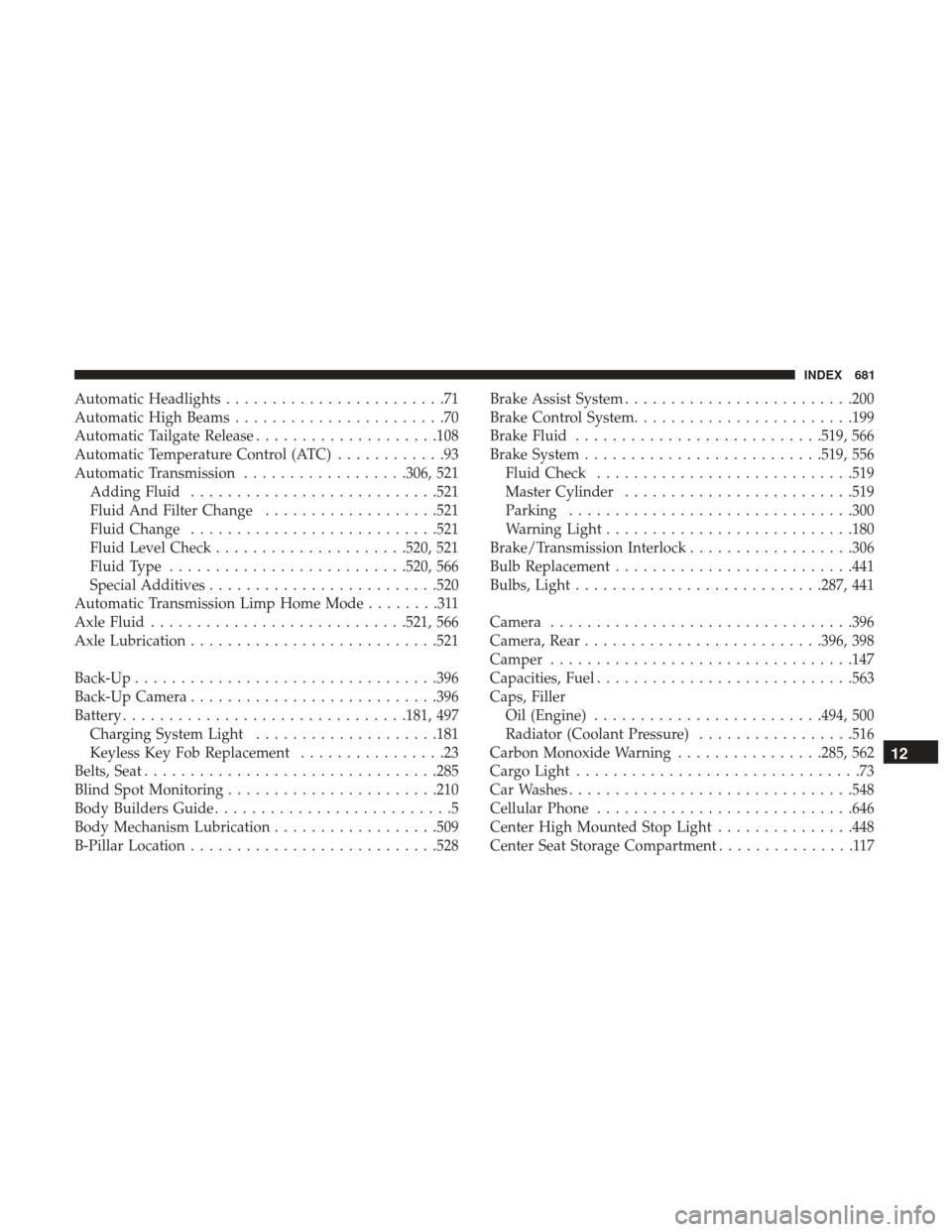
Automatic Headlights........................71
Automatic High Beams .......................70
Automatic Tailgate Release ....................108
Automatic Temperature Control (ATC) ............93
Automatic Transmission ..................306, 521
Adding Fluid .......................... .521
Fluid And Filter Change ...................521
Fluid Change .......................... .521
Fluid Level Check .....................520, 521
Fluid Type ......................... .520, 566
Special Additives ........................ .520
Automatic Transmission Limp Home Mode ........311
Axle Fluid ........................... .521, 566
Axle Lubrication .......................... .521
Back-Up ................................ .396
Back-Up Camera .......................... .396
Battery .............................. .181, 497
Charging System Light ....................181
Keyless Key Fob Replacement ................23
Belts, Seat ............................... .285
Blind Spot Monitoring ...................... .210
Body Builders Guide ..........................5
Body Mechanism Lubrication ..................509
B-Pillar Location .......................... .528Brake Assist System
........................ .200
Brake Control System ....................... .199
Brake Fluid .......................... .519, 566
Brake System ......................... .519, 556
Fluid Check ........................... .519
Master Cylinder ........................ .519
Parking .............................. .300
Warning Light .......................... .180
Brake/Transmission Interlock ..................306
Bulb Replacement ......................... .441
Bulbs, Light .......................... .287, 441
Camera ................................ .396
Camera,
Rear ......................... .396, 398
Camper ................................ .147
Capacities, Fuel ........................... .563
Caps, Filler Oil (Engine) ........................ .494, 500
Radiator (Coolant Pressure) .................516
Carbon Monoxide Warning ................285, 562
Cargo Light ...............................73
Car Washes .............................. .548
Cellular Phone ........................... .646
Center High Mounted Stop Light ...............448
Center Seat Storage Compartment ...............117
12
INDEX 681