coolant Ram 1500 2019 Owner's Guide
[x] Cancel search | Manufacturer: RAM, Model Year: 2019, Model line: 1500, Model: Ram 1500 2019Pages: 698, PDF Size: 9.04 MB
Page 518 of 698
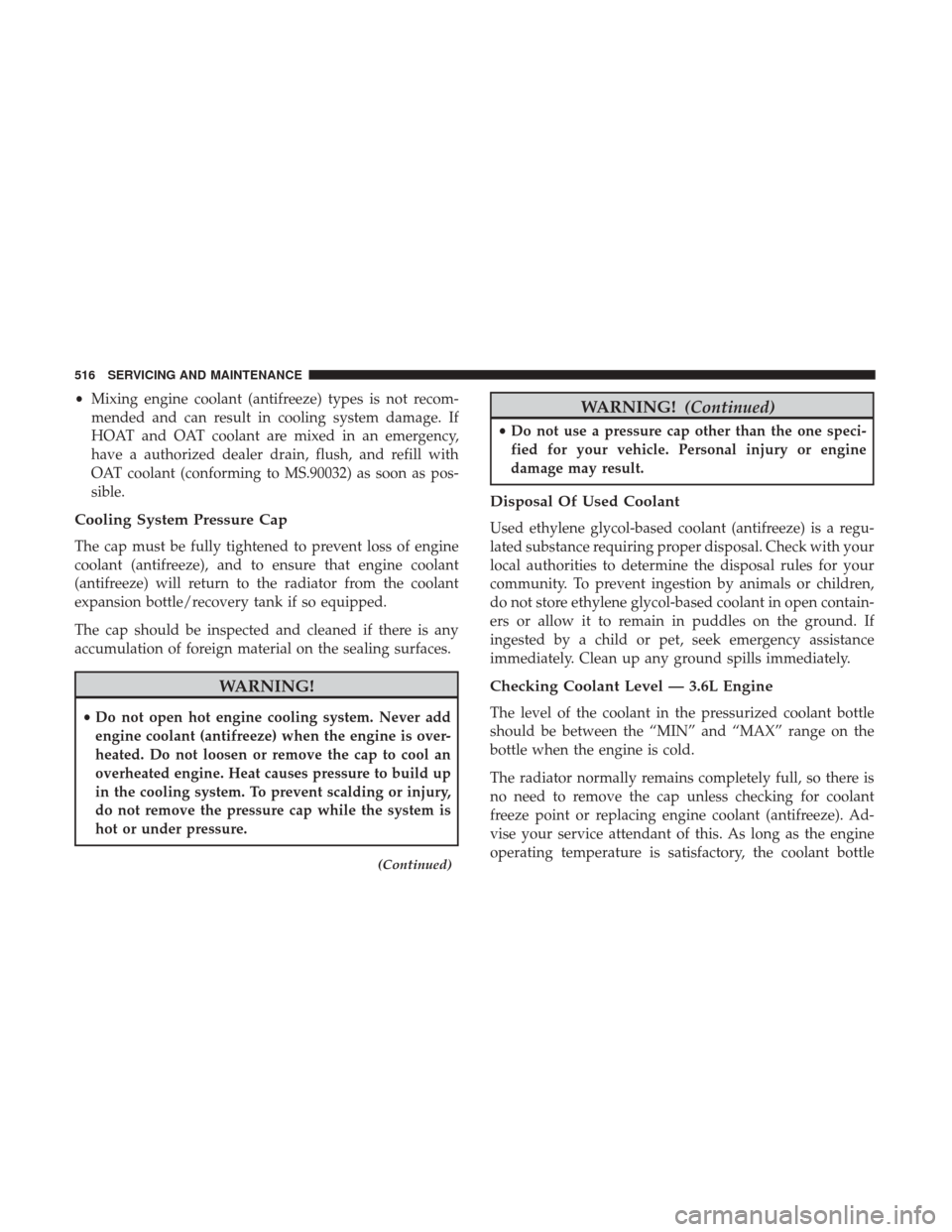
•Mixing engine coolant (antifreeze) types is not recom-
mended and can result in cooling system damage. If
HOAT and OAT coolant are mixed in an emergency,
have a authorized dealer drain, flush, and refill with
OAT coolant (conforming to MS.90032) as soon as pos-
sible.
Cooling System Pressure Cap
The cap must be fully tightened to prevent loss of engine
coolant (antifreeze), and to ensure that engine coolant
(antifreeze) will return to the radiator from the coolant
expansion bottle/recovery tank if so equipped.
The cap should be inspected and cleaned if there is any
accumulation of foreign material on the sealing surfaces.
WARNING!
• Do not open hot engine cooling system. Never add
engine coolant (antifreeze) when the engine is over-
heated. Do not loosen or remove the cap to cool an
overheated engine. Heat causes pressure to build up
in the cooling system. To prevent scalding or injury,
do not remove the pressure cap while the system is
hot or under pressure.
(Continued)
WARNING! (Continued)
•Do not use a pressure cap other than the one speci-
fied for your vehicle. Personal injury or engine
damage may result.
Disposal Of Used Coolant
Used ethylene glycol-based coolant (antifreeze) is a regu-
lated substance requiring proper disposal. Check with your
local authorities to determine the disposal rules for your
community. To prevent ingestion by animals or children,
do not store ethylene glycol-based coolant in open contain-
ers or allow it to remain in puddles on the ground. If
ingested by a child or pet, seek emergency assistance
immediately. Clean up any ground spills immediately.
Checking Coolant Level — 3.6L Engine
The level of the coolant in the pressurized coolant bottle
should be between the “MIN” and “MAX” range on the
bottle when the engine is cold.
The radiator normally remains completely full, so there is
no need to remove the cap unless checking for coolant
freeze point or replacing engine coolant (antifreeze). Ad-
vise your service attendant of this. As long as the engine
operating temperature is satisfactory, the coolant bottle
516 SERVICING AND MAINTENANCE
Page 519 of 698
need only be checked once a month. When additional
engine coolant (antifreeze) is needed to maintain the
proper level, it should be added to the coolant bottle. Do
not overfill.
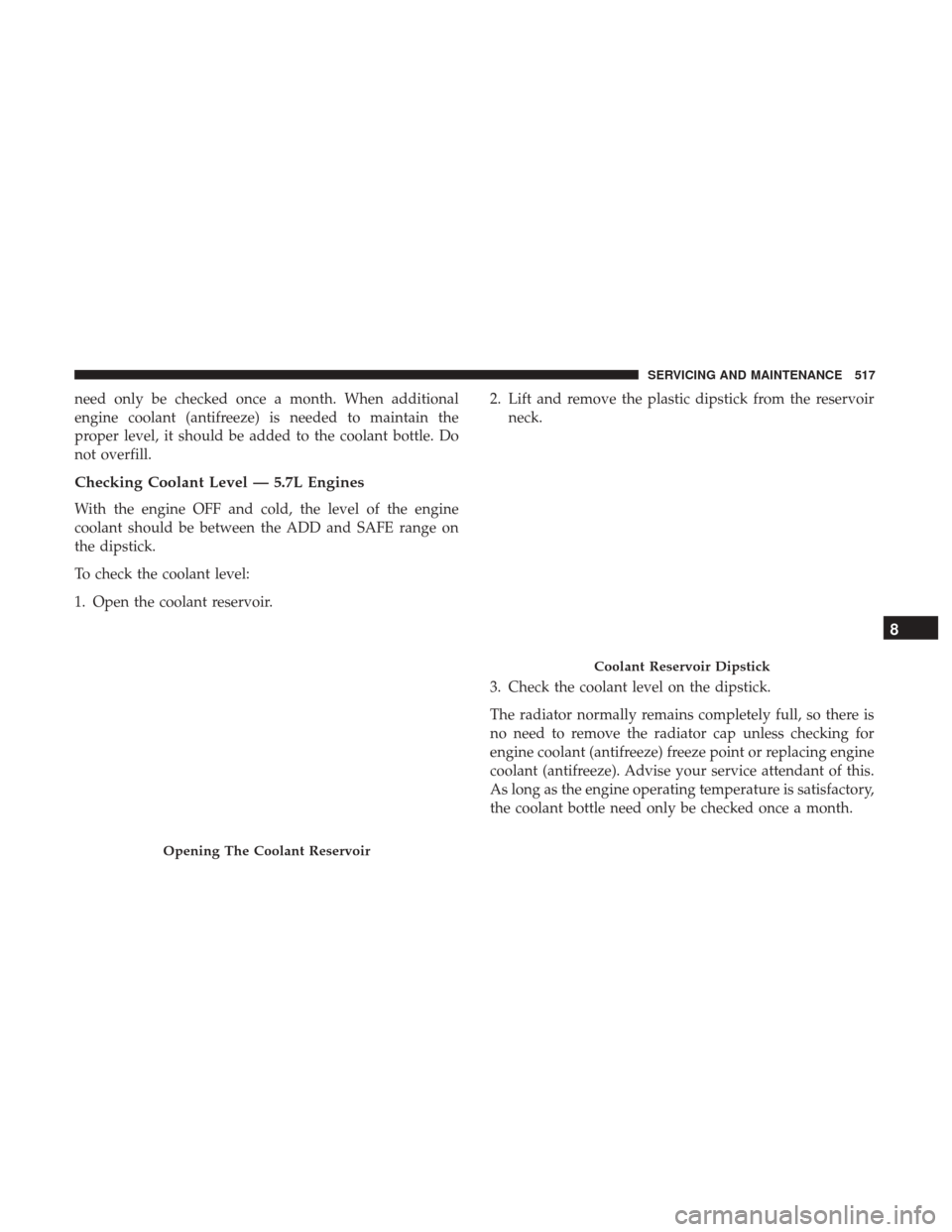
Checking Coolant Level — 5.7L Engines
With the engine OFF and cold, the level of the engine
coolant should be between the ADD and SAFE range on
the dipstick.
To check the coolant level:
1. Open the coolant reservoir.2. Lift and remove the plastic dipstick from the reservoir
neck.
3. Check the coolant level on the dipstick.
The radiator normally remains completely full, so there is
no need to remove the radiator cap unless checking for
engine coolant (antifreeze) freeze point or replacing engine
coolant (antifreeze). Advise your service attendant of this.
As long as the engine operating temperature is satisfactory,
the coolant bottle need only be checked once a month.
Opening The Coolant Reservoir
Coolant Reservoir Dipstick
8
SERVICING AND MAINTENANCE 517
Page 520 of 698

When additional engine coolant (antifreeze) is needed to
maintain the proper level, it should be added to the coolant
bottle. Do not overfill.
Points To Remember
NOTE:When the vehicle is stopped after a few miles/
kilometers of operation, you may observe vapor coming
from the front of the engine compartment. This is normally
a result of moisture from rain, snow, or high humidity
accumulating on the radiator and being vaporized when
the thermostat opens, allowing hot engine coolant (anti-
freeze) to enter the radiator.
If an examination of your engine compartment shows no
evidence of radiator or hose leaks, the vehicle may be
safely driven. The vapor will soon dissipate.
• Do not overfill the coolant expansion bottle.
• Check the coolant freeze point in the radiator and in the
coolant expansion bottle. If engine coolant (antifreeze)
needs to be added, the contents of the coolant expansion
bottle must also be protected against freezing. •
If frequent engine coolant (antifreeze) additions are
required, the cooling system should be pressure tested
for leaks.
• Maintain engine coolant (antifreeze) concentration at a
minimum of 50% OAT coolant (conforming to
MS.90032) and distilled water for proper corrosion pro-
tection of your engine which contains aluminum com-
ponents.
• Make sure that the coolant expansion bottle overflow
hoses are not kinked or obstructed.
• Keep the front of the radiator clean. If your vehicle is
equipped with air conditioning, keep the front of the
condenser clean.
• Do not change the thermostat for Summer or Winter
operation. If replacement is ever necessary, install ONLY
the correct type thermostat. Other designs may result in
unsatisfactory engine coolant (antifreeze) performance,
poor gas mileage, and increased emissions.
518 SERVICING AND MAINTENANCE
Page 565 of 698
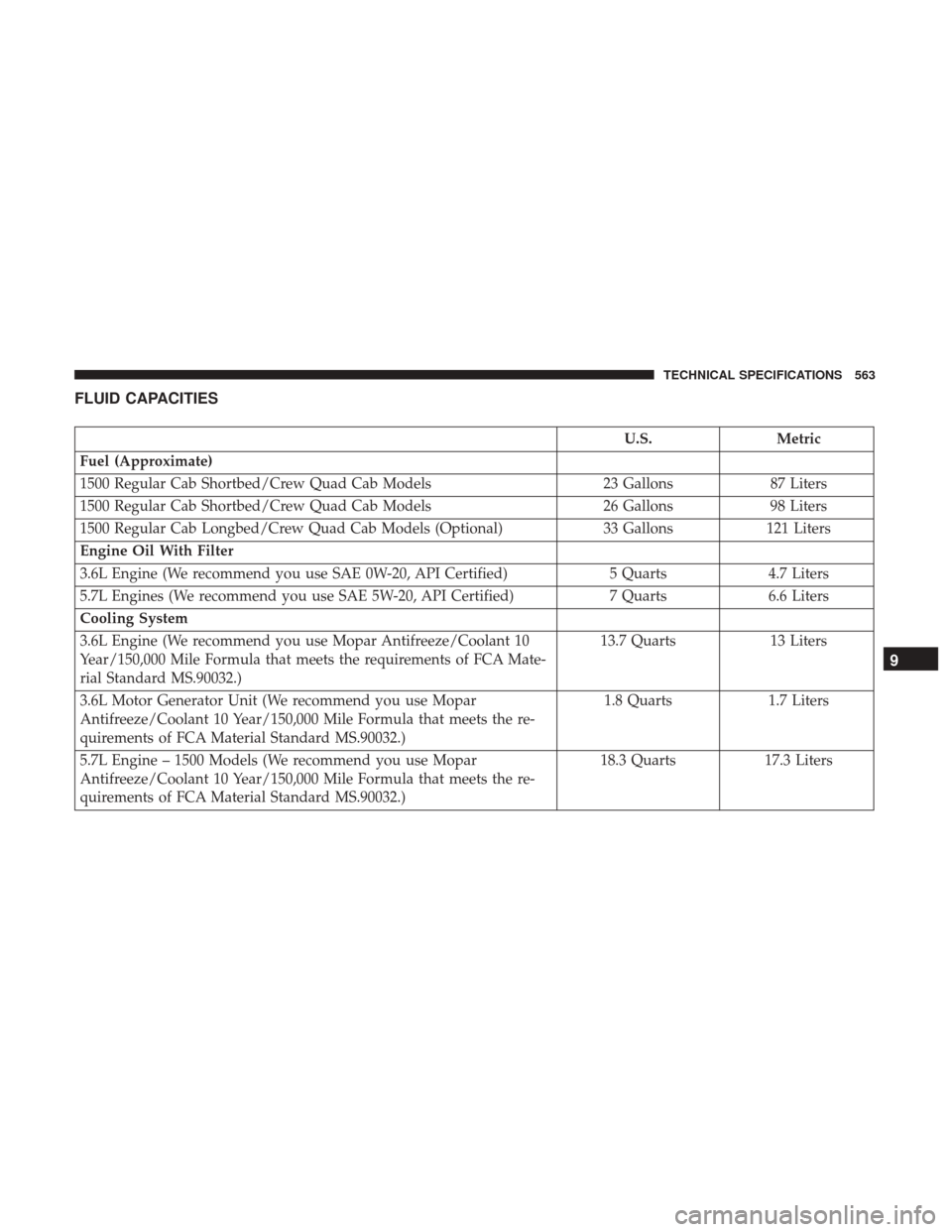
FLUID CAPACITIES
U.S.Metric
Fuel (Approximate)
1500 Regular Cab Shortbed/Crew Quad Cab Models 23 Gallons87 Liters
1500 Regular Cab Shortbed/Crew Quad Cab Models 26 Gallons98 Liters
1500 Regular Cab Longbed/Crew Quad Cab Models (Optional) 33 Gallons121 Liters
Engine Oil With Filter
3.6L Engine (We recommend you use SAE 0W-20, API Certified) 5 Quarts4.7 Liters
5.7L Engines (We recommend you use SAE 5W-20, API Certified) 7 Quarts6.6 Liters
Cooling System
3.6L Engine (We recommend you use Mopar Antifreeze/Coolant 10
Year/150,000 Mile Formula that meets the requirements of FCA Mate-
rial Standard MS.90032.) 13.7 Quarts
13 Liters
3.6L Motor Generator Unit (We recommend you use Mopar
Antifreeze/Coolant 10 Year/150,000 Mile Formula that meets the re-
quirements of FCA Material Standard MS.90032.) 1.8 Quarts
1.7 Liters
5.7L Engine – 1500 Models (We recommend you use Mopar
Antifreeze/Coolant 10 Year/150,000 Mile Formula that meets the re-
quirements of FCA Material Standard MS.90032.) 18.3 Quarts
17.3 Liters
9
TECHNICAL SPECIFICATIONS 563
Page 566 of 698
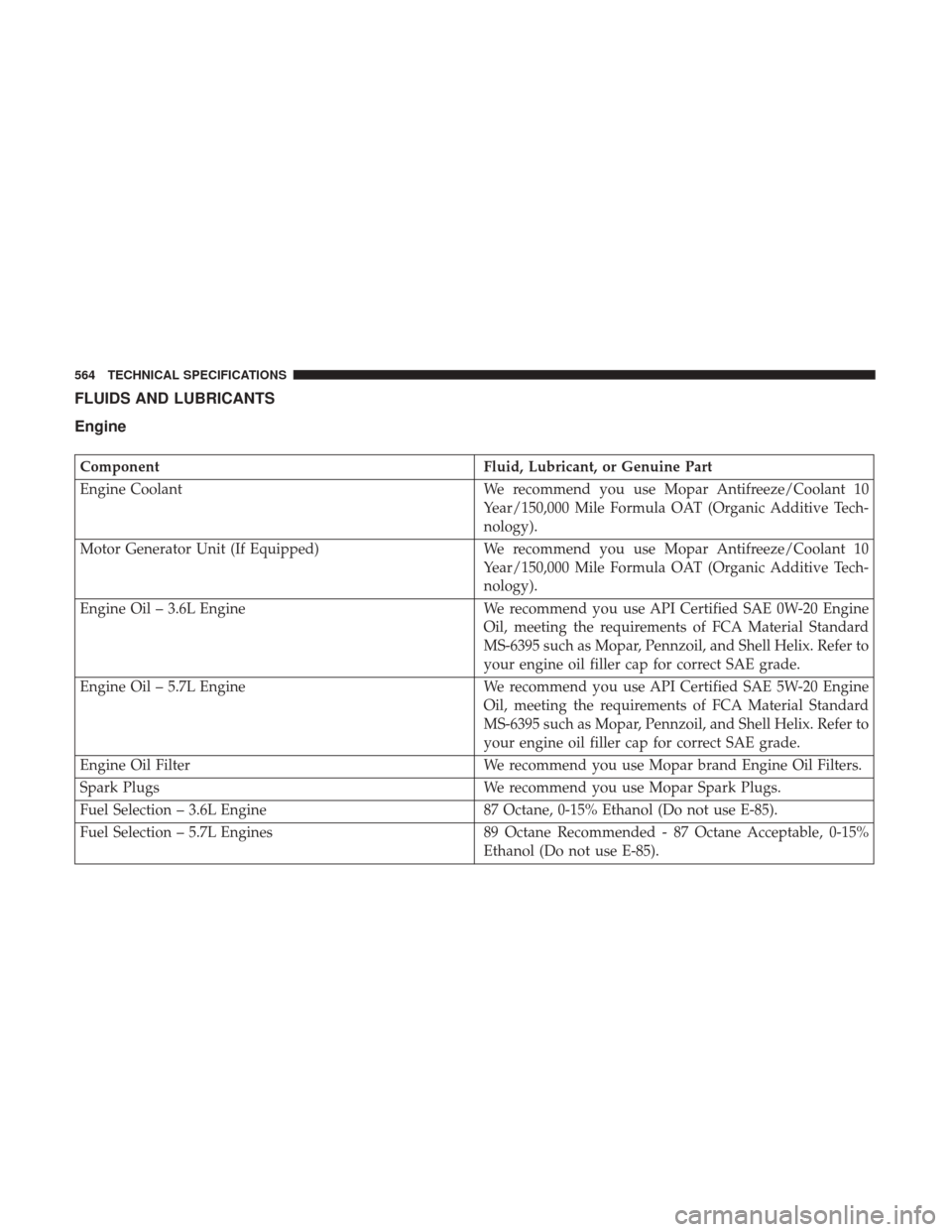
FLUIDS AND LUBRICANTS
Engine
ComponentFluid, Lubricant, or Genuine Part
Engine Coolant We recommend you use Mopar Antifreeze/Coolant 10
Year/150,000 Mile Formula OAT (Organic Additive Tech-
nology).
Motor Generator Unit (If Equipped) We recommend you use Mopar Antifreeze/Coolant 10
Year/150,000 Mile Formula OAT (Organic Additive Tech-
nology).
Engine Oil – 3.6L Engine We recommend you use API Certified SAE 0W-20 Engine
Oil, meeting the requirements of FCA Material Standard
MS-6395 such as Mopar, Pennzoil, and Shell Helix. Refer to
your engine oil filler cap for correct SAE grade.
Engine Oil – 5.7L Engine We recommend you use API Certified SAE 5W-20 Engine
Oil, meeting the requirements of FCA Material Standard
MS-6395 such as Mopar, Pennzoil, and Shell Helix. Refer to
your engine oil filler cap for correct SAE grade.
Engine Oil Filter We recommend you use Mopar brand Engine Oil Filters.
Spark Plugs We recommend you use Mopar Spark Plugs.
Fuel Selection – 3.6L Engine 87 Octane, 0-15% Ethanol (Do not use E-85).
Fuel Selection – 5.7L Engines 89 Octane Recommended - 87 Octane Acceptable, 0-15%
Ethanol (Do not use E-85).
564 TECHNICAL SPECIFICATIONS
Page 567 of 698

CAUTION!
•Mixing of engine coolant (antifreeze) other than
specified Organic Additive Technology (OAT) en-
gine coolant (antifreeze), may result in engine dam-
age and may decrease corrosion protection. Organic
Additive Technology (OAT) engine coolant is differ-
ent and should not be mixed with Hybrid Organic
Additive Technology (HOAT) engine coolant (anti-
freeze) or any “globally compatible” coolant (anti-
freeze). If a non-OAT engine coolant (antifreeze) is
introduced into the cooling system in an emergency,
the cooling system will need to be drained, flushed,
and refilled with fresh OAT coolant (conforming to
MS.90032), by an authorized dealer as soon as pos-
sible.
• Do not use water alone or alcohol-based engine
coolant (antifreeze) products. Do not use additional
rust inhibitors or antirust products, as they may not
be compatible with the radiator engine coolant and
may plug the radiator.
• This vehicle has not been designed for use with
propylene glycol-based engine coolant (antifreeze).
Use of propylene glycol-based engine coolant (anti-
freeze) is not recommended.
9
TECHNICAL SPECIFICATIONS 565
Page 682 of 698
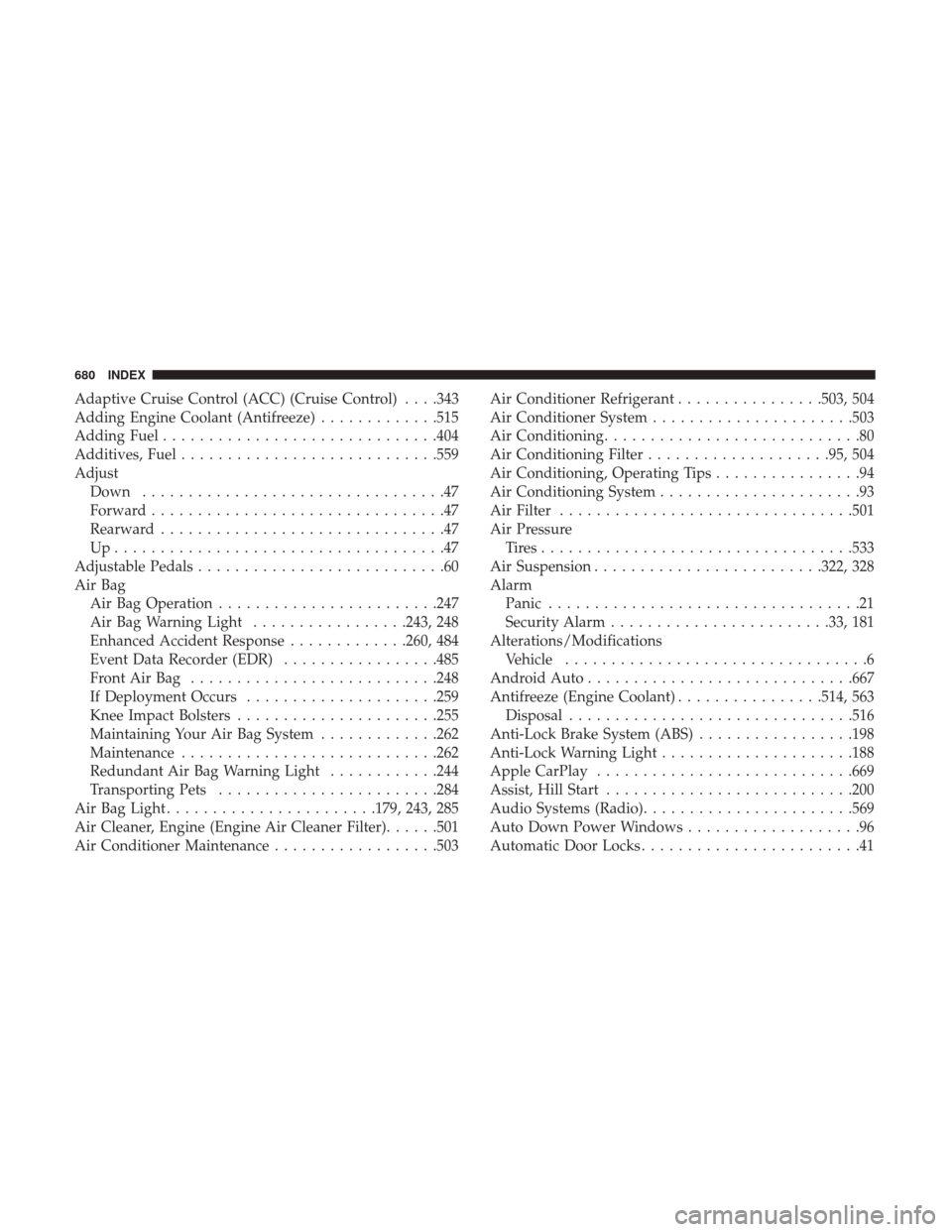
Adaptive Cruise Control (ACC) (Cruise Control) . . . .343
Adding Engine Coolant (Antifreeze).............515
Adding Fuel ............................. .404
Additives, Fuel ........................... .559
Adjust Down .................................47
Forward ................................47
Rearward ...............................47
Up....................................47
Adjustable Pedals ...........................60
Air Bag Air Bag Operation ....................... .247
Air Bag Warning Light .................243, 248
Enhanced Accident Response .............260, 484
Event Data Recorder (EDR) .................485
FrontAirBag .......................... .248
If Deployment Occurs .....................259
Knee Impact Bolsters ..................... .255
Maintaining Your Air Bag System .............262
Maintenance ........................... .262
Redundant Air Bag Warning Light ............244
Transporting Pets ....................... .284
Air Bag Light ...................... .179, 243, 285
Air Cleaner, Engine (Engine Air Cleaner Filter) ......501
Air Conditioner Maintenance ..................503 Air Conditioner Refrigerant
................503, 504
Air Conditioner System ..................... .503
Air Conditioning ............................80
Air Conditioning Filter ....................95, 504
Air Conditioning, Operating Tips ................94
Air Conditioning System ......................93
Air Filter ............................... .501
Air Pressure Tires................................. .533
Air Suspension ........................ .322, 328
Alarm Panic ..................................21
Security Alarm....................... .33, 181
Alterations/Modifications Vehicle .................................6
Android Auto ............................ .667
Antifreeze (Engine Coolant) ................514, 563
Disposal .............................. .516
Anti-Lock
Brake System (ABS) .................198
Anti-Lock Warning Light .....................188
Apple CarPlay ........................... .669
Assist, Hill Start .......................... .200
Audio Systems (Radio) ...................... .569
Auto Down Power Windows ...................96
Automatic Door Locks ........................41
680 INDEX
Page 683 of 698
Automatic Headlights........................71
Automatic High Beams .......................70
Automatic Tailgate Release ....................108
Automatic Temperature Control (ATC) ............93
Automatic Transmission ..................306, 521
Adding Fluid .......................... .521
Fluid And Filter Change ...................521
Fluid Change .......................... .521
Fluid Level Check .....................520, 521
Fluid Type ......................... .520, 566
Special Additives ........................ .520
Automatic Transmission Limp Home Mode ........311
Axle Fluid ........................... .521, 566
Axle Lubrication .......................... .521
Back-Up ................................ .396
Back-Up Camera .......................... .396
Battery .............................. .181, 497
Charging System Light ....................181
Keyless Key Fob Replacement ................23
Belts, Seat ............................... .285
Blind Spot Monitoring ...................... .210
Body Builders Guide ..........................5
Body Mechanism Lubrication ..................509
B-Pillar Location .......................... .528Brake Assist System
........................ .200
Brake Control System ....................... .199
Brake Fluid .......................... .519, 566
Brake System ......................... .519, 556
Fluid Check ........................... .519
Master Cylinder ........................ .519
Parking .............................. .300
Warning Light .......................... .180
Brake/Transmission Interlock ..................306
Bulb Replacement ......................... .441
Bulbs, Light .......................... .287, 441
Camera ................................ .396
Camera,
Rear ......................... .396, 398
Camper ................................ .147
Capacities, Fuel ........................... .563
Caps, Filler Oil (Engine) ........................ .494, 500
Radiator (Coolant Pressure) .................516
Carbon Monoxide Warning ................285, 562
Cargo Light ...............................73
Car Washes .............................. .548
Cellular Phone ........................... .646
Center High Mounted Stop Light ...............448
Center Seat Storage Compartment ...............117
12
INDEX 681
Page 684 of 698

Chart, Tire Sizing.......................... .524
Check Engine Light (Malfunction Indicator Light). . . .195
Checking Your Vehicle For Safety ...............284
Checks, Safety ............................ .284
Child Restraint ........................... .263
Child Restraints Booster Seats ........................... .267
Child Seat Installation ..................277, 278
How To Stow An unused ALR Seat Belt ........276
Infant And Child Restraints .................265
Locating The LATCH Anchorages .............273
Lower Anchors And Tethers For Children .......269
Older Children And Child Restraints ...........266
Seating Positions ........................ .268
Clean Air Gasoline ........................ .559
Cleaning Wheels ............................... .542
Climate Control ............................80
Automatic ..............................84
Manual ................................80
Cold Weather Operation ..................... .299
Compact Disc (CD) Maintenance ................671
Compact Spare Tire ........................ .540
Contract, Service .......................... .676
Cooling Pressure Cap (Radiator Cap) ............516Cooling System
........................... .513
Adding Coolant (Antifreeze) .................515
Coolant Level ....................513, 516, 517
Cooling Capacity ........................ .563
Disposal Of Used Coolant ..................516
Drain, Flush, And Refill ....................514
Inspection ......................... .516, 517
Points To Remember ..................... .518
Pressure Cap ........................... .516
Radiator Cap .......................... .516
Selection Of Coolant (Antifreeze) .......514, 563, 564
Corrosion Protection ....................... .547
Cr
uise Control (Speed Control) .................343
Cruise Light .......................... .192, 193
Cupholders .............................. .125
Customer Assistance ....................... .674
Cybersecurity ............................ .570
Daytime Running Lights ......................69
Dealer Service ............................ .498
Defroster, Rear Window .......................80
Defroster, Windshield .....................80, 286
Delay (Intermittent) Wipers ....................77
Diagnostic System, Onboard ...................194
Differential, Limited Slip .....................335
682 INDEX
Page 685 of 698
Disable Vehicle Towing..................... .481
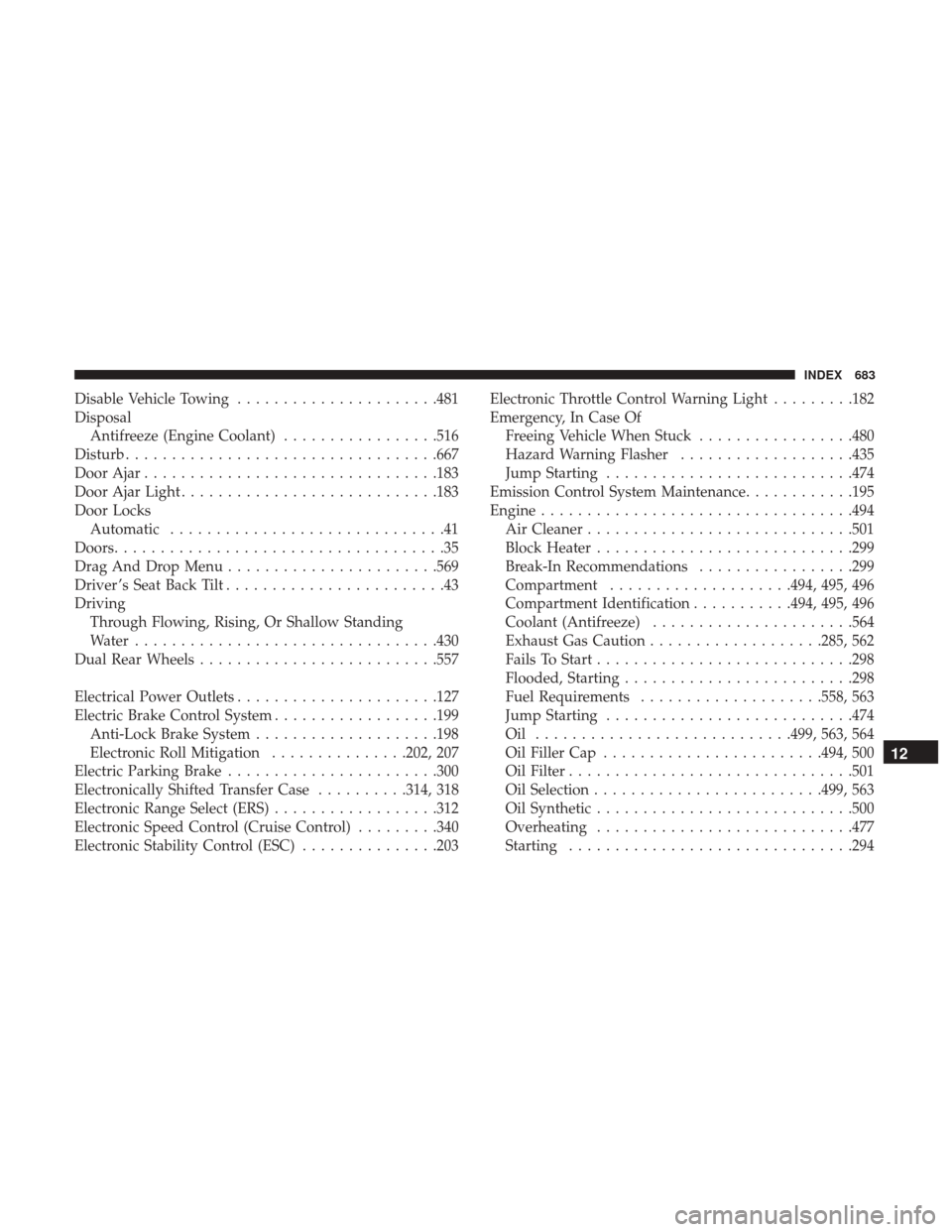
Disposal Antifreeze (Engine Coolant) .................516
Disturb ................................. .667
Door Ajar ............................... .183
Door Ajar Light ........................... .183
Door Locks Automatic ..............................41
Doors ....................................35
Drag And Drop Menu ...................... .569
Driver ’s Seat Back Tilt ........................43
Driving Through Flowing, Rising, Or Shallow Standing
Water ................................ .430
Dual Rear Wheels ......................... .557
Electrical Power Outlets ..................... .127
Electric Brake Control System ..................199
Anti-Lock Brake System ....................198
Electronic Roll Mitigation ...............202, 207
Electric Parking Brake ...................... .300
Electronically Shifted Transfer Case ..........314, 318
Electronic Range Select (ERS)..................312
Electronic Speed Control (Cruise Control) .........340
Electronic Stability Control (ESC) ...............203Electronic Throttle Control Warning Light
.........182
Emergency, In Case Of Freeing Vehicle When Stuck .................480
Hazard Warning Flasher ...................435
Jump Starting .......................... .474
Emission Control System Maintenance ............195
Engine ................................. .494
Air Cleaner ............................ .501
Block Heater ........................... .299
Break-In Recommendations .................299
Compartment ....................494, 495, 496
Compartment Identification ...........494, 495, 496
Coolant (Antifreeze) ..................... .564
Exhaust Gas Caution ...................285, 562
Fails To Start ........................... .298
Flooded,
Starting ........................ .298
Fuel Requirements ....................558, 563
Jump Starting .......................... .474
Oil ........................... .499, 563, 564
Oil Filler Cap ....................... .494, 500
Oil Filter .............................. .501
Oil Selection ........................ .499, 563
Oil Synthetic ........................... .500
Overheating ........................... .477
Starting .............................. .294
12
INDEX 683