AC system Ram 1500 2020 Owner's Manual
[x] Cancel search | Manufacturer: RAM, Model Year: 2020, Model line: 1500, Model: Ram 1500 2020Pages: 674, PDF Size: 32.69 MB
Page 227 of 674

SAFETY 225
• Medium• When the sensitivity of FCW is set to the “Medium”setting and the system status is “Only Warning”, this
allows the system to warn the driver of a possible colli -
sion with the vehicle in front using audible/visual
warnings.
• Near • When the sensitivity of FCW is set to the “Near” settingand the system status is “Only Warning”, this allows
the system to warn the driver of a possible closer colli -
sions with the vehicle in front using audible/visual
warnings.
• This setting provides less reaction time than the “Far” and “Medium” settings, which allows for a more
dynamic driving experience.
• More dynamic or aggressive drivers that want to avoid frequent warnings may prefer this setting. FCW Limited Warning
If the instrument cluster displays “ACC/FCW Limited Func
-
tionality” or “ACC/FCW Limited Functionality Clean Front
Windshield” momentarily, there may be a condition that
limits FCW functionality. Although the vehicle is still drive -
able under normal conditions, the active braking may not be
fully available. Once the condition that limited the system
performance is no longer present, the system will return to
its full performance state. If the problem persists, see an
authorized dealer.
Service FCW Warning
If the system turns off, and the instrument cluster displays:
• ACC/FCW Unavailable Service Required
• Cruise/FCW Unavailable Service Required
This indicates there is an internal system fault. Although the
vehicle is still drivable under normal conditions, have the
system checked by an authorized dealer.
4
2020_DT_1500_OM_US.book Page 225
Page 229 of 674

SAFETY 227
Tire Pressure Monitoring System (TPMS)
The Tire Pressure Monitoring System (TPMS) will warn the
driver of a low tire pressure based on the vehicle recom-
mended cold placard pressure.
NOTE:
The TPMS Warning Light will illuminate in the instrument
cluster and a chime will sound when tire pressure is low in
one or more of the four active road tires. In addition, the
instrument cluster will display a graphic showing the pres -
sure values of each tire with the low tire pressure values in a
different color, or the Uconnect radio will display a TPMS
message, when this occurs you must increase the tire pres -
sure to the recommended cold placard pressure in order for
the TPMS Warning Light to turn off.
The tire pressure will vary with temperature by about 1 psi
(7 kPa) for every 12°F (6.5°C). This means that when the
outside temperature decreases, the tire pressure will
decrease. Tire pressure should always be set based on cold
inflation tire pressure. This is defined as the tire pressure
after the vehicle has not been driven for at least three hours,
or driven less than 1 mile (1.6 km) after a three hour period.
The cold tire inflation pressure must not exceed the
maximum inflation pressure molded into the tire sidewall.
Refer to “Tires” in “Servicing And Maintenance” for infor -mation on how to properly inflate the vehicle’s tires. The tire
pressure will also increase as the vehicle is driven - this is
normal and there should be no adjustment for this increased
pressure.
The TPMS will warn the driver of a low tire pressure if the
tire pressure falls below the low-pressure warning limit for
any reason, including low temperature effects and natural
pressure loss through the tire.
The TPMS will continue to warn the driver of low tire pres
-
sure as long as the condition exists, and will not turn off until
the tire pressure is at or above the recommended cold
placard pressure. Once the low TPMS Warning Light illumi -
nates, increase the tire pressure to the recommended cold
placard pressure in order for the TPMS Warning Light to
turn off. The system will automatically update and the TPMS
Warning Light will turn off once the system receives the
updated tire pressures. The vehicle may need to be driven
for up to 20 minutes above 15 mph (24 km/h) in order for the
TPMS to receive this information.
4
2020_DT_1500_OM_US.book Page 227
Page 230 of 674

228 SAFETY
(Continued)
NOTE:
When filling warm tires, the tire pressure may need to be
increased up to an additional 4 psi (28 kPa) above the recom-
mended cold placard pressure in order to turn the TPMS
Warning Light off.
For example, your vehicle may have a recommended cold
(parked for more than three hours) placard pressure of 30 psi
(207 kPa). If the ambient temperature is 68°F (20°C) and the
measured tire pressure is 27 psi (186 kPa), a temperature
drop to 20°F (-7°C) will decrease the tire pressure to approx -
imately 23 psi (158 kPa). This tire pressure is sufficiently low
enough to turn on the TPMS Warning Light. Driving the
vehicle may cause the tire pressure to rise to approximately
27 psi (186 kPa), but the TPMS Warning Light will still be on.
In this situation, the TPMS Warning Light will turn off only
after the tires are inflated to the vehicle’s recommended cold
placard pressure value. NOTE:
• The TPMS is not intended to replace normal tire care and
maintenance or to provide warning of a tire failure or
condition.
• The TPMS should not be used as a tire pressure gauge while adjusting your tire pressure.
• Driving on a significantly under-inflated tire causes the tire to overheat and can lead to tire failure. Under-inflation
also reduces fuel efficiency and tire tread life, and may
affect the vehicle’s handling and stopping ability.
CAUTION!
• The TPMS has been optimized for the original equip -
ment tires and wheels. TPMS pressures and warning
have been established for the tire size equipped on
your vehicle. Undesirable system operation or sensor
damage may result when using replacement equipment
that is not of the same size, type, and/or style. After -
market wheels can cause sensor damage.
• Using aftermarket tire sealants may cause the Tire Pres -
sure Monitoring System (TPMS) sensor to become
inoperable. After using an aftermarket tire sealant it is
recommended that you take your vehicle to an autho -
rized dealership to have your sensor function checked.
• After inspecting or adjusting the tire pressure always reinstall the valve stem cap. This will prevent moisture
and dirt from entering the valve stem, which could
damage the TPMS sensor. CAUTION!
(Continued)
2020_DT_1500_OM_US.book Page 228
Page 231 of 674
SAFETY 229
• The TPMS is not a substitute for proper tire maintenance,and it is the driver’s responsibility to maintain correct tire
pressure using an accurate tire pressure gauge, even if
under-inflation has not reached the level to trigger illumi -
nation of the TPMS Warning Light.
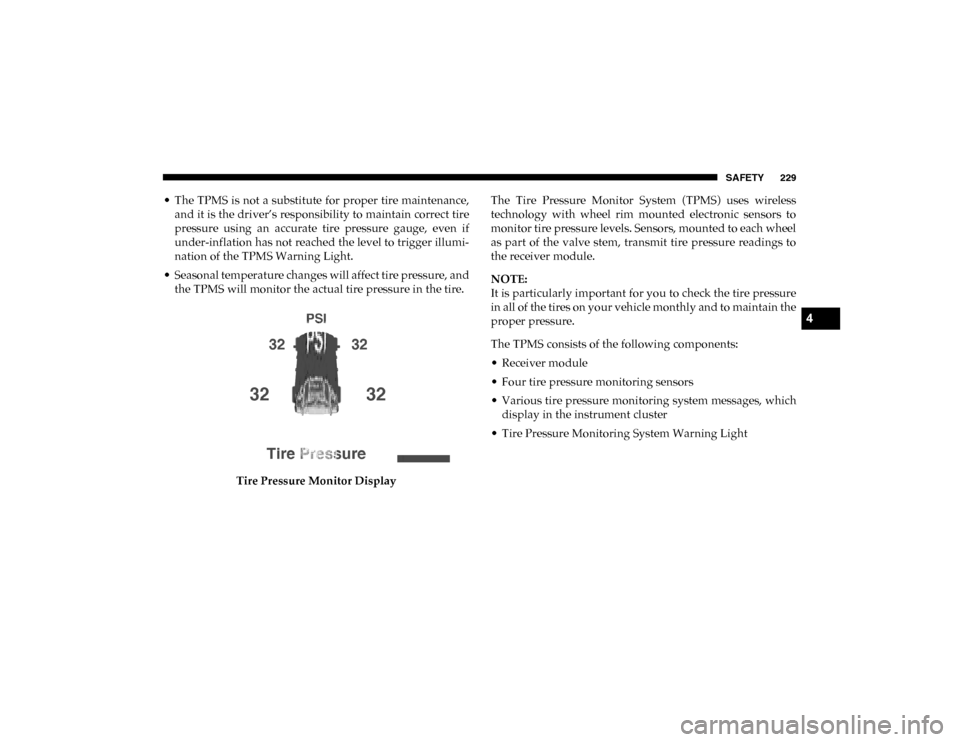
• Seasonal temperature changes will affect tire pressure, and the TPMS will monitor the actual tire pressure in the tire.
Tire Pressure Monitor Display The Tire Pressure Monitor System (TPMS) uses wireless
technology with wheel rim mounted electronic sensors to
monitor tire pressure levels. Sensors, mounted to each wheel
as part of the valve stem, transmit tire pressure readings to
the receiver module.
NOTE:
It is particularly important for you to check the tire pressure
in all of the tires on your vehicle monthly and to maintain the
proper pressure.
The TPMS consists of the following components:
• Receiver module
• Four tire pressure monitoring sensors
• Various tire pressure monitoring system messages, which
display in the instrument cluster
• Tire Pressure Monitoring System Warning Light
4
2020_DT_1500_OM_US.book Page 229
Page 232 of 674
230 SAFETY
Tire Pressure Monitoring Low Pressure WarningsThe “Tire Pressure Monitoring System (TPMS)
Warning Light” will illuminate in the instrument
cluster and a chime will sound when tire pressure is
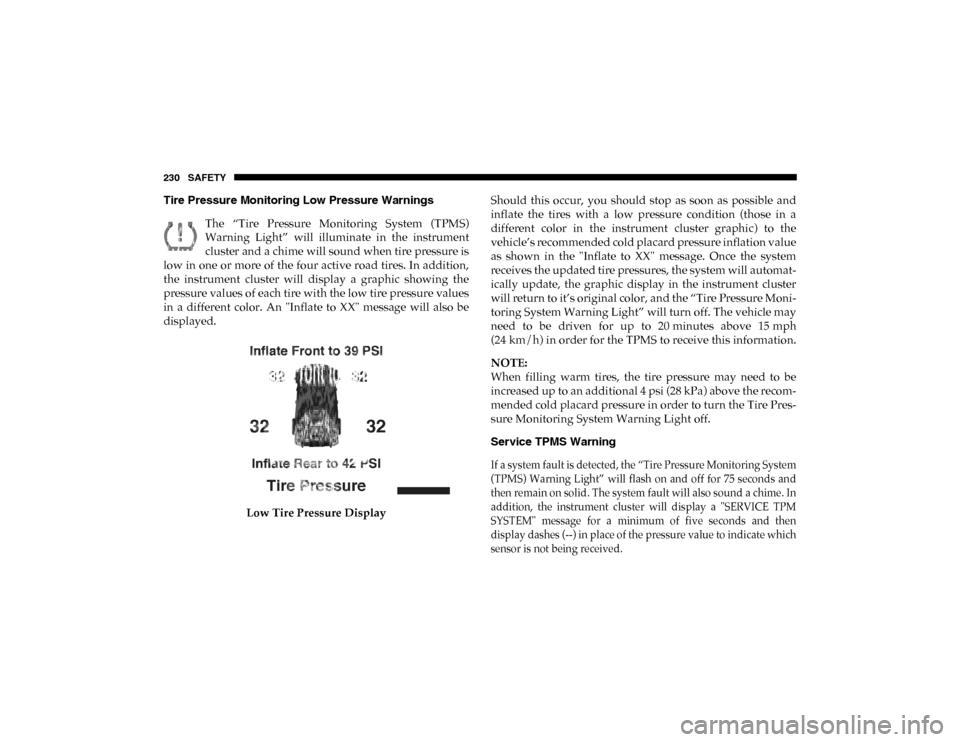
low in one or more of the four active road tires. In addition,
the instrument cluster will display a graphic showing the
pressure values of each tire with the low tire pressure values
in a different color. An "Inflate to XX" message will also be
displayed.
Low Tire Pressure Display Should this occur, you should stop as soon as possible and
inflate the tires with a low pressure condition (those in a
different color in the instrument cluster graphic) to the
vehicle’s recommended cold placard pressure inflation value
as shown in the "Inflate to XX" message. Once the system
receives the updated tire pressures, the system will automat
-
ically update, the graphic display in the instrument cluster
will return to it’s original color, and the “Tire Pressure Moni -
toring System Warning Light” will turn off. The vehicle may
need to be driven for up to 20 minutes above 15 mph
(24 km/h) in order for the TPMS to receive this information.
NOTE:
When filling warm tires, the tire pressure may need to be
increased up to an additional 4 psi (28 kPa) above the recom -
mended cold placard pressure in order to turn the Tire Pres -
sure Monitoring System Warning Light off.
Service TPMS Warning
If a system fault is detected, the “Tire Pressure Monitoring System
(TPMS) Warning Light” will flash on and off for 75 seconds and
then remain on solid. The system fault will also sound a chime. In
addition, the instrument cluster will display a "SERVICE TPM
SYSTEM" message for a minimum of five seconds and then
display dashes (--) in place of the pressure value to indicate which
sensor is not being received.
2020_DT_1500_OM_US.book Page 230
Page 233 of 674

SAFETY 231
If the ignition switch is cycled, this sequence will repeat,
providing the system fault still exists. If the system fault no
longer exists, the “Tire Pressure Monitoring System Warning
Light” will no longer flash, and the "SERVICE TPM
SYSTEM" message will no longer display, and a pressure
value will display in place of the dashes. A system fault can
occur due to any of the following:
• Signal interference due to electronic devices or drivingnext to facilities emitting the same radio frequencies as the
Tire Pressure Monitor (TPM) sensors
• Installing aftermarket window tinting that contains mate -
rials that may block radio wave signals
• Accumulation of snow or ice around the wheels or wheel housings
• Using tire chains on the vehicle
• Using wheels/tires not equipped with TPM sensors
A system fault may occur due to an incorrect TPM sensor loca -
tion condition. When a system fault occurs due to an incorrect
TPM sensor location, the “Tire Pressure Monitoring System
(TPMS) Warning Light” will flash on and off for 75 seconds
and then remain on solid. The system fault will also sound a
chime. In addition, the instrument cluster will display a “Tire
Pressure Temporarily Unavailable” message in place of the
tire pressure display screen. If the ignition switch is cycled, this sequence will repeat, providing the system fault still
exists. If the system fault no longer exists, the “Tire Pressure
Monitoring System Warning Light” will no longer flash and
the tire pressure display screen will be displayed showing the
tire pressure values the correct locations.
Vehicles With Non Matching Full Size Spare Or Compact
Spare
• The non matching full size spare or compact spare tire
does not have a TPM sensor. Therefore, the TPMS will not
monitor the pressure in the non matching full size spare or
compact spare tire.
• If you install the non matching full size spare or compact spare tire in place of a road tire that has a pressure below
the low-pressure warning limit, upon the next ignition
switch cycle, the Tire Pressure Monitoring System (TPMS)
Warning Light and a “LOW TIRE” message will remain
ON and a chime will sound. In addition, the graphic in the
instrument cluster will still display a pressure value in a
different color and an “Inflate to XX” message.
• After driving the vehicle for up to 20 minutes above 15 mph (24 km/h), the Tire Pressure Monitoring System
(TPMS) Warning Light will flash on and off for 75 seconds
and then remain on solid. In addition, the instrument
4
2020_DT_1500_OM_US.book Page 231
Page 234 of 674

232 SAFETY
cluster will display a "SERVICE TPM SYSTEM" message
for a minimum of five seconds and then display dashes (--)
in place of the pressure value.
• For each subsequent ignition switch cycle, a chime will sound, the Tire Pressure Monitoring System (TPMS)
Warning Light will flash on and off for 75 seconds and
then remain on solid, and the instrument cluster will
display a "SERVICE TPM SYSTEM" message for a
minimum of five seconds and then display dashes (--) in
place of the pressure value.
• Once you repair or replace the original road tire and rein -
stall it on the vehicle in place of the non matching full size
spare or compact spare, the TPMS will update automati -
cally. In addition, the Tire Pressure Monitoring System
(TPMS) Warning Light will turn OFF and the graphic in
the instrument cluster will display a new pressure value
instead of dashes (--), as long as no tire pressure is below
the low-pressure warning limit in any of the four active
road tires. The vehicle may need to be driven for up to
20 minutes above 15 mph (24 km/h) in order for the TPMS
to receive this information. Tire Fill Alert
This feature notifies the user when the placard tire pressure
is attained while inflating or deflating the tire.
The customer may choose to disable or enable the Tire Fill
Alert feature through use of the customer settings in the
radio.
NOTE:
• Only one tire can be filled at a time when using the Tire Fill
Alert system.
• The Tire Fill Alert feature cannot be entered if an existing TPM system fault is set to “active” or if the system is in
deactivation mode (if equipped).
The system will be activated when a positive increase in tire
pressure is detected by the TPM system while inflating the
tire. The ignition must be in the RUN mode, with the trans -
mission in PARK (P).
NOTE:
It is not required to have the engine running to enter Tire Fill
Alert mode.
2020_DT_1500_OM_US.book Page 232
Page 236 of 674

234 SAFETY
Le présent appareil est conforme aux CNR d`Innovation,
Science and Economic Development applicables aux appar-
eils radio exempts de licence. L'exploitation est autorisée aux
deux conditions suivantes:
1. l'appareil ne doit pas produire de brouillage, et
2. l'utilisateur de l'appareil doit accepter tout brouillage radioélectrique subi, même si le brouillage est susceptible
d'en compromettre le fonctionnement.
La operación de este equipo está sujeta a las siguientes dos
condiciones:
1. es posible que este equipo o dispositivo no cause interfer -
encia perjudicial y
2. este equipo o dispositivo debe aceptar cualquier interfer- encia, incluyendo la que pueda causar su operación no
deseada. NOTE:
Changes or modifications not expressly approved by the
party responsible for compliance could void the user’s
authority to operate the equipment.
OCCUPANT RESTRAINT SYSTEMS
Some of the most important safety features in your vehicle
are the restraint systems:
Occupant Restraint Systems Features
• Seat Belt Systems
• Supplemental Restraint Systems (SRS) Air Bags
• Child Restraints
Some of the safety features described in this section may be
standard equipment on some models, or may be optional
equipment on others. If you are not sure, ask an authorized
dealer.
2020_DT_1500_OM_US.book Page 234
Page 237 of 674

SAFETY 235
(Continued)
Important Safety Precautions
Please pay close attention to the information in this section.
It tells you how to use your restraint system properly, to
keep you and your passengers as safe as possible.
Here are some simple steps you can take to minimize the risk
of harm from a deploying air bag:
1. Children 12 years old and under should always ridebuckled up in the rear seat of a vehicle with a rear seat.
2. A child who is not big enough to wear the vehicle seat belt properly (Refer to “Child Restraints” in this section for
further information) must be secured in the appropriate
child restraint or belt-positioning booster seat in a rear
seating position.
3. If a child from 2 to 12 years old (not in a rear-facing child restraint) must ride in the front passenger seat, move the
seat as far back as possible and use the proper child
restraint (Refer to “Child Restraints” in this section for
further information).
4. Never allow children to slide the shoulder belt behind them or under their arm. 5. You should read the instructions provided with your
child restraint to make sure that you are using it properly.
6. All occupants should always wear their lap and shoulder belts properly.
7. The driver and front passenger seats should be moved back as far as practical to allow the front air bags room to
inflate.
8. Do not lean against the door or window. If your vehicle has side air bags, and deployment occurs, the side air
bags will inflate forcefully into the space between occu -
pants and the door and occupants could be injured.
9. If the air bag system in this vehicle needs to be modified to accommodate a disabled person, refer to the
“Customer Assistance” section for customer service
contact information.
WARNING!
• Never place a rear-facing child restraint in front of an air bag. A deploying passenger front air bag can cause
death or serious injury to a child 12 years or younger,
including a child in a rear-facing child restraint.
4
2020_DT_1500_OM_US.book Page 235
Page 238 of 674
236 SAFETY
Seat Belt Systems
Buckle up even though you are an excellent driver, even on
short trips. Someone on the road may be a poor driver and
could cause a collision that includes you. This can happen far
away from home or on your own street.
Research has shown that seat belts save lives, and they can
reduce the seriousness of injuries in a collision. Some of the
worst injuries happen when people are thrown from the
vehicle. Seat belts reduce the possibility of ejection and the
risk of injury caused by striking the inside of the vehicle.
Everyone in a motor vehicle should be belted at all times.
Enhanced Seat Belt Use Reminder System (BeltAlert)
Driver And Passenger BeltAlert — If Equipped BeltAlert is a feature intended to remind the driver and
outboard front seat passenger (if equipped with outboard front passenger seat BeltAlert) to buckle their seat belts. The
BeltAlert feature is active whenever the ignition switch is in
the START or ON/RUN position.
Initial Indication
If the driver is unbuckled when the ignition switch is first in
the START or ON/RUN position, a chime will signal for a
few seconds. If the driver or outboard front seat passenger (if
equipped with outboard front passenger seat BeltAlert) is
unbuckled when the ignition switch is first in the START or
ON/RUN position the Seat Belt Reminder Light will turn on
and remain on until both outboard front seat belts are
buckled. The outboard front passenger seat BeltAlert is not
active when an outboard front passenger seat is unoccupied.
BeltAlert Warning Sequence
The BeltAlert warning sequence is activated when the
vehicle is moving above a specified vehicle speed range and
the driver or outboard front seat passenger is unbuckled (if
equipped with outboard front passenger seat BeltAlert) (the
outboard front passenger seat BeltAlert is not active when
the outboard front passenger seat is unoccupied). The
BeltAlert warning sequence starts by blinking the Seat Belt
Reminder Light and sounding an intermittent chime. Once
the BeltAlert warning sequence has completed, the Seat Belt
• Never install a rear-facing child restraint in the front
seat of a vehicle. Only use a rear-facing child restraint
in the rear seat. If the vehicle does not have a rear seat,
do not transport a rear-facing child restraint in that
vehicle.
WARNING! (Continued)
2020_DT_1500_OM_US.book Page 236