Hood Ram 1500 2020 User Guide
[x] Cancel search | Manufacturer: RAM, Model Year: 2020, Model line: 1500, Model: Ram 1500 2020Pages: 674, PDF Size: 32.69 MB
Page 298 of 674
296 STARTING AND OPERATING
If the engine has been flooded, it may start to run, but not
have enough power to continue running when the ignition
button/key is released. If this occurs, continue cranking with
the accelerator pedal pushed all the way to the floor. Release
the accelerator pedal and the ignition button/key once the
engine is running smoothly.
If the engine shows no sign of starting after a 10 second
period of engine cranking with the accelerator pedal held to
the floor, wait 10 to 15 seconds, then repeat the “Normal
Starting” procedure.
Cold Weather Operation (Below –22°F Or −30°C)
To ensure reliable starting at these temperatures, use of an
externally powered electric engine block heater (available
from your authorized dealer) is recommended.
After Starting
The idle speed is controlled automatically, and it will
decrease as the engine warms up.
ENGINE BLOCK HEATER — IF EQUIPPED
The engine block heater warms the engine, and permits
quicker starts in cold weather. Connect the cord to a stan-
dard 110-115 Volt AC electrical outlet with a grounded,
three-wire extension cord.
The engine block heater cord is routed under the hood on the
passenger side of the vehicle near the right head lamp
assembly. It is located between the front grill and the radi -
ator, but underneath the black upper seal.
• If the vehicle has a discharged battery, booster cables
may be used to obtain a start from a booster battery or
the battery in another vehicle. This type of start can be
dangerous if done improperly. Refer to “Jump Starting
Procedure” in “In Case Of Emergency” for further
information.
CAUTION!
To prevent damage to the starter, do not crank the engine
for more than 10 seconds at a time. Wait 10 to 15 seconds
before trying again.
WARNING! (Continued)
WARNING!
Remember to disconnect the engine block heater cord
before driving. Damage to the 110-115 Volt electrical
cord could cause electrocution.
2020_DT_1500_OM_US.book Page 296
Page 337 of 674

STARTING AND OPERATING 335
• HVAC is set to full defrost mode at a high blower speed
• Engine has not reached normal operating temperature
• Engine temperature too high
• The battery is charging
• The transmission is not in DRIVE
• Hood is open
• Vehicle is in 4L transfer case mode
• TOW/HAUL mode is selected
• Accelerator pedal input
• Excessive 12 volt loads
It may be possible to operate the vehicle several consecutive
times in extreme conditions and not meet all criteria to
enable an Autostop state.
To Start The Engine While In Autostop Mode
While in DRIVE, the engine will start when the brake pedal
is released or the throttle pedal is depressed and the trans-
mission will automatically reengage upon engine restart. Conditions That Will Cause The Engine To Start Automat
-
ically While In Autostop Mode
The engine will start automatically when:
• The transmission selector is moved from DRIVE to REVERSE, NEUTRAL, or PARK
• To maintain cabin temperature near the HVAC settings
• HVAC is set to full defrost mode
• 12 volt demand requires engine restart
• Low brake vacuum (e.g. after several brake pedal applica -
tions)
• STOP/START OFF switch is pushed
• 4WD system is put into 4L mode
• The emissions system override is present
• A STOP/START system error present
5
2020_DT_1500_OM_US.book Page 335
Page 338 of 674
336 STARTING AND OPERATING
Conditions That Force An Automatic Shift To Park While
In Autostop Mode
The engine will not start automatically and the transmission
will be placed in PARK if:
• The driver door is open and brake pedal released.
• The driver door is open and the driver seat belt isunbuckled.
• The engine hood has been opened.
• A STOP/START system error present.
The engine may then be restarted by moving the transmis -
sion shift selector out of PARK (e.g. to DRIVE) or, in some
cases, only by a KEY START. The instrument cluster will
display a SHIFT OUT OF PARK message, or a STOP/START
KEY START REQUIRED message, to indicate which action is
required.
Refer to “Instrument Cluster Display” in “Getting To Know
Your Instrument Panel” for further information.To Manually Turn Off The Stop Start System
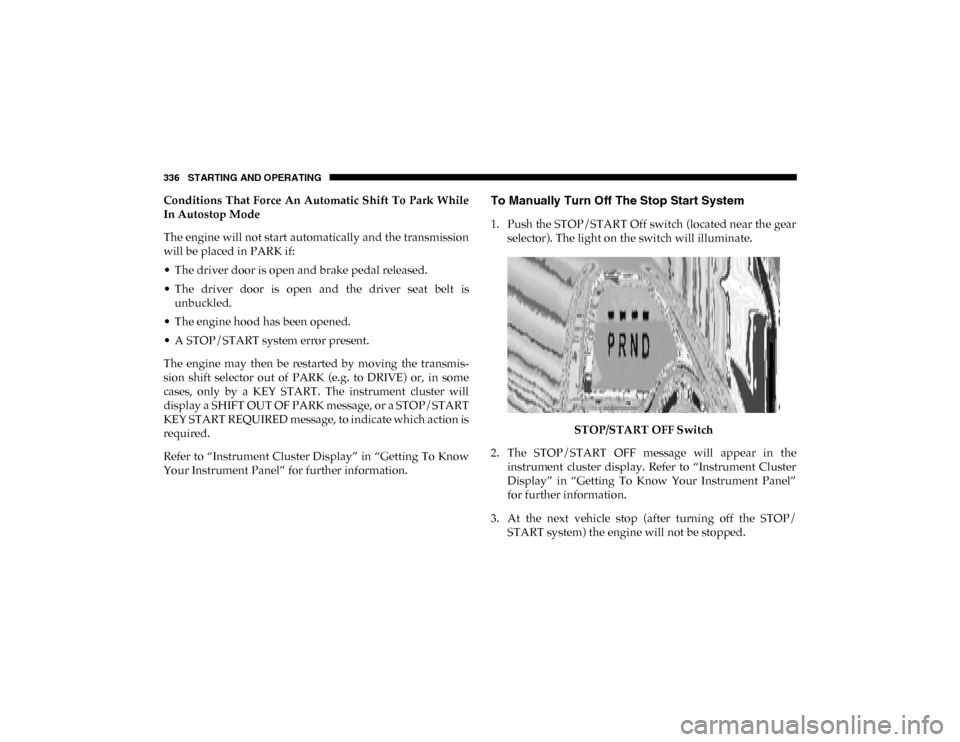
1. Push the STOP/START Off switch (located near the gear selector). The light on the switch will illuminate.
STOP/START OFF Switch
2. The STOP/START OFF message will appear in the instrument cluster display. Refer to “Instrument Cluster
Display” in “Getting To Know Your Instrument Panel”
for further information.
3. At the next vehicle stop (after turning off the STOP/ START system) the engine will not be stopped.
2020_DT_1500_OM_US.book Page 336
Page 440 of 674
438 IN CASE OF EMERGENCY
Replacing Exterior Bulbs
Base Quad: Low Beam Headlamp, High Beam Headlamp,
Front Park And Turn — If Equipped
Low Beam
1. Open the hood.
2. Disconnect and isolate the negative battery cable.
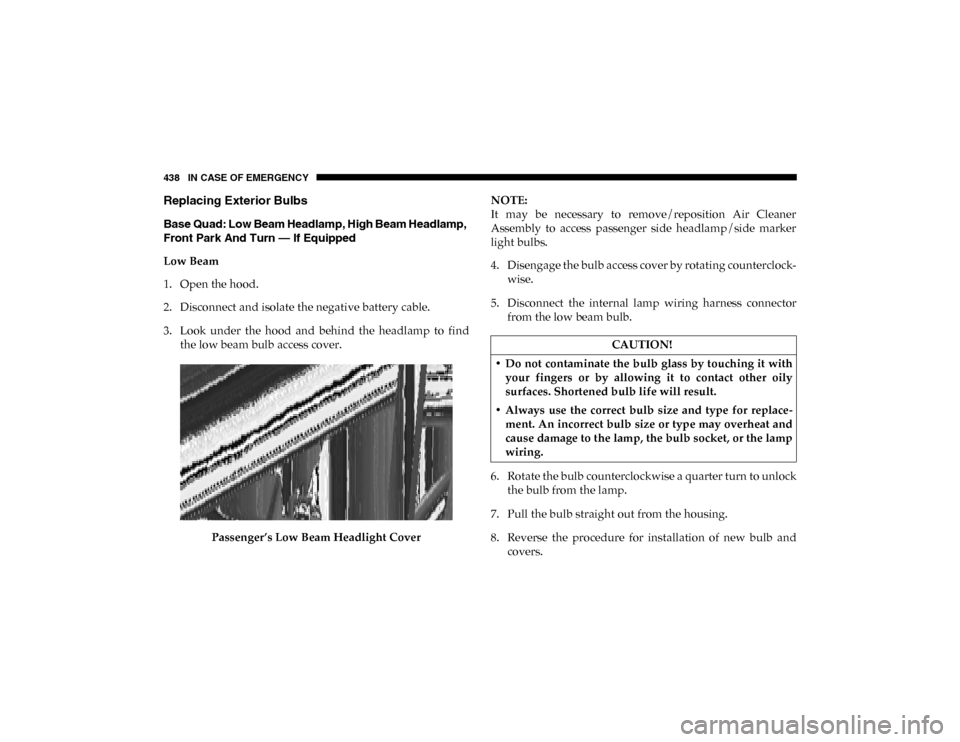
3. Look under the hood and behind the headlamp to findthe low beam bulb access cover.
Passenger’s Low Beam Headlight Cover NOTE:
It may be necessary to remove/reposition Air Cleaner
Assembly to access passenger side headlamp/side marker
light bulbs.
4. Disengage the bulb access cover by rotating counterclock
-
wise.
5. Disconnect the internal lamp wiring harness connector from the low beam bulb.
6. Rotate the bulb counterclockwise a quarter turn to unlock the bulb from the lamp.
7. Pull the bulb straight out from the housing.
8. Reverse the procedure for installation of new bulb and covers.
CAUTION!
• Do not contaminate the bulb glass by touching it with your fingers or by allowing it to contact other oily
surfaces. Shortened bulb life will result.
• Always use the correct bulb size and type for replace -
ment. An incorrect bulb size or type may overheat and
cause damage to the lamp, the bulb socket, or the lamp
wiring.
2020_DT_1500_OM_US.book Page 438
Page 441 of 674
IN CASE OF EMERGENCY 439
High Beam
1. Open the hood.
2. Disconnect and isolate the negative battery cable.
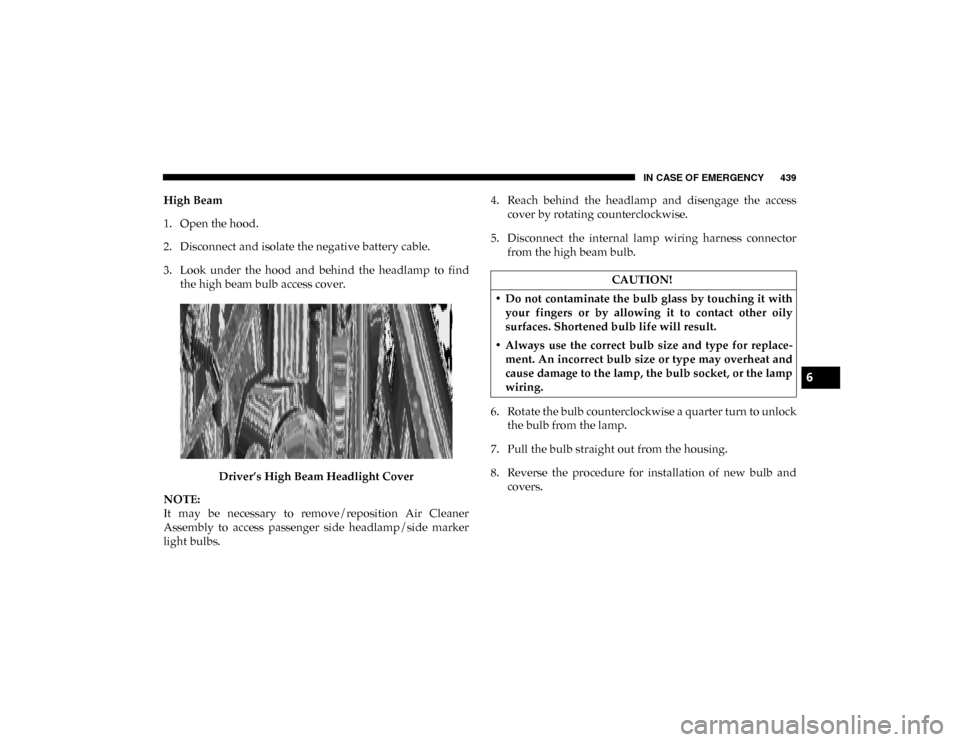
3. Look under the hood and behind the headlamp to findthe high beam bulb access cover.
Driver’s High Beam Headlight Cover
NOTE:
It may be necessary to remove/reposition Air Cleaner
Assembly to access passenger side headlamp/side marker
light bulbs. 4. Reach behind the headlamp and disengage the access
cover by rotating counterclockwise.
5. Disconnect the internal lamp wiring harness connector from the high beam bulb.
6. Rotate the bulb counterclockwise a quarter turn to unlock the bulb from the lamp.
7. Pull the bulb straight out from the housing.
8. Reverse the procedure for installation of new bulb and covers.
CAUTION!
• Do not contaminate the bulb glass by touching it with your fingers or by allowing it to contact other oily
surfaces. Shortened bulb life will result.
• Always use the correct bulb size and type for replace -
ment. An incorrect bulb size or type may overheat and
cause damage to the lamp, the bulb socket, or the lamp
wiring.
6
2020_DT_1500_OM_US.book Page 439
Page 442 of 674
440 IN CASE OF EMERGENCY
Front Park And Turn
1. Open the hood.
2. Disconnect and isolate the negative battery cable.
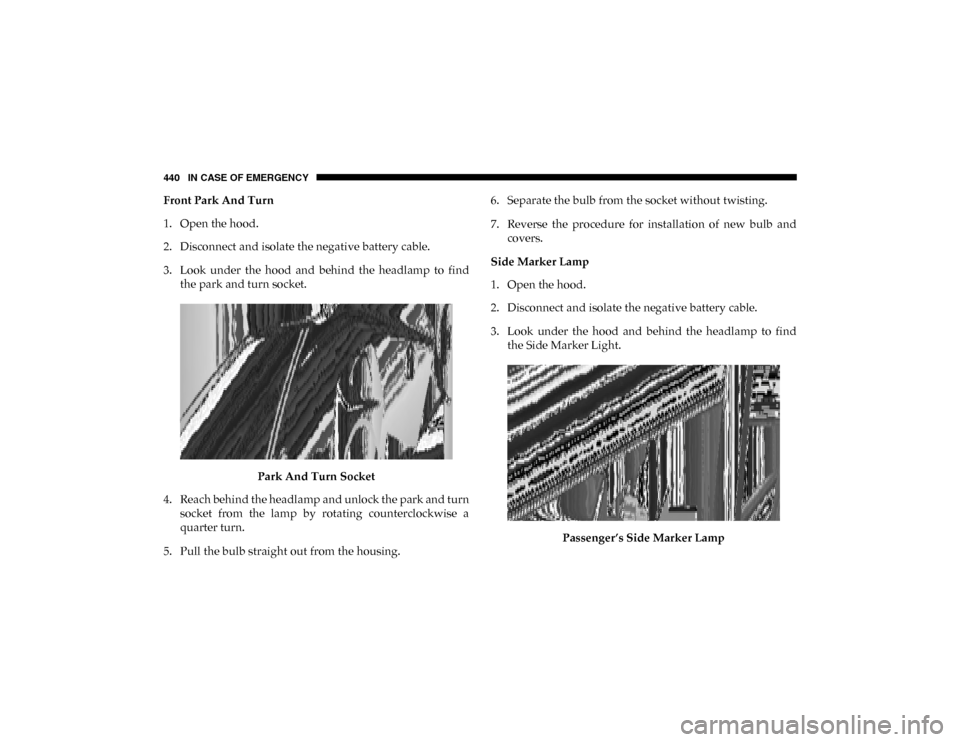
3. Look under the hood and behind the headlamp to findthe park and turn socket.
Park And Turn Socket
4. Reach behind the headlamp and unlock the park and turn socket from the lamp by rotating counterclockwise a
quarter turn.
5. Pull the bulb straight out from the housing. 6. Separate the bulb from the socket without twisting.
7. Reverse the procedure for installation of new bulb and
covers.
Side Marker Lamp
1. Open the hood.
2. Disconnect and isolate the negative battery cable.
3. Look under the hood and behind the headlamp to find the Side Marker Light.
Passenger’s Side Marker Lamp
2020_DT_1500_OM_US.book Page 440
Page 452 of 674

450 IN CASE OF EMERGENCY
F11–5 Amp TanOutput to Under-hood Power Distribution
Center (UPDC) Run Coil
F12 –25 Amp Clear Mod Audio Amplifier / Active Noise
Cancellation / SW Inverter
F13 –20 Amp Yellow Mod Seat Heater Front (Driver)
F14 –15 Amp Blue Mod Seat Heater Front (Steering Wheel)
F15 ––Spare
F16 ––Spare
F17 –20 Amp Yellow LT Spot Lamp
F18 30 Amp Pink –Motor Sunshade Sunroof
F19 ––Spare
F20 –20 Amp Yellow Comfort Rear Seat Module (CRSM) (Heat Rear
RT)
F21 ––Spare
F22 ––Spare
F23 ––Spare
F24 –15 Amp Blue Mod RF Hub / Mod Ignition / Mod Cluster
F25 40 Amp Green –Mod Integrated Trailer Brake
F26 –15 Amp Blue Mod Cluster CCN / Mod Cyber Security
F27 –5 Amp Tan Mod Cluster CCN / Mod SGW
Cavity
Cartridge Fuse Micro Fuse Description
2020_DT_1500_OM_US.book Page 450
Page 475 of 674
IN CASE OF EMERGENCY 473
1. Apply the parking brake, shift the automatic transmis-sion into PARK and turn the ignition OFF.
2. Turn off the heater, radio, and all unnecessary electrical accessories.
3. If using another vehicle to jump start the battery, park the vehicle within the jumper cables’ reach, apply the
parking brake and make sure the ignition is OFF.
Jump Starting Procedure
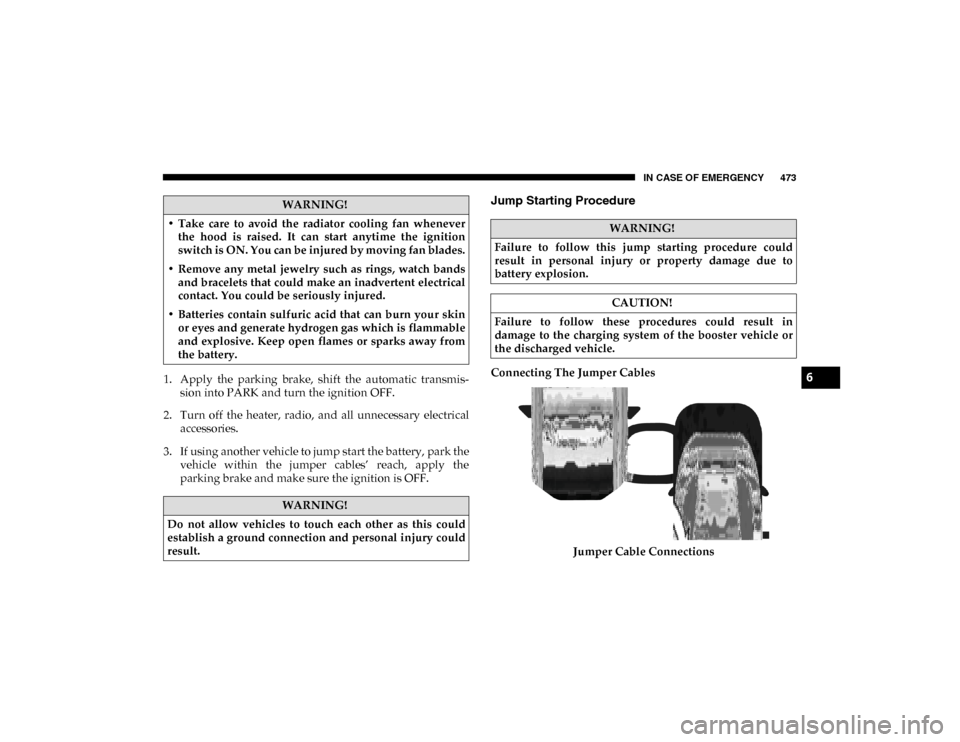
Connecting The Jumper Cables
Jumper Cable Connections
WARNING!
• Take care to avoid the radiator cooling fan whenever the hood is raised. It can start anytime the ignition
switch is ON. You can be injured by moving fan blades.
• Remove any metal jewelry such as rings, watch bands and bracelets that could make an inadvertent electrical
contact. You could be seriously injured.
• Batteries contain sulfuric acid that can burn your skin or eyes and generate hydrogen gas which is flammable
and explosive. Keep open flames or sparks away from
the battery.
WARNING!
Do not allow vehicles to touch each other as this could
establish a ground connection and personal injury could
result.
WARNING!
Failure to follow this jump starting procedure could
result in personal injury or property damage due to
battery explosion.
CAUTION!
Failure to follow these procedures could result in
damage to the charging system of the booster vehicle or
the discharged vehicle.
6
2020_DT_1500_OM_US.book Page 473
Page 477 of 674
IN CASE OF EMERGENCY 475
If frequent jump starting is required to start your vehicle you
should have the battery and charging system inspected at an
authorized dealer.
IF YOUR ENGINE OVERHEATS
In any of the following situations, you can reduce the poten-
tial for overheating by taking the appropriate action.
• On the highways — slow down.
• In city traffic — while stopped, place the transmission in NEUTRAL (N), but do not increase the engine idle speed
while preventing vehicle motion with the brakes. NOTE:
There are steps that you can take to slow down an impending
overheat condition:
• If your Air Conditioner (A/C) is on, turn it off. The A/C
system adds heat to the engine cooling system and turning
the A/C off can help remove this heat.
• You can also turn the temperature control to maximum heat, the mode control to floor and the blower control to
high. This allows the heater core to act as a supplement to
the radiator and aids in removing heat from the engine
cooling system.
CAUTION!
Accessories plugged into the vehicle power outlets draw
power from the vehicle’s battery, even when not in use
(i.e., cellular devices, etc.). Eventually, if plugged in long
enough without engine operation, the vehicle’s battery
will discharge sufficiently to degrade battery life and/or
prevent the engine from starting.
WARNING!
You or others can be badly burned by hot engine coolant
(antifreeze) or steam from your radiator. If you see or
hear steam coming from under the hood, do not open the
hood until the radiator has had time to cool. Never try to
open a cooling system pressure cap when the radiator or
coolant bottle is hot.6
2020_DT_1500_OM_US.book Page 475
Page 492 of 674

490 SERVICING AND MAINTENANCE
Checking Oil Level
To assure proper lubrication of your vehicle's engine, the
engine oil must be maintained at the correct level. Check the
oil level at regular intervals, such as every fuel stop. The best
time to check the engine oil level is about five minutes after
a fully warmed up engine is shut off.
Checking the oil while the vehicle is on level ground will
improve the accuracy of the oil level readings. Always main-
tain the oil level within the SAFE zone on the dipstick.
Adding one quart of oil when the reading is at the bottom of
the SAFE zone will result in a reading at the top of the safe
zone on these engines.
Adding Washer Fluid
The fluid reservoir is located under the hood and should be
checked for fluid level at regular intervals. Fill the reservoir
with windshield washer solvent only (not radiator anti -
freeze). When refilling the washer fluid reservoir, take some
washer fluid and apply it to a cloth or towel and wipe the
wiper blades clean. This will help blade performance. To prevent freeze-up of your windshield washer system in
cold weather, select a solution or mixture that meets or
exceeds the temperature range of your climate. This rating
information can be found on most washer fluid containers.
After the engine has warmed up, operate the defroster for a
few minutes to reduce the possibility of smearing or freezing
the fluid on the cold windshield. Windshield washer solu-
tion used with water as directed on the container, aids
cleaning action, reduces the freezing point to avoid line clog
-
ging, and is not harmful to paint or trim.
CAUTION!
Overfilling or underfilling will cause oil aeration or loss
of oil pressure. This could damage your engine.
WARNING!
Commercially available windshield washer solvents are
flammable. They could ignite and burn you. Care must
be exercised when filling or working around the washer
solution.
2020_DT_1500_OM_US.book Page 490