traction control Ram 1500 2020 User Guide
[x] Cancel search | Manufacturer: RAM, Model Year: 2020, Model line: 1500, Model: Ram 1500 2020Pages: 674, PDF Size: 32.69 MB
Page 347 of 674

STARTING AND OPERATING 345
To Set A Desired ACC Speed
When the vehicle reaches the speed desired, push the SET (+)
button or the SET (-) button and release. The instrument
cluster display will show the set speed.
If the system is set when the vehicle speed is below 20 mph
(32 km/h), the set speed shall be defaulted to 20 mph
(32 km/h). If the system is set when the vehicle speed is
above 20 mph (32 km/h), the set speed shall be the current
speed of the vehicle.
NOTE:
ACC cannot be set if there is a stationary vehicle in front of
your vehicle in close proximity.
Remove your foot from the accelerator pedal, after the ACC
has been set. If you do not, the vehicle may continue to accel -
erate beyond the set speed. If this occurs:
• The message “ACC DRIVER OVERRIDE” will display in the instrument cluster display.
• The system will not be controlling the distance between your vehicle and the vehicle ahead. The vehicle speed will
only be determined by the position of the accelerator
pedal.
To Cancel
The following conditions cancel the system:
• The brake pedal is applied.
• The CANC (cancel) button is pushed.
• An Anti-Lock Brake System (ABS) event occurs.
• The trailer brake is applied manually (if equipped).
• The gear selector is removed from the DRIVE position.
• The Electronic Stability Control/Traction Control System(ESC/TCS) activates.
• The vehicle parking brake is applied.
• Driver seatbelt is unbuckled at low speeds.
• Driver door is opened at low speeds.
• A Trailer Sway Control (TSC) event occurs.
• The driver switches ESC to Full Off mode.
• The braking temperature exceeds normal range (over -
heated).
5
2020_DT_1500_OM_US.book Page 345
Page 363 of 674

STARTING AND OPERATING 361
Metric Speed (km/h)
• Pushing the SET (-) button once will result in a 1 km/h
decrease in set speed. Each subsequent tap of the button
results in a decrease of 1 km/h.
• If the button is continually pushed, the set speed will continue to decrease in 10 km/h decrements until the
button is released. The decrease in set speed is reflected in
the instrument cluster display.
To Cancel
The following conditions will cancel the Normal (Fixed
Speed) Cruise Control without clearing the memory:
• The brake pedal is applied.
• The CANC button is pushed.
• The Electronic Stability Control/Traction Control System (ESC/TCS) activates.
• The vehicle parking brake is applied.
• The braking temperature exceeds normal range (over -
heated).
• The gear selector is removed from the DRIVE position.
• The driver switches ESC to Full Off mode. To Resume Speed
To resume a previously set speed, push the RES button and
release. Resume can be used at any speed above 20 mph
(32 km/h).
To Turn Off
The system will turn off and erase the set speed in memory if:
• The Normal (Fixed Speed) Cruise Control on/off button is
pushed.
• The ignition is placed in the OFF position.
• You engage Four-Wheel Drive Low.
• The Adaptive Cruise Control (ACC) on/off button is pushed.
PARKSENSE FRONT AND REAR PARK ASSIST
The ParkSense Park Assist system provides visual and
audible indications of the distance between the rear and/or
front fascia and a detected obstacle when backing up or
moving forward (e.g. during a parking maneuver). If your
vehicle is equipped with the automatic braking function, the
vehicle brakes may be automatically applied and released
when performing a reverse parking maneuver if the system
detects a possible collision with an obstacle.
5
2020_DT_1500_OM_US.book Page 361
Page 397 of 674
STARTING AND OPERATING 395
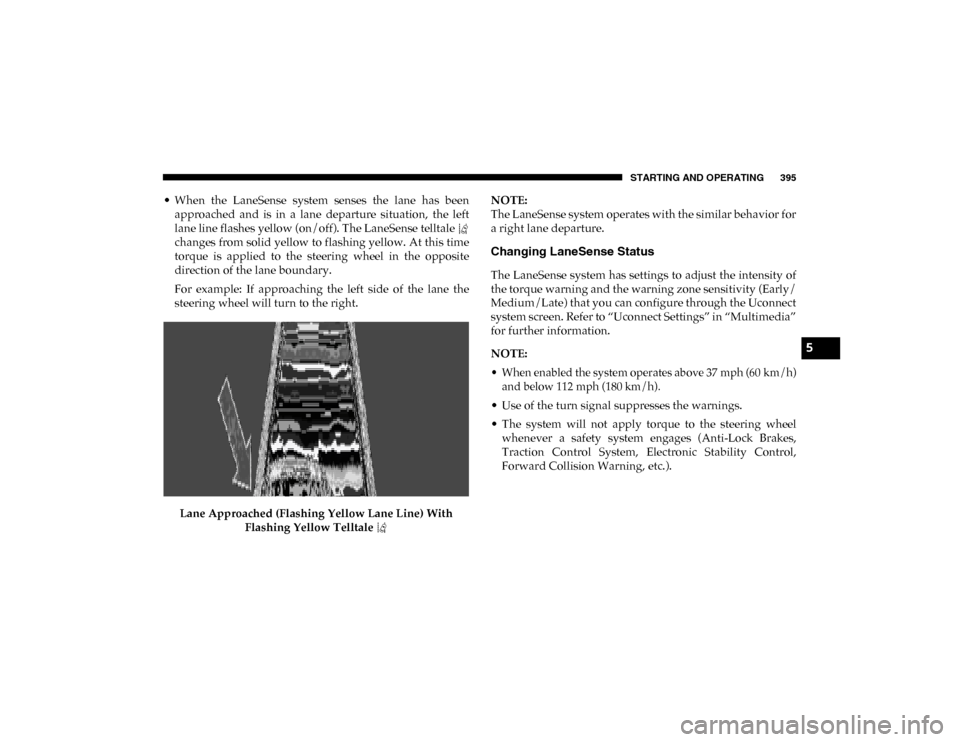
• When the LaneSense system senses the lane has beenapproached and is in a lane departure situation, the left
lane line flashes yellow (on/off). The LaneSense telltale
changes from solid yellow to flashing yellow. At this time
torque is applied to the steering wheel in the opposite
direction of the lane boundary.
For example: If approaching the left side of the lane the
steering wheel will turn to the right.
Lane Approached (Flashing Yellow Lane Line) With Flashing Yellow Telltale NOTE:
The LaneSense system operates with the similar behavior for
a right lane departure.
Changing LaneSense Status
The LaneSense system has settings to adjust the intensity of
the torque warning and the warning zone sensitivity (Early/
Medium/Late) that you can configure through the Uconnect
system screen. Refer to “Uconnect Settings” in “Multimedia”
for further information.
NOTE:
• When enabled the system operates above 37 mph (60 km/h)
and below 112 mph (180 km/h).
• Use of the turn signal suppresses the warnings.
• The system will not apply torque to the steering wheel whenever a safety system engages (Anti-Lock Brakes,
Traction Control System, Electronic Stability Control,
Forward Collision Warning, etc.).
5
2020_DT_1500_OM_US.book Page 395
Page 429 of 674

STARTING AND OPERATING 427
10. Start the engine.
11. Release the parking brake.
12. Shift the transmission into DRIVE, release the brakepedal, and check that the vehicle operates normally.
NOTE:
• Steps 3 and 4 are requirements that must be met before pushing the button to shift out of NEUTRAL (N), and must
continue to be met until the shift has been completed. If
any of these requirements are not met before pushing the
button or are no longer met during the shift, the
NEUTRAL (N) indicator light will flash continuously until
all requirements are met or until the button is released.
• The ignition must be in the ON/RUN mode for a shift to take place and for the position indicator lights to be oper -
able. If the ignition is not in the ON/RUN mode, the shift
will not take place and no position indicator lights will be
on or flashing.
• A flashing NEUTRAL (N) position indicator light indi -
cates that shift requirements have not been met.DRIVING TIPS
Driving On Slippery Surfaces
Acceleration
Rapid acceleration on snow covered, wet, or other slippery
surfaces may cause the driving wheels to pull erratically to
the right or left. This phenomenon occurs when there is a
difference in the surface traction under the rear (driving)
wheels.
Driving Through Water
Driving through water more than a few inches/centimeters
deep will require extra caution to ensure safety and prevent
damage to your vehicle.
WARNING!
Rapid acceleration on slippery surfaces is dangerous.
Unequal traction can cause sudden pulling of the rear
wheels. You could lose control of the vehicle and
possibly have a collision. Accelerate slowly and carefully
whenever there is likely to be poor traction (ice, snow,
wet, mud, loose sand, etc.).5
2020_DT_1500_OM_US.book Page 427
Page 533 of 674

SERVICING AND MAINTENANCE 531
Tire Types
All Season Tires — If Equipped
All Season tires provide traction for all seasons (Spring,
Summer, Autumn, and Winter). Traction levels may vary
between different all season tires. All season tires can be
identified by the M+S, M&S, M/S or MS designation on the
tire sidewall. Use all season tires only in sets of four; failure
to do so may adversely affect the safety and handling of your
vehicle.
Summer Or Three Season Tires — If Equipped
Summer tires provide traction in both wet and dry condi-
tions, and are not intended to be driven in snow or on ice. If
your vehicle is equipped with Summer tires, be aware these
tires are not designed for Winter or cold driving conditions.
Install Winter tires on your vehicle when ambient tempera -
tures are less than 40°F (5°C) or if roads are covered with ice
or snow. For more information, contact an authorized dealer.
Summer tires do not contain the all season designation or
mountain/snowflake symbol on the tire sidewall. Use
Summer tires only in sets of four; failure to do so may
adversely affect the safety and handling of your vehicle.
WARNING!
• Do not use a tire, wheel size, load rating, or speed rating other than that specified for your vehicle. Some combi -
nations of unapproved tires and wheels may change
suspension dimensions and performance characteris -
tics, resulting in changes to steering, handling, and
braking of your vehicle. This can cause unpredictable
handling and stress to steering and suspension compo -
nents. You could lose control and have a collision
resulting in serious injury or death. Use only the tire
and wheel sizes with load ratings approved for your
vehicle.
• Never use a tire with a smaller load index or capacity, other than what was originally equipped on your
vehicle. Using a tire with a smaller load index could
result in tire overloading and failure. You could lose
control and have a collision.
• Failure to equip your vehicle with tires having adequate speed capability can result in sudden tire
failure and loss of vehicle control.
CAUTION!
Replacing original tires with tires of a different size may
result in false speedometer and odometer readings.
7
2020_DT_1500_OM_US.book Page 531
Page 534 of 674
532 SERVICING AND MAINTENANCE
Snow Tires
Some areas of the country require the use of snow tires
during the Winter. Snow tires can be identified by a “moun-
tain/snowflake” symbol on the tire sidewall.
If you need snow tires, select tires equivalent in size
and type to the original equipment tires. Use snow
tires only in sets of four; failure to do so may
adversely affect the safety and handling of your vehicle.
Snow tires generally have lower speed ratings than what was
originally equipped with your vehicle and should not be
operated at sustained speeds over 75 mph (120 km/h). For speeds above 75 mph (120 km/h) refer to original equipment
or an authorized tire dealer for recommended safe operating
speeds, loading and cold tire inflation pressures. While studded tires improve performance on ice, skid and
traction capability on wet or dry surfaces may be poorer than
that of non-studded tires. Some states prohibit studded tires;
therefore, local laws should be checked before using these
tire types.
Spare Tires — If Equipped
NOTE:
For vehicles equipped with Tire Service Kit instead of a spare
tire, please refer to “Tire Service Kit” in “In Case Of Emer
-
gency” for further information.
Refer to the “Towing Requirements - Tires” in “Starting And
Operating” for restrictions when towing with a spare tire
designated for temporary emergency use.
WARNING!
Do not use Summer tires in snow/ice conditions. You
could lose vehicle control, resulting in severe injury or
death. Driving too fast for conditions also creates the
possibility of loss of vehicle control.
CAUTION!
Because of the reduced ground clearance, do not take
your vehicle through an automatic car wash with a
compact or limited use temporary spare installed.
Damage to the vehicle may result.
2020_DT_1500_OM_US.book Page 532
Page 538 of 674

536 SERVICING AND MAINTENANCE
(Continued)
Dark Vapor Chrome, Black Satin Chrome, or Low Gloss
Clear Coat Wheels
Tire Chains (Traction Devices)
Use of traction devices require sufficient tire-to-body clear-
ance. Follow these recommendations to guard against
damage.
• Traction device must be of proper size for the tire, as recommended by the traction device manufacturer. Please follow the table below for proper tire size, chain type,
and axle recommendations:
CAUTION!
If your vehicle is equipped with these specialty wheels,
DO NOT USE wheel cleaners, abrasives, or polishing
compounds. They will permanently damage this finish
and such damage is not covered by the New Vehicle
Limited Warranty. HAND WASH ONLY USING MILD
SOAP AND WATER WITH A SOFT CLOTH. Used on a
regular basis; this is all that is required to maintain this
finish.
Vehicle Axle Recom
-
mendations Tire Sizes Chain Class
1500 Models Rear Only 275/65R18
275/55R20S Class
WARNING!
Using tires of different size and type (M+S, Snow)
between front and rear axles can cause unpredictable
handling. You could lose control and have a collision.
CAUTION!
To avoid damage to your vehicle or tires, observe the
following precautions:
• Because of restricted traction device clearance between tires and other suspension components, it is important
that only traction devices in good condition are used.
Broken devices can cause serious damage. Stop the
vehicle immediately if noise occurs that could indicate
device breakage. Remove the damaged parts of the
device before further use.
2020_DT_1500_OM_US.book Page 536
Page 540 of 674
538 SERVICING AND MAINTENANCE
DEPARTMENT OF TRANSPORTATION UNIFORM
TIRE QUALITY GRADES
The following tire grading categories were established by
the National Highway Traffic Safety Administration. The
specific grade rating assigned by the tire's manufacturer
in each category is shown on the sidewall of the tires on
your vehicle.
All passenger vehicle tires must conform to Federal safety
requirements in addition to these grades.
Treadwear
The Treadwear grade is a comparative rating, based on
the wear rate of the tire when tested under controlled
conditions on a specified government test course. For
example, a tire graded 150 would wear one and one-half
times as well on the government course as a tire graded
100. The relative performance of tires depends upon the
actual conditions of their use, however, and may depart
significantly from the norm due to variations in driving
habits, service practices, and differences in road charac-
teristics and climate. Traction Grades
The Traction grades, from highest to lowest, are AA, A, B,
and C. These grades represent the tire's ability to stop on wet
pavement, as measured under controlled conditions on spec
-
ified government test surfaces of asphalt and concrete. A tire
marked C may have poor traction performance.
Temperature Grades
The Temperature grades are A (the highest), B, and C, repre -
senting the tire's resistance to the generation of heat and its
ability to dissipate heat, when tested under controlled condi -
tions on a specified indoor laboratory test wheel.
WARNING!
The traction grade assigned to this tire is based on
straight-ahead braking traction tests, and does not
include acceleration, cornering, hydroplaning, or peak
traction characteristics.
2020_DT_1500_OM_US.book Page 538
Page 666 of 674

664
Traction Control .................................................................. 204
Turn Signals ........................................... 71, 193, 289, 438, 441
Warning Instrument Cluster Descriptions .............. 181, 193
Limited-Slip Differential ................................................ 332, 515
Load Shed Battery Saver Mode............................................. 176
Load Shed Battery Saver On ................................................. 176
Load Shed Electrical Load Reduction .................................. 176
Load Shed Intelligent Battery Sensor ................................... 176
Loading Vehicle ...................................................................... 405 Tires....................................................................................... 521
Locks Automatic Door..................................................................... 41
Child Protection .................................................................... 42
Power Door ............................................................................ 36
Low Tire Pressure System ..................................................... 227
Lubrication, Body ................................................................... 502
Lug Nuts................................................................................... 547
Lug Nuts/Bolts ....................................................................... 546 M
Maintenance..................................................................... 100, 105
Maintenance Free Battery ...................................................... 491
Maintenance Schedule ........................................................... 482
Malfunction Indicator Light (Check Engine) ...................... 183
Manual Service ................................................................................... 656
Media Hub ............................................................................... 623 Memory Seat ..............................................................................47
Methanol...................................................................................550
Mirrors ........................................................................................59
Electric Powered ....................................................................61
Heated .....................................................................................65
Memory...................................................................................47
Outside....................................................................................61
Rearview ................................................................... 59, 60, 431 Trailer Towing .......................................................................64
Modifications/Alterations Vehicle.....................................................................................15
Monitor, Tire Pressure System ..............................................227
Mopar Parts..............................................................................655
MP3 Control ............................................................................. 623
Multi-Function Control Lever .................................................68 N
New Vehicle Break-In Period ................................................297 O
Occupant Restraints ................................................................234
Octane Rating, Gasoline (Fuel)......................................548, 549
Off-Pavement Driving (Off-Road) ........................................429
Off-Road Driving (Off-Pavement) ........................................429
Oil Filter, Change .................................................................... 494
Oil Filter, Selection ..................................................................494
Oil Pressure Light ...................................................................181
Oil, Engine ........................................................................492, 554
2020_DT_1500_OM_US.book Page 664
Page 671 of 674

669
Inflation Pressure ................................................................ 526
Life Of Tires ......................................................................... 529
Load Capacity .............................................................. 521, 522
Pressure Monitoring System (TPMS) ....................... 185, 227
Quality Grading .................................................................. 538
Radial .................................................................................... 527Replacement......................................................................... 530
Rotation ................................................................................ 537
Safety............................................................................. 516, 525
Sizes....................................................................................... 517Snow Tires ............................................................................ 532
Spare Tires ............................................................ 532, 533, 534
Spinning................................................................................ 528
Trailer Towing ..................................................................... 415
Tread Wear Indicators ........................................................ 529
Wheel Nut Torque .............................................................. 546
To Open Hood ......................................................................... 105
Tongue Weight/Trailer Weight ............................................ 413
Tonneau Cover ................................................................ 150, 540
Tonneau Cover Cleaning ....................................................... 540
Towing.............................................................................. 407, 478 Disabled Vehicle.................................................................. 478
Guide..................................................................................... 413
Recreational.......................................................................... 422
Weight................................................................................... 413
Towing Behind A Motorhome .............................................. 422 Traction .....................................................................................427
Traction Control ......................................................................210
Traction Control Switch .........................................................210
Trailer Sway Control (TSC) ................................................... 210
Trailer Towing .........................................................................407 Cooling System Tips ........................................................... 421Hitches ..................................................................................411
Minimum Requirements ....................................................413
Mirrors ....................................................................................64
Tips ........................................................................................420Trailer And Tongue Weight...............................................413
Wiring ...................................................................................419
Trailer Towing Guide .............................................................413
Trailer Weight ..........................................................................413
Transfer Case ...........................................................................515 Electronically Shifted ..................................................311, 314
Fluid ...................................................................................... 556
Transmission ............................................................................304 Automatic .....................................................................304, 513
Fluid ...................................................................................... 556
Maintenance .........................................................................513
Shifting ..................................................................................302
Transporting Pets .................................................................... 285
Tread Wear Indicators ............................................................ 529
Turn Signals ....................................................... 71, 193, 438, 441
11
2020_DT_1500_OM_US.book Page 669