wheel size Ram 1500 2020 User Guide
[x] Cancel search | Manufacturer: RAM, Model Year: 2020, Model line: 1500, Model: Ram 1500 2020Pages: 674, PDF Size: 32.69 MB
Page 345 of 674

STARTING AND OPERATING 343
NOTE:
Any chassis/suspension or tire size modifications to the
vehicle will effect the performance of the Adaptive Cruise
Control and Forward Collision Warning System.
Activating Adaptive Cruise Control (ACC)
You can only engage ACC if the vehicle speed is above
0 mph (0 km/h).
The minimum set speed for the ACC system is 20 mph
(32 km/h).
When the system is turned on and in the ready state, the
instrument cluster display will read “ACC Ready.”
When the system is off, the instrument cluster display will
read “Adaptive Cruise Control (ACC) Off.”NOTE:
You cannot engage ACC under the following conditions:
• When in Four-Wheel Drive Low
• When you apply the brakes
• When the parking brake is applied
• When the automatic transmission is in PARK, REVERSE or
NEUTRAL
• When the vehicle speed is outside of the speed range
• When the brakes are overheated
• When the driver door is open at low speed
• When the driver seat belt is unbuckled at low speed
• ESC Full-Off Mode is active
5
2020_DT_1500_OM_US.book Page 343
Page 408 of 674

406 STARTING AND OPERATING
Gross Axle Weight Rating (GAWR)
The GAWR is the maximum permissible load on the front
and rear axles. The load must be distributed in the cargo area
so that the GAWR of each axle is not exceeded.
Each axle GAWR is determined by the components in the
system with the lowest load carrying capacity (axle, springs,
tires or wheels). Heavier axles or suspension components
sometimes specified by purchasers for increased durability
does not necessarily increase the vehicle's GVWR.
Tire Size
The tire size on the Vehicle Certification Label represents the
actual tire size on your vehicle. Replacement tires must be
equal to the load capacity of this tire size.
Rim Size
This is the rim size that is appropriate for the tire size listed.
Inflation Pressure
This is the cold tire inflation pressure for your vehicle for all
loading conditions up to full Gross Axle Weight Rating
(GAWR).
Curb Weight
The curb weight of a vehicle is defined as the total weight of
the vehicle with all fluids, including vehicle fuel, at full
capacity conditions, and with no occupants or cargo loaded
into the vehicle. The front and rear curb weight values are
determined by weighing your vehicle on a commercial scale
before any occupants or cargo are added.
Loading
The actual total weight and the weight of the front and rear
of your vehicle at the ground can best be determined by
weighing it when it is loaded and ready for operation.
The entire vehicle should first be weighed on a commercial
scale to insure that the Gross Vehicle Weight Rating (GVWR)
has not been exceeded. The weight on the front and rear of
the vehicle should then be determined separately to be sure
that the load is properly distributed over the front and rear
axle. Weighing the vehicle may show that the Gross Axle
Weight Rating (GAWR) of either the front or rear axles has
been exceeded but the total load is within the specified
GVWR. If so, weight must be shifted from front to rear or
rear to front as appropriate until the specified weight limita-
tions are met. Store the heavier items down low and be sure
2020_DT_1500_OM_US.book Page 406
Page 411 of 674
STARTING AND OPERATING 409
If equipped, the electronic TSC recognizes a swaying trailer
and automatically applies individual wheel brakes and/or
reduces engine power to attempt to eliminate the trailer sway.
Weight-Carrying Hitch
A weight-carrying hitch supports the trailer tongue weight,
just as if it were luggage located at a hitch ball or some other
connecting point of the vehicle. These kinds of hitches are the
most popular on the market today and they are commonly
used to tow small and medium sized trailers.
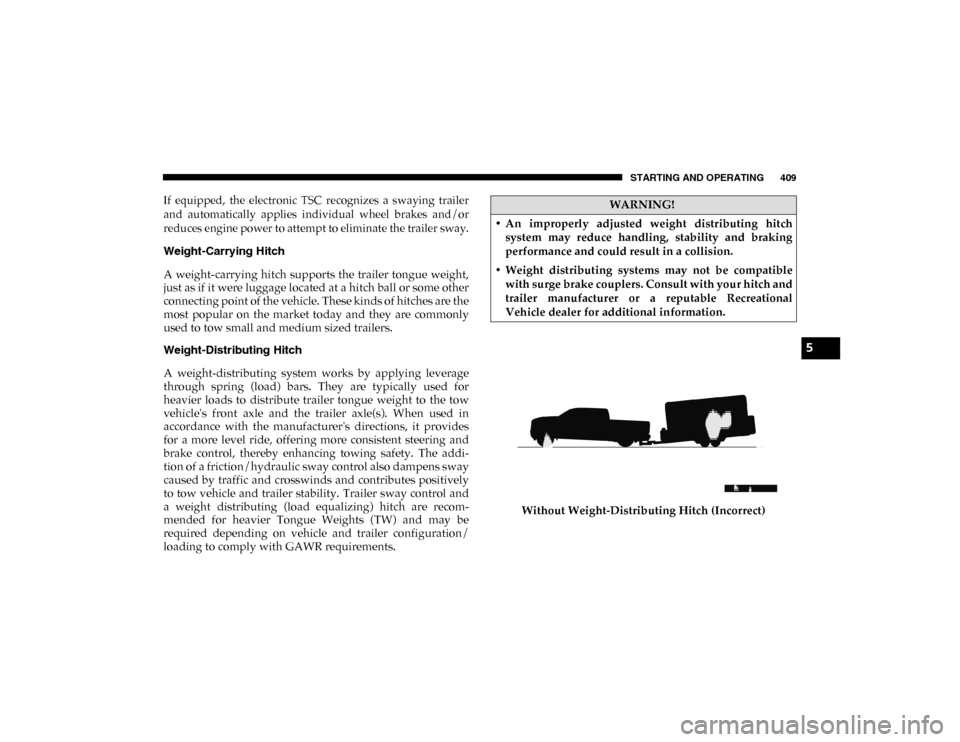
Weight-Distributing Hitch
A weight-distributing system works by applying leverage
through spring (load) bars. They are typically used for
heavier loads to distribute trailer tongue weight to the tow
vehicle's front axle and the trailer axle(s). When used in
accordance with the manufacturer's directions, it provides
for a more level ride, offering more consistent steering and
brake control, thereby enhancing towing safety. The addi-
tion of a friction/hydraulic sway control also dampens sway
caused by traffic and crosswinds and contributes positively
to tow vehicle and trailer stability. Trailer sway control and
a weight distributing (load equalizing) hitch are recom -
mended for heavier Tongue Weights (TW) and may be
required depending on vehicle and trailer configuration/
loading to comply with GAWR requirements. Without Weight-Distributing Hitch (Incorrect)WARNING!
• An improperly adjusted weight distributing hitch system may reduce handling, stability and braking
performance and could result in a collision.
• Weight distributing systems may not be compatible with surge brake couplers. Consult with your hitch and
trailer manufacturer or a reputable Recreational
Vehicle dealer for additional information.
5
2020_DT_1500_OM_US.book Page 409
Page 532 of 674

530 SERVICING AND MAINTENANCE
NOTE:
Wheel Valve Stem must be replaced as well when installing
new tires due to wear and tear in existing tires.
Keep dismounted tires in a cool, dry place with as little expo-
sure to light as possible. Protect tires from contact with oil,
grease, and gasoline.
Replacement Tires
The tires on your new vehicle provide a balance of many
characteristics. They should be inspected regularly for wear
and correct cold tire inflation pressures. The manufacturer
strongly recommends that you use tires equivalent to the
originals in size, quality and performance when replacement
is needed. Refer to the paragraph on “Tread Wear Indica -
tors” in this section. Refer to the Tire and Loading Informa -
tion placard or the Vehicle Certification Label for the size designation of your tire. The Load Index and Speed Symbol
for your tire will be found on the original equipment tire
sidewall.
See the Tire Sizing Chart example found in the “Tire Safety
Information” section of this manual for more information
relating to the Load Index and Speed Symbol of a tire.
It is recommended to replace the two front tires or two rear
tires as a pair. Replacing just one tire can seriously affect
your vehicle’s handling. If you ever replace a wheel, make
sure that the wheel’s specifications match those of the orig
-
inal wheels.
It is recommended you contact an authorized tire dealer or
original equipment dealer with any questions you may have
on tire specifications or capability. Failure to use equivalent
replacement tires may adversely affect the safety, handling,
and ride of your vehicle.
WARNING!
Tires and the spare tire should be replaced after six
years, regardless of the remaining tread. Failure to follow
this warning can result in sudden tire failure. You could
lose control and have a collision resulting in serious
injury or death.
2020_DT_1500_OM_US.book Page 530
Page 533 of 674

SERVICING AND MAINTENANCE 531
Tire Types
All Season Tires — If Equipped
All Season tires provide traction for all seasons (Spring,
Summer, Autumn, and Winter). Traction levels may vary
between different all season tires. All season tires can be
identified by the M+S, M&S, M/S or MS designation on the
tire sidewall. Use all season tires only in sets of four; failure
to do so may adversely affect the safety and handling of your
vehicle.
Summer Or Three Season Tires — If Equipped
Summer tires provide traction in both wet and dry condi-
tions, and are not intended to be driven in snow or on ice. If
your vehicle is equipped with Summer tires, be aware these
tires are not designed for Winter or cold driving conditions.
Install Winter tires on your vehicle when ambient tempera -
tures are less than 40°F (5°C) or if roads are covered with ice
or snow. For more information, contact an authorized dealer.
Summer tires do not contain the all season designation or
mountain/snowflake symbol on the tire sidewall. Use
Summer tires only in sets of four; failure to do so may
adversely affect the safety and handling of your vehicle.
WARNING!
• Do not use a tire, wheel size, load rating, or speed rating other than that specified for your vehicle. Some combi -
nations of unapproved tires and wheels may change
suspension dimensions and performance characteris -
tics, resulting in changes to steering, handling, and
braking of your vehicle. This can cause unpredictable
handling and stress to steering and suspension compo -
nents. You could lose control and have a collision
resulting in serious injury or death. Use only the tire
and wheel sizes with load ratings approved for your
vehicle.
• Never use a tire with a smaller load index or capacity, other than what was originally equipped on your
vehicle. Using a tire with a smaller load index could
result in tire overloading and failure. You could lose
control and have a collision.
• Failure to equip your vehicle with tires having adequate speed capability can result in sudden tire
failure and loss of vehicle control.
CAUTION!
Replacing original tires with tires of a different size may
result in false speedometer and odometer readings.
7
2020_DT_1500_OM_US.book Page 531
Page 535 of 674

SERVICING AND MAINTENANCE 533
Spare Tire Matching Original Equipped Tire And Wheel
— If Equipped
Your vehicle may be equipped with a spare tire and wheel
equivalent in look and function to the original equipment
tire and wheel found on the front or rear axle of your vehicle.
This spare tire may be used in the tire rotation for your
vehicle. If your vehicle has this option, refer to an authorized
tire dealer for the recommended tire rotation pattern.
Compact Spare Tire — If Equipped
The compact spare is for temporary emergency use only.
You can identify if your vehicle is equipped with a compact
spare by looking at the spare tire description on the Tire and
Loading Information Placard located on the driver’s side
door opening or on the sidewall of the tire. Compact spare
tire descriptions begin with the letter “T” or “S” preceding
the size designation. Example: T145/80D18 103M.
T, S = Temporary Spare Tire
Since this tire has limited tread life, the original equipment
tire should be repaired (or replaced) and reinstalled on your
vehicle at the first opportunity.
Do not install a wheel cover or attempt to mount a conven-
tional tire on the compact spare wheel, since the wheel is designed specifically for the compact spare tire. Do not
install more than one compact spare tire and wheel on the
vehicle at any given time.
Collapsible Spare Tire — If Equipped
The collapsible spare is for temporary emergency use only.
You can identify if your vehicle is equipped with a collaps
-
ible spare by looking at the spare tire description on the Tire
and Loading Information Placard located on the driver’s side
door opening or on the sidewall of the tire.
Collapsible spare tire description example: 165/80-17 101P.
Since this tire has limited tread life, the original equipment
tire should be repaired (or replaced) and reinstalled on your
vehicle at the first opportunity.
WARNING!
Compact and collapsible spares are for temporary
emergency use only. With these spares, do not drive
more than 50 mph (80 km/h). Temporary use spares have
limited tread life. When the tread is worn to the tread
wear indicators, the temporary use spare tire needs to be
replaced. Be sure to follow the warnings, which apply to
your spare. Failure to do so could result in spare tire
failure and loss of vehicle control.
7
2020_DT_1500_OM_US.book Page 533
Page 536 of 674

534 SERVICING AND MAINTENANCE
Inflate collapsible tire only after the wheel is properly
installed to the vehicle. Inflate the collapsible tire using the
electric air pump before lowering the vehicle.
Do not install a wheel cover or attempt to mount a conven-
tional tire on the collapsible spare wheel, since the wheel is
designed specifically for the collapsible spare tire.
Full Size Spare — If Equipped
The full size spare is for temporary emergency use only. This
tire may look like the originally equipped tire on the front or
rear axle of your vehicle, but it is not. This spare tire may
have limited tread life. When the tread is worn to the tread
wear indicators, the temporary use full size spare tire needs
to be replaced. Since it is not the same as your original equip -ment tire, replace (or repair) the original equipment tire and
reinstall on the vehicle at the first opportunity.
Limited Use Spare — If Equipped
The limited use spare tire is for temporary emergency use
only. This tire is identified by a label located on the limited
use spare wheel. This label contains the driving limitations
for this spare. This tire may look like the original equipped
tire on the front or rear axle of your vehicle, but it is not.
Installation of this limited use spare tire affects vehicle
handling. Since it is not the same as your original equipment
tire, replace (or repair) the original equipment tire and rein
-
stall on the vehicle at the first opportunity.
WARNING!
Compact and Collapsible spares are for temporary
emergency use only. With these spares, do not drive
more than 50 mph (80 km/h). Temporary use spares have
limited tread life. When the tread is worn to the tread
wear indicators, the temporary use spare tire needs to be
replaced. Be sure to follow the warnings, which apply to
your spare. Failure to do so could result in spare tire
failure and loss of vehicle control.
WARNING!
Limited use spares are for emergency use only.
Installation of this limited use spare tire affects vehicle
handling. With this tire, do not drive more than the
speed listed on the limited use spare wheel. Keep
inflated to the cold tire inflation pressures listed on your
Tire and Loading Information Placard located on the
driver’s side B-Pillar or the rear edge of the driver’s side
door. Replace (or repair) the original equipment tire at
the first opportunity and reinstall it on your vehicle.
Failure to do so could result in loss of vehicle control.
2020_DT_1500_OM_US.book Page 534
Page 538 of 674

536 SERVICING AND MAINTENANCE
(Continued)
Dark Vapor Chrome, Black Satin Chrome, or Low Gloss
Clear Coat Wheels
Tire Chains (Traction Devices)
Use of traction devices require sufficient tire-to-body clear-
ance. Follow these recommendations to guard against
damage.
• Traction device must be of proper size for the tire, as recommended by the traction device manufacturer. Please follow the table below for proper tire size, chain type,
and axle recommendations:
CAUTION!
If your vehicle is equipped with these specialty wheels,
DO NOT USE wheel cleaners, abrasives, or polishing
compounds. They will permanently damage this finish
and such damage is not covered by the New Vehicle
Limited Warranty. HAND WASH ONLY USING MILD
SOAP AND WATER WITH A SOFT CLOTH. Used on a
regular basis; this is all that is required to maintain this
finish.
Vehicle Axle Recom
-
mendations Tire Sizes Chain Class
1500 Models Rear Only 275/65R18
275/55R20S Class
WARNING!
Using tires of different size and type (M+S, Snow)
between front and rear axles can cause unpredictable
handling. You could lose control and have a collision.
CAUTION!
To avoid damage to your vehicle or tires, observe the
following precautions:
• Because of restricted traction device clearance between tires and other suspension components, it is important
that only traction devices in good condition are used.
Broken devices can cause serious damage. Stop the
vehicle immediately if noise occurs that could indicate
device breakage. Remove the damaged parts of the
device before further use.
2020_DT_1500_OM_US.book Page 536
Page 549 of 674
TECHNICAL SPECIFICATIONS 547
Torque Specifications
**Use only your authorized dealer recommended lug nuts/
bolts and clean or remove any dirt or oil before tightening.
NOTE:
Do not oil wheel studs. For chrome wheels, do not substitute
with chrome plated wheel nuts.
Inspect the wheel mounting surface prior to mounting the
tire and remove any corrosion or loose particles.Wheel Mounting Surface
Lug Nut/Bolt
Torque Lug Nut/Bolt
Type **Lug Nut/
Bolt Size Lug Nut/Bolt
Socket Size
130 Ft-Lbs (176 N·m) Cone M14 x 1.50 22 mm
8
2020_DT_1500_OM_US.book Page 547
Page 671 of 674

669
Inflation Pressure ................................................................ 526
Life Of Tires ......................................................................... 529
Load Capacity .............................................................. 521, 522
Pressure Monitoring System (TPMS) ....................... 185, 227
Quality Grading .................................................................. 538
Radial .................................................................................... 527Replacement......................................................................... 530
Rotation ................................................................................ 537
Safety............................................................................. 516, 525
Sizes....................................................................................... 517Snow Tires ............................................................................ 532
Spare Tires ............................................................ 532, 533, 534
Spinning................................................................................ 528
Trailer Towing ..................................................................... 415
Tread Wear Indicators ........................................................ 529
Wheel Nut Torque .............................................................. 546
To Open Hood ......................................................................... 105
Tongue Weight/Trailer Weight ............................................ 413
Tonneau Cover ................................................................ 150, 540
Tonneau Cover Cleaning ....................................................... 540
Towing.............................................................................. 407, 478 Disabled Vehicle.................................................................. 478
Guide..................................................................................... 413
Recreational.......................................................................... 422
Weight................................................................................... 413
Towing Behind A Motorhome .............................................. 422 Traction .....................................................................................427
Traction Control ......................................................................210
Traction Control Switch .........................................................210
Trailer Sway Control (TSC) ................................................... 210
Trailer Towing .........................................................................407 Cooling System Tips ........................................................... 421Hitches ..................................................................................411
Minimum Requirements ....................................................413
Mirrors ....................................................................................64
Tips ........................................................................................420Trailer And Tongue Weight...............................................413
Wiring ...................................................................................419
Trailer Towing Guide .............................................................413
Trailer Weight ..........................................................................413
Transfer Case ...........................................................................515 Electronically Shifted ..................................................311, 314
Fluid ...................................................................................... 556
Transmission ............................................................................304 Automatic .....................................................................304, 513
Fluid ...................................................................................... 556
Maintenance .........................................................................513
Shifting ..................................................................................302
Transporting Pets .................................................................... 285
Tread Wear Indicators ............................................................ 529
Turn Signals ....................................................... 71, 193, 438, 441
11
2020_DT_1500_OM_US.book Page 669