Exhaust Ram 1500 2020 Owner's Manual
[x] Cancel search | Manufacturer: RAM, Model Year: 2020, Model line: 1500, Model: Ram 1500 2020Pages: 674, PDF Size: 32.69 MB
Page 7 of 674

5
GETTING TO KNOW YOUR INSTRUMENT
PANEL
BASE / MIDLINE INSTRUMENT CLUSTER .............. 161
Base / Midline Instrument Cluster Descriptions.... 162
PREMIUM INSTRUMENT CLUSTER ........................... 164
Premium Instrument Cluster Descriptions ............. 164
INSTRUMENT CLUSTER DISPLAY ............................. 166
Instrument Cluster Display Controls ....................... 166
Oil Life Reset ................................................................ 168
Display Menu Items .................................................... 169
Battery Saver On/Battery Saver Mode Message —
Electrical Load Reduction Actions — If
Equipped....................................................................... 176
WARNING LIGHTS AND MESSAGES ........................ 178
Red Warning Lights .................................................... 179
Yellow Warning Lights............................................... 183
Yellow Indicator Lights .............................................. 188
Green Indicator Lights ................................................ 192
White Indicator Lights ................................................ 193
Blue Indicator Lights ................................................... 194
ONBOARD DIAGNOSTIC SYSTEM — OBD II ........... 195
Onboard Diagnostic System (OBD II)
Cybersecurity ............................................................... 195
EMISSIONS INSPECTION AND MAINTENANCE
PROGRAMS....................................................................... 196
SAFETY
SAFETY FEATURES .........................................................198
Anti-Lock Brake System (ABS) ................................. 198
Electronic Brake Control System ..............................199
AUXILIARY DRIVING SYSTEMS ..................................211
Blind Spot Monitoring (BSM) — If Equipped ........211
Forward Collision Warning (FCW) With Mitigation —
If Equipped ...................................................................222
Tire Pressure Monitoring System (TPMS) ............... 227
OCCUPANT RESTRAINT SYSTEMS ...........................234
Occupant Restraint Systems Features ......................234
Important Safety Precautions.....................................235
Seat Belt Systems .........................................................236
Supplemental Restraint Systems (SRS).....................245
Child Restraints............................................................ 265
Transporting Pets.........................................................285
SAFETY TIPS......................................................................285
Transporting Passengers ............................................285
Exhaust Gas .................................................................286
Safety Checks You Should Make Inside The
Vehicle ..........................................................................286
Periodic Safety Checks You Should Make Outside
The Vehicle ...................................................................289
2020_DT_1500_OM_US.book Page 5
Page 11 of 674

9
FUSES.................................................................................. 444
External Power Distribution Center ........................ 445
Internal Power Distribution Center ......................... 449
JACKING AND TIRE CHANGING .............................. 454
Jack Location ................................................................ 454
Removal Of Jack And Tools ....................................... 455
Removing The Spare Tire ........................................... 458
Preparations For Jacking ............................................ 462
Jacking Instructions ..................................................... 463
To Stow The Flat Or Spare ........................................ 468
Reinstalling The Jack And Tools ............................... 470
JUMP STARTING ............................................................ 472
Preparations For Jump Start ...................................... 472
Jump Starting Procedure ............................................ 473
IF YOUR ENGINE OVERHEATS .................................. 475
MANUAL PARK RELEASE ............................................ 476
FREEING A STUCK VEHICLE ...................................... 477
TOWING A DISABLED VEHICLE ................................ 478
Two-Wheel Drive Models .......................................... 480
Four-Wheel Drive Models.......................................... 480
Emergency Tow Hooks — If Equipped ................... 481
ENHANCED ACCIDENT RESPONSE SYSTEM
(EARS) ................................................................................ 481
EVENT DATA RECORDER (EDR) ................................ 481
SERVICING AND MAINTENANCE
SCHEDULED SERVICING .............................................482
Maintenance Plan ........................................................483
Heavy Duty Use Of The Vehicle ...............................486
ENGINE COMPARTMENT ............................................487
3.6L Engine With Stop/Start .....................................487
5.7L Engine Without Stop/Start ................................488
5.7L Engine With Stop/Start ......................................489
Checking Oil Level ......................................................490
Adding Washer Fluid..................................................490
Maintenance-Free Battery .......................................... 491
Pressure Washing ........................................................491
DEALER SERVICE ........................................................... 492
Engine Oil — Gas Engine .......................................... 492
Engine Oil Filter ........................................................... 494
Engine Air Cleaner Filter ............................................494
Air Conditioner Maintenance ....................................496
Accessory Drive Belt Inspection ................................501
Body Lubrication .........................................................502
Windshield Wiper Blades ...........................................503
Exhaust System ........................................................... 505
Cooling System ........................................................... 506
2020_DT_1500_OM_US.book Page 9
Page 30 of 674

28 GETTING TO KNOW YOUR VEHICLE
(Continued)
REMOTE START — IF EQUIPPED
How To Use Remote Start
All of the following conditions must be met before the engine
will remote start:
• Gear selector in PARK
• Doors closed
• Hood closed
• HAZARD switch off
• BRAKE switch inactive (brake pedal not pushed)
• Battery at an acceptable charge level
• PANIC button not pushed
• Fuel meets minimum requirement
• System not disabled from previous remote start event
• Vehicle security alarm not active
Remote Start Abort Message
The following messages will display in the instrument
cluster display if the vehicle fails to remote start or exits
remote start prematurely:
• Remote Start Cancelled — Door Open
• Remote Start Cancelled — Hood Open
• Remote Start Cancelled — Fuel Low
• Remote Start Cancelled — System Fault
• Remote Start Disabled — Start Vehicle to Reset
The instrument cluster display message stays active until the
ignition is turned to the ON/RUN position.
WARNING!
• Do not start or run an engine in a closed garage or confined area. Exhaust gas contains Carbon Monoxide
(CO) which is odorless and colorless. Carbon
Monoxide is poisonous and can cause serious injury or
death when inhaled.
• Keep key fobs away from children. Operation of the
Remote Start System, windows, door locks or other
controls could cause serious injury or death.
WARNING! (Continued)
2020_DT_1500_OM_US.book Page 28
Page 53 of 674
GETTING TO KNOW YOUR VEHICLE 51
Heated Seats — If Equipped
On some models, the front and rear seats may be equipped
with heaters located in the seat cushions and seat backs.
Front Heated Seats
The heated seats control buttons are located on the center
instrument panel below the touchscreen, and are also located
within the climate or controls screen of the touchscreen.• Push the heated seat button once to turn the HI setting
on.
• Push the heated seat button a second time to turn the MED setting on.
• Push the heated seat button a third time to turn the LO setting on.
• Push the heated seat button a fourth time to turn the heating elements off.
NOTE:
• The engine must be running for the heated seats to operate.
• The level of heat selected will stay on until the operator changes it.
Vehicles Equipped With Remote Start
On models that are equipped with remote start, the driver’s
seat can be programmed to come on during a remote start.
This feature can be programmed through the Uconnect
system. Refer to “Uconnect Settings” in “Multimedia” for
further information.
WARNING!
• Persons who are unable to feel pain to the skin because of advanced age, chronic illness, diabetes, spinal cord
injury, medication, alcohol use, exhaustion or other
physical condition must exercise care when using the
seat heater. It may cause burns even at low tempera -
tures, especially if used for long periods of time.
• Do not place anything on the seat or seatback that insu -
lates against heat, such as a blanket or cushion. This
may cause the seat heater to overheat. Sitting in a seat
that has been overheated could cause serious burns due
to the increased surface temperature of the seat.2
2020_DT_1500_OM_US.book Page 51
Page 60 of 674
58 GETTING TO KNOW YOUR VEHICLE
DRIVER ADJUSTABLE PEDALS — IF EQUIPPED
The adjustable pedals system is designed to allow a greater
range of driver comfort for steering wheel tilt and seat posi-
tion. This feature allows the brake and accelerator pedals to
move toward or away from the driver to provide improved
position with the steering wheel.
The adjustable pedal switch is located on the instrument
panel, below the headlight switch. Adjustable Pedals Switch
• The pedals can be adjusted with the ignition placed in the OFF position.
• The pedals cannot be adjusted when the vehicle is in
REVERSE or when the Speed Control System or Adaptive
Cruise Control systems are on. The following messages
will appear on vehicles equipped with an instrument
cluster display if the pedals are attempted to be adjusted
when the system is locked out: “Adjustable Pedal Disabled
— Cruise Control Engaged” or “Adjustable Pedal
Disabled — Vehicle In Reverse”.
WARNING!
• Persons who are unable to feel pain to the skin because of advanced age, chronic illness, diabetes, spinal cord
injury, medication, alcohol use, exhaustion, or other
physical conditions must exercise care when using the
steering wheel heater. It may cause burns even at low
temperatures, especially if used for long periods.
• Do not place anything on the steering wheel that insu -
lates against heat, such as a blanket or steering wheel
covers of any type and material. This may cause the
steering wheel heater to overheat.
2020_DT_1500_OM_US.book Page 58
Page 112 of 674
110 GETTING TO KNOW YOUR VEHICLE
NOTE:
HomeLink® is disabled when the Vehicle Security Alarm is
active.
NOTE:
Only use this transceiver with a garage door opener that has
a “stop and reverse” feature as required by federal safety
standards. This includes most garage door opener models
manufactured after 1982. Do not use a garage door openerwithout these safety features. Call toll-free 1-800-355-3515 or,
on the Internet at HomeLink.com for safety information or
assistance.
Before You Begin Programming HomeLink®
Be sure that your vehicle is parked outside of the garage
before you begin programming.
For more efficient programming and accurate transmission
of the radio-frequency signal it is recommended that a new
battery be placed in the hand-held transmitter of the device
that is being programmed to the HomeLink® system.
To erase the channels, place the ignition in the ON/RUN
position, and push and hold the two outside HomeLink®
buttons (I and III) for up to 20 seconds or until the orange
indicator flashes.
NOTE:
• Erasing all channels should only be performed when programming HomeLink® for the first time. Do not erase
channels when programming additional buttons.
• If you have any problems, or require assistance, please call toll-free 1-800-355-3515 or, on the Internet at Home-
Link.com for information or assistance.
WARNING!
• Your motorized door or gate will open and close while you are programming the universal transceiver. Do not
program the transceiver if people, pets or other objects
are in the path of the door or gate. Only use this trans -
ceiver with a garage door opener that has a “stop and
reverse” feature as required by Federal safety stan -
dards. This includes most garage door opener models
manufactured after 1982. Do not use a garage door
opener without these safety features.
• Vehicle exhaust contains carbon monoxide, a dangerous gas. Do not run your vehicle in the garage
while programming the transceiver. Exhaust gas can
cause serious injury or death.
2020_DT_1500_OM_US.book Page 110
Page 149 of 674
GETTING TO KNOW YOUR VEHICLE 147
NOTE:
When a cap or pickup camper is installed on a vehicle, an
alternate Center High-Mounted Stop Light (CHMSL) must
be provided.
EASY-OFF TAILGATE
To simplify mounting of a camper unit with an overhang, the
tailgate can be removed.
NOTE:
The electric connector at the bottom of the tailgate must be
disconnected prior to removing the tailgate.
Disconnecting The Rear Camera And Remote Keyless
Entry
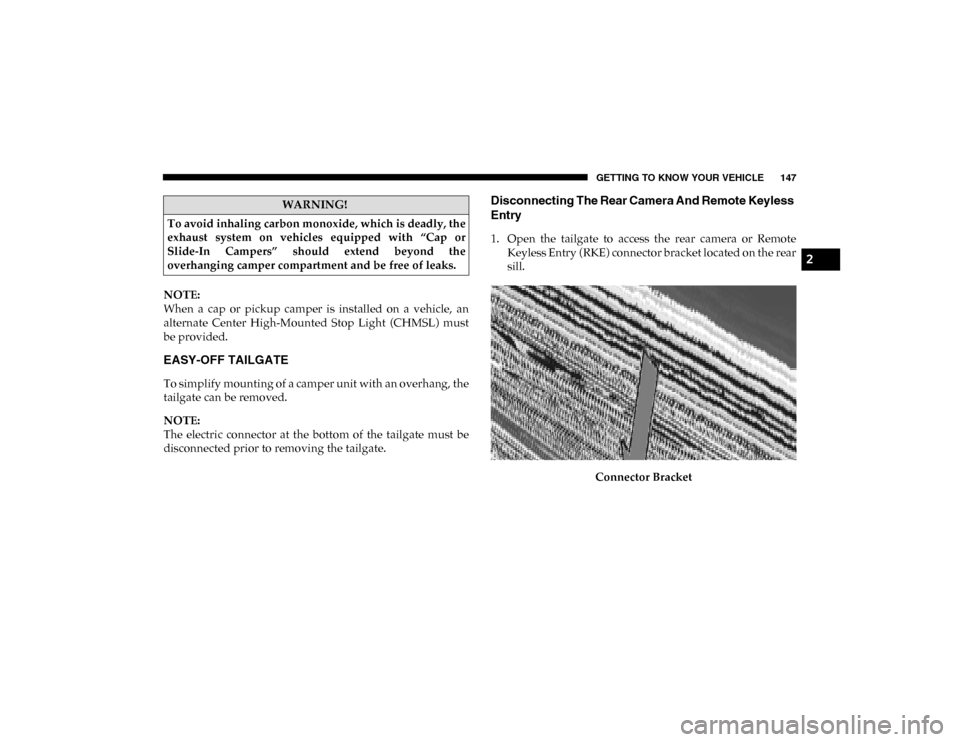
1. Open the tailgate to access the rear camera or RemoteKeyless Entry (RKE) connector bracket located on the rear
sill.
Connector Bracket
WARNING!
To avoid inhaling carbon monoxide, which is deadly, the
exhaust system on vehicles equipped with “Cap or
Slide-In Campers” should extend beyond the
overhanging camper compartment and be free of leaks.
2
2020_DT_1500_OM_US.book Page 147
Page 151 of 674
GETTING TO KNOW YOUR VEHICLE 149
2. Unlatch the tailgate and remove the support cables byreleasing the lock tang from the pivot.
NOTE:
Make sure tailgate is supported when removing support
cables.
Locking Tang 3. Position the tailgate on a 45 degree angle.
4. Raise the right side of the tailgate until the right side pivot
clears the hanger bracket.
5. Without latching, rotate the tailgate to nearly closed, then slide the entire tailgate to the right to free the left side
pivot.
6. Remove the tailgate from the vehicle.
NOTE:
Do not carry the tailgate loose in the truck pickup box.
WARNING!
To avoid inhaling carbon monoxide, which is deadly, the
exhaust system on vehicles equipped with “Cap or
Slide-In Campers” should extend beyond the
overhanging camper compartment and be free of leaks.
2
2020_DT_1500_OM_US.book Page 149
Page 180 of 674

178 GETTING TO KNOW YOUR INSTRUMENT PANEL
What to do when an electrical load reduction action
message is present (“Battery Saver On” or “Battery Saver
Mode”)
During a trip:
• Reduce power to unnecessary loads if possible:• Turn off redundant lights (interior or exterior).
• Check what may be plugged in to power outlets +12 Volts,115V AC, USB ports.
• Check HVAC settings (blower, temperature).
• Check the audio settings (volume).
After a trip:
• Check if any aftermarket equipment was installed (addi -
tional lights, upfitter electrical accessories, audio systems,
alarms) and review specifications if any (load and Ignition
Off Draw currents).
• Evaluate the latest driving cycles (distance, driving time and parking time).
• The vehicle should have service performed if the message is still present during consecutive trips and the evaluation
of the vehicle and driving pattern did not help to identify
the cause.WARNING LIGHTS AND MESSAGES
The warning/indicator lights will illuminate in the instru-
ment panel together with a dedicated message and/or
acoustic signal when applicable. These indications are indic -
ative and precautionary and as such must not be considered
as exhaustive and/or alternative to the information
contained in the Owner’s Manual, which you are advised to
read carefully in all cases. Always refer to the information in
this chapter in the event of a failure indication. All active tell -
tales will display first if applicable. The system check menu
may appear different based upon equipment options and
current vehicle status. Some telltales are optional and may
not appear.
2020_DT_1500_OM_US.book Page 178
Page 184 of 674
182 GETTING TO KNOW YOUR INSTRUMENT PANEL
NOTE:
This light may turn on if the accelerator and brake pedals are
pressed at the same time.
If the light continues to flash when the vehicle is running,
immediate service is required and you may experience
reduced performance, an elevated/rough idle, or engine
stall and your vehicle may require towing. The light will
come on when the ignition is placed in the ON/RUN or
ACC/ON/RUN position and remain on briefly as a bulb
check. If the light does not come on during starting, have the
system checked by an authorized dealer. — Electric Power Steering Fault Warning Light
This warning light will turn on when there's a fault with the
Electric Power Steering (EPS) system. Refer to “Power Steering”
in “Starting And Operating” for further information.
— Tailgate Open Warning Light
This warning light will illuminate when the tailgate is open.
NOTE:
If the vehicle is moving, there will also be a single chime.
— Trailer Brake Disconnected Warning Light
This warning light will illuminate when the Trailer Brake has
been disconnected.
— Transmission Temperature Warning Light — If
Equipped
This warning light will illuminate to warn of a high transmis -
sion fluid temperature. This may occur with strenuous usage
such as trailer towing. If this light turns on, stop the vehicle
and run the engine at idle or slightly faster, with the trans -
mission in PARK or NEUTRAL, until the light turns off.
Once the light turns off, you may continue to drive normally.
WARNING!
Continued operation with reduced assist could pose a
safety risk to yourself and others. Service should be
obtained as soon as possible.
WARNING!
If you continue operating the vehicle when the
Transmission Temperature Warning Light is illuminated
you could cause the fluid to boil over, come in contact
with hot engine or exhaust components and cause a fire.
2020_DT_1500_OM_US.book Page 182