engine overheat Ram 1500 2020 Owner's Manual
[x] Cancel search | Manufacturer: RAM, Model Year: 2020, Model line: 1500, Model: Ram 1500 2020Pages: 674, PDF Size: 32.69 MB
Page 11 of 674

9
FUSES.................................................................................. 444
External Power Distribution Center ........................ 445
Internal Power Distribution Center ......................... 449
JACKING AND TIRE CHANGING .............................. 454
Jack Location ................................................................ 454
Removal Of Jack And Tools ....................................... 455
Removing The Spare Tire ........................................... 458
Preparations For Jacking ............................................ 462
Jacking Instructions ..................................................... 463
To Stow The Flat Or Spare ........................................ 468
Reinstalling The Jack And Tools ............................... 470
JUMP STARTING ............................................................ 472
Preparations For Jump Start ...................................... 472
Jump Starting Procedure ............................................ 473
IF YOUR ENGINE OVERHEATS .................................. 475
MANUAL PARK RELEASE ............................................ 476
FREEING A STUCK VEHICLE ...................................... 477
TOWING A DISABLED VEHICLE ................................ 478
Two-Wheel Drive Models .......................................... 480
Four-Wheel Drive Models.......................................... 480
Emergency Tow Hooks — If Equipped ................... 481
ENHANCED ACCIDENT RESPONSE SYSTEM
(EARS) ................................................................................ 481
EVENT DATA RECORDER (EDR) ................................ 481
SERVICING AND MAINTENANCE
SCHEDULED SERVICING .............................................482
Maintenance Plan ........................................................483
Heavy Duty Use Of The Vehicle ...............................486
ENGINE COMPARTMENT ............................................487
3.6L Engine With Stop/Start .....................................487
5.7L Engine Without Stop/Start ................................488
5.7L Engine With Stop/Start ......................................489
Checking Oil Level ......................................................490
Adding Washer Fluid..................................................490
Maintenance-Free Battery .......................................... 491
Pressure Washing ........................................................491
DEALER SERVICE ........................................................... 492
Engine Oil — Gas Engine .......................................... 492
Engine Oil Filter ........................................................... 494
Engine Air Cleaner Filter ............................................494
Air Conditioner Maintenance ....................................496
Accessory Drive Belt Inspection ................................501
Body Lubrication .........................................................502
Windshield Wiper Blades ...........................................503
Exhaust System ........................................................... 505
Cooling System ........................................................... 506
2020_DT_1500_OM_US.book Page 9
Page 53 of 674
GETTING TO KNOW YOUR VEHICLE 51
Heated Seats — If Equipped
On some models, the front and rear seats may be equipped
with heaters located in the seat cushions and seat backs.
Front Heated Seats
The heated seats control buttons are located on the center
instrument panel below the touchscreen, and are also located
within the climate or controls screen of the touchscreen.• Push the heated seat button once to turn the HI setting
on.
• Push the heated seat button a second time to turn the MED setting on.
• Push the heated seat button a third time to turn the LO setting on.
• Push the heated seat button a fourth time to turn the heating elements off.
NOTE:
• The engine must be running for the heated seats to operate.
• The level of heat selected will stay on until the operator changes it.
Vehicles Equipped With Remote Start
On models that are equipped with remote start, the driver’s
seat can be programmed to come on during a remote start.
This feature can be programmed through the Uconnect
system. Refer to “Uconnect Settings” in “Multimedia” for
further information.
WARNING!
• Persons who are unable to feel pain to the skin because of advanced age, chronic illness, diabetes, spinal cord
injury, medication, alcohol use, exhaustion or other
physical condition must exercise care when using the
seat heater. It may cause burns even at low tempera -
tures, especially if used for long periods of time.
• Do not place anything on the seat or seatback that insu -
lates against heat, such as a blanket or cushion. This
may cause the seat heater to overheat. Sitting in a seat
that has been overheated could cause serious burns due
to the increased surface temperature of the seat.2
2020_DT_1500_OM_US.book Page 51
Page 94 of 674

92 GETTING TO KNOW YOUR VEHICLE
NOTE:
• It is not necessary to move the temperature settings forcold or hot vehicles. The system automatically adjusts the
temperature, mode, and blower speed to provide comfort
as quickly as possible.
• The temperature can be displayed in U.S. or Metric units by selecting the U.S./Metric customer-programmable
feature. Refer to the “Uconnect Settings” in “Multimedia”
for further information.
To provide you with maximum comfort in the Automatic
mode during cold start-ups, the blower fan will remain on
low until the engine warms up. The blower will increase in
speed and transition into Auto mode.
Manual Operation Override
This system offers a full complement of manual override
features. The AUTO symbol in the front ATC display will be
turned off when the system is being used in the manual
mode.
Operating Tips
NOTE:
Refer to the chart at the end of this section for suggested
control settings for various weather conditions. Summer Operation
The engine cooling system must be protected with a
high-quality antifreeze coolant to provide proper corrosion
protection and to protect against engine overheating. OAT
coolant (conforming to MS.90032) is recommended.
Winter Operation
To ensure the best possible heater and defroster perfor
-
mance, make sure the engine cooling system is functioning
properly and the proper amount, type, and concentration of
coolant is used. Use of the Air Recirculation mode during
Winter months is not recommended, because it may cause
window fogging.
Vacation/Storage
Before you store your vehicle, or keep it out of service (i.e.,
vacation) for two weeks or more, run the air conditioning
system at idle for about five minutes, in fresh air with the
blower setting on high. This will ensure adequate system
lubrication to minimize the possibility of compressor
damage when the system is started again.
2020_DT_1500_OM_US.book Page 92
Page 165 of 674
GETTING TO KNOW YOUR INSTRUMENT PANEL 163
7. Temperature Gauge• The pointer shows engine coolant temperature. Thepointer positioned within the normal range indicates
that the engine cooling system is operating satisfacto -
rily.
• The pointer will likely indicate a higher temperature when driving in hot weather, up mountain grades, or
when towing a trailer. It should not be allowed to
exceed the upper limits of the normal operating range.
WARNING!
A hot engine cooling system is dangerous. You or others
could be badly burned by steam or boiling coolant. You
may want to call an authorized dealer for service if your
vehicle overheats. Refer to “Cooling System Pressure
Cap” in “Servicing And Maintenance” for further
information if you decide to look under the hood.
CAUTION!
Driving with a hot engine cooling system could damage
your vehicle. If the temperature gauge reads “H,” pull
over and stop the vehicle. Idle the vehicle with the air
conditioner turned off until the pointer drops back into
the normal range. If the pointer remains on the “H,” turn
the engine off immediately and call an authorized dealer
for service.
3
2020_DT_1500_OM_US.book Page 163
Page 167 of 674
GETTING TO KNOW YOUR INSTRUMENT PANEL 165
3. Speedometer• Indicates vehicle speed.
4. Fuel Gauge
• The pointer shows the level of fuel in the fuel tankwhen the ignition is in the ON/RUN position.
• The fuel pump symbol points to the side of the vehicle where the fuel door is located.
5. Temperature Gauge
• The pointer shows engine coolant temperature. Thepointer positioned within the normal range indicates
that the engine cooling system is operating satisfacto -
rily.
• The pointer will likely indicate a higher temperature when driving in hot weather, up mountain grades, or
when towing a trailer. It should not be allowed to
exceed the upper limits of the normal operating range.WARNING!
A hot engine cooling system is dangerous. You or others
could be badly burned by steam or boiling coolant. You
may want to call an authorized dealer for service if your
vehicle overheats. Refer to “Cooling System Pressure
Cap” in “Servicing And Maintenance” for further
information if you decide to look under the hood.
CAUTION!
Driving with a hot engine cooling system could damage
your vehicle. If the temperature gauge reads “H,” pull
over and stop the vehicle. Idle the vehicle with the air
conditioner turned off until the pointer drops back into
the normal range. If the pointer remains on the “H,” turn
the engine off immediately and call an authorized dealer
for service.
3
2020_DT_1500_OM_US.book Page 165
Page 183 of 674
GETTING TO KNOW YOUR INSTRUMENT PANEL 181
— Engine Coolant Temperature Warning Light
This warning light warns of an overheated engine condition.
If the engine coolant temperature is too high, this indicator
will illuminate and a single chime will sound. If the tempera -
ture reaches the upper limit, a continuous chime will sound
for four minutes or until the engine is able to cool: whichever
comes first.
If the light turns on while driving, safely pull over and stop
the vehicle. If the A/C system is on, turn it off. Also, shift the
transmission into NEUTRAL (N) and idle the vehicle. If the
temperature reading does not return to normal, turn the
engine off immediately and call for service.
Refer to “If Your Engine Overheats” in “In Case Of Emer -
gency” for further information.
— Battery Charge Warning Light
This warning light will illuminate when the battery is not
charging properly. If it stays on while the engine is running,
there may be a malfunction with the charging system.
Contact an authorized dealer as soon as possible.
This indicates a possible problem with the electrical system
or a related component. — Oil Pressure Warning Light
This warning light will illuminate to indicate low engine oil
pressure. If the light turns on while driving, stop the vehicle,
shut off the engine as soon as possible, and contact an autho -
rized dealer. A chime will sound when this light turns on.
Do not operate the vehicle until the cause is corrected. This
light does not indicate how much oil is in the engine. The
engine oil level must be checked under the hood.
— Oil Temperature Warning Light
This warning light will illuminate to indicate the engine oil
temperature is high. If the light turns on while driving, stop
the vehicle and shut off the engine as soon as possible. Wait
for oil temperature to return to normal levels.
— Electronic Throttle Control (ETC) Warning Light
This warning light will illuminate to indicate a problem with the
Electronic Throttle Control (ETC) system. If a problem is
detected while the vehicle is running, the light will either stay on
or flash depending on the nature of the problem. Cycle the igni -
tion when the vehicle is safely and completely stopped and the
transmission is placed in the PARK position. The light should
turn off. If the light remains on with the vehicle running, your
vehicle will usually be drivable; however, see an authorized
dealer for service as soon as possible.
3
2020_DT_1500_OM_US.book Page 181
Page 292 of 674
290
(Continued)
STARTING AND OPERATING
STARTING THE ENGINE
Before starting your vehicle, adjust your seat, adjust both
inside and outside mirrors, and fasten your seat belt.
The starter should not be operated for more than 10-second
intervals. Waiting a few seconds between such intervals will
protect the starter from overheating.
WARNING!
• When leaving the vehicle, always make sure the keyless ignition node is in the "OFF" mode, remove the
key fob from the vehicle and lock the vehicle.
• Never leave children alone in a vehicle, or with access to an unlocked vehicle. Allowing children to be in a
vehicle unattended is dangerous for a number of
reasons. A child or others could be seriously or fatally
injured. Children should be warned not to touch the
parking brake, brake pedal or the gear selector.
• Do not leave the key fob in or near the vehicle, or in alocation accessible to children, and do not leave the
ignition of a vehicle equipped with Keyless
Enter-N-Go in the ACC or ON/RUN mode. A child
could operate power windows, other controls, or move
the vehicle.
• Do not leave children or animals inside parked vehicles in hot weather. Interior heat build-up may cause
serious injury or death.
WARNING! (Continued)
2020_DT_1500_OM_US.book Page 290
Page 312 of 674
310 STARTING AND OPERATING
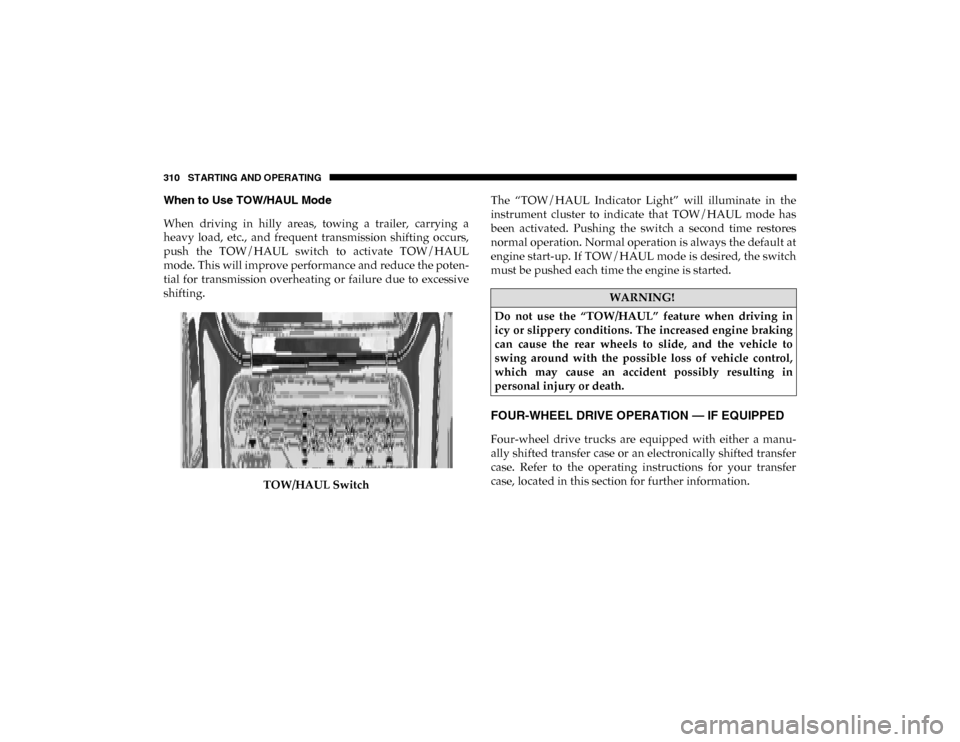
When to Use TOW/HAUL Mode
When driving in hilly areas, towing a trailer, carrying a
heavy load, etc., and frequent transmission shifting occurs,
push the TOW/HAUL switch to activate TOW/HAUL
mode. This will improve performance and reduce the poten-
tial for transmission overheating or failure due to excessive
shifting.
TOW/HAUL Switch The “TOW/HAUL Indicator Light” will illuminate in the
instrument cluster to indicate that TOW/HAUL mode has
been activated. Pushing the switch a second time restores
normal operation. Normal operation is always the default at
engine start-up. If TOW/HAUL mode is desired, the switch
must be pushed each time the engine is started.
FOUR-WHEEL DRIVE OPERATION — IF EQUIPPED
Four-wheel drive trucks are equipped with either a manu-
ally shifted transfer case or an electronically shifted transfer
case. Refer to the operating instructions for your transfer
case, located in this section for further information.
WARNING!
Do not use the “TOW/HAUL” feature when driving in
icy or slippery conditions. The increased engine braking
can cause the rear wheels to slide, and the vehicle to
swing around with the possible loss of vehicle control,
which may cause an accident possibly resulting in
personal injury or death.
2020_DT_1500_OM_US.book Page 310
Page 423 of 674
STARTING AND OPERATING 421
Tow/Haul Mode
To reduce potential for automatic transmission overheating,
activate TOW/HAUL mode when driving in hilly areas, or
select a lower gear range (using the Electronic Range Select
(ERS) shift control) on more severe grades.
Speed Control — If Equipped
• Do not use on hilly terrain or with heavy loads.
• When using the speed control, if you experience speeddrops greater than 10 mph (16 km/h), disengage until you
can get back to cruising speed.
• Use speed control in flat terrain and with light loads to maximize fuel efficiency.
Cooling System
To reduce potential for engine and transmission over -
heating, take the following actions:
City Driving
In city traffic — while stopped, place the transmission in
NEUTRAL, but do not increase engine idle speed. Highway Driving
• Reduce speed
• Temporarily turn off air conditioning
Air Suspension System
To aid in attaching/detaching the trailer from the vehicle, the air
suspension system can be used. Refer to “Air Suspension
System” in “Starting And Operating” for further information.
NOTE:
The vehicle must remain in the engine running position
while attaching a trailer for proper leveling of the air suspen
-
sion system.
SNOWPLOW
NOTE:
Do not use this model vehicle for snowplow applications.
WARNING!
Snowplows and other aftermarket equipment should not
be added to the front end of your vehicle. The airbag
crash sensors may be affected by the change in the front
end structure. The airbags could deploy unexpectedly or
could fail to deploy during a collision resulting in
serious injury or death.
5
2020_DT_1500_OM_US.book Page 421
Page 477 of 674
IN CASE OF EMERGENCY 475
If frequent jump starting is required to start your vehicle you
should have the battery and charging system inspected at an
authorized dealer.
IF YOUR ENGINE OVERHEATS
In any of the following situations, you can reduce the poten-
tial for overheating by taking the appropriate action.
• On the highways — slow down.
• In city traffic — while stopped, place the transmission in NEUTRAL (N), but do not increase the engine idle speed
while preventing vehicle motion with the brakes. NOTE:
There are steps that you can take to slow down an impending
overheat condition:
• If your Air Conditioner (A/C) is on, turn it off. The A/C
system adds heat to the engine cooling system and turning
the A/C off can help remove this heat.
• You can also turn the temperature control to maximum heat, the mode control to floor and the blower control to
high. This allows the heater core to act as a supplement to
the radiator and aids in removing heat from the engine
cooling system.
CAUTION!
Accessories plugged into the vehicle power outlets draw
power from the vehicle’s battery, even when not in use
(i.e., cellular devices, etc.). Eventually, if plugged in long
enough without engine operation, the vehicle’s battery
will discharge sufficiently to degrade battery life and/or
prevent the engine from starting.
WARNING!
You or others can be badly burned by hot engine coolant
(antifreeze) or steam from your radiator. If you see or
hear steam coming from under the hood, do not open the
hood until the radiator has had time to cool. Never try to
open a cooling system pressure cap when the radiator or
coolant bottle is hot.6
2020_DT_1500_OM_US.book Page 475