wheel torque RAM 1500 2021 User Guide
[x] Cancel search | Manufacturer: RAM, Model Year: 2021, Model line: 1500, Model: RAM 1500 2021Pages: 496, PDF Size: 20.89 MB
Page 320 of 496
318SAFETY
Ready Alert Braking (RAB)
RAB may reduce the time required to reach full
braking during emergency braking situations. It
anticipates when an emergency braking
situation may occur by monitoring how fast the
throttle is released by the driver. The Electronic
Brake Control System will prepare the brake
system for a panic stop.
Traction Control System (TCS)
TCS monitors the amount of wheel spin of each
of the driven wheels. If wheel spin is detected,
the TCS may apply brake pressure to the
spinning wheel(s) and/or reduce engine power
to provide enhanced acceleration and stability.
A feature of the TCS, Brake Limited Differential
(BLD), functions similarly to a limited slip
differential and controls the wheel spin across a
driven axle. If one wheel on a driven axle is
spinning faster than the other, the system will
apply the brake of the spinning wheel. This will
allow more engine torque to be applied to the
wheel that is not spinning. BLD may remain
enabled even if TCS and Electronic Stability
Control (ESC) are in reduced modes.
Trailer Sway Control (TSC)
TSC uses sensors in the vehicle to recognize an
excessively swaying trailer and will take the
appropriate actions to attempt to stop the sway.
NOTE:
TSC cannot stop all trailers from swaying.
Always use caution when towing a trailer and
follow the trailer tongue weight recommenda -
tions Ú page 214.
When TSC is functioning, the ESC Activation/
Malfunction Indicator Light will flash, the engine
power may be reduced and you may feel the
brakes being applied to individual wheels to
attempt to stop the trailer from swaying. TSC is
disabled when the ESC system is in the “Partial
Off” or “Full Off” modes.AUXILIARY DRIVING SYSTEMS
BLIND SPOT MONITORING (BSM) — IF
E
QUIPPED
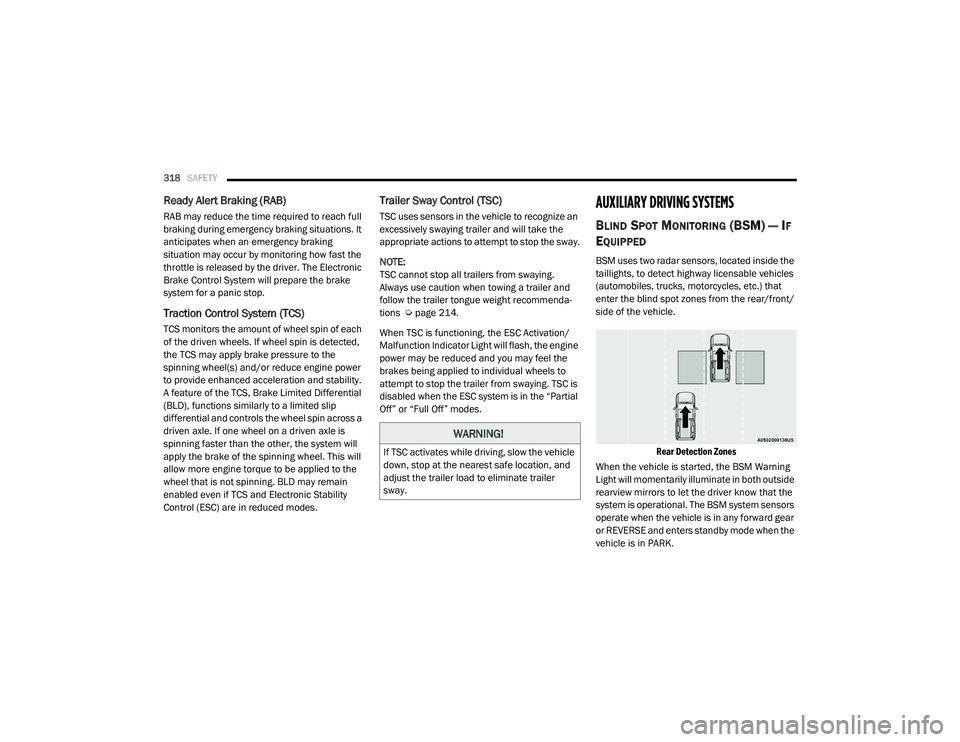
BSM uses two radar sensors, located inside the
taillights, to detect highway licensable vehicles
(automobiles, trucks, motorcycles, etc.) that
enter the blind spot zones from the rear/front/
side of the vehicle.
Rear Detection Zones
When the vehicle is started, the BSM Warning
Light will momentarily illuminate in both outside
rearview mirrors to let the driver know that the
system is operational. The BSM system sensors
operate when the vehicle is in any forward gear
or REVERSE and enters standby mode when the
vehicle is in PARK.
WARNING!
If TSC activates while driving, slow the vehicle
down, stop at the nearest safe location, and
adjust the trailer load to eliminate trailer
sway.
21_DT_OM_EN_USC_t.book Page 318
Page 385 of 496

IN CASE OF EMERGENCY383
When changing a rear wheel, assemble the
extension with jack hook to the jack and
connect the extension tubes. Access the
rear jacking location from behind the rear
tire. Place the jack under the Jack Lifting
Point located on the rear axle lower control
arm bracket. Then locate the slot in the jack
lift plate onto the rear axle Jack Lifting Point.
Attach the extension with jack hook extend -
ing to the rear of the vehicle.
Rear Lifting Point Rear Jacking Location
Connect the long extensions to the lug
wrench.
5. By rotating the lug wrench clockwise, raise the vehicle until the wheel just clears the
ground surface. 6. Remove the lug nuts and pull the wheel off.
Install the spare wheel and lug nuts with the
cone shaped end of the lug nuts toward the
wheel. Hand tighten the lug nuts with the
vehicle lifted. To avoid the risk of forcing the
vehicle off the jack, do not fully tighten the
lug nuts until the vehicle has been
completely lowered.
7. Finish tightening the lug nuts. Push down on the wrench handle for increased leverage.
Tighten the lug nuts in a star pattern until
each lug nut has been tightened twice
Úpage 467. If in doubt about the correct
tightness, have them checked with a torque
wrench by an authorized dealer or at a
service station.
CAUTION!
Before raising the wheel off the ground, make
sure that the jack will not damage
surrounding truck parts and adjust the jack
position as required.
WARNING!
Raising the vehicle higher than necessary can
make the vehicle less stable. It could slip off
the jack and hurt someone near it. Raise the
vehicle only enough to remove the tire.
7
21_DT_OM_EN_USC_t.book Page 383
Page 469 of 496

467
TECHNICAL SPECIFICATIONS
VEHICLE IDENTIFICATION NUMBER
The Vehicle Identification Number (VIN) is found
on the left front corner of the instrument panel,
visible through the windshield.
Vehicle Identification Number
NOTE:
It is illegal to remove or alter the VIN.
BRAKE SYSTEM
If power assist is lost for any reason (for
example, repeated brake applications with the
engine off), the brakes will still function.
However, you will experience a substantial
increase in braking effort to stop the vehicle.
If either the front or rear hydraulic system loses
normal braking capability, the remaining
system will still function with some loss of
overall braking effectiveness. This will be
evident by increased pedal travel during
application, greater pedal force required to slow
or stop, and the “Brake Warning Light” and the
“ABS Warning Light” will activate during brake
use.
WHEEL AND TIRE TORQUE SPECIFICATIONS
Proper lug nut/bolt torque is very important to
ensure that the wheel is properly mounted to
the vehicle. Any time a wheel has been removed
and reinstalled on the vehicle, the lug nuts/
bolts should be torqued using a properly
calibrated torque wrench using a six sided (hex)
deep wall socket.
TORQUE SPECIFICATIONS
**Use only authorized dealer recommended lug nuts/
bolts and clean or remove any dirt or oil before tightening.
Lug Nut/ Bolt
Torque Lug Nut/
Bolt Type **Lug
Nut/Bolt Size Lug Nut/
Bolt
Socket Size
130
Ft-Lbs
(176 N·m) Cone
M14 x
1.50 22 mm
9
21_DT_OM_EN_USC_t.book Page 467
Page 470 of 496

468TECHNICAL SPECIFICATIONS
NOTE:
Do not oil wheel studs. For chrome wheels, do
not substitute with chrome plated wheel nuts.
Inspect the wheel mounting surface prior to
mounting the tire and remove any corrosion or
loose particles.
Wheel Mounting Surface
Tighten the lug nuts/bolts in a star pattern until
each nut/bolt has been tightened twice. Ensure
that the socket is fully engaged on the lug nut/
bolt (do not insert it halfway).
After 25 miles (40 km), check the lug nut/bolt torque to be sure that all the lug nuts/bolts are
properly seated against the wheel.
Four, Five, And Six Lug Nuts/Bolts Torque Pattern
FUEL REQUIREMENTS — GASOLINE ENGINE
While operating on gasoline with the required
octane number, hearing a light knocking sound
from the engine is not a cause for concern.
However, if the engine is heard making a heavy
knocking sound, see a dealer immediately. Use
of gasoline with a lower than recommended octane number can cause engine failure and
may void or not be covered by the New Vehicle
Limited Warranty.
Poor quality gasoline can cause problems such
as hard starting, stalling, and hesitations. If you
experience these symptoms, try another brand
of gasoline before considering service for the
vehicle.
3.6L ENGINE
Do not use E-85 flex fuel or ethanol blends
greater than 15% in this engine.
This engine is designed to meet all
emissions regulations and provide
optimum fuel economy and
performance when using high quality
unleaded “Regular” gasoline having a posted
octane number of 87 as specified by the (R+M)/
2 method. The use of higher octane “Premium”
gasoline is not required, as it will not provide
any benefit over “Regular” gasoline in these
engines.WARNING!
To avoid the risk of forcing the vehicle off the
jack, do not tighten the lug nuts/bolts fully
until the vehicle has been lowered. Failure to
follow this warning may result in personal
injury.
21_DT_OM_EN_USC_t.book Page 468
Page 493 of 496
491
Tires
................................... 371, 449, 455, 460Aging (Life Of Tires)................................... 452Air Pressure............................................... 449Chains....................................................... 458Compact Spare......................................... 455Dual........................................................... 467General Information........................ 449, 455High Speed................................................ 451Inflation Pressure...................................... 450Life Of Tires............................................... 452Load Capacity............................................ 447Pressure Monitoring System (TPMS)........................................ 131, 327Quality Grading.......................................... 460Radial........................................................ 451Replacement............................................. 453Rotation.................................................... 460Safety.............................................. 443, 449Sizes.......................................................... 444Snow Tires................................................. 454Spare Tires...................................... 455, 456Spinning.................................................... 452Trailer Towing............................................ 222Tread Wear Indicators............................... 452Wheel Nut Torque..................................... 467To Open Hood.................................................. 84Tongue Weight/Trailer Weight....................... 219Tonneau Cover....................................... 97, 462Tonneau Cover Cleaning................................ 462
Towing................................................. 214, 392Disabled Vehicle....................................... 392Guide........................................................ 218Recreational............................................. 230Weight...................................................... 218Towing Behind A Motorhome........................ 230Traction......................................................... 234Traction Control............................................ 318Trailer Reverse Steering Control................... 219Trailer Sway Control (TSC)............................. 318Trailer Towing............................................... 214Hitches..................................................... 218Minimum Requirements........................... 221Mirrors......................................................... 48Tips........................................................... 227Trailer And Tongue Weight........................ 219Wiring....................................................... 225Trailer Towing Guide..................................... 218Trailer Weight................................................ 218Transfer Case............................................... 427Electronically Shifted....................... 161, 163Fluid......................................................... 478Transmission................................................ 156Automatic........................................ 156, 426Fluid......................................................... 478Maintenance............................................ 426Shifting..................................................... 154Transporting Pets.......................................... 369Tread Wear Indicators.................................. 452Turn Signals......................... 55, 136, 439, 441
U
UconnectPhone Call Features
................................. 276Things You Should Know About Your Uconnect Phone................................... 279Uconnect App................................................ 284Uconnect Phone................................... 272, 273Answer Or Ignore An Incoming Call — Call Currently In Progress..................... 278Answer Or Ignore An Incoming Call — No Call Currently In Progress................ 277Bluetooth Communication Link................ 281Call Continuation...................................... 279Call Controls............................................. 277Call Termination....................................... 279Cancel Command..................................... 273Connecting To A Particular Mobile Phone Or Audio Device After Pairing................ 275Help Command......................................... 273Join Calls.................................................. 279Making A Phone Or Audio Device AFavorite................................................ 275Making A Second Call While Current Call Is In Progress........................................ 278Managing Your Favorites.......................... 276Natural Speech......................................... 272Operation.................................................. 272Overview................................................... 27111
21_DT_OM_EN_USC_t.book Page 491