check oil RAM 1500 2022 User Guide
[x] Cancel search | Manufacturer: RAM, Model Year: 2022, Model line: 1500, Model: RAM 1500 2022Pages: 496, PDF Size: 18.03 MB
Page 402 of 496
400SERVICING AND MAINTENANCE
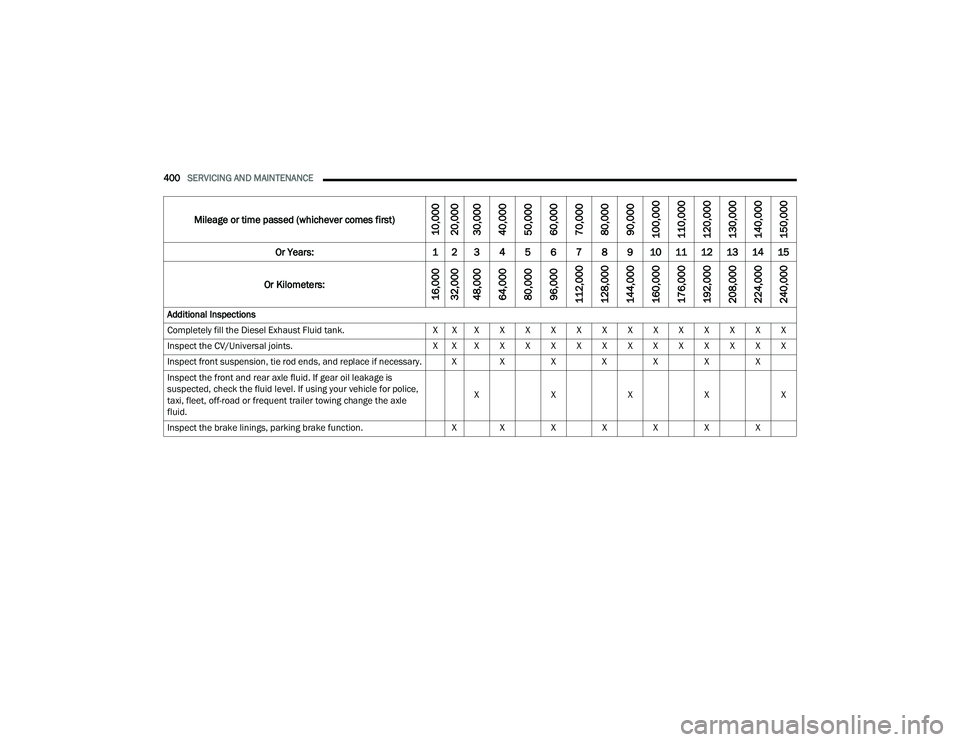
Mileage or time passed (whichever comes first)
10,000
20,000
30,000
40,000
50,000
60,000
70,000
80,000
90,000
100,000
110,000
120,000
130,000
140,000
150,000
Or Years: 1 2 3 4 5 6 7 8 9 10 11 12 13 14 15
Or Kilometers:
16,000
32,000
48,000
64,000
80,000
96,000
112,000
128,000
144,000
160,000
176,000
192,000
208,000
224,000
240,000
Additional Inspections
Completely fill the Diesel Exhaust Fluid tank. X X X X X X X X X X X X X X X
Inspect the CV/Universal joints. X X X X X X X X X X X X X X X
Inspect front suspension, tie rod ends, and replace if necessary. X X X X X X X Inspect the front and rear axle fluid. If gear oil leakage is
suspected, check the fluid level. If using your vehicle for police,
taxi, fleet, off-road or frequent trailer towing change the axle
fluid. X
XXXX
Inspect the brake linings, parking brake function. X X X X X X X
22_DT_OM_EN_USC_t.book Page 400
Page 409 of 496
SERVICING AND MAINTENANCE407
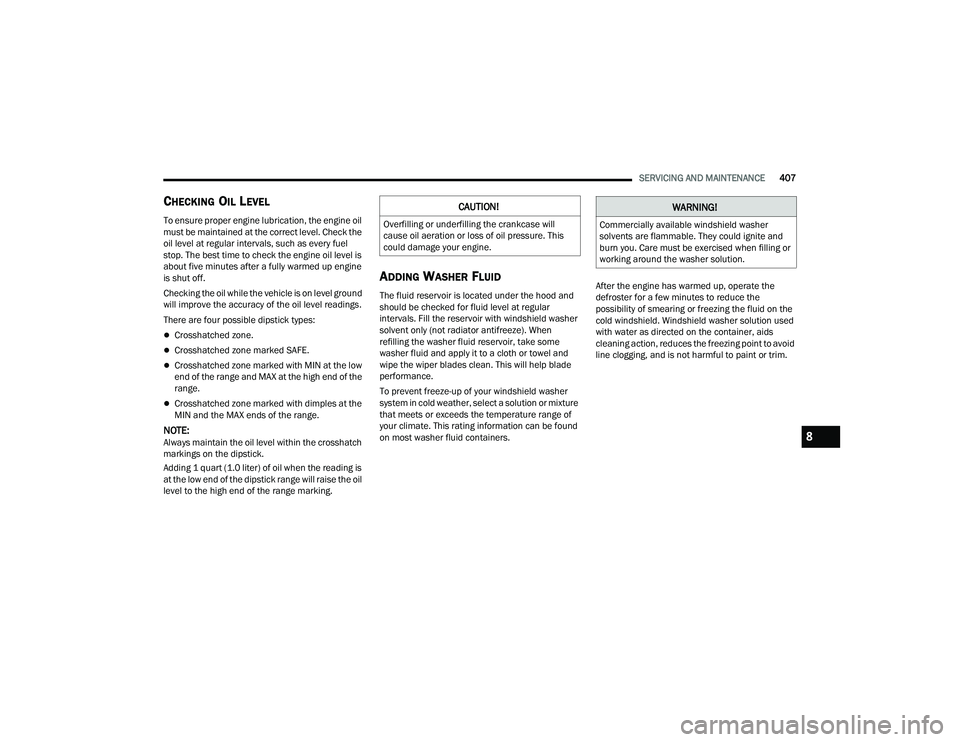
CHECKING OIL LEVEL
To ensure proper engine lubrication, the engine oil
must be maintained at the correct level. Check the
oil level at regular intervals, such as every fuel
stop. The best time to check the engine oil level is
about five minutes after a fully warmed up engine
is shut off.
Checking the oil while the vehicle is on level ground
will improve the accuracy of the oil level readings.
There are four possible dipstick types:
Crosshatched zone.
Crosshatched zone marked SAFE.
Crosshatched zone marked with MIN at the low
end of the range and MAX at the high end of the
range.
Crosshatched zone marked with dimples at the
MIN and the MAX ends of the range.
NOTE:Always maintain the oil level within the crosshatch
markings on the dipstick.
Adding 1 quart (1.0 liter) of oil when the reading is
at the low end of the dipstick range will raise the oil
level to the high end of the range marking.
ADDING WASHER FLUID
The fluid reservoir is located under the hood and
should be checked for fluid level at regular
intervals. Fill the reservoir with windshield washer
solvent only (not radiator antifreeze). When
refilling the washer fluid reservoir, take some
washer fluid and apply it to a cloth or towel and
wipe the wiper blades clean. This will help blade
performance.
To prevent freeze-up of your windshield washer
system in cold weather, select a solution or mixture
that meets or exceeds the temperature range of
your climate. This rating information can be found
on most washer fluid containers. After the engine has warmed up, operate the
defroster for a few minutes to reduce the
possibility of smearing or freezing the fluid on the
cold windshield. Windshield washer solution used
with water as directed on the container, aids
cleaning action, reduces the freezing point to avoid
line clogging, and is not harmful to paint or trim.
CAUTION!
Overfilling or underfilling the crankcase will
cause oil aeration or loss of oil pressure. This
could damage your engine.
WARNING!
Commercially available windshield washer
solvents are flammable. They could ignite and
burn you. Care must be exercised when filling or
working around the washer solution.
8
22_DT_OM_EN_USC_t.book Page 407
Page 417 of 496

SERVICING AND MAINTENANCE415
DIESEL EXHAUST FLUID
Diesel Exhaust Fluid (DEF) sometimes known
simply by the name of its active component,
UREA—is a key component of Selective Catalytic
Reduction (SCR) systems, which help diesel
vehicles meet stringent emission regulations. DEF
is a liquid reducing agent that reacts with engine
exhaust in the presence of a catalyst to convert
smog-forming Nitrogen Oxides (NOx) into harmless
nitrogen and water vapor.
Refer to Engine Fluids And Lubricants Úpage 473
for further information.
AIR CONDITIONER MAINTENANCE
For best possible performance, your air conditioner
should be checked and serviced by an authorized
dealer at the start of each warm season. This
service should include cleaning of the condenser
fins and a performance test. Drive belt tension
should also be checked at this time.
Refrigerant Recovery And Recycling —
R–1234yf
R–1234yf Air Conditioning Refrigerant is a
Hydrofluoroolefin (HFO) that is endorsed by the
Environmental Protection Agency and is an
ozone-friendly substance with a low
global-warming potential. It is recommended that
air conditioning service be performed by an
authorized dealer using recovery and recycling
equipment.
NOTE:Use only the manufacturer approved A/C system
PAG compressor oil, and refrigerants.
WARNING!
A hot exhaust system can start a fire if you park
over materials that can burn, such as grass or
leaves, and those items that come into contact
with your exhaust system. Do not park or
operate your vehicle in areas where your
exhaust system can contact anything that can
burn.
WARNING!
Use only refrigerants and compressor lubri -
cants approved by the manufacturer for your
air conditioning system. Some unapproved
refrigerants are flammable and can explode,
injuring you. Other unapproved refrigerants or
lubricants can cause the system to fail,
requiring costly repairs. Refer to Warranty
Information Book, for further warranty infor -
mation.
The air conditioning system contains refrig -
erant under high pressure. To avoid risk of
personal injury or damage to the system,
adding refrigerant or any repair requiring lines
to be disconnected should be done by an
experienced technician.
CAUTION!
Do not use chemical flushes in your air
conditioning system as the chemicals can
damage your air conditioning components. Such
damage is not covered by the New Vehicle
Limited Warranty.
8
22_DT_OM_EN_USC_t.book Page 415
Page 427 of 496

SERVICING AND MAINTENANCE425
(Continued)
To guarantee optimum performance of the system,
keep the surfaces of the charge air cooler,
condenser and radiator clean and free of debris.
Periodically check the hoses leading to and from
the charge air cooler for cracks or loose clamps
resulting in loss of pressure and reduced engine
performance.
BRAKE SYSTEM
In order to ensure brake system performance, all
brake system components should be inspected
periodically Ú
page 394.
Fluid Level Check — Brake Master Cylinder
The fluid level of the brake master cylinder should
be checked whenever the vehicle is serviced, or
immediately if the Brake System Warning Light is
on. If necessary, add fluid to bring level within the
designated marks on the side of the reservoir of
the brake master cylinder. Be sure to clean the top
of the master cylinder area before removing cap.
With disc brakes, fluid level can be expected to fall
as the brake pads wear. Brake fluid level should be
checked when pads are replaced. If the brake fluid
is abnormally low, check the system for leaks
Úpage 476.
WARNING!
Riding the brakes can lead to brake failure and
possibly a collision. Driving with your foot resting
or riding on the brake pedal can result in
abnormally high brake temperatures, excessive
lining wear, and possible brake damage. You
would not have your full braking capacity in an
emergency.WARNING!
Use only manufacturer's recommended brake
fluid Ú page 476. Using the wrong type of
brake fluid can severely damage your brake
system and/or impair its performance. The
proper type of brake fluid for your vehicle is
also identified on the original factory installed
hydraulic master cylinder reservoir.
To avoid contamination from foreign matter or
moisture, use only new brake fluid or fluid that
has been in a tightly closed container. Keep
the master cylinder reservoir cap secured at
all times. Brake fluid in an open container
absorbs moisture from the air resulting in a
lower boiling point. This may cause it to boil
unexpectedly during hard or prolonged
braking, resulting in sudden brake failure. This
could result in a collision.
Overfilling the brake fluid reservoir can result
in spilling brake fluid on hot engine parts,
causing the brake fluid to catch fire. Brake
fluid can also damage painted and vinyl
surfaces, care should be taken to avoid its
contact with these surfaces.
Do not allow petroleum based fluid to contam -
inate the brake fluid. Brake seal components
could be damaged, causing partial or
complete brake failure. This could result in a
collision.
WARNING!
8
22_DT_OM_EN_USC_t.book Page 425
Page 429 of 496
SERVICING AND MAINTENANCE427
REAR AXLE AND 4X4 FRONT DRIVING
A
XLE FLUID LEVEL
For normal service, periodic fluid level checks are
not required. When the vehicle is serviced for other
reasons the exterior surfaces of the axle assembly
should be inspected. If gear oil leakage is
suspected inspect the fluid level Úpage 476. This
inspection should be made with the vehicle in a
level position.
The fluid level should be even with the bottom of
the fill hole (within 1/4 in (6.4 mm) of edge of hole)
for the front axle and rear axle.
Drain And Refill
For the proper maintenance intervals Úpage 394.
Lubricant Selection
For further information Ú page 476.
NOTE:The presence of water in the gear lubricant will
result in corrosion and possible failure of differ -
ential components. Operation of the vehicle in
water, as may be encountered in some off-highway
types of service, will require draining and refilling
the axle to avoid damage. Limited-Slip Differentials
Rear axles equipped with a Limited Slip Differential
require that 5 oz. (148 ml) Mopar® Limited Slip
Additive be added to the gear lubricant
Ú
page 476. The Mopar® Limited Slip Additive
should be added to the gear lubricant whenever a
fluid change is made to an axle equipped with a
Limited Slip Differential.
NOTE:When refilling a limited slip differential axle which
requires a friction modification additive, the
additive should be added before the gear lubricant
to ensure proper additive fill.
TRANSFER CASE
Fluid Level Check
This fluid level can be checked by removing the
filler plug. The fluid level should be to the bottom
edge of the filler plug hole (or within 1/8 inch of the
bottom) with the vehicle in a level position.
Drain And Refill
For the proper maintenance intervals Úpage 394.
Selection Of Lubricant
Use only the manufacturer recommended fluid
Úpage 476.
FUSES
General Information
WARNING!
When replacing a blown fuse, always use an
appropriate replacement fuse with the same
amp rating as the original fuse. Never replace
a fuse with another fuse of higher amp rating.
The use of a fuse with a rating other than indi -
cated may result in a dangerous electrical
system overload. If a properly rated fuse
continues to blow, it indicates a problem in the
circuit that must be corrected. Never replace a
blown fuse with metal wires or any other mate -
rial. Do not place a fuse inside a circuit
breaker cavity or vice versa. Failure to use
proper fuses may result in serious personal
injury, fire and/or property damage.
Before replacing a fuse, make sure that the
ignition is off and that all the other services
are switched off and/or disengaged.
If the replaced fuse blows again, contact an
authorized dealer.
If a general protection fuse for safety systems
(air bag system, braking system), power unit
systems (engine system, transmission
system) or steering system blows, contact an
authorized dealer.
8
22_DT_OM_EN_USC_t.book Page 427
Page 466 of 496
464SERVICING AND MAINTENANCE
Repairing The Spray-On Bedliner
While extremely tough, it is possible to damage a
Spray-On Bedliner. One common condition is when
loading a heavy pallet and dragging that pallet
across the floor of the bed. If a nail or sharp point
is exposed under the weight of the pallet a scratch
or tear is possible. While not covered by your new
vehicle warranty, a cosmetic fix to cover the metal
exposed by the scratch is required. To repair a tear
or gouge, follow the directions provided in the
Mopar® Quick Repair Kit.
INTERIORS
SEATS AND FABRIC PARTS
Use Mopar® Total Clean to clean fabric upholstery
and carpeting.
Stain Repel Fabric Cleaning Procedure — If
Equipped
Stain Repel seats may be cleaned in the following
manner:
Remove as much of the stain as possible by
blotting with a clean, dry towel.
Blot any remaining stain with a clean, damp
towel.
For tough stains, apply Mopar® Total Clean, or
a mild soap solution to a clean, damp cloth and
remove stain. Use a fresh, damp towel to
remove soap residue.
For grease stains, apply Mopar® Multi-Purpose
Cleaner to a clean, damp cloth and remove
stain. Use a fresh, damp towel to remove soap
residue.
Do not use any harsh solvents or any other form
of protectants on Stain Repel products.
Seat Belt Maintenance
Do not bleach, dye or clean the belts with chemical
solvents or abrasive cleaners. This will weaken the
fabric. If the belts need cleaning, use a mild soap solution
or lukewarm water. Do not remove the belts from
the vehicle to wash them. Dry with a soft cloth.
Sun damage can also weaken the fabric. Replace
the belts if they appear frayed or worn or if the
buckles do not work properly.
NOTE:If the belts retract slowly, inspect the upper turning
loop for soiling. If soiling is present, clean with a
wet soft cloth until all residue is removed.
WARNING!
Do not use volatile solvents for cleaning
purposes. Many are potentially flammable, and
if used in closed areas they may cause
respiratory harm.
WARNING!
A frayed or torn seat belt could rip apart in a
collision and leave you with no protection.
Inspect the seat belt system periodically,
checking for cuts, frays, or loose parts.
Damaged parts must be replaced immediately.
Do not disassemble or modify the seat belt
system. If your vehicle is involved in a collision,
or if you have questions regarding seat belt or
retractor conditions, take your vehicle to an
authorized FCA dealer or authorized FCA
Certified Collision Care Program facility for
inspection.
22_DT_OM_EN_USC_t.book Page 464
Page 484 of 496
482 Bed Divider
...................................................... 97Bed Step.......................................................... 90Bedliner......................................................... 463Belts, Seat..................................................... 368Blind Spot Monitoring.................................... 319Bluetooth Connecting To A Particular MobilePhone Or Audio Device After Pairing
..... 276Body Builders Guide........................................ 11Body Mechanism Lubrication........................ 418Bodywork....................................................... 461B-Pillar Location............................................. 448Brake Assist System...................................... 313Brake Control System.................................... 313Brake Fluid.......................................... 425, 476Brake System...................................... 425, 466Fluid Check............................................... 425Master Cylinder......................................... 425Parking...................................................... 150Warning Light............................................ 128Brake/Transmission Interlock....................... 154Bulb Replacement......................................... 438Bulbs, Light.......................................... 370, 438
C
Camera.......................................................... 199Camera, AUX.................................................. 203Camera, Rear................................................ 199Camera, Surround View................................. 200
Camera, Trailer 360...................................... 203Capacities, Fuel............................................ 472Caps, FillerOil (Engine)............................................... 403Radiator (Coolant Pressure)..................... 423Car Washes................................................... 462Carbon Monoxide Warning............................ 370Care And Maintenance................................. 461Cargo Light..............................................57, 135CD................................................................. 270Cellular Phone.............................................. 302Center High Mounted Stop Light................... 443Center Seat Storage Compartment.................. 70Charge Air Cooler.......................................... 424Chart, Tire Sizing........................................... 445Check Engine Light
(Malfunction Indicator Light)......................... 139Checking Your Vehicle For Safety................. 368Checks, Safety.............................................. 368Child Restraint.............................................. 354Child RestraintsBooster Seats........................................... 357Child Seat Installation..................... 363, 364How To Stow An unused ALR Seat Belt.... 362Infant And Child Restraints....................... 356Locating The LATCH Anchorages.............. 361Lower Anchors And Tethers ForChildren................................................ 359Older Children And Child Restraints......... 357Seating Positions...................................... 358
Clean Air Gasoline......................................... 468CleaningWheels...................................................... 457Climate Control................................................62Automatic....................................................62Manual........................................................65Cold Weather Operation................................ 145Compact Spare Tire...................................... 456Connected Services...................................... 282Connected Services FAQ............................... 297Connected Services Features....................... 286Connected Services, Getting Started............ 284Connected Services, Introduction................. 283Contract, Service........................................... 478Controls........................................................ 262Cooling Pressure Cap (Radiator Cap)............ 423Cooling System.................................... 130, 421Adding Coolant (Antifreeze)...................... 422Coolant Level..........................421, 423, 424Cooling Capacity....................................... 472Disposal Of Used Coolant......................... 423Drain, Flush, And Refill............................. 422Inspection........................................ 423, 424Points To Remember................................ 424Pressure Cap............................................ 423Radiator Cap............................................. 423Selection Of Coolant (Antifreeze)......................... 422, 472, 473Corrosion Protection..................................... 461
22_DT_OM_EN_USC_t.book Page 482
Page 486 of 496
484 Oil Selection
.................................... 409, 472Oil Synthetic.............................................. 409Oil Temperature........................................ 130Overheating............................................... 387Starting........................................... 141, 144Enhanced Accident Response
Feature................................................ 352, 392Entry System, Illuminated................................ 60Ethanol.......................................................... 468Exhaust Gas Cautions.................................... 370Exhaust System................................... 370, 420Exterior Lights......................................... 54, 370
F
Family Alerts.................................................. 296FiltersAir Cleaner................................................. 410Air Conditioning.................................. 68, 416Engine Fuel............................................... 412Engine Oil........................................ 409, 473Engine Oil Disposal................................... 409FlashersTurn Signals.................................... 137, 370Flash-To-Pass.................................................. 55Flat Tire Stowage........................................... 382Fluid Capacities............................................. 472Fluid Leaks.................................................... 370Fluid Level ChecksBrake........................................................ 425Fluid, Brake................................................... 476
Fog Lights..................................... 57, 136, 442Fold-Flat Seats................................................. 35Forward Collision Warning.......... 133, 135, 325Four Wheel Drive............... 133, 135, 137, 160Four-Way Hazard Flasher.............................. 371Freeing A Stuck Vehicle................................ 389Front Axle (Differential)................................. 427Fuel............................................. 208, 467, 469Adding............................................. 207, 208Additives................................................... 468Clean Air................................................... 468Ethanol..................................................... 468Filter......................................................... 412Gasoline................................................... 467Light......................................................... 132Materials Added....................................... 468Methanol.................................................. 468Octane Rating.................................. 467, 473Requirements......................... 467, 469, 472Specifications........................................... 470Tank Capacity........................................... 472Fuel Saver Technology.................................. 174Fuses............................................................ 427
G
Garage Door Opener (HomeLink)..................... 49Gasoline, Clean Air........................................ 468Gasoline, Reformulated................................ 468GaugesVoltage..................................................... 146
Glass Cleaning.............................................. 465Grocery Bag Retainer.......................................41Gross Axle Weight Rating.............................. 213Gross Combination Weight Rating................ 213Gross Trailer Weight...................................... 213Gross Vehicle Weight Rating......................... 213GuideBody Builders...............................................11GVWR............................................................ 211
H
HazardDriving Through Flowing, Rising, Or Shallow Standing Water
................... 231Hazard Warning Flashers.............................. 371Head Restraints...............................................41Head Rests......................................................41Headlights............................................ 136, 440Cleaning.................................................... 462Delay...........................................................56High Beam......................................... 55, 137High Beam/Low Beam Select Switch..........55Lights On Reminder.....................................56On With Wipers............................................56Passing........................................................55Switch..........................................................54Heads Up Display (HUD)....................... 121, 122Heated Mirrors.................................................49Heated Seats...................................................39Heated Steering Wheel....................................34
22_DT_OM_EN_USC_t.book Page 484
Page 488 of 496

486 Air Suspension Payload Protection
............ 134Air Suspension Ride Height Lowering........ 135Air Suspension Ride Height Raising..........134Anti-Lock Brake System............................. 131Brake Assist Warning................................ 316Brake Warning.......................................... 128Bulb Replacement..................................... 438Cargo.................................................. 57, 135Center Mounted Stop................................ 443Courtesy/Reading....................................... 59Cruise.............................................. 136, 137Daytime Running......................................... 55ECO Mode................................................. 136Electric Power Steering............................. 130Electronic Park Brake................................ 131Electronic Stability Control........................ 131Electronic Throttle Control......................... 129Engine Coolant Temperature..................... 130Exterior............................................... 54, 370Fog.................................................. 136, 442Forward Collision Warning......................... 135Hazard Warning Flasher............................ 371Headlights............................................ 54, 56High Beam......................................... 55, 137High Beam/Low Beam Select..................... 55Hill Descent Control Indicator.......... 137, 316Hood Open................................................ 130Illuminated Entry......................................... 60Interior........................................................ 59LaneSense...................................... 136, 137
Lights On Reminder..................................... 56Low Diesel Exhaust Fluid.......................... 135Low Fuel................................................... 136Malfunction Indicator (Check Engine)....... 132NEUTRAL.................................................. 135Oil Temperature........................................ 130Passing........................................................ 55Rear Axle Lock.......................................... 135Rear Axle Lock Fault................................. 133Rear Tail Lamps....................................... 442Seat Belt Reminder.................................. 130Security Alarm.......................................... 131Service..................................................... 438Service Stop Start..................................... 133Stop Start Active....................................... 136TOW HAUL................................................ 135Traction Control........................................ 316Transmission Temperature....................... 131Turn Signals.................................... 137, 440Wait To Start............................................. 135Warning Instrument ClusterDescriptions......................................... 137Limited-Slip Differential....................... 173, 427Load Shed Battery Saver Mode.................... 127Load Shed Battery Saver On......................... 127Load Shed Electrical Load Reduction........... 127Load Shed Intelligent Battery Sensor............ 127Loading Vehicle............................................ 211Tires......................................................... 448
LocksAutomatic Door............................................32Child Protection...........................................32Power Door..................................................29Low Tire Pressure System............................. 328Lubrication, Body.......................................... 418Lug Nuts........................................................ 466Lug Nuts/Bolts.............................................. 466
M
Maintenance.............................................83, 85Maintenance Free Battery............................ 408Maintenance Schedule............... 393, 398, 399Malfunction Indicator Light
(Check Engine).............................................. 132ManualService...................................................... 480Media Hub.......................................................75Media Mode.................................................. 270Memory Seat....................................................34Memory Settings..............................................34Methanol....................................................... 468Mirrors.............................................................45Automatic Dimming.....................................45Digital..........................................................46Electric Powered..........................................48Heated.........................................................49Manual Dimming.........................................45Memory.......................................................34Outside........................................................47
22_DT_OM_EN_USC_t.book Page 486