fuel pump RAM 1500 2022 User Guide
[x] Cancel search | Manufacturer: RAM, Model Year: 2022, Model line: 1500, Model: RAM 1500 2022Pages: 496, PDF Size: 18.03 MB
Page 389 of 496

IN CASE OF EMERGENCY387
(Continued)
Refueling Funnel
Emergency Gas Can Refueling:
Most gas cans will not open the flapper doors. A
funnel is provided to allow emergency refueling
with a gas can.
See below steps for refueling:
1. Retrieve funnel from the spare tire storage area.
2. Insert funnel into same filler pipe opening as the fuel nozzle.
Inserting Funnel
3. Ensure funnel is inserted fully to hold flapper doors open.
4. Pour fuel into funnel opening.
5. Remove funnel from filler pipe, clean off prior to putting back in the spare tire storage area.
IF YOUR ENGINE OVERHEATS
If the vehicle is overheating, it will need to be
serviced by an authorized dealer.
In any of the following situations, you can reduce
the potential for overheating by taking the
appropriate action.
On the highways — slow down.
In city traffic — while stopped, place the trans -
mission in NEUTRAL (N), but do not increase the
engine idle speed while preventing vehicle
motion with the brakes.
CAUTION!
To avoid fuel spillage and overfilling, do not “top
off” the fuel tank after filling.
WARNING!
Never have any smoking materials lit in or
near the vehicle when the fuel door is open or
the tank is being filled.
Never add fuel when the engine is running.
This is in violation of most state and federal
fire regulations and may cause the Malfunc -
tion Indicator Light to turn on.
A fire may result if fuel is pumped into a
portable container that is inside of a vehicle.
You could be burned. Always place fuel
containers on the ground while filling.
WARNING!
7
22_DT_OM_EN_USC_t.book Page 387
Page 415 of 496

SERVICING AND MAINTENANCE413
Upon proper draining of the water from the fuel
filter, the Water In Fuel Indicator Light will remain
illuminated for approximately 10 seconds. If the
water was drained while the engine was running,
the Water In Fuel Indicator Light may remain on for
approximately three minutes.
NOTE:Care should be taken in disposing of used fluids
from your vehicle. Used fluids, indiscriminately
discarded, can present a problem to the envi -
ronment. Contact an authorized dealer, service
station, or government agency for advice on recy -
cling programs and for where used fluids and
filters can be properly disposed of in your area.
Drain the fuel/water separator filter when the
Water In Fuel Indicator Light is ON. Within
10 minutes of vehicle shutdown, turn the filter
drain valve (located on the bottom of the filter
housing) counterclockwise to drain fuel/water,
then turn the ignition switch to the ON position,
and allow any accumulated water to drain. Leave
the drain valve open until all water and
contaminants have been removed. When clean
fuel is visible, close the drain valve by turning it
clockwise, and turn the ignition switch to OFF.
If more than two ounces or 60 milliliters of fuel
have been drained Ú page 414.
UNDERBODY MOUNTED FUEL FILTER
R
EPLACEMENT — DIESEL ENGINE
NOTE:Using a fuel filter that does not meet the manufac -
turer’s filtration and water separating require -
ments can severely impact fuel system life and reli -
ability. Under normal conditions the diesel fuel
filter should be replaced every 20,000 miles (every
other oil change). If the vehicle is being used in
severe operating conditions, or In certain
geographical areas of the country (Pennsylvania,
New York, Ohio, Maryland, West Virginia, Arkansas,
Oklahoma, Kansas, Iowa, Missouri and Nebraska)
due to fuel cleanliness issues, it’s recommended
to replace the fuel filter every 10,000 miles.
Fuel Filter Assembly
1. Turn engine off.
2. Place a drain pan under the fuel filter assembly.
3. Open the water drain valve, and let any accumulated water drain.
4. Close the water drain valve.
5. Remove bottom cover using a strap wrench. Rotate counterclockwise for removal. Remove
the used o-ring and discard it.
CAUTION!
Diesel fuel will damage blacktop paving
surfaces. Drain the filter into an appropriate
container.
Do not prefill the fuel filter when installing a
new fuel filter. There is a possibility debris
could be introduced into the fuel filter during
this action. It is best to install the filter dry and
allow the in-tank lift pump to prime the fuel
system.
1 — Water In Fuel Drain Valve
2 — Fuel Filter Access
8
22_DT_OM_EN_USC_t.book Page 413
Page 416 of 496
414SERVICING AND MAINTENANCE
6. Remove the used filter cartridge from the housing and dispose of it according to your
local regulations.
7. Wipe the sealing surfaces of the lid and housing clean.
8. Install a new o-ring into the ring groove on the filter housing and lubricate with clean engine
oil.
PRIMING IF THE ENGINE HAS RUN OUT
O
F FUEL — DIESEL ENGINE
1. Add a substantial amount of fuel to the tank,
approximately 2 to 5 gal (8 L to 19 L).
2. Press ignition switch twice without your foot on brake to put vehicle in ON/RUN position. This
will activate the in tank fuel pump for approxi -
mately 30 seconds. Repeat this process twice. 3. Start the engine using the “Normal Starting”
procedure Ú page 144.
NOTE:The engine may run rough until the air is forced
from all the fuel lines.
NOTE:
Use of biodiesel mixture in excess of 20% can
negatively impact the fuel filter's ability to sepa -
rate water from the fuel, resulting in high pres -
sure fuel system corrosion or damage.
In addition, commercially available fuel addi -
tives are not necessary for the proper operation
of your diesel engine.
For extreme cold conditions, "Mopar® Premium
Diesel Fuel Treatment" is recommended to
assist with cold starting.
INTERVENTION REGENERATION
S
TRATEGY — MESSAGE PROCESS FLOW
(D
IESEL ENGINE)
This engine meets all required diesel engine
emissions standards. To achieve these emissions
standards, your vehicle is equipped with a
state-of-the-art engine and exhaust system. These
systems are seamlessly integrated into your
vehicle and managed by the Powertrain Control
Module (PCM). The PCM manages engine
combustion to allow the exhaust system’s catalyst
to trap and burn Particulate Matter (PM)
pollutants, with no input or interaction on your part.
Additionally, your vehicle has the ability to alert you
to additional maintenance required on your vehicle
or engine Ú page 114.
WARNING!
Do not open the high pressure fuel system with
the engine running. Engine operation causes
high fuel pressure. High pressure fuel spray can
cause serious injury or death.
CAUTION!
The starter motor will engage for approximately
30 seconds at a time. Allow two minutes
between cranking intervals.
WARNING!
Do not use alcohol or gasoline as a fuel blending
agent. They can be unstable under certain
conditions and be hazardous or explosive when
mixed with diesel fuel.
CAUTION!
Due to lack of lubricants in alcohol or gasoline,
the use of these fuels can cause damage to the
fuel system.
22_DT_OM_EN_USC_t.book Page 414
Page 431 of 496
SERVICING AND MAINTENANCE429
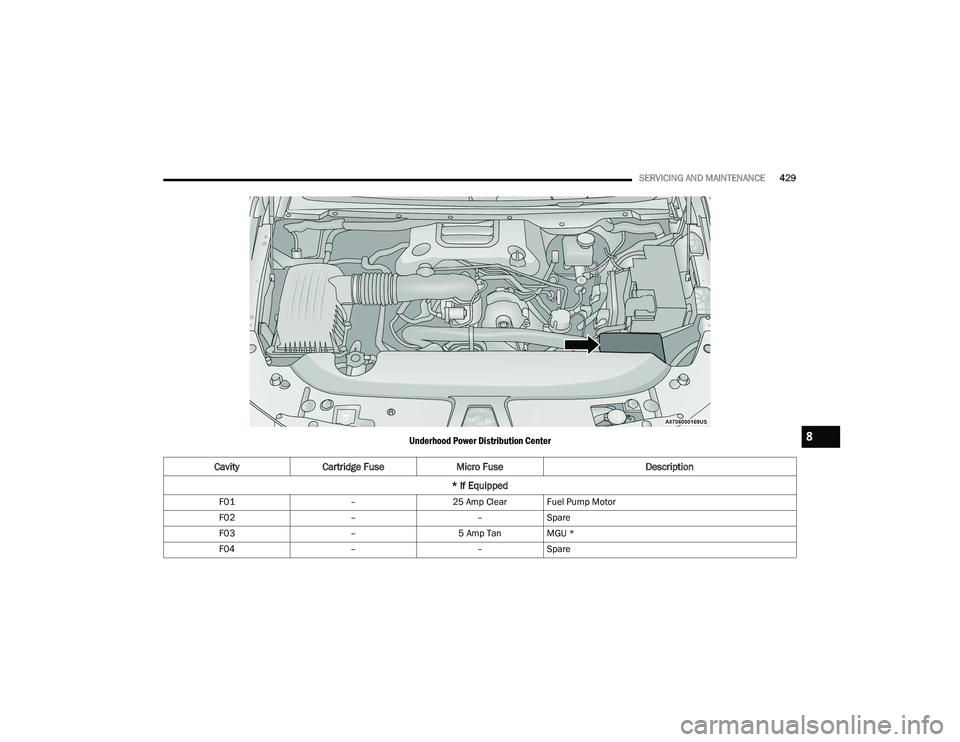
Underhood Power Distribution Center
Cavity Cartridge Fuse Micro Fuse Description
* If Equipped
F01 –25 Amp Clear Fuel Pump Motor
F02 ––Spare
F03 –5 Amp Tan MGU *
F04 ––Spare
8
22_DT_OM_EN_USC_t.book Page 429
Page 434 of 496

432SERVICING AND MAINTENANCE
F44 –10 Amp Red Trailer Camera *
F45 –10 Amp Red ADCM *
F46 30 Amp Pink –Fuel Heater *
F47 30 Amp Pink –Rear Defroster
F48 ––Spare
F49 30 Amp Pink –Htr Ctrl *
F50 20 Amp Blue –AUX SWITCH #6 *
F51 25 Amp White –FUEL PUMP MOTOR #1 *
F52 ––Spare
F53 –10 Amp Red Supply / Purging Pump *
F54 –15 Amp Blue PCM *
10 Amp Red Vapor Blocking Valve *
F55 –15 Amp Blue RT HID Headlamp
F56 ––Spare
F57 –20 Amp Yellow Horn
F58 25 Amp White –FUEL PUMP MOTOR #2 *
F59 –25 Amp Clear Injectors / IGN Coil / Glow Plug Module *
F60 –20 Amp Yellow ECM / PCM / ACT Short Running Valve / LTR Coolant Pump *
F61 –15 Amp Blue LT HID Headlamp
CavityCartridge Fuse Micro Fuse Description
* If Equipped
22_DT_OM_EN_USC_t.book Page 432
Page 470 of 496

468TECHNICAL SPECIFICATIONS
REFORMULATED GASOLINE
Many areas of the country require the use of
cleaner-burning gasoline referred to as
“reformulated gasoline”. Reformulated gasoline
contains oxygenates and are specifically blended
to reduce vehicle emissions and improve air
quality.
The use of reformulated gasoline is recommended.
Properly blended reformulated gasoline will
provide improved performance and durability of
engine and fuel system components.
MATERIALS ADDED TO FUEL
Besides using unleaded gasoline with the proper
octane rating, gasolines that contain detergents,
corrosion and stability additives are
recommended. Using gasolines that have these
additives will help improve fuel economy, reduce
emissions, and maintain vehicle performance.
Designated TOP TIER Detergent
Gasoline contains a higher level of
detergents to further aide in minimizing
engine and fuel system deposits. When
available, the usage of TOP TIER Detergent
Gasoline is recommended. Visit
www.toptiergas.com for a list of TOP TIER
Detergent Gasoline retailers. Indiscriminate use of fuel system cleaning agents
should be avoided. Many of these materials
intended for gum and varnish removal may contain
active solvents or similar ingredients. These can
harm fuel system gasket and diaphragm materials.
GASOLINE/OXYGENATE BLENDS
Some fuel suppliers blend unleaded gasoline with
oxygenates such as ethanol.
Problems that result from using gasoline
containing more than 15% ethanol (E-15) or
gasoline containing methanol are not the
responsibility of the manufacturer and may void
the New Vehicle Limited Warranty.
DO NOT USE E-85 IN NON-FLEX FUEL
V
EHICLES
Non-Flex Fuel Vehicles (FFV) are compatible with
gasoline containing up to 15% ethanol (E-15). Use
of gasoline with higher ethanol content may void
the New Vehicle Limited Warranty.
If a Non-FFV vehicle is inadvertently fueled with
E-85 fuel, the engine will have some or all of these
symptoms:
Operate in a lean mode.
OBD II Malfunction Indicator Light on.
Poor engine performance.
Poor cold start and cold drivability.
Increased risk for fuel system component corro -
sion.
CNG AND LP FUEL SYSTEM
M
ODIFICATIONS
Modifications that allow the engine to run on
Compressed Natural Gas (CNG) or Liquid Propane
(LP) may result in damage to the engine,
emissions, and fuel system components. Problems
that result from running CNG or LP are not the
responsibility of the manufacturer and may void
the New Vehicle Limited Warranty.
CAUTION!
DO NOT use E-85, gasoline containing methanol,
or gasoline containing more than 15% ethanol
(E-15). Use of these blends may result in starting
and drivability problems, damage critical fuel
system components, cause emissions to exceed
the applicable standard, and/or cause the
Malfunction Indicator Light to illuminate. Please
observe pump labels as they should clearly
communicate if a fuel contains greater than
15% ethanol (E-15).
22_DT_OM_EN_USC_t.book Page 468
Page 471 of 496

TECHNICAL SPECIFICATIONS469
(Continued)
METHYLCYCLOPENTADIENYL
M
ANGANESE TRICARBONYL (MMT) IN
G
ASOLINE
MMT is a manganese-containing metallic additive
that is blended into some gasoline to increase
octane. Gasoline blended with MMT provides no
performance advantage beyond gasoline of the
same octane number without MMT. Gasoline
blended with MMT reduces spark plug life and
reduces emissions system performance in some
vehicles. The manufacturer recommends that
gasoline without MMT be used in your vehicle. The
MMT content of gasoline may not be indicated on
the gasoline pump; therefore, you should ask the
gasoline retailer whether the gasoline contains
MMT. MMT is prohibited in Federal and California
reformulated gasoline.
FUEL SYSTEM CAUTIONSNOTE:Intentional tampering with the emissions control
system can result in civil penalties being assessed
against you.
FUEL REQUIREMENTS – DIESEL ENGINE
Federal law requires that you must fuel this vehicle
with Ultra Low Sulfur Highway Diesel fuel (15 ppm
Sulfur maximum) and prohibits the use of Low
Sulfur Highway Diesel fuel (500 ppm Sulfur
maximum) to avoid damage to the emissions
control system.
Use good quality diesel fuel from a reputable
supplier in your vehicle. For most year-round
service, No. 2 diesel fuel meeting ASTM (formerly
known as the American Society for Testing and
Materials) specification D-975 Grade S15 will
provide good performance. If the vehicle is
exposed to extreme cold (below 20°F or -7°C), or
is required to operate at colder-than-normal
conditions for prolonged periods, use Climatized
Number 2 diesel fuel or dilute the Number 2 diesel
fuel with 50% Number 1 diesel fuel. This will
provide better protection from fuel gelling or
wax-plugging of the fuel filters.
CAUTION!
Follow these guidelines to maintain your
vehicle’s performance:
The use of leaded gasoline is prohibited by
Federal law. Using leaded gasoline can impair
engine performance and damage the emis -
sions control system.
An out-of-tune engine or certain fuel or ignition
malfunctions can cause the catalytic
converter to overheat. If you notice a pungent
burning odor or some light smoke, your engine
may be out of tune or malfunctioning and may
require immediate service. Contact an autho -
rized dealer for service assistance.
The use of fuel additives, which are now being
sold as octane enhancers, is not recom -
mended. Most of these products contain high
concentrations of methanol. Fuel system
damage or vehicle performance problems
resulting from the use of such fuels or addi -
tives is not the responsibility of the manufac-
turer and may void or not be covered under
the New Vehicle Limited Warranty.
CAUTION!
WARNING!
Do not use alcohol or gasoline as a fuel blending
agent. They can be unstable under certain
conditions and hazardous or explosive when
mixed with diesel fuel.9
22_DT_OM_EN_USC_t.book Page 469