sport mode RAM 1500 2022 User Guide
[x] Cancel search | Manufacturer: RAM, Model Year: 2022, Model line: 1500, Model: RAM 1500 2022Pages: 496, PDF Size: 18.03 MB
Page 255 of 496
MULTIMEDIA253
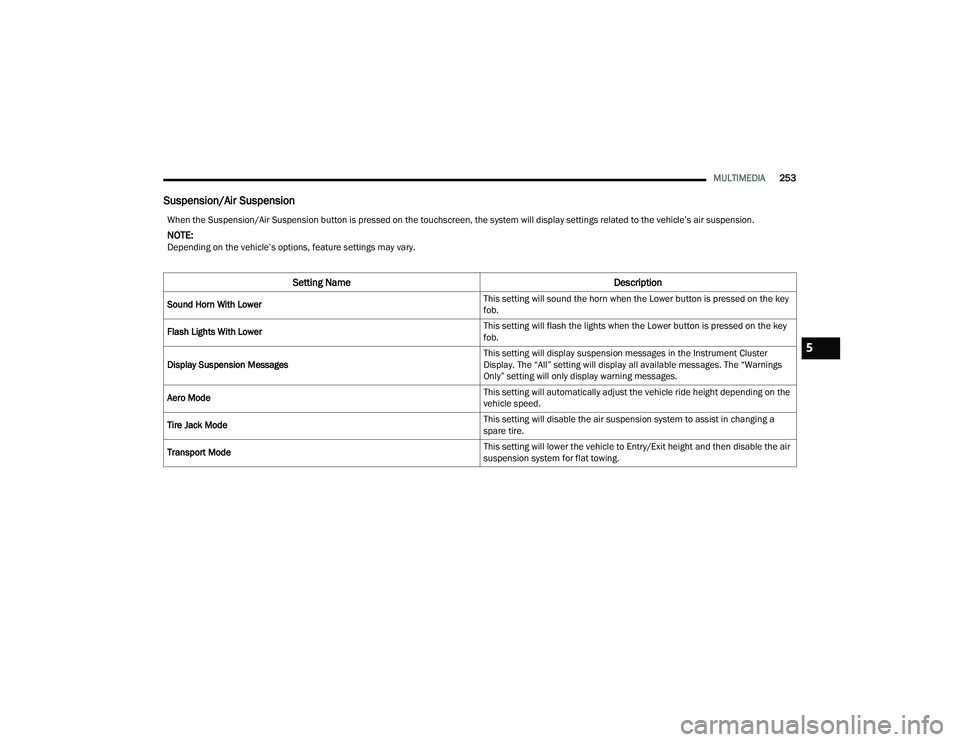
Suspension/Air Suspension
When the Suspension/Air Suspension button is pressed on the touchscreen, the system will display settings related to the vehicle’s air suspension.
NOTE:Depending on the vehicle’s options, feature settings may vary.
Setting Name Description
Sound Horn With Lower This setting will sound the horn when the Lower button is pressed on the key
fob.
Flash Lights With Lower This setting will flash the lights when the Lower button is pressed on the key
fob.
Display Suspension Messages This setting will display suspension messages in the Instrument Cluster
Display. The “All” setting will display all available messages. The “Warnings
Only” setting will only display warning messages.
Aero Mode This setting will automatically adjust the vehicle ride height depending on the
vehicle speed.
Tire Jack Mode This setting will disable the air suspension system to assist in changing a
spare tire.
Transport Mode This setting will lower the vehicle to Entry/Exit height and then disable the air
suspension system for flat towing.
5
22_DT_OM_EN_USC_t.book Page 253
Page 256 of 496

254MULTIMEDIA
AUX Switches
Wheel Alignment Mode
This setting must be activated before performing a wheel alignment, which
will move the vehicle to normal ride height and then disable the air
suspension system. Refer to an authorized dealer for further information.
Four Corner Air Suspension Modes There are three air suspension modes designed to protect the system in
unique situations. Tire Jack Mode is selected to assist in changing a spare
tire. Transport Mode is selected to assist when the vehicle is being flat bed
towed. Wheel Alignment Mode is selected before performing a wheel
alignment. Refer to an authorized dealer for further information.
Setting Name
Description
When the AUX Switches button is pressed on the touchscreen, the system displays the options related to the four vehicle AUX switches.
NOTE:Depending on the vehicle’s options, feature settings may vary.
Setting NameDescription
AUX 1-4 This setting will adjust the type and power source for the four vehicle AUX
switches. There are two types: “Latching” and “Momentary”. The power
source for the AUX switches can either be set to run off the “Battery” or from
the “Ignition”. In addition to setting the type and power source, you can set if
the vehicle will recall the previous state at which the AUX switches were set.
The Recalled Last State setting can be set to “On” or “Off”. Last state
conditions are met only if the type is set to Latching and the power source is
set to Ignition.
22_DT_OM_EN_USC_t.book Page 254
Page 306 of 496
304MULTIMEDIA
The following describes each feature and its
operation:
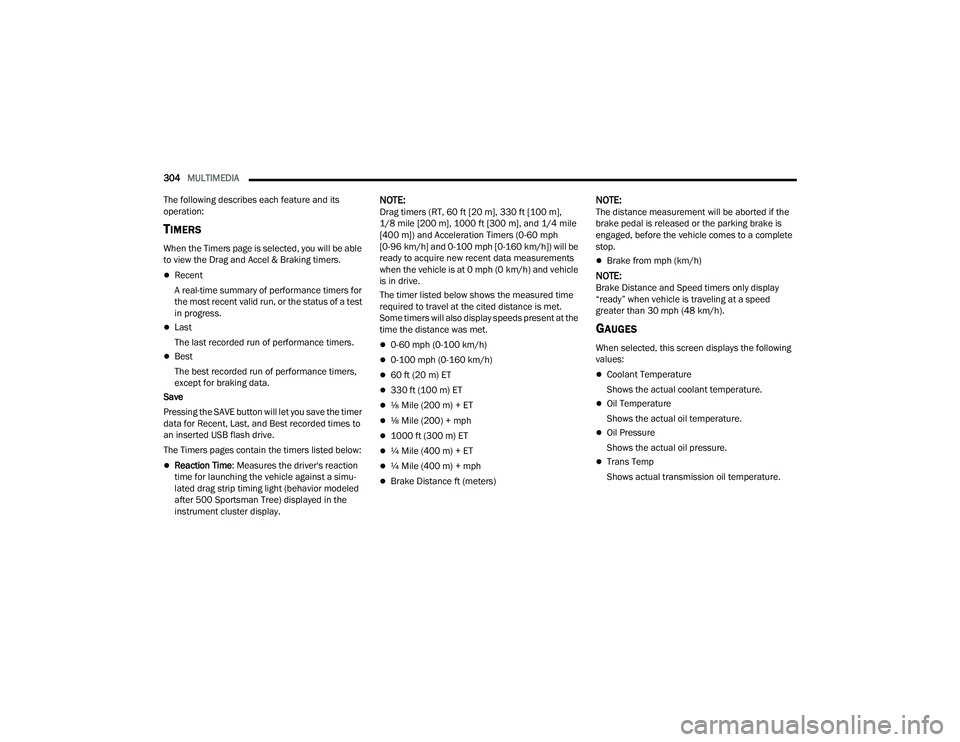
TIMERS
When the Timers page is selected, you will be able
to view the Drag and Accel & Braking timers.
Recent
A real-time summary of performance timers for
the most recent valid run, or the status of a test
in progress.
Last
The last recorded run of performance timers.
Best
The best recorded run of performance timers,
except for braking data.
Save
Pressing the SAVE button will let you save the timer
data for Recent, Last, and Best recorded times to
an inserted USB flash drive.
The Timers pages contain the timers listed below:
Reaction Time: Measures the driver's reaction
time for launching the vehicle against a simu -
lated drag strip timing light (behavior modeled
after 500 Sportsman Tree) displayed in the
instrument cluster display.
NOTE:Drag timers (RT, 60 ft [20 m], 330 ft [100 m],
1/8 mile [200 m], 1000 ft [300 m], and 1/4 mile
[400 m]) and Acceleration Timers (0-60 mph
[0-96 km/h] and 0-100 mph [0-160 km/h]) will be
ready to acquire new recent data measurements
when the vehicle is at 0 mph (0 km/h) and vehicle
is in drive.
The timer listed below shows the measured time
required to travel at the cited distance is met.
Some timers will also display speeds present at the
time the distance was met.
0-60 mph (0-100 km/h)
0-100 mph (0-160 km/h)
60 ft (20 m) ET
330 ft (100 m) ET
⅛ Mile (200 m) + ET
⅛ Mile (200) + mph
1000 ft (300 m) ET
¼ Mile (400 m) + ET
¼ Mile (400 m) + mph
Brake Distance ft (meters)
NOTE:The distance measurement will be aborted if the
brake pedal is released or the parking brake is
engaged, before the vehicle comes to a complete
stop.
Brake from mph (km/h)
NOTE:Brake Distance and Speed timers only display
“ready” when vehicle is traveling at a speed
greater than 30 mph (48 km/h).
GAUGES
When selected, this screen displays the following
values:
Coolant Temperature
Shows the actual coolant temperature.
Oil Temperature
Shows the actual oil temperature.
Oil Pressure
Shows the actual oil pressure.
Trans Temp
Shows actual transmission oil temperature.
22_DT_OM_EN_USC_t.book Page 304
Page 343 of 496
SAFETY341
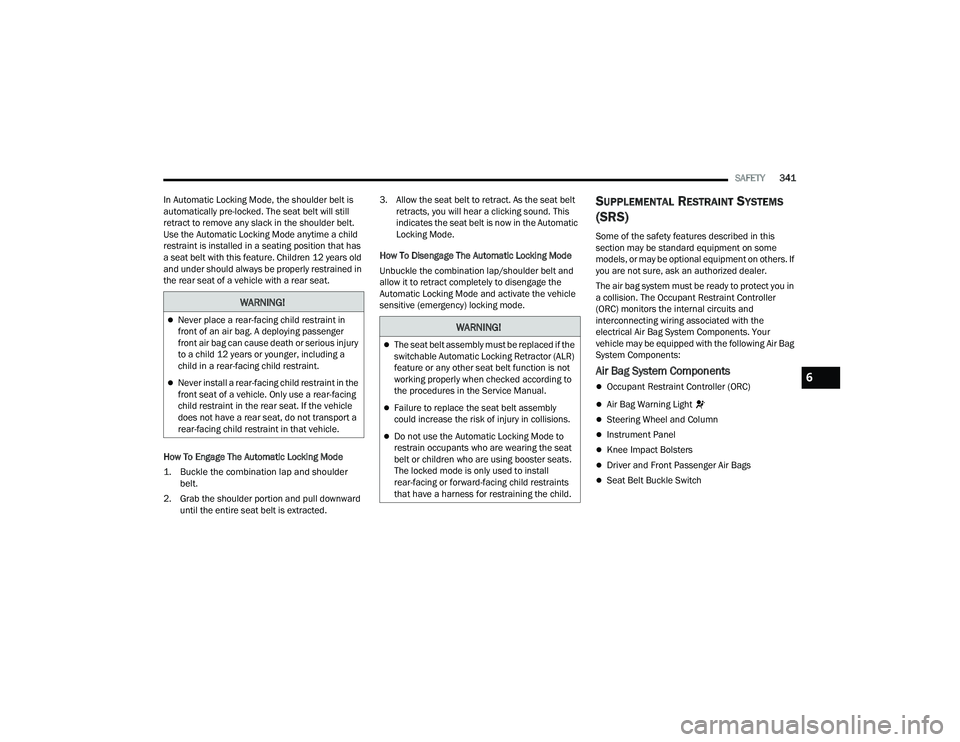
In Automatic Locking Mode, the shoulder belt is
automatically pre-locked. The seat belt will still
retract to remove any slack in the shoulder belt.
Use the Automatic Locking Mode anytime a child
restraint is installed in a seating position that has
a seat belt with this feature. Children 12 years old
and under should always be properly restrained in
the rear seat of a vehicle with a rear seat.
How To Engage The Automatic Locking Mode
1. Buckle the combination lap and shoulder belt.
2. Grab the shoulder portion and pull downward until the entire seat belt is extracted. 3. Allow the seat belt to retract. As the seat belt
retracts, you will hear a clicking sound. This
indicates the seat belt is now in the Automatic
Locking Mode.
How To Disengage The Automatic Locking Mode
Unbuckle the combination lap/shoulder belt and
allow it to retract completely to disengage the
Automatic Locking Mode and activate the vehicle
sensitive (emergency) locking mode.
SUPPLEMENTAL RESTRAINT SYSTEMS
(SRS)
Some of the safety features described in this
section may be standard equipment on some
models, or may be optional equipment on others. If
you are not sure, ask an authorized dealer.
The air bag system must be ready to protect you in
a collision. The Occupant Restraint Controller
(ORC) monitors the internal circuits and
interconnecting wiring associated with the
electrical Air Bag System Components. Your
vehicle may be equipped with the following Air Bag
System Components:
Air Bag System Components
Occupant Restraint Controller (ORC)
Air Bag Warning Light
Steering Wheel and Column
Instrument Panel
Knee Impact Bolsters
Driver and Front Passenger Air Bags
Seat Belt Buckle Switch
WARNING!
Never place a rear-facing child restraint in
front of an air bag. A deploying passenger
front air bag can cause death or serious injury
to a child 12 years or younger, including a
child in a rear-facing child restraint.
Never install a rear-facing child restraint in the
front seat of a vehicle. Only use a rear-facing
child restraint in the rear seat. If the vehicle
does not have a rear seat, do not transport a
rear-facing child restraint in that vehicle.
WARNING!
The seat belt assembly must be replaced if the
switchable Automatic Locking Retractor (ALR)
feature or any other seat belt function is not
working properly when checked according to
the procedures in the Service Manual.
Failure to replace the seat belt assembly
could increase the risk of injury in collisions.
Do not use the Automatic Locking Mode to
restrain occupants who are wearing the seat
belt or children who are using booster seats.
The locked mode is only used to install
rear-facing or forward-facing child restraints
that have a harness for restraining the child.
6
22_DT_OM_EN_USC_t.book Page 341
Page 370 of 496

368SAFETY
SAFETY TIPS
TRANSPORTING PASSENGERS
NEVER TRANSPORT PASSENGERS IN THE CARGO
AREA.
TRANSPORTING PETS
Air Bags deploying in the front seat could harm
your pet. An unrestrained pet will be thrown about
and possibly injured, or injure a passenger during
panic braking or in a collision. Pets should be restrained in the rear seat (if
equipped) in pet harnesses or pet carriers that are
secured by seat belts.
SAFETY CHECKS YOU SHOULD MAKE
I
NSIDE THE VEHICLE
Seat Belts
Inspect the seat belt system periodically, checking
for cuts, frays, and loose parts. Damaged parts
must be replaced immediately. Do not
disassemble or modify the system.
If your vehicle is involved in a collision, or if you
have questions regarding the seat belt or retractor
conditions, take your vehicle to an authorized FCA
dealer or authorized FCA Certified Collision Care
Program facility for inspection.
Air Bag Warning Light
The Air Bag Warning Light will turn on for
four to eight seconds as a bulb check
when the ignition switch is first placed in
the ON/RUN position. If the light is either
not on during starting, stays on, or turns on while
driving, have the system inspected at an
authorized dealer as soon as possible. After the
bulb check, this light will illuminate with a single chime when a fault with the Air Bag System has
been detected. It will stay on until the fault is
removed. If the light comes on intermittently or
remains on while driving, have an authorized
dealer service the vehicle immediately.
See Ú
page 334 for further information.
Defroster
Check operation by selecting the defrost mode and
place the blower control on high speed. You should
be able to feel the air directed against the
windshield. See an authorized dealer for service if
your defroster is inoperable.
Floor Mat Safety Information
Always use floor mats designed to fit your vehicle.
Only use a floor mat that does not interfere with the
operation of the accelerator, brake or clutch
pedals. Only use a floor mat that is securely
attached using the floor mat fasteners so it cannot
slip out of position and interfere with the
accelerator, brake or clutch pedals or impair safe
operation of your vehicle in other ways.
WARNING!
Do not leave children or animals inside parked
vehicles in hot weather. Interior heat buildup
may cause serious injury or death.
It is extremely dangerous to ride in a cargo
area, inside or outside of a vehicle. In a colli -
sion, people riding in these areas are more
likely to be seriously injured or killed.
Do not allow people to ride in any area of your
vehicle that is not equipped with seats and
seat belts.
Be sure everyone in your vehicle is in a seat
and using a seat belt properly.
22_DT_OM_EN_USC_t.book Page 368
Page 392 of 496

390IN CASE OF EMERGENCY
NOTE:Shifts between DRIVE and REVERSE can only be
achieved at wheel speeds of 5 mph (8 km/h) or
less. Whenever the transmission remains in
NEUTRAL (N) for more than two seconds, you must
press the brake pedal to engage DRIVE or
REVERSE.
Push the ESC OFF button to place the Electronic
Stability Control (ESC) system in “Partial OFF”
mode, before rocking the vehicle Ú page 314.
Once the vehicle has been freed, push the ESC OFF
button to restore “ESC On” mode.TOWING A DISABLED VEHICLE
This section describes procedures for towing a
disabled vehicle using a commercial towing
service.
If the transmission and drivetrain are operable,
disabled vehicles may also be towed as described
on Ú page 227.
NOTE:
Vehicles equipped with the Active-Level Four
Corner Air Suspension System must be placed in
Transport mode, before tying them down (from the
body) on a trailer or flatbed truck Ú page 165. If
the vehicle cannot be placed in Transport mode
(for example, engine will not run), tie-downs must
be fastened to the axles (not to the body). Failure
to follow these instructions may cause fault codes
to be set and/or cause loss of proper tie-down
tension.
CAUTION!
Racing the engine or spinning the wheels may
lead to transmission overheating and failure.
Allow the engine to idle with the transmission
in NEUTRAL for at least one minute after every
five rocking-motion cycles. This will minimize
overheating and reduce the risk of transmis -
sion failure during prolonged efforts to free a
stuck vehicle.
When “rocking” a stuck vehicle by shifting
between DRIVE and REVERSE, do not spin the
wheels faster than 15 mph (24 km/h), or
drivetrain damage may result.
Revving the engine or spinning the wheels too
fast may lead to transmission overheating and
failure. It can also damage the tires. Do not
spin the wheels above 30 mph (48 km/h)
while in gear (no transmission shifting occur -
ring).
WARNING!
Fast spinning tires can be dangerous. Forces
generated by excessive wheel speeds may
cause damage, or even failure, of the axle and
tires. A tire could explode and injure someone.
Do not spin your vehicle's wheels faster than
30 mph (48 km/h) or for longer than 30
seconds continuously without stopping when
you are stuck and do not let anyone near a
spinning wheel, no matter what the speed.
22_DT_OM_EN_USC_t.book Page 390
Page 483 of 496

481
INDEX
A
Accessory Drive Belt Inspection..................... 418Adaptive Cruise Control (ACC)
(Cruise Control).........131, 136, 137, 176, 178Adding Engine Coolant (Antifreeze)............... 422Adding Fuel.......................................... 207, 208Additives, Fuel............................................... 468AdjustDown........................................................... 38Forward....................................................... 38Rearward..................................................... 38Up................................................................ 38Adjustable Pedals............................................ 44Advance Phone Connectivity......................... 280Air BagAir Bag Operation...................................... 344Air Bag Warning Light...................... 342, 344Enhanced Accident Response......... 352, 392Event Data Recorder (EDR)....................... 392Front Air Bag............................................. 344If Deployment Occurs................................ 351Knee Impact Bolsters................................ 349Maintaining Your Air Bag System.............. 353Maintenance............................................. 353Redundant Air Bag Warning Light.............342Transporting Pets...................................... 368
Air Bag Light................................ 128, 342, 368Air Cleaner, Engine
(Engine Air Cleaner Filter)............................. 410Air Conditioner Maintenance........................ 415Air Conditioner Refrigerant........................... 415Air Conditioner System................................. 415Air Conditioning......................................... 62, 65Air Conditioning Filter..............................68, 416Air Conditioning System................................... 67Air Conditioning, Operating Tips....................... 68Air Filter............................................... 410, 412Air PressureTires......................................................... 452Air Suspension......... 131, 134, 135, 165, 169AlarmSecurity Alarm....................................27, 131Alterations/ModificationsVehicle......................................................... 13Antifreeze (Engine Coolant)................. 422, 472Disposal................................................... 423Anti-Lock Brake System (ABS)...................... 312Anti-Lock Warning Light................................ 131Assist, Hill Start............................................. 318Audio Settings............................................... 268Audio Systems (Radio).................................. 233Auto Down Power Windows............................. 80
Automatic Door Locks......................................32Automatic Headlights.......................................56Automatic High Beams.....................................55Automatic Tailgate Release.............................86Automatic Temperature Control (ATC)..............67Automatic Transmission....................... 154, 426Adding Fluid.............................................. 426Fluid And Filter Change............................. 426Fluid Change............................................. 426Fluid Level Check...................................... 426Fluid Type........................................ 426, 476Special Additives...................................... 426Automatic Transmission Limp Home Mode... 158AutoPark....................................................... 142AUX Camera.................................................. 203Auxiliary Driving Systems.............................. 319Axle Fluid.............................................. 427, 476Axle Locker System....................................... 172Axle Lubrication............................................ 427
B
Back-Up Camera........................................... 199Battery................................................. 129, 408Charging System Light.............................. 129Keyless Key Fob Replacement....................21Battery Saver Feature......................................59
11
22_DT_OM_EN_USC_t.book Page 481