oil RAM 1500 2022 Workshop Manual
[x] Cancel search | Manufacturer: RAM, Model Year: 2022, Model line: 1500, Model: RAM 1500 2022Pages: 496, PDF Size: 18.03 MB
Page 444 of 496

442SERVICING AND MAINTENANCE
4. Disengage the side marker socket by rotating counterclockwise a quarter turn.
5. Pull the socket and bulb straight out from the housing.
6. Separate the bulb from the socket without twisting.
7. Reverse the procedure for installation of new bulb and covers.
FOG LAMPS — IF EQUIPPED
Please see an authorized dealer for service on LED
and Halogen front fog lamps.
Halogen
See below steps to replace:
1. Reach under and behind the front fascia/bumper to access the back of the front fog
lamp housing.
2. Disconnect the fog lamp wiring harness connector from the fog lamp bulb.
Fog Lamp Bulb
3. Rotate the bulb counterclockwise a quarter turn to unlock the bulb from the housing.
4. Pull the bulb straight out from the housing.
5. Reverse the procedure to install the bulb and cover.
REAR TAIL/STOP, TURN SIGNAL AND BACKUP
LAMPS
See below steps to replace:
1. Remove the two screws and push pin retainers that pass through the bed sheet
metal.
Tail Lamp Locations
2. Pull the outboard side of the lamp rearward far enough to unsnap the two receptacles on the
outboard side of the lamp housing from the
two plastic snap post retainers in the outer box
side panel.
CAUTION!
Do not contaminate the bulb glass by touching it
with your fingers or by allowing it to contact other
oily surfaces. Shortened bulb life will result.1 — Tail Lamp
2 — Fasteners
3 — Push - Pin Retainers
22_DT_OM_EN_USC_t.book Page 442
Page 445 of 496
SERVICING AND MAINTENANCE443
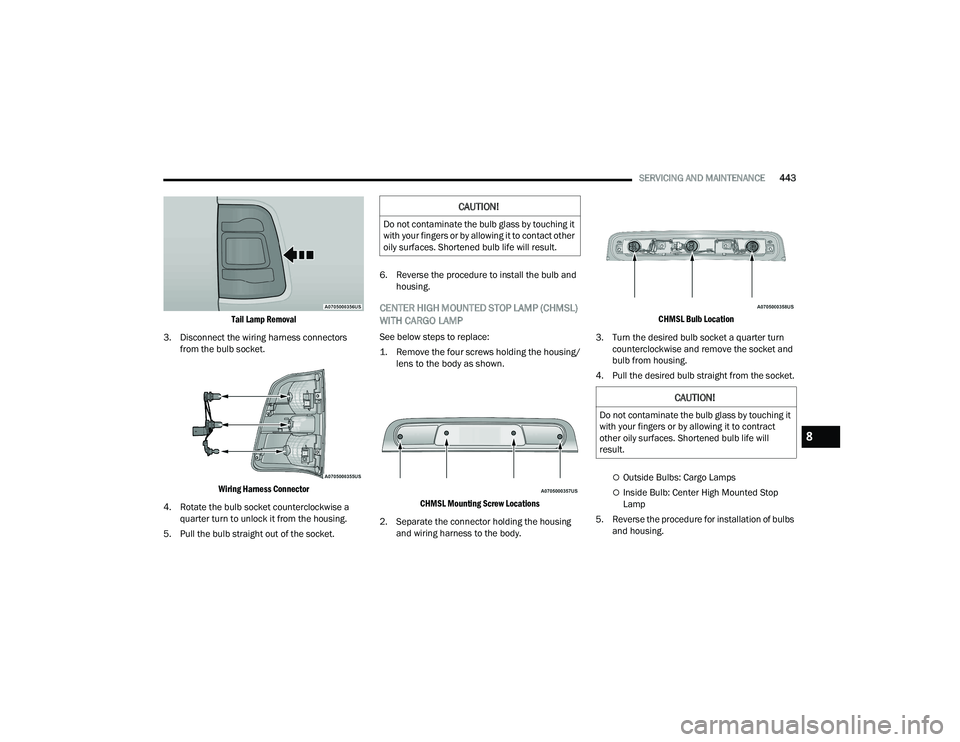
Tail Lamp Removal
3. Disconnect the wiring harness connectors from the bulb socket.
Wiring Harness Connector
4. Rotate the bulb socket counterclockwise a quarter turn to unlock it from the housing.
5. Pull the bulb straight out of the socket. 6. Reverse the procedure to install the bulb and
housing.
CENTER HIGH MOUNTED STOP LAMP (CHMSL)
WITH CARGO LAMP
See below steps to replace:
1. Remove the four screws holding the housing/lens to the body as shown.
CHMSL Mounting Screw Locations
2. Separate the connector holding the housing and wiring harness to the body.
CHMSL Bulb Location
3. Turn the desired bulb socket a quarter turn counterclockwise and remove the socket and
bulb from housing.
4. Pull the desired bulb straight from the socket.
Outside Bulbs: Cargo Lamps
Inside Bulb: Center High Mounted Stop
Lamp
5. Reverse the procedure for installation of bulbs and housing.
CAUTION!
Do not contaminate the bulb glass by touching it
with your fingers or by allowing it to contact other
oily surfaces. Shortened bulb life will result.
CAUTION!
Do not contaminate the bulb glass by touching it
with your fingers or by allowing it to contract
other oily surfaces. Shortened bulb life will
result.
8
22_DT_OM_EN_USC_t.book Page 443
Page 456 of 496

454SERVICING AND MAINTENANCE
Life Of Tire
The service life of a tire is dependent upon varying
factors including, but not limited to:
Driving style
Tire pressure - Improper cold tire inflation pres -
sures can cause uneven wear patterns to
develop across the tire tread. These abnormal
wear patterns will reduce tread life, resulting in
the need for earlier tire replacement
Distance driven
Performance tires, tires with a speed rating of V
or higher, and Summer tires typically have a
reduced tread life. Rotation of these tires per
the vehicle scheduled maintenance is highly
recommended
NOTE:Wheel Valve Stem must be replaced as well when
installing new tires due to wear and tear in existing
tires. Keep dismounted tires in a cool, dry place with as
little exposure to light as possible. Protect tires
from contact with oil, grease, and gasoline.
Replacement Tires
The tires on your new vehicle provide a balance of
many characteristics. They should be inspected
regularly for wear and correct cold tire inflation
pressures. The manufacturer strongly
recommends that you use tires equivalent to the
originals in size, quality and performance when
replacement is needed Ú
page 453. Refer to the
Tire and Loading Information placard or the
Vehicle Certification Label for the size designation
of your tire. The Load Index and Speed Symbol for
your tire will be found on the original equipment
tire sidewall.
For more information relating to the Load Index
and Speed Symbol of a tire Ú page 445.
It is recommended to replace the two front tires or
two rear tires as a pair. Replacing just one tire can
seriously affect your vehicle’s handling. If you ever
replace a wheel, make sure that the wheel’s
specifications match those of the original wheels.
It is recommended you contact an authorized tire
dealer or original equipment dealer with any
questions you may have on tire specifications or
capability. Failure to use equivalent replacement
tires may adversely affect the safety, handling, and
ride of your vehicle.
WARNING!
Tires and the spare tire should be replaced after
six years, regardless of the remaining tread.
Failure to follow this warning can result in
sudden tire failure. You could lose control and
have a collision resulting in serious injury or
death.
WARNING!
Do not use a tire, wheel size, load rating, or
speed rating other than that specified for your
vehicle. Some combinations of unapproved
tires and wheels may change suspension
dimensions and performance characteristics,
resulting in changes to steering, handling, and
braking of your vehicle. This can cause unpre -
dictable handling and stress to steering and
suspension components. You could lose
control and have a collision resulting in
serious injury or death. Use only the tire and
wheel sizes with load ratings approved for
your vehicle.
Never use a tire with a smaller load index or
capacity, other than what was originally
equipped on your vehicle. Using a tire with a
smaller load index could result in tire over -
loading and failure. You could lose control and
have a collision.
Failure to equip your vehicle with tires having
adequate speed capability can result in
sudden tire failure and loss of vehicle control.
22_DT_OM_EN_USC_t.book Page 454
Page 465 of 496
SERVICING AND MAINTENANCE463
Special Care
If you drive on salted or dusty roads or if you
drive near the ocean, hose off the undercarriage
at least once a month.
It is important that the drain holes in the lower
edges of the doors, rocker panels, and trunk be
kept clear and open.
If you detect any stone chips or scratches in the
paint, touch them up immediately.
If your vehicle is damaged due to a collision or
similar cause that destroys the paint and protec -
tive coating, have your vehicle repaired as soon
as possible.
If you carry special cargo such as chemicals,
fertilizers, de-icer salt, etc., be sure that such
materials are well packaged and sealed.
If a lot of driving is done on gravel roads,
consider mud or stone shields behind each
wheel.
Use Mopar® Touch Up Paint on scratches as
soon as possible. An authorized dealer has
touch up paint to match the color of your
vehicle.
Spray-On Bedliner – If Equipped
During ownership, the shine and luster of the
Spray-On Bedliner can fade from oxidation, road
dirt, heavy-duty hauling and hard water stains.
Weathering and UV exposure will lead to fading.
To help maintain the appearance of your Spray-On
Bedliner, the manufacturer recommends you
periodically rinse all loose dirt from your truck bed
and clean your truck at least twice per year using
the Mopar® Spray-On Bedliner Conditioner
available at a local authorized dealer. To Help Maintain The Appearance Of Your
Spray-On Bedliner, Follow The Steps Below:
1. Rinse your truck bed out with water to remove any loose dirt and debris.
2. Mix a mild soap or detergent with water. Then apply solution with a soft cloth or brush.
3. Rinse bedliner with water.
4. Once dry, apply a small amount of Mopar® Spray-On Bedliner Conditioner to a moist towel
or sponge and wipe over the entire surface of
the truck bedliner.
Spray-On Bedliners are chemically-resistant to
many different types of chemicals (including
gasoline, oil, hydraulic fluids) for short periods of
time. If a spill occurs on your Spray-On Bedliner,
rinse the truck out as soon as possible to avoid
permanent damage.
CAUTION!
Do not use scouring pads, steel wool, a bristle
brush, metal polishes, or oven cleaner. These
products may damage the bumper’s protec -
tive finish. Such damage is not covered by the
New Vehicle Limited Warranty. Only car wash
soap, Mopar® Chrome Cleaner, or equivalent
is recommended.
Avoid products or automatic car washes that
use acidic solutions, strong alkaline additives,
or harsh brushes. Many aftermarket cleaners
and automatic car washes may damage the
bumper’s protective finish. Such damage is
not covered by the New Vehicle Limited
Warranty. Only car wash soap, Mopar®
Chrome Cleaner, or equivalent is recom -
mended.
WARNING!
Do not use silicon-based protection products to
clean your bedliner. Silicon-based products can
become slippery and may result in personal
injury.
8
22_DT_OM_EN_USC_t.book Page 463
Page 466 of 496
464SERVICING AND MAINTENANCE
Repairing The Spray-On Bedliner
While extremely tough, it is possible to damage a
Spray-On Bedliner. One common condition is when
loading a heavy pallet and dragging that pallet
across the floor of the bed. If a nail or sharp point
is exposed under the weight of the pallet a scratch
or tear is possible. While not covered by your new
vehicle warranty, a cosmetic fix to cover the metal
exposed by the scratch is required. To repair a tear
or gouge, follow the directions provided in the
Mopar® Quick Repair Kit.
INTERIORS
SEATS AND FABRIC PARTS
Use Mopar® Total Clean to clean fabric upholstery
and carpeting.
Stain Repel Fabric Cleaning Procedure — If
Equipped
Stain Repel seats may be cleaned in the following
manner:
Remove as much of the stain as possible by
blotting with a clean, dry towel.
Blot any remaining stain with a clean, damp
towel.
For tough stains, apply Mopar® Total Clean, or
a mild soap solution to a clean, damp cloth and
remove stain. Use a fresh, damp towel to
remove soap residue.
For grease stains, apply Mopar® Multi-Purpose
Cleaner to a clean, damp cloth and remove
stain. Use a fresh, damp towel to remove soap
residue.
Do not use any harsh solvents or any other form
of protectants on Stain Repel products.
Seat Belt Maintenance
Do not bleach, dye or clean the belts with chemical
solvents or abrasive cleaners. This will weaken the
fabric. If the belts need cleaning, use a mild soap solution
or lukewarm water. Do not remove the belts from
the vehicle to wash them. Dry with a soft cloth.
Sun damage can also weaken the fabric. Replace
the belts if they appear frayed or worn or if the
buckles do not work properly.
NOTE:If the belts retract slowly, inspect the upper turning
loop for soiling. If soiling is present, clean with a
wet soft cloth until all residue is removed.
WARNING!
Do not use volatile solvents for cleaning
purposes. Many are potentially flammable, and
if used in closed areas they may cause
respiratory harm.
WARNING!
A frayed or torn seat belt could rip apart in a
collision and leave you with no protection.
Inspect the seat belt system periodically,
checking for cuts, frays, or loose parts.
Damaged parts must be replaced immediately.
Do not disassemble or modify the seat belt
system. If your vehicle is involved in a collision,
or if you have questions regarding seat belt or
retractor conditions, take your vehicle to an
authorized FCA dealer or authorized FCA
Certified Collision Care Program facility for
inspection.
22_DT_OM_EN_USC_t.book Page 464
Page 467 of 496
SERVICING AND MAINTENANCE465
PLASTIC AND COATED PARTS
Use Mopar® Total Clean to clean vinyl upholstery.
Cleaning Plastic Instrument Cluster
Lenses
The lenses in front of the instruments in this
vehicle are molded in clear plastic. When cleaning
the lenses, care must be taken to avoid scratching
the plastic. Clean with a wet soft cloth. A mild soap solution
may be used, but do not use high alcohol content
or abrasive cleaners. If soap is used, wipe clean
with a clean damp cloth. Dry with a soft cloth.
LEATHER SURFACES
Mopar® Total Clean is specifically recommended
for leather upholstery.
Your leather upholstery can be best preserved by
regular cleaning with a damp soft cloth. Small
particles of dirt can act as an abrasive and damage
the leather upholstery and should be removed
promptly with a damp cloth. Stubborn soils can be
removed easily with a soft cloth and Mopar® Total
Clean. Care should be taken to avoid soaking your
leather upholstery with any liquid. Please do not
use polishes, oils, cleaning fluids, solvents,
detergents, or ammonia-based cleaners to clean
your leather upholstery.
NOTE:If equipped with light colored leather, it tends to
show any foreign material, dirt, and fabric dye
transfer more so than darker colors. The leather is
designed for easy cleaning, and the manufacturer
recommends Mopar® Total Clean leather cleaner
applied on a cloth to clean the leather seats as
needed.
GLASS SURFACES
All glass surfaces should be cleaned on a regular
basis with Mopar® Glass Cleaner, or any
commercial household-type glass cleaner. Never
use an abrasive type cleaner. Use caution when
cleaning the inside rear window equipped with
electric defrosters or windows equipped with radio
antennas. Do not use scrapers or other sharp
instruments that may scratch the elements.
When cleaning the rear view mirror, spray cleaner
on the towel or cloth that you are using. Do not
spray cleaner directly on the mirror.
CAUTION!
Direct contact of air fresheners, insect repel
-
lents, suntan lotions, or hand sanitizers to the
plastic, painted, or decorated surfaces of the
interior may cause permanent damage. Wipe
away immediately.
Damage caused by these type of products
may not be covered by your New Vehicle
Limited Warranty.
CAUTION!
Do not use Alcohol and Alcohol-based and/or
Ketone based cleaning products to clean leather
upholstery, as damage to the upholstery may
result.
8
22_DT_OM_EN_USC_t.book Page 465
Page 468 of 496

466
TECHNICAL SPECIFICATIONS
VEHICLE IDENTIFICATION NUMBER (VIN)
The VIN is found on the left front corner of the
instrument panel, visible through the windshield.
Vehicle Identification Number
NOTE:It is illegal to remove or alter the VIN.
BRAKE SYSTEM
If power assist is lost for any reason (for example,
repeated brake applications with the engine off),
the brakes will still function. However, you will
experience a substantial increase in braking effort
to stop the vehicle.
If either the front or rear hydraulic system lose
normal braking capability, the remaining system
will still function with some loss of overall braking
effectiveness. This will be evident by increased
pedal travel during application, greater pedal force
required to slow or stop, and the Brake Warning
Light and the ABS Warning Light will activate
during brake use.
WHEEL AND TIRE TORQUE SPECIFICATIONS
Proper lug nut/bolt torque is very important to
ensure that the wheel is properly mounted to the
vehicle. Any time a wheel has been removed and
reinstalled on the vehicle, the lug nuts/bolts
should be torqued using a properly calibrated
torque wrench using a six-sided (hex) deep wall
socket.
TORQUE SPECIFICATIONS
**Use only authorized dealer recommended lug
nuts/bolts and clean or remove any dirt or oil
before tightening.
NOTE:Do not oil wheel studs. For chrome wheels, do not
substitute with chrome plated wheel nuts.
Inspect the wheel mounting surface prior to
mounting the tire and remove any corrosion or
loose particles.
Lug Nut/
Bolt
Torque Lug Nut/
Bolt Type**Lug
Nut/Bolt
SizeLug Nut/
Bolt
Socket
Size
130 Ft-Lb
(176 N·m) ConeM14 x
1.5022 mm
22_DT_OM_EN_USC_t.book Page 466
Page 472 of 496

470TECHNICAL SPECIFICATIONS
Diesel fuel is seldom completely free of water. To
prevent fuel system trouble, drain the
accumulated water from the fuel/water separator
filter using the fuel/water separator drain provided
on the fuel filter housing. If you buy good quality
fuel and follow the cold weather advice above, fuel
conditioners should not be required in your vehicle.
If available in your area, a high cetane “premium”
diesel fuel may offer improved cold-starting and
warm-up performance.
DIESEL FUEL SPECIFICATIONS
This diesel engine has been developed to take
advantage of the high energy content and
generally lower cost Number 2 Ultra Low Sulfur
diesel fuel or Number 2 Ultra Low Sulfur Climatized
diesel fuels.
NOTE:
If you accidentally fill the fuel tank with gasoline
or DEF on your diesel vehicle, do not start the
engine. Damage to the engine and fuel system
could occur. Please call an authorized dealer for
service.
A maximum blend of 5% biodiesel meeting
ASTM specification D-975 may be used with
your diesel engine without any adjustments to
regular service schedules.
Commercially available fuel additives are not
necessary for the proper operation of your
diesel engine.
Number 1 Ultra Low Sulfur diesel fuel should
only be used where extended arctic conditions
(-10°F or -23°C) exist.
BIODIESEL FUEL REQUIREMENTS
A maximum blend of 5% biodiesel meeting ASTM
specification D975 is recommended for use with
your diesel engine. If frequent operation with
Biodiesel blends that are between 6% and 20%
(B6–B20) is desired, the maintenance schedule is
subject to shorter intervals.
The oil and filter change along with fuel filter
replacement is subject to shorter intervals when
operating your engine on biodiesel greater than
5%. Do not use biodiesel greater than 20%. For regular use of biodiesel blends between 6%
and 20% (B6–B20) it is important that you
understand and comply with these requirements.
For further direction Ú
page 402.
Biodiesel is a fuel produced from renewable
resources typically derived from animal fat,
rapeseed oil (Rapeseed Methyl Ester (RME) base),
or soybean oil (Soy Methyl Ester (SME or SOME)
base).
Biodiesel fuel has inherent limitations which
require that you understand and adhere to the
following requirements if you use blends of
Biodiesel between 6% and 20% (B6–B20). There
are no unique restrictions for the use of B5.
CAUTION!
If the Water in Fuel Indicator Light remains on,
DO NOT START engine before you drain the water
from the fuel filter(s) to avoid engine damage
Ú page 412.
CAUTION!
Failure to comply with Oil Change requirements
for vehicles operating on biodiesel blends
between 6% and 20% (B6–B20) will result in
premature engine wear. Such wear is not
covered by the New Vehicle Limited Warranty.
CAUTION!
Use of blends greater than 20% is not approved.
Use of blends greater than 20% can result in
engine damage. Such damage is not covered by
the New Vehicle Limited Warranty.
22_DT_OM_EN_USC_t.book Page 470
Page 473 of 496

TECHNICAL SPECIFICATIONS471
Biodiesel Fuel Properties — Low Ambient
Temperatures
Biodiesel fuel may gel or solidify at low ambient
temperatures, which may pose problems for both
storage and operation. Precautions can be
necessary at low ambient temperatures, such as
storing the fuel in a heated building or a heated
storage tank, or using cold temperature additives.
Fuel Quality — Must Comply With ASTM
Standards
The quality of Biodiesel fuel may vary widely. Only
fuel produced by a BQ9000 supplier to the
following specifications may be blended to meet
Biodiesel blend B6 – B20 fuel meeting ASTM
specification D-7467: Petrodiesel fuel meeting ASTM specification D-975
and Biodiesel fuel (B100) meeting ASTM
specification D-6751
Fuel Oxidation Stability — Must Use Fuel
Within Six Months Of Manufacture
Biodiesel fuel has poor oxidation stability which
can result in long term storage problems. Fuel
produced to approved ASTM standards, if stored
properly, provides for protection against fuel
oxidation for up to six months.
Fuel Water Separation — Must Use
Mopar® Approved Fuel Filter Elements
Biodiesel fuel has a natural affinity to water and
water accelerates microbial growth. Your Mopar®
filtration system is designed to provide adequate
fuel water separation capabilities.
Fuel In Oil Dilution — Must Adhere To
Required Oil Change Interval
Fuel dilution of lubricating oil has been observed
with the use of Biodiesel fuel. Fuel in oil must not
exceed 5%. To ensure this limit is met your oil
change interval must be maintained with in the
suggested schedule. The regular use of biodiesel
between 6% and 20% requires intervals shorter
than the outlined 10,000 miles (16,100 km) and
must not exceed the suggested schedule. When
routinely operating on biodiesel between 6% and
20%, oil and filter replacement intervals must not
exceed 8,000 Miles (12,900 km) or six months,
which ever comes first.
Biodiesel Fuel Filter Change Intervals
The use of biodiesel requires more frequent fuel
filter change intervals. When operating on
biodiesel between 6% and 20%, fuel filter
replacement intervals should be every second oil
change, and must not exceed 16,000 miles
(25,750 km).
NOTE:Under no circumstances should oil change
intervals exceed 8,000 miles (12,875 km) or six
months, if regular operation occurs with 6% - 20%
biodiesel blends. Under no circumstances should
fuel filter replacement intervals exceed every
second oil change and must not exceed
16,000 miles (25,750 km), if regular operation
occurs with 6% - 20% biodiesel blends. Failure to
comply with these oil change and fuel filter require
-
ments for vehicles operating on biodiesel blends
up to B20 may result in premature engine wear.
Such wear is not covered by the New Vehicle
Limited Warranty. The engine may suffer severe
damage if operated with concentrations of
biodiesel higher than 20%.
CAUTION!
In the event that the vehicle is filled with
biodiesel and not used for more than a month,
the fuel should either be used up by driving (up
to quarter tank) and filled with standard diesel
blends with less than 5% that is normally
available. This will help prevent the fuel filter
clogging and potential damage to the fuel
injection system due to degraded biodiesel,
which is not covered by the New Vehicle Limited
Warranty.
9
22_DT_OM_EN_USC_t.book Page 471
Page 474 of 496

472TECHNICAL SPECIFICATIONS
FLUID CAPACITIES
USMetric
Fuel (Approximate)
1500 Regular Cab Shortbed/Crew Quad Cab Models 23 Gallons87 Liters
1500 Regular Cab Shortbed/Crew Quad Cab Models 26 Gallons98 Liters
1500 Regular Cab Longbed/Crew Quad Cab Models (Optional) 33 Gallons121 Liters
Engine Oil With Filter
3.6L Engine 5 Quarts4.7 Liters
5.7L Engine 7 Quarts6.6 Liters
Cooling System
3.6L Engine 13.7 Quarts13 Liters
3.6L Motor Generator Unit 1.8 Quarts1.7 Liters
5.7L Engine 18.3 Quarts17.3 Liters
US Metric
Fuel (Approximate)
3.0L Turbo Diesel Engine 26 Gallons98.5 Liters
Diesel Exhaust Fluid Tank
Tradesman/Rebel Models 5.14 Gallons19.5 Liters
All Other Models 5.74 Gallons21.7 Liters
22_DT_OM_EN_USC_t.book Page 472