open gas tank RAM 1500 2023 Owners Manual
[x] Cancel search | Manufacturer: RAM, Model Year: 2023, Model line: 1500, Model: RAM 1500 2023Pages: 416, PDF Size: 20.59 MB
Page 100 of 416
98GETTING TO KNOW YOUR INSTRUMENT PANEL
PREMIUM INSTRUMENT CLUSTER
D
ESCRIPTIONS — GASOLINE
1. Temperature Gauge
The temperature gauge shows engine coolant
temperature. Any reading within 203°F - 230°F
(95°C - 110°C) indicates that the engine cooling
system is operating satisfactorily.
The pointer will likely indicate a higher tempera -
ture when driving in hot weather, up mountain
grades, or when towing a trailer. It should not be
allowed to exceed the upper limits of the normal
operating range. 2. Speedometer
Indicates vehicle speed.
3. Fuel Gauge The pointer shows the level of fuel in the fuel tank
when the Keyless Push Button Ignition is in the
ON/RUN position.
The fuel pump symbol points to the
side of the vehicle where the fuel door
is located.
4. Tachometer Indicates the engine speed in revolutions per
minute (RPM x 1000).
5. Instrument Cluster Display The instrument cluster display features a driver
interactive display
Úpage 98.
NOTE:The hard telltales will illuminate for a bulb check when the
ignition is first cycled.
INSTRUMENT CLUSTER DISPLAY
Depending on your vehicles trim level, features and
options may vary.
Your vehicle will be equipped with an instrument cluster
display, which offers useful information to the driver. With
the ignition in the OFF mode, opening/closing of a door will
activate the display for viewing, and display the total miles,
or kilometers, in the odometer. Your instrument cluster
display is designed to display important information about
your vehicle’s systems and features. Using a driver interactive display located on the
instrument panel, your instrument cluster display can
show you how systems are working and give you warnings
when they are not. The steering wheel mounted controls
allow you to scroll through the main menus and
submenus. You can access the specific information you
want and make selections and adjustments.
INSTRUMENT CLUSTER DISPLAY
L
OCATION AND CONTROLS
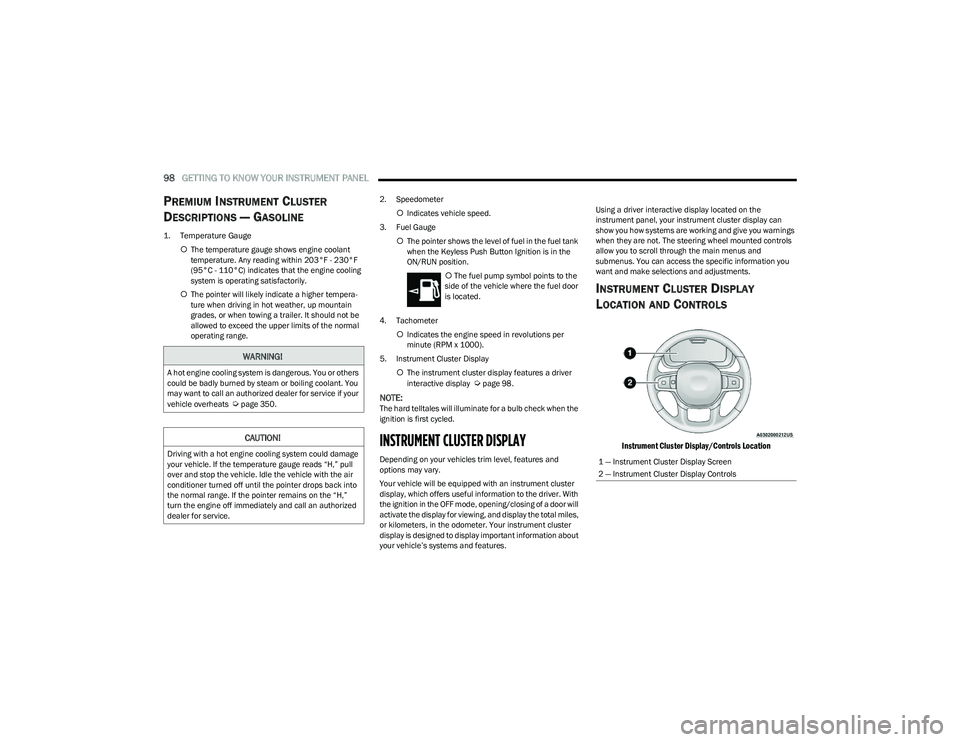
Instrument Cluster Display/Controls Location
WARNING!
A hot engine cooling system is dangerous. You or others
could be badly burned by steam or boiling coolant. You
may want to call an authorized dealer for service if your
vehicle overheats
Úpage 350.
CAUTION!
Driving with a hot engine cooling system could damage
your vehicle. If the temperature gauge reads “H,” pull
over and stop the vehicle. Idle the vehicle with the air
conditioner turned off until the pointer drops back into
the normal range. If the pointer remains on the “H,”
turn the engine off immediately and call an authorized
dealer for service.1 — Instrument Cluster Display Screen
2 — Instrument Cluster Display Controls
23_DT_OM_EN_USC_t.book Page 98
Page 173 of 416

STARTING AND OPERATING171
REFUELING THE VEHICLE
The capless fuel filler is located on the left side of the
vehicle.
The capless system is sealed by two flapper doors.
1. Put the vehicle in PARK and switch the ignition off.
2. Push the center-rear edge of the fuel filler door
(3 o'clock position) and release to open.
Fuel Filler Door
3. Insert the fuel nozzle fully into the filler pipe, the nozzle opens and holds both flapper doors while
refueling.
Fuel Filler
4. When the fuel nozzle “clicks” or shuts off, the fuel tank is full.
5. Keep the nozzle in the filler for five seconds after nozzle clicks to allow fuel to drain from the nozzle.
6. Remove the fuel filler nozzle.
7. To close the fuel filler door, push the center-rear edge (3 o’clock position) of the fuel filler door and then
release. The fuel filler door will latch closed.
NOTE:In certain cold conditions, ice may prevent the fuel filler
door from opening. If this occurs, lightly push on the fuel
filler door around the perimeter to break the ice build up.
WARNING!
Never have any smoking materials lit in or near the
vehicle when the fuel door is open or the tank is
being filled.
Never add fuel when the engine is running. This is in
violation of most state and federal fire regulations
and may cause the MIL to turn on.
A fire may result if gasoline is pumped into a portable
container that is inside of a vehicle. You could be
burned. Always place gas containers on the ground
while filling.
CAUTION!
To avoid fuel spillage and overfilling, do not “top off” the
fuel tank after filling.
WARNING!
Always place container on the ground before filling.
Keep the pump nozzle in contact with the container
when you are filling it.
Use only approved containers for flammable liquid.
Do not leave container unattended while filling.
A static electric charge could cause a spark and
fire hazard.
4
23_DT_OM_EN_USC_t.book Page 171
Page 299 of 416
SAFETY297
If A Deployment Occurs
The front air bags are designed to deflate immediately
after deployment.
NOTE:Front and/or side air bags will not deploy in all collisions.
This does not mean something is wrong with the air bag
system.
If you do have a collision which deploys the air bags, any
or all of the following may occur:
The air bag material may sometimes cause abrasions
and/or skin reddening to the occupants as the air bags
deploy and unfold. The abrasions are similar to friction
rope burns or those you might get sliding along a carpet
or gymnasium floor. They are not caused by contact
with chemicals. They are not permanent and normally
heal quickly. However, if you haven’t healed signifi -
cantly within a few days, or if you have any blistering,
see your doctor immediately.
As the air bags deflate, you may see some smoke-like
particles. The particles are a normal by-product of the
process that generates the non-toxic gas used for air
bag inflation. These airborne particles may irritate the
skin, eyes, nose, or throat. If you have skin or eye irrita -
tion, rinse the area with cool water. For nose or throat
irritation, move to fresh air. If the irritation continues,
see your doctor. If these particles settle on your
clothing, follow the garment manufacturer’s instruc -
tions for cleaning. Do not drive your vehicle after the air bags have deployed.
If you are involved in another collision, the air bags will not
be in place to protect you.
NOTE:
Air bag covers may not be obvious in the interior trim,
but they will open during air bag deployment.
After any collision, the vehicle should be taken to an
authorized dealer immediately.
Enhanced Accident Response System
In the event of an impact, if the communication network
remains intact, and the power remains intact, depending
on the nature of the event, the Occupant Restraint
Controller (ORC) will determine whether to have the
Enhanced Accident Response System perform the
following functions:
Cut off fuel to the engine (if equipped)
Cut off battery power to the electric motor (if equipped)
Flash hazard lights as long as the battery has power
Turn on the interior lights, which remain on as long as
the battery has power or for 15 minutes from the inter -
vention of the Enhanced Accident Response System
Unlock the power door locks
Your vehicle may also be designed to perform any of these
other functions in response to the Enhanced Accident
Response System:
Turn off the Fuel Filter Heater, Turn off the HVAC Blower
Motor, Close the HVAC Circulation Door
Cut off battery power to the:
Engine
Electric Motor (if equipped)
Electric power steering
Brake booster
Electric park brake
Automatic transmission gear selector
Horn
Front wiper
Headlight washer pump (if equipped)
NOTE:After an accident, remember to cycle the ignition to the
STOP (OFF/LOCK) position and remove the key from the
ignition switch to avoid draining the battery. Carefully
check the vehicle for fuel leaks in the engine compartment
and on the ground near the engine compartment and fuel
tank before resetting the system and starting the engine.
If there are no fuel leaks or damage to the vehicle elec -
trical devices (e.g. headlights) after an accident, reset the
system by following the procedure described below. If you
have any doubt, contact an authorized dealer.
WARNING!
Deployed air bags and seat belt pretensioners cannot
protect you in another collision. Have the air bags, seat
belt pretensioners, and the seat belt retractor
assemblies replaced by an authorized dealer
immediately. Also, have the Occupant Restraint
Controller System serviced as well.
6
23_DT_OM_EN_USC_t.book Page 297
Page 329 of 416

IN CASE OF EMERGENCY327
(Continued)
Fuel Funnel Location
NOTE:
In certain cold conditions, ice may prevent the fuel door
from opening. If this occurs, lightly push on the fuel door
to break the ice buildup and re-release the fuel door using
the inside release button. Do not pry on the door.
Emergency Gas Can Refueling:
Most gas cans will not open the flapper doors. A funnel is
provided to allow emergency refueling with a gas can.
See the following steps for refueling:
1. Retrieve funnel from under the passenger’s front seat.
2. Insert funnel into same filler pipe opening as the fuel nozzle.
Inserting Funnel
3. Ensure funnel is inserted fully to hold flapper doors open.
4. Pour fuel into funnel opening.
5. Remove funnel from filler pipe, clean off prior to putting back in the spare tire storage area.IF YOUR ENGINE OVERHEATS
If the vehicle is overheating, it will need to be serviced by
an authorized dealer.
Potential signs of vehicle overheating:
Temperature gauge is at HOT (H)
Strong smell of coolant
White smoke coming from engine or exhaust
Coolant bottle coolant has bubbles present
CAUTION!
To avoid fuel spillage and overfilling, do not “top off” the
fuel tank after filling.
WARNING!
Never have any smoking materials lit in or near the
vehicle when the fuel door is open or the tank is
being filled.
Never add fuel when the engine is running. This is in
violation of most state and federal fire regulations
and may cause the Malfunction Indicator Light to
turn on.
A fire may result if fuel is pumped into a portable
container that is inside of a vehicle. You could be
burned. Always place fuel containers on the ground
while filling.
WARNING!
You or others can be badly burned by hot engine
coolant (antifreeze) or steam from your radiator. If you
see or hear steam coming from under the hood, do not
open the hood until the radiator has had time to cool.
Never try to open a cooling system pressure cap when
the radiator or coolant bottle is hot.
WARNING!
7
23_DT_OM_EN_USC_t.book Page 327
Page 407 of 416

405
E
Electric Brake Control System..................................... 263 Anti-Lock Brake System ......................................... 262
Electronic Roll Mitigation .............................. 264
, 268
Electric Parking Brake ................................................. 122
Electric Power Steering................................................ 141
Electrical Power Outlets..................................................66 Electronic Range Select (ERS) .................................... 128
Electronic Stability Control (ESC) ................................ 264
Electronic Throttle Control Warning Light................... 109
Electronically Shifted Transfer Case .................. 130
, 132
Emergency Braking ...................................................... 276
Emergency Gas Can Refueling .................................... 326
Emergency, In Case Of Freeing Vehicle When Stuck .................................. 329
Hazard Warning Flasher ......................................... 314
Jump Starting .......................................................... 325
Emission Control System Maintenance...................... 117
Engine ........................................................................... 337 Air Cleaner ............................................................... 342Block Heater ........................................................... 121
Break-In Recommendations .................................. 122
Compartment ........................................337
, 338, 339
Compartment Identification .................337, 338, 339
Coolant (Antifreeze) ................................................ 396
Exhaust Gas Caution .............................................. 313
Fails To Start ........................................................... 121
Flooded, Starting .................................................... 121
Fuel Requirements ........................................ 393
, 395
Jump Starting .......................................................... 325
Oil ...........................................................341
, 395, 396
Oil Filler Cap ............................................................ 337 Oil Filter ....................................................................342
Oil Selection ................................................... 341
, 395
Oil Synthetic ............................................................. 342
Overheating ............................................................. 327
Starting.....................................................................118
Enhanced Accident Response Feature ............. 297
, 332
Entry System, Illuminated .............................................. 52 Ethanol .......................................................................... 394
Exhaust Gas Cautions ..................................................313
Exhaust System .................................................. 313
, 348
Exterior Lights ........................................................46, 313
FFamily Alerts .................................................................. 248
FAQ ................................................................................ 248
Features ........................................................................ 239
Filters Air Cleaner ............................................................... 342
Air Conditioning ................................................59
, 344
Engine Oil ................................................................. 342
Engine Oil Disposal..................................................342
Flashers Turn Signals ................................................... 115
, 313
Flash-To-Pass .................................................................. 48
Flat Tire Stowage .......................................................... 323
Fluid Capacities ............................................................395
Fluid Leaks ....................................................................313
Fluid Level Checks Brake ........................................................................ 352
Fluid, Brake ...................................................................397
Fog Lights ...............................................................48
, 368
Fold-Flat Seats ................................................................ 30 Forward Collision Warning ........................................... 274
Four Wheel Drive .......................................................... 130
Four-Way Hazard Flasher ............................................. 314
Freeing A Stuck Vehicle ............................................... 329
Front Axle (Differential) ................................................ 353
Fuel................................................................................ 393
Adding ...................................................................... 171Additives .................................................................. 393
Clean Air .................................................................. 393
Ethanol..................................................................... 394Gasoline ................................................................... 393
Light ......................................................................... 111
Materials Added ...................................................... 393
Methanol ................................................................. 394
Octane Rating.................................................393
, 396
Requirements .................................................393, 395
Tank Capacity .......................................................... 395
Fuel Saver Technology ................................................. 141
Fuses ............................................................................. 354
GGarage Door Opener (HomeLink) .................................. 42 Gasoline, Clean Air ....................................................... 393
Gasoline, Reformulated ............................................... 393
Getting Started ............................................................. 238
Glass Cleaning .............................................................. 391
Grocery Bag Retainer ..................................................... 34
Gross Axle Weight Rating ............................................. 173
Gross Combination Weight Rating .............................. 173
Gross Trailer Weight ..................................................... 173
Gross Vehicle Weight Rating ....................................... 173
Guide Body Builders ...............................................................9
GVWR ............................................................................ 172
11
23_DT_OM_EN_USC_t.book Page 405