wheel Ram 2500 2013 Owner's Manual
[x] Cancel search | Manufacturer: RAM, Model Year: 2013, Model line: 2500, Model: Ram 2500 2013Pages: 743, PDF Size: 5.43 MB
Page 590 of 743

4x4 Series Trucks Front Jacking Location
There is a jack location indicator on the rear portion of the
lower control arm.
When changing a front wheel, place the scissor jack
under the rear portion of the lower control arm as shown
below.4x2 and 4x4 Rear Jacking Location
Operate the jack using the jack drive tube and the wheel
wrench. The tube extension may be used but is not
required.
4X4 Front Jacking Location Indicator
4X4 Front Jacking Location
588 WHAT TO DO IN EMERGENCIES
Page 591 of 743

For 4x2 and 4x4 trucks, when changing a rear wheel,
assemble the jack drive tube to the jack and connect the
drive tube to the extension tube. Place the jack under the
axle between the wheel and the shock bracket with the
drive tubes extending to the rear.Connect the jack tube extension and wheel wrench.
CAUTION!
Before raising the wheel off the ground, make sure
that the jack will not damage surrounding truck parts
and adjust the jack position as required.
4. By rotating the lug wrench clockwise, raise the vehicle until the wheel just clears the surface.
WARNING!
Raising the vehicle higher than necessary can make
the vehicle unstable and cause a collision. It could
slip off the jack and hurt someone near it. Raise the
vehicle only enough to remove the tire.
5. Remove the wheel nuts and pull the wheel off. Install the spare wheel and wheel nuts with the cone shaped
Rear Jacking Location
6
WHAT TO DO IN EMERGENCIES 589
Page 592 of 743
end of the wheel nuts toward the wheel. To avoid the
risk of forcing the vehicle off the jack, do not fully
tighten the wheel nuts until the vehicle has been
lowered.
6. Using the lug wrench, finish tightening the wheel nuts using a crisscross pattern. The correct wheel nut
tightness for a cone type wheel nut is 120–140 ft lbs
(160–190 N·m) torque, for a flanged type wheel nut is
130–160 ft lbs (175–215 N·m) torque. If in doubt about
the correct tightness, have them checked with a torque
wrench by your authorized dealer or at a service
station.
WARNING!
A loose tire or jack thrown forward in a collision or
hard stop could injure someone in the vehicle. Al-
ways stow the jack parts and the extra tire and wheel
in the places provided. 7. Install the wheel center cap and remove the wheel
blocks. Do not install chrome or aluminum wheel
center caps on the spare wheel. This may result in cap
damage.
8. Lower the jack to its fully closed position. If the bottle jack will not lower by turning the dial (thumbwheel)
by hand, it may be necessary to use the jack drive tube
in order to lower the jack. Stow the replaced tire, jack,
and tools as previously described.
9. Adjust the tire pressure when possible.
NOTE: Do not oil wheel studs. For chrome wheels, do
not substitute with chrome plated wheel nuts.
590 WHAT TO DO IN EMERGENCIES
Page 593 of 743
To Stow The Flat Or Spare
NOTE:Vehicles equipped with aluminum wheels can-
not be stored under the vehicle because the wheel
retainer will not fit through the wheel pilot hole. Secure
the flat tire in the bed of the truck. Have the flat tire
repaired or replaced immediately.
WARNING!
A loose tire thrown forward in a collision or hard
stop could injure the occupants in the vehicle. Have
the deflated (flat) tire repaired or replaced immedi-
ately.
1. Turn the wheel so that the valve stem is facing the ground and toward the rear of the vehicle for conve-
nience in checking the spare tire inflation. Slide the
wheel retainer through the center of the wheel. 2. Lift the spare tire with one hand to give clearance to
tilt the retainer at the end of the cable and position it
properly across the wheel opening.6
WHAT TO DO IN EMERGENCIES 591
Page 594 of 743
3. Attach the wheel wrench to the jack extension tubewith the curved angle facing away from the vehicle.
Insert the tube through the access hole between the
lower tailgate and the top of the bumper and into the
winch mechanism tube. 4. Rotate the lug wrench handle clockwise until the
wheel is drawn into place against the underside of the
vehicle. Continue to rotate until you feel the winch
mechanism slip, or click three or four times. It cannot
be overtightened. Push against the tire several times to
ensure it is firmly in place.
592 WHAT TO DO IN EMERGENCIES
Page 597 of 743
WARNING!
After using the jack and tools, always reinstall them
in the original carrier and location. While driving
(Continued)
WARNING!(Continued)
you may experience abrupt stopping, rapid accelera-
tion or sharp turns. A loose jack, tools, bracket or
other objects in the vehicle may move around with
force, resulting in serious injury.
Hub Caps/Wheel Covers — If Equipped
The hub caps must be removed before raising the vehicle
off the ground.
CAUTION!
Use a back-and-forth motion to remove the hub cap.
Do not use a twisting motion when removing the hub
cap, damage to the hub cap finish may occur.
You must use the flat end of the lug wrench to pry off the
wheel skins. Insert the flat tip completely and using aJack And Tools (1500 Series)
6
WHAT TO DO IN EMERGENCIES 595
Page 598 of 743
back-and-forth motion, loosen the wheel skin. Repeat this
procedure around the tire until the skin pops off.
Replace the wheel skins first using a rubber mallet. When
replacing the hub caps, tilt the cap retainer over the lug
nut bolt circle and strike the high side down with a
rubber mallet. Be sure that the hub caps and wheel skins
are firmly seated around the wheel.
Wheel Nuts
All wheel nuts should be tightened occasionally to elimi-
nate the possibility of wheel studs being sheared or the
bolt holes in the wheels becoming elongated. This isespecially important during the first few hundred miles/
kilometers of operation to allow the wheel nuts to
become properly set. All wheel nuts should first be firmly
seated against the wheel. The wheel nuts should then be
tightened to recommended torque. Tighten the wheel
nuts to final torque in increments. Progress around the
bolt circle, tightening the wheel nut opposite to the wheel
nut just previously tightened until final torque is
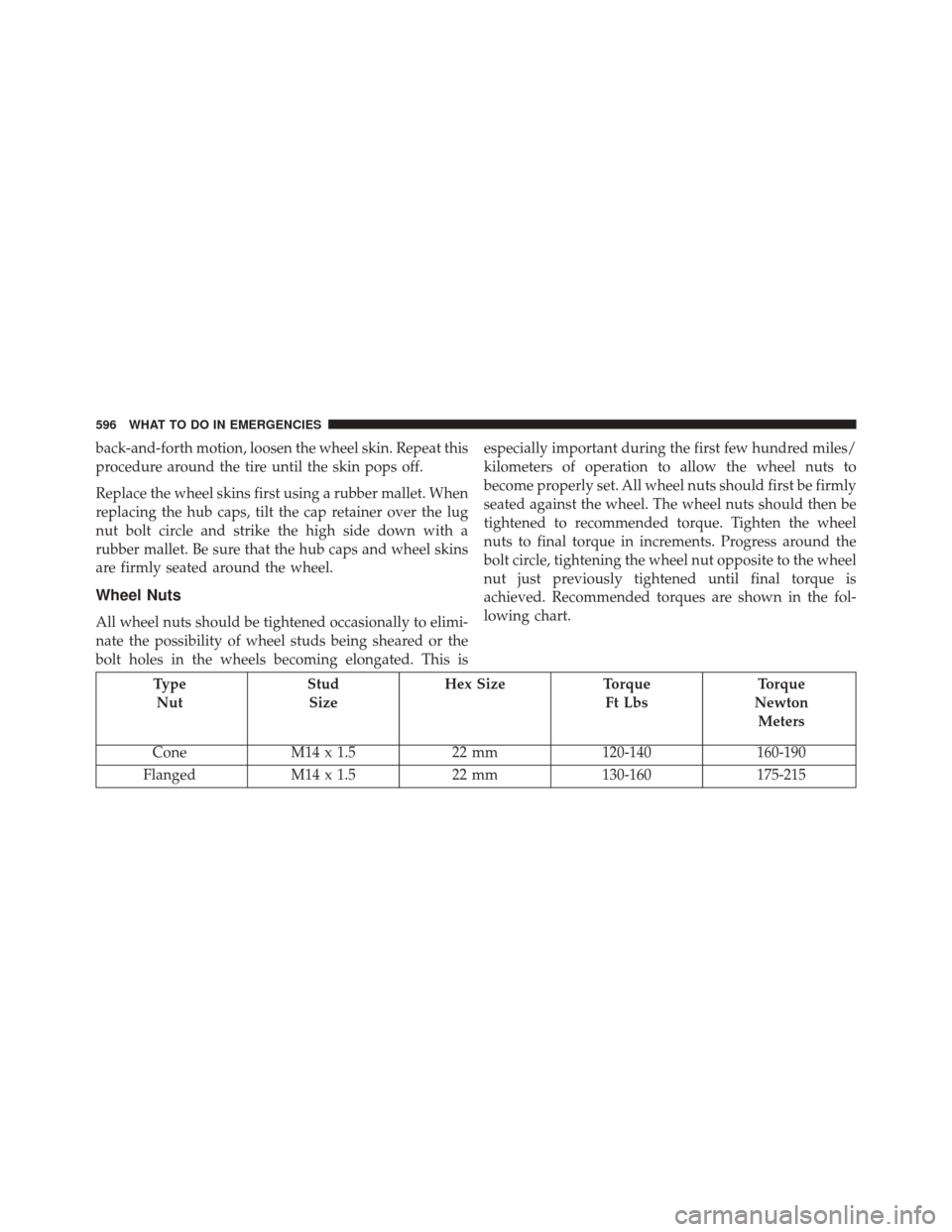
achieved. Recommended torques are shown in the fol-
lowing chart.
Type
Nut Stud
Size Hex Size Torque
Ft LbsTorque
Newton Meters
Cone M14 x 1.5 22 mm120-140 160-190
Flanged M14 x 1.5 22 mm130-160 175-215
596 WHAT TO DO IN EMERGENCIES
Page 599 of 743

JACKING AND TIRE CHANGING 2500 AND 3500
SERIES TRUCKS
WARNING!
•Do not attempt to change a tire on the side of the
vehicle close to moving traffic. Pull far enough off
the road to avoid the danger of being hit when
operating the jack or changing the wheel.
• Being under a jacked-up vehicle is dangerous. The
vehicle could slip off the jack and fall on you. You
could be crushed. Never put any part of your body
under a vehicle that is on a jack. If you need to get
under a raised vehicle, take it to a service center
where it can be raised on a lift.
• Never start or run the engine while the vehicle is
on a jack.
(Continued)
WARNING! (Continued)
•The jack is designed to be used as a tool for
changing tires only. The jack should not be used to
lift the vehicle for service purposes. The vehicle
should be jacked on a firm level surface only.
Avoid ice or slippery areas.
Jack Location
The jack and jack tools are stored under the front
passenger seat.
Removal Of Jack And Tools (2500, 3500 Series)
To access the jack and jack tools you must remove the
plastic access cover, located on the side of the front
passengers seat. To remove the cover, pull the front part
of the cover (closest to the front of the seat) toward you
to release a locking tab. Once the front of the cover is
loose, slide the cover toward the front of the seat until it
is free from the seat frame.
6
WHAT TO DO IN EMERGENCIES 597
Page 601 of 743
Remove the jack and tools from the bracket assembly.
Turn the jack-turn-screw counterclockwise to release jack
from bracket assembly.WARNING!
After using the jack and tools, always reinstall them
in the original carrier and location. While driving
you may experience abrupt stopping, rapid accelera-
tion or sharp turns. A loose jack, tools, bracket or
other objects in the vehicle may move around with
force, resulting in serious injury.
Removing The Spare Tire
1. Remove the spare tire before attempting to jack up thetruck. Attach the wheel wrench to the jack extension
tube with the curved angle facing away from the
vehicle. Insert the tube through the access hole be-
tween the lower tailgate and the top of the bumper
and into the winch mechanism tube.
Jack And Tools Bracket Assembly
6
WHAT TO DO IN EMERGENCIES 599
Page 602 of 743
2. Rotate the wheel wrench handle counterclockwiseuntil the spare tire is on the ground with enough cable
slack to allow you to pull it out from under the vehicle. 3. Pull the spare tire out from under the vehicle to gain
access to the spare tire retainer.
600 WHAT TO DO IN EMERGENCIES