climate control Ram 2500 2013 User Guide
[x] Cancel search | Manufacturer: RAM, Model Year: 2013, Model line: 2500, Model: Ram 2500 2013Pages: 743, PDF Size: 5.43 MB
Page 321 of 743
Economy Mode
If ECONOMY mode is desired, press the A/C button to
turn off the LED indicator and the A/C compressor.
Rotate the temperature control knob to the desired tem-
perature. Also, make sure to select only Panel, Bi-Level or
Floor modes.
Stop/Start System – If Equipped
While in an Autostop, the Climate Controls system may
automatically adjust airflow to maintain cabin comfort.
Customer settings will be maintained upon return to an
engine running condition.
Manual Climate Controls With Touch-Screen — If
Equipped
Hard-Keys
The hard-keys are located below the radio touch-screen.
Climate Controls — Hard-keys
4
UNDERSTANDING YOUR INSTRUMENT PANEL 319
Page 325 of 743

6. Blower Control
Blower control is used to regulate the amount of air
forced through the climate system. There are seven
blower speeds available. Adjusting the blower will cause
automatic mode to switch to manual operation. The
speeds can be selected using either hard-keys or soft-keys
as follows:
Hard-key
The blower speed increases as you turn the control
clockwise from the lowest blower setting. The blower
speed decreases as you turn the knob counter-clockwise.
Soft-key
Use the small blower icon to reduce the blower setting
and the large blower icon to increase the blower setting.
Blower can also be selected by pressing the blower bar
area between the icons.7. Climate Control OFF Button
Press and release this button to turn the Climate Control
ON/OFF.
8. Temperature Control Down Button
Push the button for cooler temperature settings. On the
touch-screen, slide the temperature bar towards the blue
arrow soft-key for cooler temperature settings.
9. Temperature Control Up Button
Push the button for warmer temperature settings. On the
touch-screen, slide the temperature bar towards the blue
arrow soft-key for cooler temperature settings.
Recirculation Control
When outside air contains smoke, odors, or
high humidity, or if rapid cooling is desired,
you may wish to recirculate interior air by
4
UNDERSTANDING YOUR INSTRUMENT PANEL 323
Page 326 of 743

pressing the RECIRCULATION control button. Recircu-
lation mode should only be used temporarily. The recir-
culation LED will illuminate on the blower control knob
when this button is selected. Push the button a second
time to turn off the Recirculation mode LED and allow
outside air into the vehicle.
NOTE:In cold weather, use of Recirculation mode may
lead to excessive window fogging. The Recirculation
mode is not allowed in Defrost mode to improve window
clearing operation. Recirculation will be disabled auto-
matically if these modes are selected.Automatic Climate Controls With Touch-Screen
— If Equipped
Hard-Keys
The hard-keys located below the radio touch-screen.
Dual Zone Automatic Climate Controls — Hard-keys
324 UNDERSTANDING YOUR INSTRUMENT PANEL
Page 330 of 743

6. Blower Control
Blower control is used to regulate the amount of air
forced through the climate system. There are seven
blower speeds available. Adjusting the blower will cause
automatic mode to switch to manual operation. The
speeds can be selected using either hard-keys or soft-keys
as follows:
Hard-key
The blower speed increases as you turn the control
clockwise from the lowest blower setting. The blower
speed decreases as you turn the knob counter-clockwise.
Soft-key
Use the small blower icon to reduce the blower setting
and the large blower icon to increase the blower setting.
Blower can also be selected by pressing the blower bar
area between the icons.7. Climate Control OFF Button
Press and release this button to turn the Climate Control
ON/OFF.
8. Driver Temperature Controls
Push the Up button for warmer temperature settings.
Push the Down button for cooler temperature settings.
On the touch-screen, slide the temperature bar towards
the red arrow soft-key for warmer temperature settings
or slide the temperature bar towards the blue arrow
soft-key for cooler temperature settings.
9. Passenger Temperature Controls
Push the Up button for warmer temperature settings.
Push the Down button for cooler temperature settings.
On the touch-screen, slide the temperature bar towards
the red arrow soft-key for warmer temperature settings
or slide the temperature bar towards the blue arrow
soft-key for cooler temperature settings.
328 UNDERSTANDING YOUR INSTRUMENT PANEL
Page 332 of 743

•The temperature can be displayed in U.S. or Metric
units by selecting the US/M customer-programmable
feature. Refer to the “Uconnect® System Settings” in
this section of the manual.
To provide you with maximum comfort in the Automatic
mode, during cold start-ups the blower fan will remain
on low until the engine warms up. The blower will
increase in speed and transition into Auto mode.
Recirculation Control
When outside air contains smoke, odors, or
high humidity, or if rapid cooling is desired,
you may wish to recirculate interior air by
pressing the RECIRCULATION control button.
Recirculation mode should only be used temporarily. The
recirculation LED will illuminate on the soft and hard
keys when either button is selected. Push either soft or hard key a second time to turn off the Recirculation mode
LED and allow outside air into the vehicle.
NOTE:
In cold weather, use of Recirculation mode may
lead to excessive window fogging. The recirculation
feature may be unavailable (soft-key button greyed out)
if conditions exist that could create fogging on the inside
of the windshield. On systems with Manual Climate
Controls, the recirculation mode is not allowed in Defrost
mode to improve window clearing operation. Recircula-
tion will be disabled automatically if this mode is se-
lected. Attempting to use Recirculation while in this
mode will cause the LED in the control button to blink
and then turn off.
330 UNDERSTANDING YOUR INSTRUMENT PANEL
Page 334 of 743

NOTE:Automatic Temperature Controls (ATC) will au-
tomatically adjust the climate control settings to reduce
or eliminate window fogging on the front windshield.
When this occurs, recirculation will be unavailable.
Outside Air Intake
Make sure the air intake, located directly in front of the
windshield, is free of obstructions such as leaves. Leaves
collected in the air intake may reduce airflow, can cause
odor, and if they enter the plenum they could plug the
water drains. In Winter months make sure the air intake
is clear of ice, slush and snow.
332 UNDERSTANDING YOUR INSTRUMENT PANEL
Page 349 of 743

To Activate The Autostop Mode, The Following Must
Occur:
1. The system must be in STOP/START READY state. ASTOP/START READY message will be displayed in
the Electronic Vehicle Information Center (EVIC)
within the Stop/Start section. Refer to “Electronic
Vehicle Information Center (EVIC)” in “Understand-
ing Your Instrument Panel” for further information.
2. The vehicle must be completely stopped.
3. The transmission Gear Selector must be in Drive and the brake pedal depressed.
The engine will shut down, the tachometer will move to
the zero position and the stop/start telltale will illumi-
nate indicating you are in an Autostop. While in an Autostop, the Climate Controls system may automati-
cally adjust airflow to maintain cabin comfort. Customer
settings will be maintained upon return to an engine
running condition.
Possible Reasons The Engine Does Not AUTO
STOP
Prior to engine shut down, the system will check many
safety and comfort conditions to see if they are fulfilled.
In following situations the engine will not stop:
•
Driver ’s seat belt is not buckled
• Driver ’s door is not closed
• Outside temperature is less than 1°F (–17°C) or greater
than 104°F (40°C)
• Battery temperature too warm or cold
• The vehicle is on a steep grade5
STARTING AND OPERATING 347
Page 686 of 743
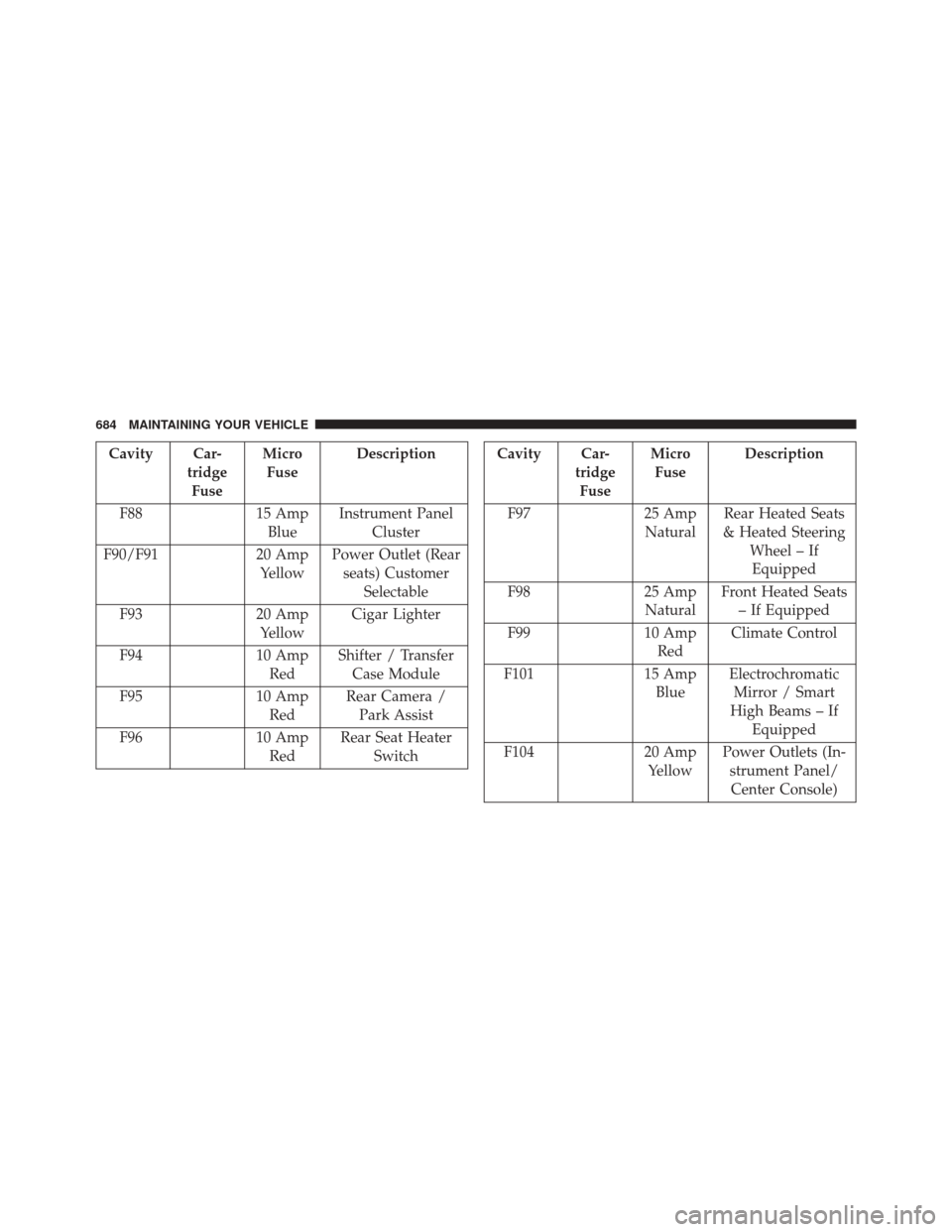
Cavity Car-tridgeFuse Micro
Fuse Description
F88 15 Amp
Blue Instrument Panel
Cluster
F90/F91 20 Amp
Yellow Power Outlet (Rear
seats) Customer Selectable
F93 20 Amp
Yellow Cigar Lighter
F94 10 Amp
Red Shifter / Transfer
Case Module
F95 10 Amp
Red Rear Camera /
Park Assist
F96 10 Amp
Red Rear Seat Heater
SwitchCavity Car- tridgeFuse Micro
Fuse Description
F97 25 Amp
Natural Rear Heated Seats
& Heated Steering Wheel – IfEquipped
F98 25 Amp
Natural Front Heated Seats
– If Equipped
F99 10 Amp
Red Climate Control
F101 15 Amp
Blue Electrochromatic
Mirror / Smart
High Beams – If Equipped
F104 20 Amp
Yellow Power Outlets (In-
strument Panel/Center Console)
684 MAINTAINING YOUR VEHICLE
Page 721 of 743

Call toll free at:
•1–800–890–4038 (U.S.)
• 1–800–387–1143 (Canada)
Or
Visit us on the Worldwide Web at:
• www.techauthority.com
DEPARTMENT OF TRANSPORTATION UNIFORM
TIRE QUALITY GRADES
The following tire grading categories were established by
the National Highway Traffic Safety Administration. The
specific grade rating assigned by the tire’s manufacturer
in each category is shown on the sidewall of the tires on
your vehicle.
All passenger car tires must conform to Federal safety
requirements in addition to these grades.
Treadwear
The Treadwear grade is a comparative rating, based on
the wear rate of the tire when tested under controlled
conditions on a specified government test course. For
example, a tire graded 150 would wear one and one-half
times as well on the government course as a tire graded
100. The relative performance of tires depends upon the
actual conditions of their use, however, and may depart
significantly from the norm due to variations in driving
habits, service practices, and differences in road charac-
teristics and climate.
Traction Grades
The Traction grades, from highest to lowest, are AA, A, B,
and C. These grades represent the tire’s ability to stop on wet
pavement, as measured under controlled conditions on
specified government test surfaces of asphalt and concrete.
A tire marked C may have poor traction performance.9
IF YOU NEED CONSUMER ASSISTANCE 719
Page 726 of 743

Car Washes............................ .669
Cellular Phone .......................... .313
Center High Mounted Stop Light ..............692
Center Seat Storage Compartment .............216
Certification Label ........................ .536
Chart, Tire Sizing ........................ .488
Check Engine Light (Malfunction Indicator Light) . .255
Checking Your Vehicle For Safety ..............116
Checks, Safety ............................116
Child Restraint ............................82
Cigar Lighter ........................... .209
Clean Air Gasoline ....................... .527
Cleaning Wheels .............................. .671
Climate Control ......................... .314
Cold Weather Operation ....................345
Compact Disc (CD) Maintenance ..............312
Compact Spare Tire ....................... .503
Console, Overhead ....................... .191Contract, Service
......................... .715
Coolant Pressure Cap (Radiator Cap) ...........657
Cooling System .......................... .654
Adding Coolant (Antifreeze) ...............656
Coolant Capacity ...................... .696
Coolant Level ......................... .654
Disposal of Used Coolant .................658
Drain, Flush, and Refill ...................655
Inspection ........................... .658
Points to Remember .....................660
Pressure Cap ......................... .657
Radiator Cap ......................... .657
Selection of Coolant (Antifreeze) .............655
Corrosion Protection ...................... .668
Cupholders ..............................211
Customer Assistance ...................... .713
Data Recorder, Event .......................81
Daytime Running Lights ....................159
724 INDEX