lock Ram 2500 2013 Manual Online
[x] Cancel search | Manufacturer: RAM, Model Year: 2013, Model line: 2500, Model: Ram 2500 2013Pages: 743, PDF Size: 5.43 MB
Page 241 of 743

4. Rotate the handles to the horizontal position to secureinto place.WARNING!
To reduce the risk of potential injury or property
damage:
•Cargo must be secured.
• Do not exceed cargo load rating of your vehicle.
• Secure all loads to truck utilizing cargo tie downs.
• Extender should not be used as cargo tie down.
• When vehicle is in motion do not exceed 150 lbs
(68 kg) load on the tailgate.
• The bed extender is not intended for off road use.
• When not in use, the extender/divider should be in
stowed or divider position with the tailgate closed.
• When in use all handles are to be in the locked
position.
Locking Tab
3
UNDERSTANDING THE FEATURES OF YOUR VEHICLE 239
Page 242 of 743

Bed Rail Tie-Down System
CAUTION!
The maximum load per cleat should not exceed
250 lbs (113 kg) and the angle of the load on each cleat
should not exceed 45 degrees above horizontal, or
damage to the cleat or cleat rail may occur.
There are two adjustable cleats on each side of the bed
that can be used to assist in securing cargo.
Each cleat must be located and tightened down in one of
the detents, along either rail, in order to keep cargo
properly secure.
To move the cleat to any position on the rail, turn the nut
counterclockwise, approximately three turns. Then pull
Adjustable Cleats
240 UNDERSTANDING THE FEATURES OF YOUR VEHICLE
Page 243 of 743

out on the cleat and slide it to the detent nearest the
desired location. Make sure the cleat is seated in the
detent and tighten the nut.To remove the cleats from the utility rail, remove the end
cap by pushing up on the locking tab, located on the
bottom of the end cap. Slide the cleat off the end of the
rail.
1 — Utility Rail Detent
2 — Cleat Retainer Nut
3 — Utility Rail CleatUtility Rail End Cap
3
UNDERSTANDING THE FEATURES OF YOUR VEHICLE 241
Page 245 of 743

2. Remove the connector bracket from the sill by press-ing inward in the locking tab. 3. Disconnect the chassis wiring harness, ensuring the
connector bracket does not fall into the sill.
4. Connect the chassis plug and bracket (provided in the glove box) to the chassis wiring harness and insert the
bracket back into the sill.
Connector BracketLocking Tab
3
UNDERSTANDING THE FEATURES OF YOUR VEHICLE 243
Page 246 of 743

5. Connect the tailgate plug (provided in the glove box)to the tailgate wiring harness to ensure that the
terminals do not corrode.
6. Tape the tailgate harness and bracket against the forward-facing surface of the tailgate. This will pre-
vent damaging the connector and bracket when stor-
ing or reinstalling the tailgate.
Removing The Tailgate
1. Disconnect the wiring harness for the rear camera andor power locks (if equipped), refer to “Disconnecting
the Rear Camera — If Equipped” in this section.
2. Unlatch the tailgate and remove the support cables by releasing the lock tang from the pivot.
NOTE: Make sure tailgate is supported when removing
support cables. 3. Raise the tailgate to a 45 degree angle.
4. Raise the right side of the tailgate until the right side
pivot clears the hanger bracket.
5. Slide the entire tailgate to the right to free the left side pivot.
Locking Tang
244 UNDERSTANDING THE FEATURES OF YOUR VEHICLE
Page 247 of 743

6. Remove the tailgate from the vehicle.
NOTE:Do not carry the tailgate loose in the truck
pickup box.
WARNING!
To avoid inhaling carbon monoxide, which is deadly,
the exhaust system on vehicles equipped with “Cap
or Slide-In Campers” should extend beyond the
overhanging camper compartment and be free of
leaks.
Locking Tailgate
The lock is located next to the tailgate handle. The
tailgate can be locked using the vehicle key or by locking
the truck with the key-fob if equipped with remote
keyless entry.
TRI-FOLD TONNEAU COVER-IF EQUIPPED
Tri-Fold Tonneau Cover — If Equipped
Your vehicle may be equipped with a Tri-Fold Tonneau
Cover which consists of different features:
• Easy Tri-Fold cover
• Tonneau fore aft locator
• Crosscar inside bed locator
• Front and rear clamps
• Stowage strap
• Locking Capability
NOTE: The Tonneau Cover can be folded up and secured
at the front of the box without removing completely.
3
UNDERSTANDING THE FEATURES OF YOUR VEHICLE 245
Page 250 of 743

NOTE:Be sure the Tonneau Cover has been folded
completely before removing.
Tri-Fold Tonneau Cover Installation And Cleaning
Position the folded Tonneau Cover on the truck bed and
push the Cover forward against the front of the truck
bed. The Tonneau Cover centers itself when placed on the
vehicle. Disengage the stowage straps and unfold the
Tonneau Cover then attach the rear clamps to the truck
bed flange to secure the Tonneau Cover to the vehicle.
The Tonneau Cover clamps can be locked when in the
clamped position by placing a lock through the locking
hole.
Stowage Strap
248 UNDERSTANDING THE FEATURES OF YOUR VEHICLE
Page 251 of 743

NOTE:Be sure the Tonneau Cover is secured before
driving after installation. For proper cleaning of the Tonneau Cover use MOPAR®
Whitewall &Vinyl Top Cleaner and MOPAR® Leather &
Vinyl Conditioner/Protectant.
Locking Hole
3
UNDERSTANDING THE FEATURES OF YOUR VEHICLE 249
Page 257 of 743

INSTRUMENT CLUSTER DESCRIPTIONS
1. Tachometer
The tachometer indicates engine speed in Revolutions
Per Minute (RPM x 1000).
CAUTION!
Do not operate the engine with the tachometer
pointer at high RPM for extended periods. Engine
operation over 3200 RPM (Redline) can result in
significant damage that will not be covered under
warranty.
2. Anti-Lock Brake (ABS) Light This light monitors the Anti-lock Brake System
(ABS). The light will turn on when the ignition
switch is turned to the ON/RUN position and
may stay on for as long as four seconds. If the ABS light remains on or turns on while driving, it
indicates that the anti-lock portion of the brake system is
not functioning and that service is required. However,
the conventional brake system will continue to operate
normally if the BRAKE warning light is not on.
If the ABS light is on, the brake system should be serviced
as soon as possible to restore the benefits of anti-lock
brakes. If the ABS light does not turn on when the
ignition switch is turned to the ON/RUN position, have
the light inspected by an authorized dealer.
3. Malfunction Indicator Light (MIL)
The Malfunction Indicator Light (MIL) is part
of an onboard diagnostic (OBDII) system
which monitors the emissions and engine con-
trol system. If the vehicle is ready for emissions
testing, the light will come on when the ignition is first
turned on and remain on, as a bulb check, until the
engine is started. If the vehicle is not ready for emissions
4
UNDERSTANDING YOUR INSTRUMENT PANEL 255
Page 259 of 743
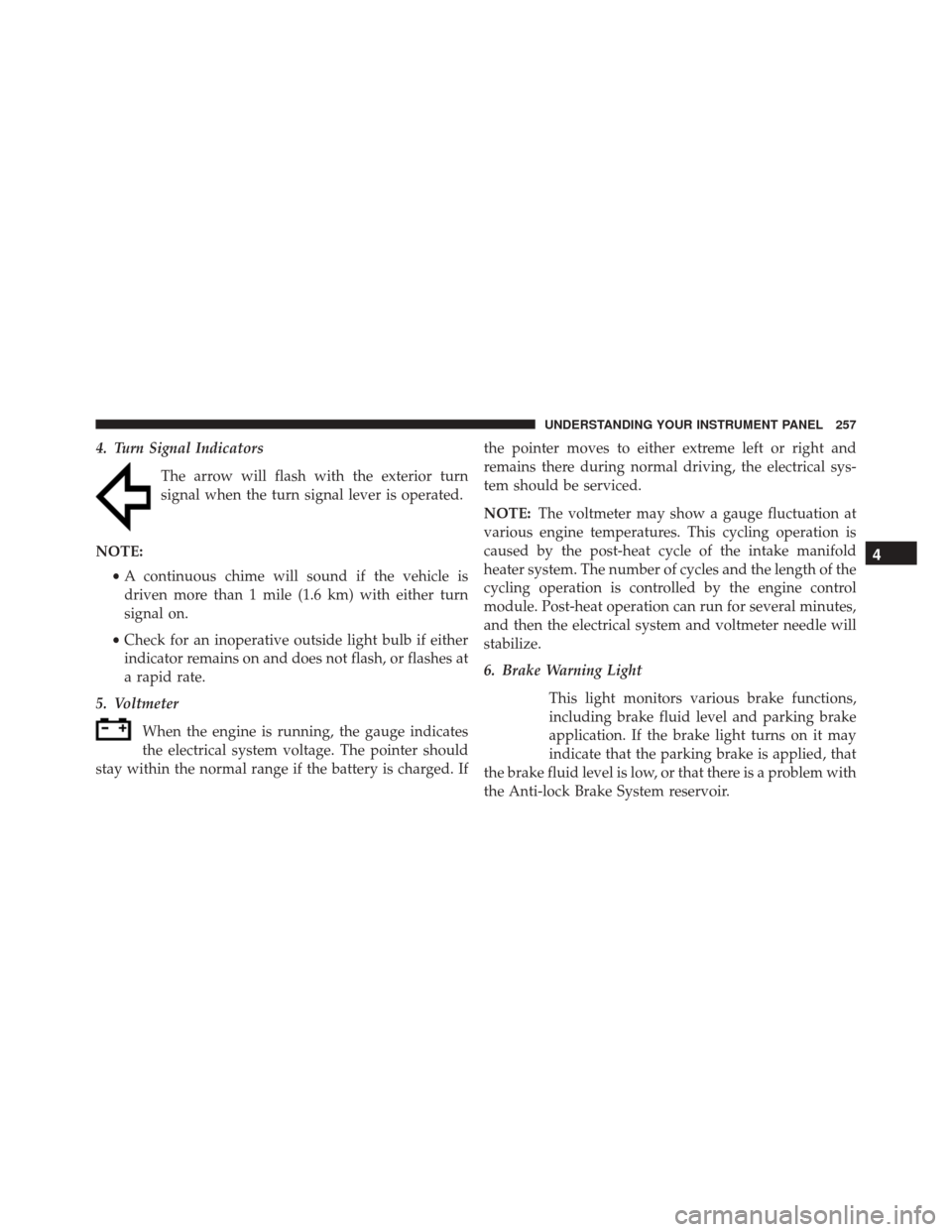
4. Turn Signal IndicatorsThe arrow will flash with the exterior turn
signal when the turn signal lever is operated.
NOTE: •A continuous chime will sound if the vehicle is
driven more than 1 mile (1.6 km) with either turn
signal on.
• Check for an inoperative outside light bulb if either
indicator remains on and does not flash, or flashes at
a rapid rate.
5. Voltmeter
When the engine is running, the gauge indicates
the electrical system voltage. The pointer should
stay within the normal range if the battery is charged. If the pointer moves to either extreme left or right and
remains there during normal driving, the electrical sys-
tem should be serviced.
NOTE:
The voltmeter may show a gauge fluctuation at
various engine temperatures. This cycling operation is
caused by the post-heat cycle of the intake manifold
heater system. The number of cycles and the length of the
cycling operation is controlled by the engine control
module. Post-heat operation can run for several minutes,
and then the electrical system and voltmeter needle will
stabilize.
6. Brake Warning Light
This light monitors various brake functions,
including brake fluid level and parking brake
application. If the brake light turns on it may
indicate that the parking brake is applied, that
the brake fluid level is low, or that there is a problem with
the Anti-lock Brake System reservoir.
4
UNDERSTANDING YOUR INSTRUMENT PANEL 257