fuel pressure Ram 2500 2014 Diesel Supplement
[x] Cancel search | Manufacturer: RAM, Model Year: 2014, Model line: 2500, Model: Ram 2500 2014Pages: 360, PDF Size: 2.02 MB
Page 224 of 360
•sudden loss of power
•unusual engine noises
•fuel, oil or coolant leaks
•sudden change, outside the normal operating range, in
the engine operating temperature
•excessive smoke
•oil pressure drop
ENGINE BLOCK HEATER — IF EQUIPPED
The engine block heater warms engine coolant and
permits quicker starts in cold weather. Connect the heater
cord to a ground-fault interrupter protected 110–115 Volt
AC electrical outlet with a grounded, three-wire exten-
sion cord.
The engine block heater cord is routed under the hood to
the right side and can be located just behind the grille
near the headlamp.NOTE:The engine block heater cord is a factory installed
option. If your vehicle is not equipped, heater cords are
available from your authorized MOPAR® dealer.
The block heater must be plugged in at least one hour to
have an adequate warming effect on the coolant.
WARNING!
Remember to disconnect the cord before driving.
Damage to the 110–115 Volt electrical cord could
cause electrocution.
NOTE:The block heater will require 110 Volts AC and 6.5
Amps to activate the heater element.
Block Heater Usage
For ambient temperatures below 0°F (-18°C), engine
block heater usage is recommended.
222 STARTING AND OPERATING
Page 259 of 360
WARNING!
•Never have any smoking materials lit in or near the
vehicle when the fuel filler cap is removed or the
tank filled.
•Never add fuel to the vehicle when the engine is
running.
Avoid Using Contaminated Fuel
Fuel that is contaminated by water or dirt can cause
severe damage to the engine fuel system. Proper main-
tenance of the engine fuel filter and fuel tank is essential.
Refer to “Maintenance Procedures” in “Maintaining Your
Vehicle” for further information.
Bulk Fuel Storage — Diesel Fuel
If you store quantities of fuel, good maintenance of the
stored fuel is also essential. Fuel contaminated with
water will promote the growth of “microbes.” Thesemicrobes form “slime” that will clog the fuel filtration
system and lines. Drain condensation from the supply
tank and change the line filter on a regular basis.
NOTE:When a diesel engine is allowed to run out of
fuel, air is pulled into the fuel system.
If the vehicle will not start, refer to “Maintenance
Procedures/Priming If The Engine Has Run Out Of Fuel”
in “Maintaining Your Vehicle” for further information.
WARNING!
Do not open the high pressure fuel system with the
engine running. Engine operation causes high fuel
pressure. High pressure fuel spray can cause serious
injury or death.
4
STARTING AND OPERATING 257
Page 308 of 360
Priming If The Engine Has Run Out Of Fuel
WARNING!
Do not open the high pressure fuel system with the
engine running. Engine operation causes high fuel
pressure. High pressure fuel spray can cause serious
injury or death.
1. Add a substantial amount of fuel to the tank, approxi-
mately 2 to 5 gal (8L to 19L).
2. Turn ignition switch to the start position to engage
starter for one second, return ignition switch to run
position. This will activate in tank fuel pump for
approximately 15 seconds. Repeat this process twice.
3. Start the engine using the “Normal Starting” proce-
dure. Refer to “Starting Procedures” in “Starting and
Operating” for further information.
CAUTION!
Do not engage the starter motor for more than 15
seconds at a time. Allow two minutes between the
cranking intervals.
NOTE:The engine may run rough until the air is forced
from all the fuel lines.
WARNING!
Do not use alcohol or gasoline as a fuel blending
agent. They can be unstable under certain conditions
and be hazardous or explosive when mixed with
diesel fuel.
306 MAINTAINING YOUR VEHICLE
Page 309 of 360
CAUTION!
Due to lack of lubricants in alcohol or gasoline, the
use of these fuels can cause damage to the fuel
system.
NOTE:
•A maximum blend of 5% biodiesel, meeting ASTM
specification D-975 may be used with your Cummins®
diesel engine. (Chassis Cab models not configured
with B20 capability.)
•A maximum blend of 20% biodiesel, meeting ASTM
specification D-7467 may be used with your Cum-
mins® diesel engine. (Pickup models and Chassis Cab
models configured with B20 capability.)•Use of biodiesel mixture in excess of 20% can nega-
tively impact the fuel filter’s ability to separate water
from the fuel, resulting in high pressure fuel system
corrosion or damage.
•Ethanol blends are not recommended or approved for
use with your Cummins® diesel engine.
•In addition, commercially available fuel additives are
not necessary for the proper operation of your Cum-
mins® diesel engine.
Intervention Regeneration Strategy — EVIC
Message Process Flow
The Cummins® diesel engine meets all EPA Heavy Duty
Diesel Engine Emissions Standards, resulting in one of
the lowest emitting diesel engines ever produced.
6
MAINTAINING YOUR VEHICLE 307
Page 317 of 360
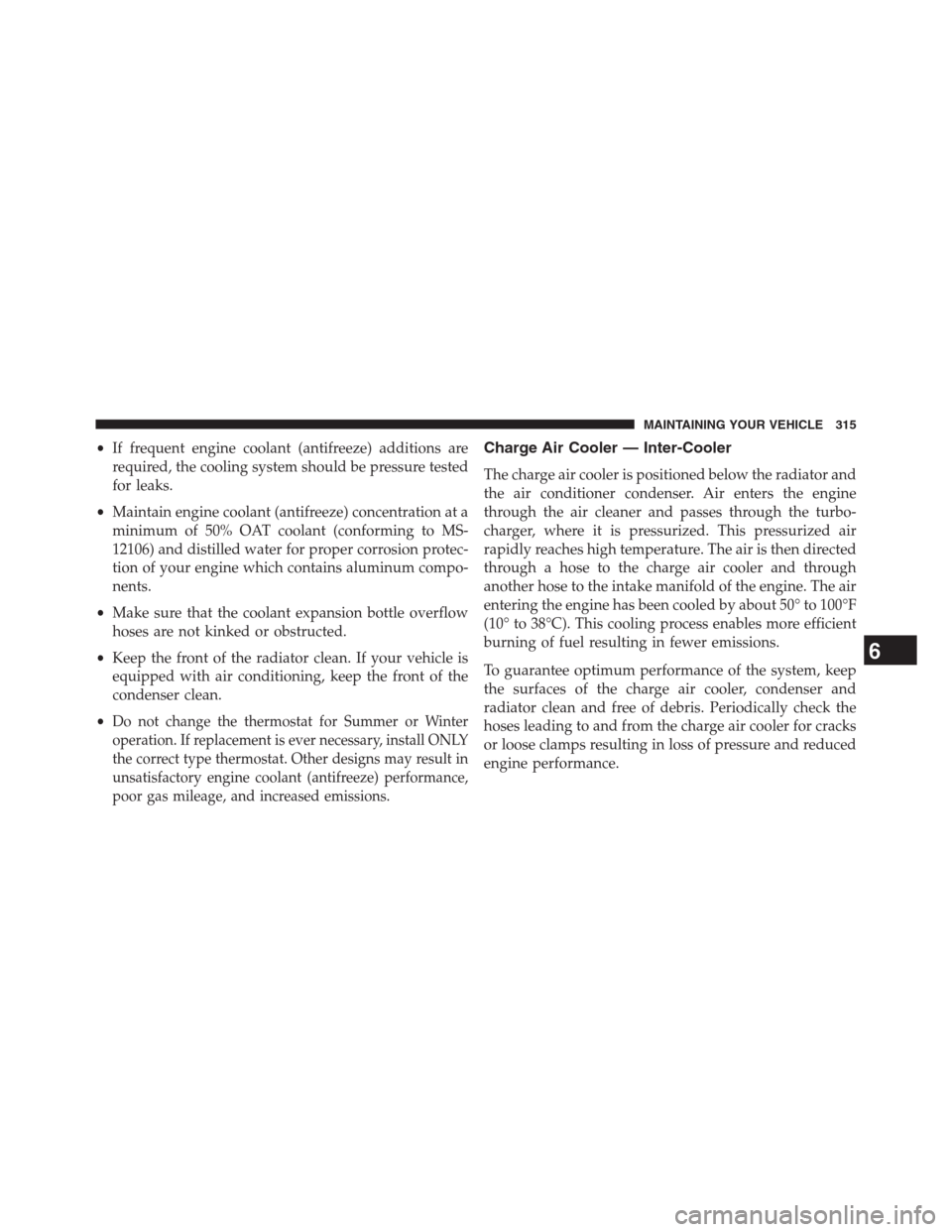
•If frequent engine coolant (antifreeze) additions are
required, the cooling system should be pressure tested
for leaks.
•Maintain engine coolant (antifreeze) concentration at a
minimum of 50% OAT coolant (conforming to MS-
12106) and distilled water for proper corrosion protec-
tion of your engine which contains aluminum compo-
nents.
•Make sure that the coolant expansion bottle overflow
hoses are not kinked or obstructed.
•Keep the front of the radiator clean. If your vehicle is
equipped with air conditioning, keep the front of the
condenser clean.
•
Do not change the thermostat for Summer or Winter
operation. If replacement is ever necessary, install ONLY
the correct type thermostat. Other designs may result in
unsatisfactory engine coolant (antifreeze) performance,
poor gas mileage, and increased emissions.
Charge Air Cooler — Inter-Cooler
The charge air cooler is positioned below the radiator and
the air conditioner condenser. Air enters the engine
through the air cleaner and passes through the turbo-
charger, where it is pressurized. This pressurized air
rapidly reaches high temperature. The air is then directed
through a hose to the charge air cooler and through
another hose to the intake manifold of the engine. The air
entering the engine has been cooled by about 50° to 100°F
(10° to 38°C). This cooling process enables more efficient
burning of fuel resulting in fewer emissions.
To guarantee optimum performance of the system, keep
the surfaces of the charge air cooler, condenser and
radiator clean and free of debris. Periodically check the
hoses leading to and from the charge air cooler for cracks
or loose clamps resulting in loss of pressure and reduced
engine performance.
6
MAINTAINING YOUR VEHICLE 315
Page 348 of 360
Adding Engine Coolant (Antifreeze)............114
Adding Fuel..............................92
Air Cleaner, Engine (Engine Air Cleaner Filter). . . .104
Airbag Light.............................23
Alarm Light..............................24
Anti-Lock Warning Light.....................18
Antifreeze (Engine Coolant)..................113
Capacities............................121
Disposal..............................117
Automatic Transmission
Fluid Type............................125
Axle Fluid..............................125
Battery.................................111
Brake Fluid.............................125
Brake System............................118
Fluid Check...........................118
Master Cylinder........................118
Warning Light..........................21Capacities, Antifreeze (Engine Coolant)..........121
Capacities, Fluid..........................121
Caps, Filler
Oil (Engine)...........................103
Radiator (Coolant Pressure)................116
Charge Air Cooler.........................118
Check Engine Light (Malfunction Indicator Light) . . .18
Coolant Pressure Cap (Radiator Cap)...........116
Cooling System...........................112
Adding Coolant (Antifreeze)...............114
Coolant Capacity.......................121
Coolant Level..........................112
Disposal of Used Coolant..................117
Drain, Flush, and Refill...................113
Points to Remember.....................117
Pressure Cap..........................116
Radiator Cap..........................116
Selection of Coolant (Antifreeze).........113,122
346 INDEX - RAM 1500
Page 350 of 360
Tank Capacity..........................121
Fueling.................................92
Gauges
Speedometer...........................23
Tachometer............................18
Voltmeter..............................63
Gross Axle Weight Rating....................75
Gross Vehicle Weight Rating..................74
Hitches
Trailer Towing..........................77
Information Center, Vehicle...................30
Instrument Cluster.........................16
Integrated Trailer Brake Controls...............82
Intervention Regeneration Strategy..............41
Keyless Enter-N-Go........................61Lights
Airbag................................23
Alarm................................24
Anti-Lock.............................18
Brake Warning..........................21
Check Engine (Malfunction Indicator)..........18
Fog ..................................26
High Beam............................22
High Beam Indicator......................22
Instrument Cluster.......................18
Seat Belt Reminder.......................22
Security Alarm..........................24
Tire Pressure Monitoring (TPMS).............24
Warning (Instrument Cluster Description).......18
Maintenance Procedures....................101
Maintenance Schedule......................128
New Vehicle Break-In Period..................14
348 INDEX - RAM 1500
Page 353 of 360
Adding Engine Coolant (Antifreeze)............312
Adding Fuel.............................253
Air Cleaner, Engine (Engine Air Cleaner Filter). . . .296
Air Filter...............................296
Airbag Light.............................159
Alarm Light.............................160
Anti-Lock Warning Light....................154
Antifreeze (Engine Coolant)..................311
Capacities............................327
Disposal..............................314
Automatic Transmission
Adding Fluid..........................320
Fluid Level Check.......................319
Fluid Type............................330
Shifting..............................227
Axle Fluid..............................330
Battery.................................309
Blanket...........................216 , 310Emergency Starting......................282
Brake System............................316
Fluid Check...........................316
Master Cylinder........................316
Warning Light.........................157
Brake/Transmission Interlock.................227
Capacities, Antifreeze (Engine Coolant)..........327
Capacities, Fluid..........................327
Caps, Filler
Oil (Engine)...........................294
Radiator (Coolant Pressure)................313
Charge Air Cooler.........................315
Check Engine Light (Malfunction Indicator Light) . .154
Coolant Pressure Cap (Radiator Cap)...........313
Cooling System...........................310
Adding Coolant (Antifreeze)...............312
Coolant Capacity.......................327
Coolant Level..........................310
INDEX - RAM 2500 / 3500 / 4500 / 5500 351
Page 354 of 360
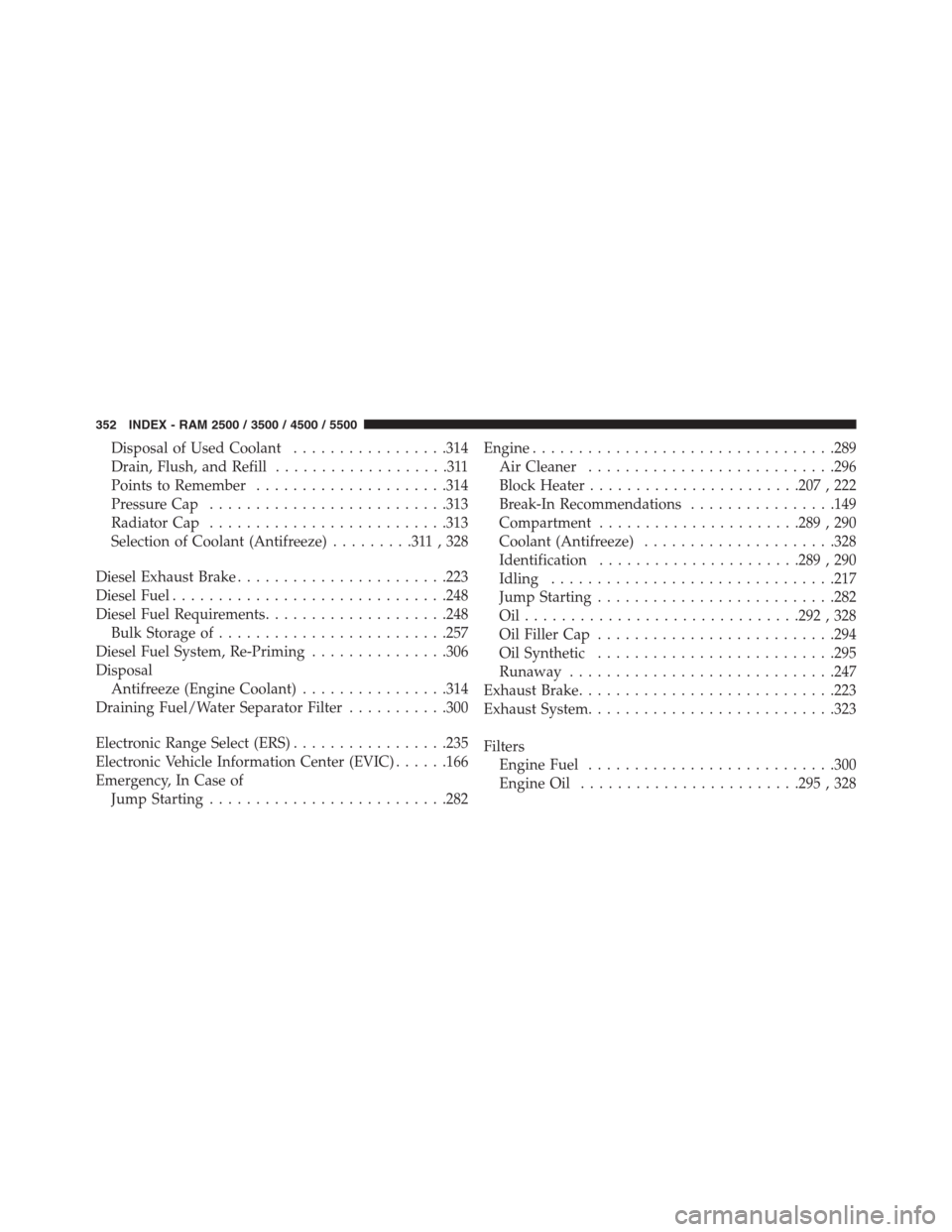
Disposal of Used Coolant.................314
Drain, Flush, and Refill...................311
Points to Remember.....................314
Pressure Cap..........................313
Radiator Cap..........................313
Selection of Coolant (Antifreeze).........311,328
Diesel Exhaust Brake.......................223
Diesel Fuel..............................248
Diesel Fuel Requirements....................248
Bulk Storage of.........................257
Diesel Fuel System, Re-Priming...............306
Disposal
Antifreeze (Engine Coolant)................314
Draining Fuel/Water Separator Filter...........300
Electronic Range Select (ERS).................235
Electronic Vehicle Information Center (EVIC)......166
Emergency, In Case of
Jump Starting..........................282Engine.................................289
Air Cleaner...........................296
Block Heater.......................207 , 222
Break-In Recommendations................149
Compartment......................289 , 290
Coolant (Antifreeze).....................328
Identification......................289 , 290
Idling...............................217
Jump Starting..........................282
Oil..............................292 , 328
Oil Filler Cap..........................294
Oil Synthetic..........................295
Runaway.............................247
Exhaust Brake............................223
Exhaust System...........................323
Filters
Engine Fuel...........................300
Engine Oil........................295 , 328
352 INDEX - RAM 2500 / 3500 / 4500 / 5500
Page 358 of 360
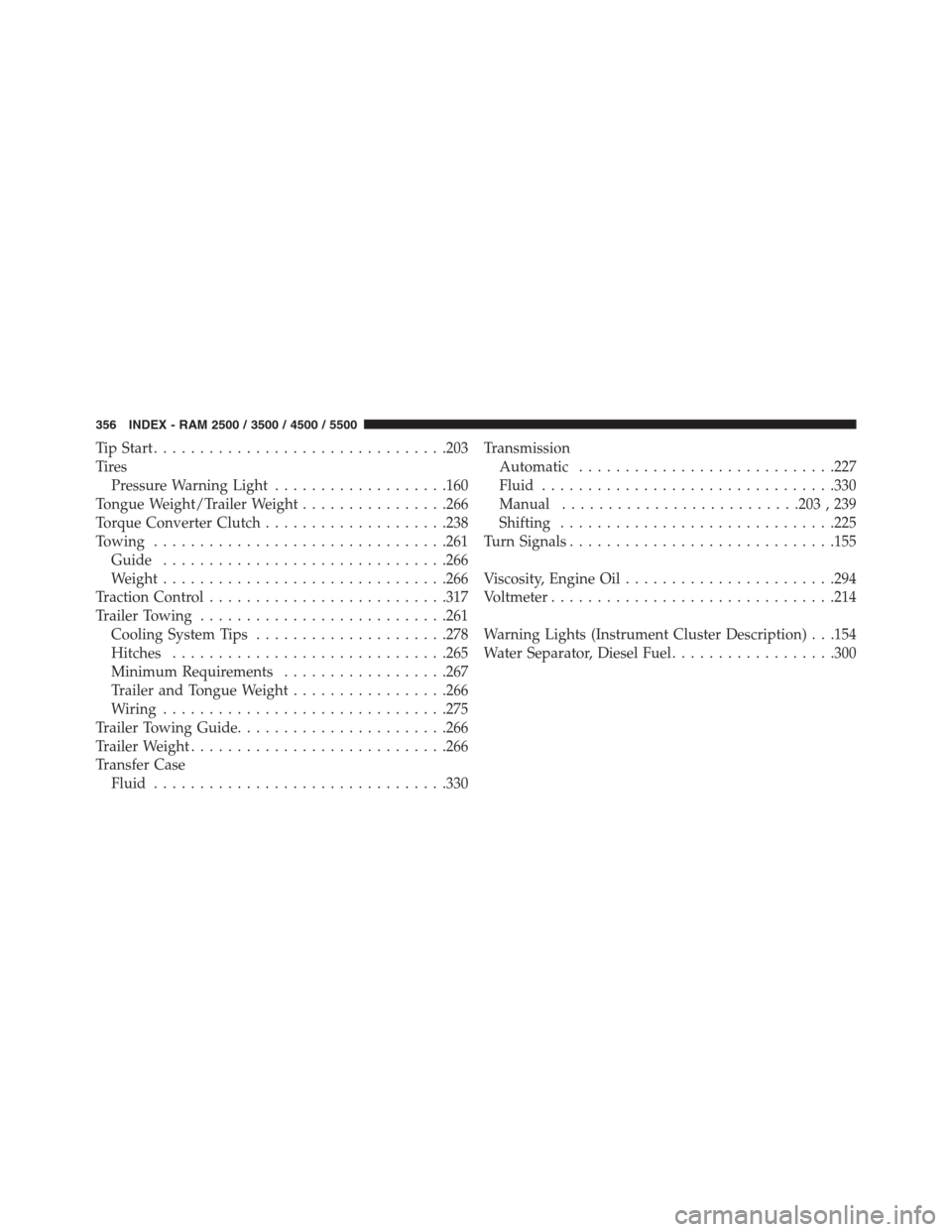
Tip Start................................203
Ti re s
Pressure Warning Light...................160
Tongue Weight/Trailer Weight................266
Torque Converter Clutch....................238
Towing................................261
Guide...............................266
Weight...............................266
Traction Control..........................317
Trailer Towing...........................261
Cooling System Tips.....................278
Hitches..............................265
Minimum Requirements..................267
Trailer and Tongue Weight.................266
Wiring...............................275
Trailer Towing Guide.......................266
Trailer Weight............................266
Transfer Case
Fluid................................330Transmission
Automatic............................227
Fluid................................330
Manual..........................203 , 239
Shifting..............................225
Turn Signals.............................155
Viscosity, Engine Oil.......................294
Voltmeter...............................214
Warning Lights (Instrument Cluster Description) . . .154
Water Separator, Diesel Fuel..................300
356 INDEX - RAM 2500 / 3500 / 4500 / 5500