fuel Ram 2500 2016 Diesel Supplement
[x] Cancel search | Manufacturer: RAM, Model Year: 2016, Model line: 2500, Model: Ram 2500 2016Pages: 406, PDF Size: 1.84 MB
Page 281 of 406
Operating Precautions
Avoid Overheating The Engine
The temperature of the engine coolant (antifreeze) (a
mixture of 50% ethylene-glycol and 50% water) must not
exceed the normal range of the temperature gauge 240°F
(116°C) with a 21 psi (145 kPa) coolant pressure cap.
Usually the engine coolant (antifreeze) temperature indi-
cated during operation will be to the left of center in the
normal range of the gauge.
Avoid Low Coolant Temperature Operation
Continual operation at low engine coolant (antifreeze)
temperature below the normal range on the gauge 140°F
(60°C) can be harmful to the engine. Low engine coolant
(antifreeze) temperature can cause incomplete combus-
tion which allows carbon and varnish to form on pistonrings and injector nozzles. Also, the unburned fuel can
enter the crankcase, diluting the lubricating oil and
causing rapid wear to the engine.
Cooling System Tips — Automatic Transmission
To reduce potential for engine and transmission over-
heating in high ambient temperature conditions, take the
following actions:
•
City Driving —
When stopped, shift the transmission into NEUTRAL
and increase engine idle speed.
• Highway Driving —
Reduce your speed.
• Up Steep Hills —
Select a lower transmission gear.
• Air Conditioning —
Turn it off temporarily.
5
STARTING AND OPERATING 279
Page 282 of 406
Do Not Operate The Engine With Low Oil
Pressure
When the engine is at normal operating temperature, the
minimum oil pressures required are:
Idle 700 to 800 RPM 10 psi (69 kPa)
Full speed and load 30 psi (207 kPa)
CAUTION!
If oil pressure falls to less than normal readings, shut
the engine off immediately. Failure to do so could
result in immediate and severe engine damage.
Do Not Operate The Engine With Failed Parts
All engine failures give some warning before the parts
fail. Be on the alert for changes in performance, sounds,
and visual evidence that the engine requires service.
Some important clues are:•
Engine misfiring or vibrating severely.
• Sudden loss of power.
• Unusual engine noises.
• Fuel, oil or coolant leaks.
• Sudden change, outside the normal operating range, in
the engine operating temperature.
• Excessive smoke.
• Oil pressure drop.
ENGINE BLOCK HEATER — IF EQUIPPED
The engine block heater warms engine coolant and
permits quicker starts in cold weather. Connect the heater
cord to a ground-fault interrupter protected 110–115 Volt
AC electrical outlet with a grounded, three-wire exten-
sion cord.
280 STARTING AND OPERATING
Page 293 of 406
NEUTRAL (N)
Use this range when the vehicle is standing for prolonged
periods with the engine running. The engine may be
started in this range. Apply the parking brake and shift
the transmission into PARK if you must leave the vehicle.
WARNING!
Do not coast in NEUTRAL and never turn off the
ignition to coast down a hill. These are unsafe
practices that limit your response to changing traffic
or road conditions. You might lose control of the
vehicle and have a collision.
CAUTION!
Towing the vehicle, coasting, or driving for any other
reason with the transmission in NEUTRAL can cause
(Continued)
CAUTION!(Continued)
severe transmission damage. Refer to “Recreational
Towing” in “Starting And Operating” and “Towing A
Disabled Vehicle” in “What To Do In Emergencies”
for further information.
DRIVE (D)
This range should be used for most city and highway
driving. It provides the smoothest upshifts and down-
shifts, and the best fuel economy. The transmission
automatically upshifts through underdrive first, second,
and third gears, direct fourth gear and overdrive fifth and
sixth gears. The DRIVE position provides optimum driv-
ing characteristics under all normal operating conditions.
When frequent transmission shifting occurs (such as
when operating the vehicle under heavy loading condi-
tions, in hilly terrain, traveling into strong head winds, or
while towing heavy trailers), use the Electronic Range
5
STARTING AND OPERATING 291
Page 299 of 406
The “TOW/HAUL Indicator Light” will illuminate in the
instrument cluster to indicate that TOW/HAUL mode
has been activated. Pressing the switch a second time
restores normal operation. Normal operation is always
the default at engine start-up. If TOW/HAUL mode isdesired, the switch must be pressed each time the engine
is started.
WARNING!
Do not use the “TOW/HAUL” feature when driving
in icy or slippery conditions. The increased engine
braking could cause the rear wheels to slide, and the
vehicle to swing around with the possible loss of
vehicle control, which could cause an accident possi-
bly resulting in personal injury or death.
Torque Converter Clutch
A feature designed to improve fuel economy has been
included in the automatic transmission on your vehicle.
A clutch within the torque converter engages automati-
cally at calibrated speeds. This may result in a slightly
different feeling or response during normal operation in
the upper gears. When the vehicle speed drops or during
some accelerations, the clutch automatically disengages.
TOW/HAUL Switch
5
STARTING AND OPERATING 297
Page 302 of 406
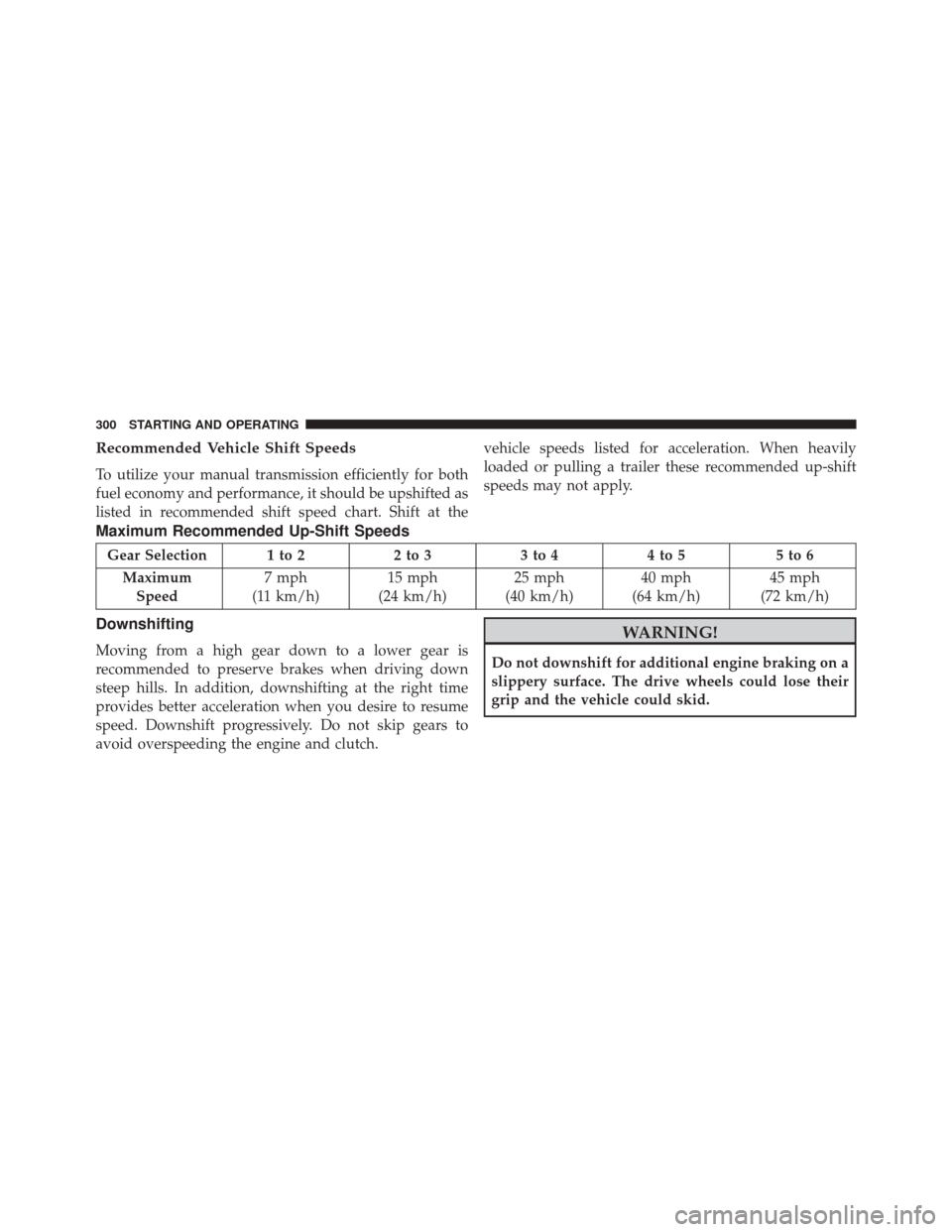
Recommended Vehicle Shift Speeds
To utilize your manual transmission efficiently for both
fuel economy and performance, it should be upshifted as
listed in recommended shift speed chart. Shift at thevehicle speeds listed for acceleration. When heavily
loaded or pulling a trailer these recommended up-shift
speeds may not apply.
Maximum Recommended Up-Shift Speeds
Gear Selection 1 to 2
2 to 33 to 44 to 5 5 to 6
Maximum Speed 7 mph
(11 km/h) 15 mph
(24 km/h) 25 mph
(40 km/h) 40 mph
(64 km/h) 45 mph
(72 km/h)
Downshifting
Moving from a high gear down to a lower gear is
recommended to preserve brakes when driving down
steep hills. In addition, downshifting at the right time
provides better acceleration when you desire to resume
speed. Downshift progressively. Do not skip gears to
avoid overspeeding the engine and clutch.
WARNING!
Do not downshift for additional engine braking on a
slippery surface. The drive wheels could lose their
grip and the vehicle could skid.
300 STARTING AND OPERATING
Page 309 of 406
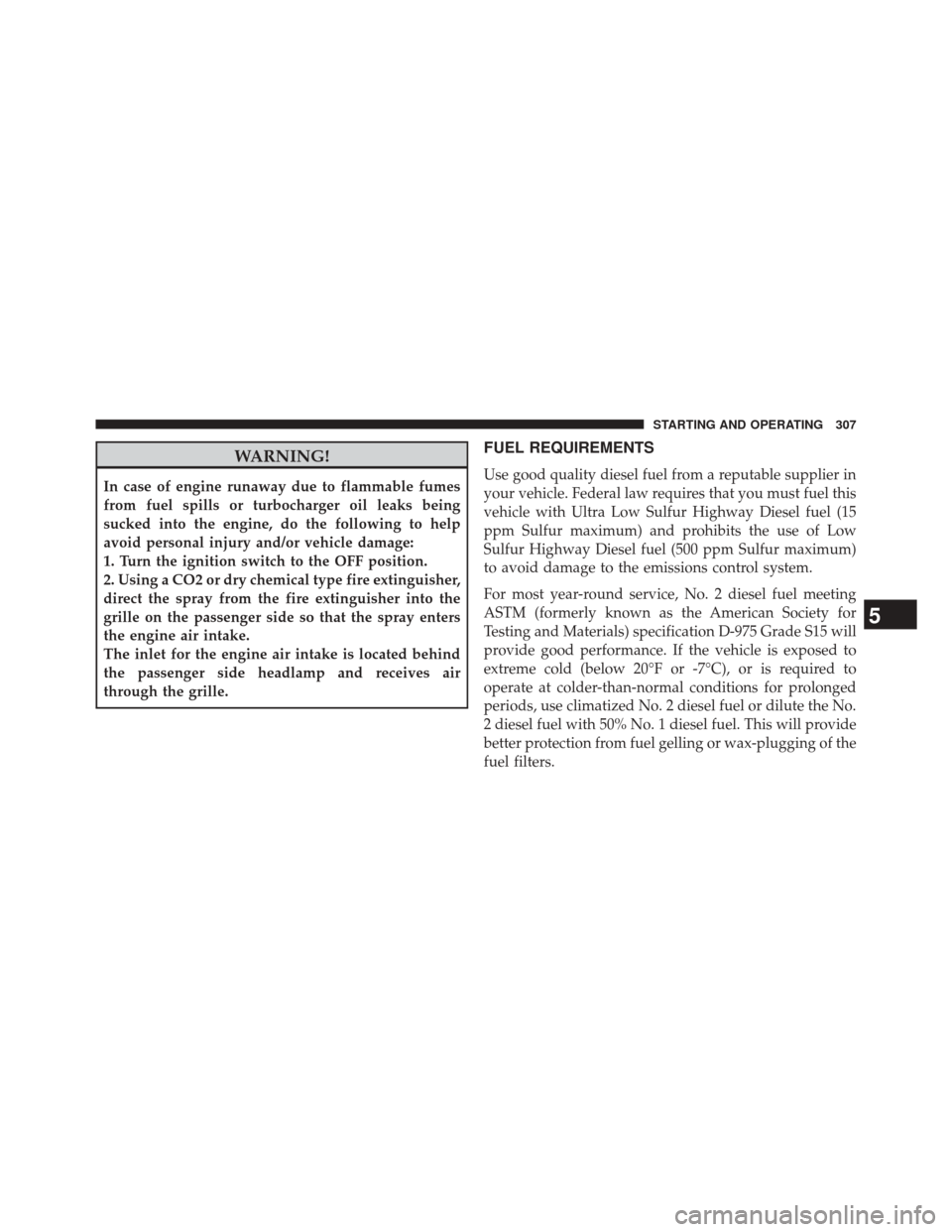
WARNING!
In case of engine runaway due to flammable fumes
from fuel spills or turbocharger oil leaks being
sucked into the engine, do the following to help
avoid personal injury and/or vehicle damage:
1. Turn the ignition switch to the OFF position.
2. Using a CO2 or dry chemical type fire extinguisher,
direct the spray from the fire extinguisher into the
grille on the passenger side so that the spray enters
the engine air intake.
The inlet for the engine air intake is located behind
the passenger side headlamp and receives air
through the grille.
FUEL REQUIREMENTS
Use good quality diesel fuel from a reputable supplier in
your vehicle. Federal law requires that you must fuel this
vehicle with Ultra Low Sulfur Highway Diesel fuel (15
ppm Sulfur maximum) and prohibits the use of Low
Sulfur Highway Diesel fuel (500 ppm Sulfur maximum)
to avoid damage to the emissions control system.
For most year-round service, No. 2 diesel fuel meeting
ASTM (formerly known as the American Society for
Testing and Materials) specification D-975 Grade S15 will
provide good performance. If the vehicle is exposed to
extreme cold (below 20°F or -7°C), or is required to
operate at colder-than-normal conditions for prolonged
periods, use climatized No. 2 diesel fuel or dilute the No.
2 diesel fuel with 50% No. 1 diesel fuel. This will provide
better protection from fuel gelling or wax-plugging of the
fuel filters.
5
STARTING AND OPERATING 307
Page 310 of 406
WARNING!
Do not use alcohol or gasoline as a fuel blending
agent. They can be unstable under certain conditions
and hazardous or explosive when mixed with diesel
fuel.
Diesel fuel is seldom completely free of water. To prevent
fuel system trouble, drain the accumulated water from
the fuel/water separator using the fuel/water separator
drain provided on both fuel filters. If you buy good
quality fuel and follow the cold weather advice above,
fuel conditioners should not be required in your vehicle.
If available in your area, a high cetane “premium” diesel
fuel may offer improved cold-starting and warm-up
performance.
CAUTION!
If the “Water in Fuel Indicator Light” remains on, DO
NOT START engine before you drain the water from
the fuel filter(s) to avoid engine damage. Refer to
“Maintenance Procedures/Draining Fuel/Water Sepa-
rator Filter” in “Maintaining Your Vehicle” for fur-
ther information.
Fuel Specifications
The Cummins diesel engine has been developed to take
advantage of the high energy content and generally
lower cost No. 2 Ultra Low Sulfur diesel fuel or No. 2
Ultra Low Sulfur climatized diesel fuels. Experience has
shown that it also operates on No. 1 Ultra Low Sulfur
diesel fuels or other fuels within specification.
308 STARTING AND OPERATING
Page 311 of 406
NOTE:
•If you accidentally fill the fuel tank with gasoline on
your diesel vehicle, Do not start the vehicle. If you
restart your vehicle you risk damaging the engine and
fuel system. Please call your local dealer for service.
• A maximum blend of 5% biodiesel meeting ASTM
specification D-975 may be used with your Cummins
diesel engine. (Chassis Cab models not configured
with B20 capability.)
• A maximum blend of 20% biodiesel meeting ASTM
specification D-7467 may be used with your Cummins
diesel engine. (Pickup models and Chassis Cab models
configured with B20 Capability.)
• In addition, commercially available fuel additives are
not necessary for the proper operation of your Cum-
mins diesel engine. However, if seasonably adjusted
fuel is not available and you are operating below 20°F (-6°C), MOPAR Premium Diesel Fuel Treatment (or
equivalent) may be beneficial to avoid fuel gelling.
• No. 1 Ultra Low Sulfur diesel fuel should only be used
where extended arctic conditions (-10°F or -23°C) exist.
Bio-Diesel Fuel Requirements
Chassis Cab Models
A maximum blend of 5% biodiesel meeting ASTM speci-
fication D975 may be used with your Cummins diesel
engine. If operation with Biodiesel blends greater than
5% but not greater than 20% (B6-B20) is desired, the truck
must first be reconfigured by an authorized Ram dealer
and the provisions in the following section must be
adhered to.5
STARTING AND OPERATING 309
Page 312 of 406
Pickup Models And Chassis Cab Models Ordered
With B20 Option
Your vehicle has been validated and approved for the use
of Biodiesel in blends up to 20% (B20) provided that you
comply with the requirements outlined below. It is im-
portant that you understand and comply with these
requirements. Failure to comply with Oil Change require-
ments for vehicles operating on biodiesel blends up to
B20 will result in premature engine wear. Such wear is
not covered by the New Vehicle Limited Warranty.
Biodiesel is a fuel produced from renewable resources
typically derived from animal fat, rapeseed oil (Rapeseed
Methyl Ester (RME) base), or soybean oil (Soy Methyl
Ester (SME or SOME) base). Biodiesel fuel has inherent
limitations which require that you understand and ad-
here to the following requirements if you use blends of
Biodiesel greater then 5% but not greater than 20%
(B6-B20). There are no unique restrictions for the use ofB5. Use of blends greater than 20% is not approved. Use
of blends greater than 20% can result in engine damage.
Such damage is not covered by the New Vehicle Limited
Warranty.
Fuel Quality — Must Comply With ASTM
Standards
The quality of Biodiesel fuel may vary widely. Only fuel
produced by a BQ9000 supplier to the following specifi-
cations may be blended to meet Biodiesel blend (B6–B20)
fuel meeting ASTM specification D-7467:
•
Pretrodiesel fuel meeting ASTM specification D-975
and Biodiesel fuel (B100) meeting ASTM specification
D-6751.
Fuel Oxidation Stability — Must Use Fuel Within
Six Months Of Manufacture
Biodiesel fuel has poor oxidation stability which can
result in long term storage problems. Fuel produced to
310 STARTING AND OPERATING
Page 313 of 406
approved ASTM standards, if stored properly, provides
for protection against fuel oxidation for up to six months.
Fuel Water Separation — Must Use MOPAR/
Cummins Approved Fuel Filter Elements
You must use MOPAR/Cummins approved fuel filter
elements in both your engine mounted filter and frame
mounted filter.
Biodiesel fuel has a natural affinity to water and water
accelerates microbial growth. Your MOPAR/Cummins
filtration system is designed to provide adequate fuel
water separation capabilities.
Bio-Diesel Fuel Properties — Low Ambient
Temperatures
Biodiesel fuel may gel or solidify at low ambient tem-
peratures, which may pose problems for both storage and
operation. Precautions can be necessary at low ambienttemperatures, such as storing the fuel in a heated build-
ing or a heated storage tank, or using cold temperature
additives.
Fuel In Oil Dilution — Must Adhere To Required
Oil Change Interval
Fuel dilution of lubricating oil has been observed with
the use of Biodiesel fuel. Fuel in oil must not exceed 5%.
To ensure this limit is met your oil change interval must
be maintained to the following schedule:
•
Ram PickUp 2500/3500 Only — 15,000 Miles*
• Ram 3500/4500/5500 Chassis Cab — 12,500 Miles*
(*unless otherwise notified with a oil service message)
5
STARTING AND OPERATING 311