warning Ram 2500 2016 Diesel Supplement
[x] Cancel search | Manufacturer: RAM, Model Year: 2016, Model line: 2500, Model: Ram 2500 2016Pages: 406, PDF Size: 1.84 MB
Page 318 of 406
WARNING!
A fire may result if fuel is pumped into a portable
container that is on a truck bed. You could be burned.
Always place fuel containers on the ground while
filling.
Fuel Filler Cap
If the fuel filler cap is lost or damaged, be sure the
replacement cap is for use with this vehicle.
CAUTION!
Damage to the fuel system or emission control sys-
tem could result from using an improper fuel tank
filler tube cap. A poorly fitting cap could let impuri-
ties into the fuel system.
WARNING!
•Never have any smoking materials lit in or near the
vehicle when the fuel filler cap is removed or the
tank filled.
• Never add fuel to the vehicle when the engine is
running.
Avoid Using Contaminated Fuel
Fuel that is contaminated by water or dirt can cause
severe damage to the engine fuel system. Proper main-
tenance of the engine fuel filter and fuel tank is essential.
Refer to “Maintenance Procedures” in “Maintaining Your
Vehicle” for further information.
Bulk Fuel Storage — Diesel Fuel
If you store quantities of fuel, good maintenance of the
stored fuel is also essential. Fuel contaminated with
water will promote the growth of “microbes.” These
316 STARTING AND OPERATING
Page 319 of 406
microbes form “slime” that will clog the fuel filtration
system and lines. Drain condensation from the supply
tank and change the line filter on a regular basis.
NOTE:When a diesel engine is allowed to run out of
fuel, air is pulled into the fuel system.
If the vehicle will not start, refer to “Maintenance
Procedures/Priming If The Engine Has Run Out Of Fuel”
in “Maintaining Your Vehicle” for further information.
WARNING!
Do not open the high pressure fuel system with the
engine running. Engine operation causes high fuel
pressure. High pressure fuel spray can cause serious
injury or death.
Diesel Exhaust Fluid Storage
Diesel Exhaust Fluid (DEF) is considered a very stable
product with a long shelf life. If DEF is kept in tempera-
tures between 10° and 90°F (-12° and 32°C), it will last a
minimum of one year.
DEF is subject to freezing at the lowest temperatures. For
example, DEF may freeze at temperatures at or below 12°
F (-11° C). The system has been designed to operate in
this environment.
NOTE: When working with DEF, it is important to know
that:
• Any containers or parts that come into contact with
DEF must be DEF compatible (plastic or stainless
steel). Copper, brass, aluminum, iron or non-stainless
steel should be avoided as they are subject to corrosion
by DEF.
• If DEF is spilled, it should be wiped up completely.
5
STARTING AND OPERATING 317
Page 328 of 406
JUMP STARTING
WARNING!
•To prevent personal injury or damage to clothing,
do not allow battery fluid to contact eyes, skin or
fabrics. Do not lean over a battery when connecting
jumper cables or allow cable clamps to touch each
other. Keep open flames or sparks away from
battery vent holes. Always wear eye protection
when working with batteries.
• Do not use a booster battery or any other booster
source that has a greater than 12 Volt system, i.e., do
not use a 24 Volt power source.
NOTE: Replacement batteries should both be of equal
size to prevent damage to the vehicle’s charging system.
Your vehicle is equipped with two 12 Volt batteries. If it
becomes necessary to use a booster battery with jumper cables to start a vehicle’s engine because its batteries are
discharged, the following procedure should be used:
Set the parking brake and place an automatic transmis-
sion in PARK (or NEUTRAL for a manual transmission).
Turn off lights, heater and other electrical loads. Observe
charge indicator (if equipped) in both batteries. If the
indicator (if equipped) is light or yellow on either battery,
replace that battery.
CAUTION!
Use the jump start procedure only when the charge
indicator (if equipped) in both batteries is dark in the
center. Do not attempt jump starting when either
battery charge indicator (if equipped) is bright or
yellow. If the charge indicator (if equipped) has a
green dot in the center, failure to start is not due to a
discharged battery and cranking system should be
checked.
326 WHAT TO DO IN EMERGENCIES
Page 329 of 406
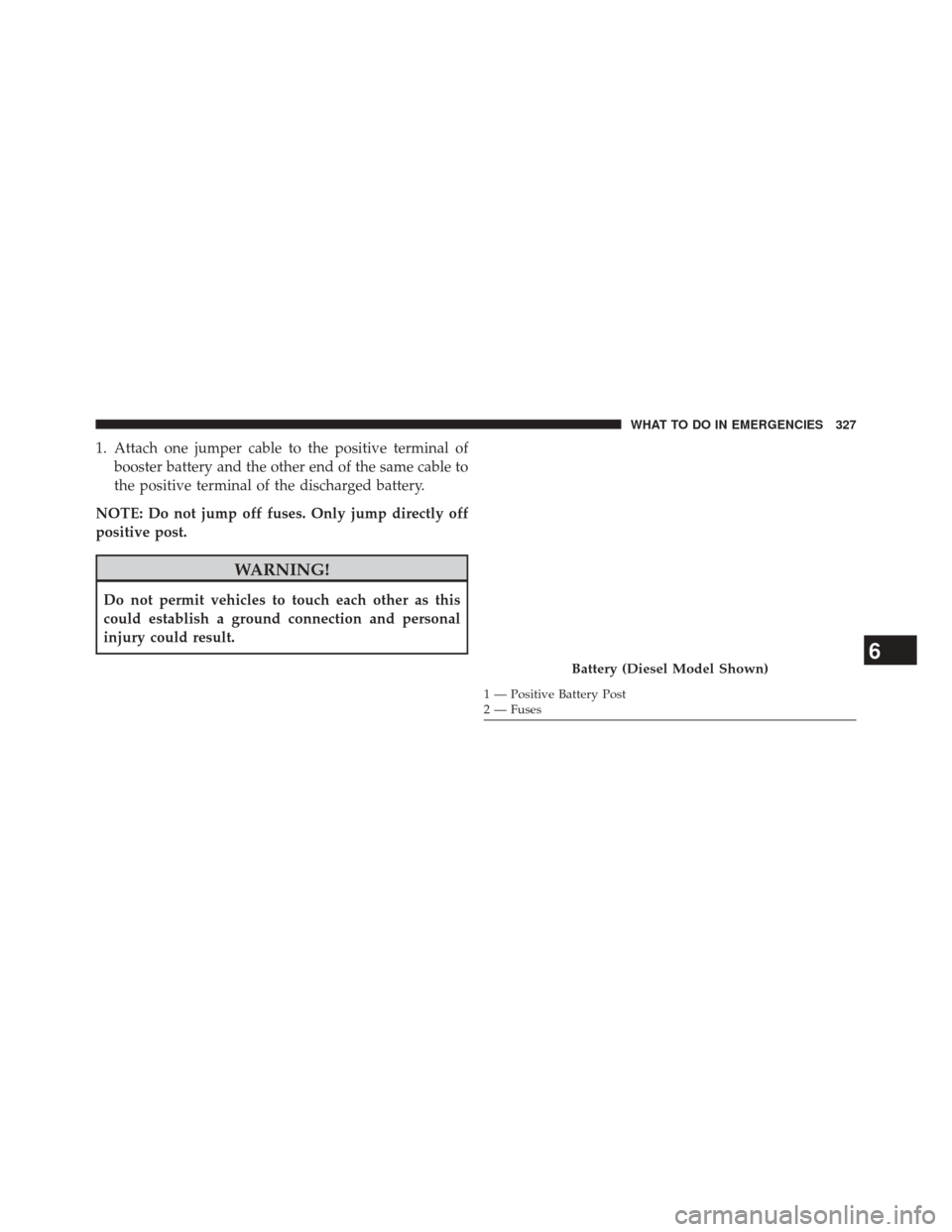
1. Attach one jumper cable to the positive terminal ofbooster battery and the other end of the same cable to
the positive terminal of the discharged battery.
NOTE: Do not jump off fuses. Only jump directly off
positive post.
WARNING!
Do not permit vehicles to touch each other as this
could establish a ground connection and personal
injury could result.
Battery (Diesel Model Shown)
1 — Positive Battery Post
2 — Fuses
6
WHAT TO DO IN EMERGENCIES 327
Page 330 of 406
2. Connect one end of the other jumper cable to negative(-) post of booster battery. Connect the other end of the
jumper cable to a good ground on the engine block of
the vehicle with the discharged battery. Make sure a
good connection is made, free of dirt and grease.
WARNING!
•Do not connect the cable to the negative post of the
discharge battery. The resulting electrical spark
could cause the battery to explode.
• During cold weather when temperatures are below
freezing point, electrolyte in a discharged battery
may freeze. Do not attempt jump starting because
the battery could rupture or explode. The battery
temperature must be brought up above freezing
point before attempting to jump start. 3. Take care that the clamps from one cable do not
inadvertently touch clamps from the other cable. Do
not lean over the battery when making connection.
The negative connection must provide good electrical
conductivity and current carrying capacity.
4. After the engine is started or if the engine fails to start, cables must be disconnected in the following order:
• Disconnect the negative cable at the engine ground.
• Disconnect the negative cable at the negative post on
booster battery.
• Disconnect the cable from the positive post of both
batteries.
328 WHAT TO DO IN EMERGENCIES
Page 331 of 406
WARNING!
Any procedure other than above could result in:
•Personal injury caused by electrolyte squirting out
the battery vent.
• Personal injury or property damage due to battery
explosion.
• Damage to charging system of booster vehicle or of
immobilized vehicle.
With Portable Starting Unit
There are many types of these units available. Follow the
manufacturer’s instructions for necessary precautions
and operation.
CAUTION!
It is very important that the starting unit operating
voltage does not exceed 12 Volts DC or damage to
battery, starter motor, alternator, or electrical system
may occur.
6
WHAT TO DO IN EMERGENCIES 329
Page 342 of 406
Engine Oil Filter
Refer to “Fluids, Lubricants, And Genuine Parts” in
“Maintaining Your Vehicle” for further information. The
engine oil filter should be changed at every engine oil
change.
Disposing Of Used Engine Oil And Oil Filters
Care should be taken in disposing of used engine oil and
oil filters from your vehicle. Used oil and oil filters,
indiscriminately discarded, can present a problem to the
environment. Contact your authorized dealer, service
station or governmental agency for advice on how and
where used oil and oil filters can be safely discarded in
your area.
Engine Air Cleaner Filter
CAUTION!
All air entering the engine intake must be filtered.
The abrasive particles in unfiltered air will cause
rapid wear to engine components.
WARNING!
The air induction system (air cleaner, hoses, etc.)
provides a measure of protection. Do not remove the
air induction system (air cleaner, hoses, etc.) unless
such removal is necessary for repair or maintenance.
Make sure that no one is near the engine compart-
ment before starting the vehicle with the air induc-
tion system (air cleaner, hoses, etc.) removed. Failure
to do so can result in serious personal injury.
340 MAINTAINING YOUR VEHICLE
Page 352 of 406
5. Remove lid using a socket or strap wrench. Rotatecounterclockwise for removal. Remove used o-ring
and discard it.
6. Remove the used filter cartridge from the housing and dispose of according to your local regulations.
7. Wipe clean the sealing surfaces of the lid and housing.
8. Install new o-ring back into ring groove on the filter housing and lubricate with clean engine oil.
NOTE: WIF sensor is re-usable. Service kit comes with
new o-ring for filter canister and WIF sensor.Priming If The Engine Has Run Out Of Fuel
WARNING!
Do not open the high pressure fuel system with the
engine running. Engine operation causes high fuel
pressure. High pressure fuel spray can cause serious
injury or death.
1. Add a substantial amount of fuel to the tank, approxi- mately 2 to 5 gal (8L to 19L).
2. Turn ignition switch to the start position to engage starter for one second, return ignition switch to run
position. This will activate in tank fuel pump for
approximately 15 seconds. Repeat this process twice.
3. Start the engine using the “Normal Starting” proce- dure. Refer to “Starting Procedures” in “Starting and
Operating” for further information.
350 MAINTAINING YOUR VEHICLE
Page 353 of 406
CAUTION!
Do not engage the starter motor for more than 15
seconds at a time. Allow two minutes between the
cranking intervals.
NOTE: The engine may run rough until the air is forced
from all the fuel lines.
WARNING!
Do not use alcohol or gasoline as a fuel blending
agent. They can be unstable under certain conditions
and be hazardous or explosive when mixed with
diesel fuel.
CAUTION!
Due to lack of lubricants in alcohol or gasoline, the
use of these fuels can cause damage to the fuel
system.
NOTE:
• A maximum blend of 5% biodiesel, meeting ASTM
specification D-975 may be used with your Cummins
diesel engine. (Chassis Cab models not configured
with B20 capability.)
• A maximum blend of 20% biodiesel, meeting ASTM
specification D-7467 may be used with your Cummins
diesel engine. (Pickup models and Chassis Cab models
configured with B20 capability.)
7
MAINTAINING YOUR VEHICLE 351
Page 354 of 406
•Use of biodiesel mixture in excess of 20% can nega-
tively impact the fuel filter’s ability to separate water
from the fuel, resulting in high pressure fuel system
corrosion or damage.
• Ethanol blends are not recommended or approved for
use with your Cummins diesel engine.
• In addition, commercially available fuel additives are
not necessary for the proper operation of your Cum-
mins diesel engine.
Intervention Regeneration Strategy — Message
Process Flow
The Cummins diesel engine meets all EPA Heavy Duty
Diesel Engine Emissions Standards, resulting in one of
the lowest emitting diesel engines ever produced.
To achieve these emissions standards, your vehicle is
equipped with a state-of-the-art engine and exhaust
system. The engine and exhaust after-treatment system work together to achieve the EPA Heavy Duty Diesel
Engine Emissions Standards. These systems are seam-
lessly integrated into your vehicle and managed by the
Cummins Powertrain Control Module (PCM). The PCM
manages engine combustion to allow the exhaust sys-
tem’s catalyst to trap and burn Particulate Matter (PM)
pollutants, with no input or interaction on your part.
Additionally, your vehicle has the ability to alert you to
additional maintenance required on your truck or engine.
Refer to “Electronic Vehicle Information Center (EVIC)”
or “Driver Information Display (DID)” in “Understand-
ing Your Instrument Panel” for further information.
WARNING!
A hot exhaust system can start a fire if you park over
materials that can burn. Such materials might be
(Continued)
352 MAINTAINING YOUR VEHICLE