battery Ram 2500 2016 Diesel Supplement
[x] Cancel search | Manufacturer: RAM, Model Year: 2016, Model line: 2500, Model: Ram 2500 2016Pages: 406, PDF Size: 1.84 MB
Page 336 of 406
ENGINE COMPARTMENT — 6.7L DIESEL — SIX-SPEED AS69RC HD (3500/CHASSIS CAB MODELS)
1 — Battery7 — Washer Fluid Reservoir
2 — Engine Coolant Reservoir 8 — Power Steering Fluid Reservoir
3 — Automatic Transmission Dipstick 9 — Power Distribution Center
4 — Brake Fluid Reservoir 10 — Engine Oil Dipstick
5 — Battery 11 — Engine Oil Fill
6 — Aux Power Distribution Center 12 — Air Cleaner Filter
334 MAINTAINING YOUR VEHICLE
Page 355 of 406
WARNING!(Continued)
grass or leaves coming into contact with your exhaust
system. Do not park or operate your vehicle in areas
where your exhaust system can contact anything that
can burn.
Diesel Exhaust Fluid
Diesel Exhaust Fluid (DEF) sometimes known simply by
the name of its active component, UREA—is a key
component of selective catalytic reduction (SCR) systems,
which help diesel vehicles meet stringent emission regu-
lations. DEF is a liquid reducing agent that reacts with
engine exhaust in the presence of a catalyst to convert
smog-forming nitrogen oxides (NOx) into harmless ni-
trogen and water vapor.
Refer to “Fluids, Lubricants, and Genuine Parts” in
“Maintaining Your Vehicle” for further information. You can receive assistance in locating DEF in the United
States by calling 866-RAM-INFO (866-726-4636). In
Canada call 1–800–465–2001 (English) or 1–800–387–9983
(French)
Maintenance-Free Batteries
The top of the maintenance-free batteries are perma-
nently sealed. You will never have to add water, nor is
periodic maintenance required.
NOTE:
Replacement batteries should both be of equal
capacity to prevent damage to the vehicle’s charging
system.
CAUTION!
It is essential when replacing the cables on the
battery that the positive cable is attached to the
positive post and the negative cable is attached to the
(Continued)
7
MAINTAINING YOUR VEHICLE 353
Page 356 of 406
CAUTION!(Continued)
negative post. Battery posts are marked (+) positive
and negative (-) and are identified on the battery
case. Also, if a “fast charger” is used while the battery
is in vehicle, disconnect both vehicle battery cables
before connecting the charger to the battery. Do not
use a “fast charger” to provide starting voltage.
WARNING!
Battery posts, terminals, and related accessories con-
tain lead and lead compounds. Always wash hands
after handling the battery.
Battery Blanket Usage
A battery loses 60% of its cranking power as the battery
temperature decreases to 0°F (-18°). For the same de-
crease in temperature, the engine requires twice as much
power to crank at the same RPM. The use of 120 Volt AC powered battery blankets will greatly increase starting
capability at low temperatures. Suitable battery blankets
are available from your authorized MOPAR dealer.
Cooling System
WARNING!
You or others can be badly burned by hot engine
coolant (antifreeze) or steam from your radiator. If
you see or hear steam coming from under the hood,
do not open the hood until the radiator has had time
to cool. Never try to open a cooling system pressure
cap when the radiator is hot.
Engine Coolant Checks
Check the engine coolant (antifreeze) protection every 12
months (before the onset of freezing weather, where
applicable). If the engine coolant (antifreeze) is dirty or
rusty in appearance, the system should be drained,
354 MAINTAINING YOUR VEHICLE
Page 394 of 406
Adding Engine Coolant (Antifreeze)............140
Adding Fuel .............................114
Air Bag Light .............................25
Air Cleaner, Engine (Engine Air Cleaner Filter) . . . .128
Alarm (Security Alarm) ......................28
Antifreeze (Engine Coolant) ..................139
Capacities ........................... .146
Disposal ............................. .142
Automatic Transmission Fluid Type ........................... .150
Axle Fluid ............................. .150
Battery .................................30
Charging System Light ....................30
Brake Fluid ............................ .150
Brake System ........................... .144
Fluid Check .......................... .144
Master Cylinder ....................... .144Warning Light
..........................26
Capacities, Antifreeze (Engine Coolant) ..........146
Capacities, Fluid ......................... .146
Caps, Filler Oil (Engine) .......................... .127
Radiator (Coolant Pressure) ................142
Charge Air Cooler ........................ .144
Coolant Pressure Cap (Radiator Cap) ...........142
Cooling System .......................... .138
Adding Coolant (Antifreeze) ...............140
Coolant Capacity ...................... .146
Coolant Level ......................... .138
Disposal Of Used Coolant .................142
Drain, Flush, And Refill ...................139
Points To Remember .....................143
Pressure Cap ......................... .142
Radiator Cap ......................... .142
Selection Of Coolant (Antifreeze) ........139 , 147
8
INDEX - RAM 1500 391
Page 399 of 406
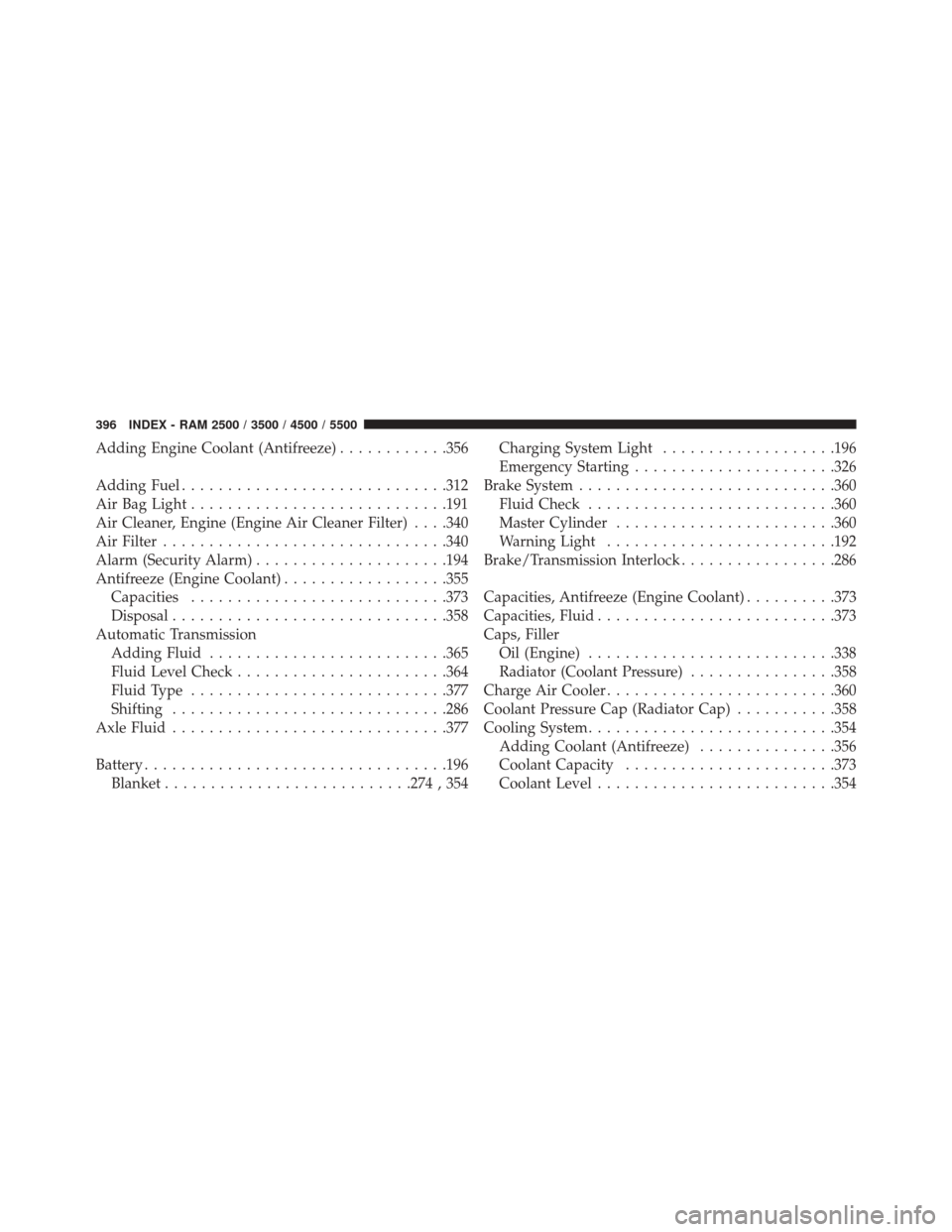
Adding Engine Coolant (Antifreeze)............356
Adding Fuel ............................ .312
Air Bag Light ........................... .191
Air Cleaner, Engine (Engine Air Cleaner Filter) . . . .340
Air Filter .............................. .340
Alarm (Security Alarm) .....................194
Antifreeze (Engine Coolant) ..................355
Capacities ........................... .373
Disposal ............................. .358
Automatic Transmission Adding Fluid ......................... .365
Fluid Level Check ...................... .364
Fluid Type ........................... .377
Shifting ............................. .286
Axle Fluid ............................. .377
Battery ................................ .196
Blanket .......................... .274 , 354Charging System Light
...................196
Emergency Starting ..................... .326
Brake System ........................... .360
Fluid Check .......................... .360
Master Cylinder ....................... .360
Warning Light ........................ .192
Brake/Transmission Interlock .................286
Capacities, Antifreeze (Engine Coolant) ..........373
Capacities, Fluid ......................... .373
Caps, Filler Oil (Engine) .......................... .338
Radiator (Coolant Pressure) ................358
Charge Air Cooler ........................ .360
Coolant Pressure Cap (Radiator Cap) ...........358
Cooling System .......................... .354
Adding Coolant (Antifreeze) ...............356
Coolant Capacity ...................... .373
Coolant Level ......................... .354
396 INDEX - RAM 2500 / 3500 / 4500 / 5500
Page 405 of 406

INSTALLATION OF RADIO TRANSMITTING
EQUIPMENT
Special design considerations are incorporated into this
vehicle’s electronic system to provide immunity to radio
frequency signals. Mobile two-way radios and telephone
equipment must be installed properly by trained person-
nel. The following must be observed during installation.
The positive power connection should be made directly
to the battery and fused as close to the battery as possible.
The negative power connection should be made to body
sheet metal adjacent to the negative battery connection.
This connection should not be fused.
Antennas for two-way radios should be mounted on the
roof or the rear area of the vehicle. Care should be used
in mounting antennas with magnet bases. Magnets may
affect the accuracy or operation of the compass on
vehicles so equipped.The antenna cable should be as short as practical and
routed away from the vehicle wiring when possible. Use
only fully shielded coaxial cable.
Carefully match the antenna and cable to the radio to
ensure a low Standing Wave Ratio (SWR).
Mobile radio equipment with output power greater than
normal may require special precautions.
All installations should be checked for possible interfer-
ence between the communications equipment and the
vehicle’s electronic systems.