heat Ram 2500 2016 Diesel Supplement
[x] Cancel search | Manufacturer: RAM, Model Year: 2016, Model line: 2500, Model: Ram 2500 2016Pages: 406, PDF Size: 1.84 MB
Page 123 of 406
CAUTION!(Continued)
•Never add anything other than DEF to the tank –
especially any form of hydrocarbon such as diesel
fuel, fuel system additives, gasoline, or any other
petroleum-based product. Even a very small
amount of these (less than 100 parts per million or
less than 1 oz. per 78 gallons) will contaminate the
entire DEF system and will require replacement. If
owners use a container, funnel or nozzle when
refilling the tank, it should either be new or one
that is has only been used for adding DEF. MOPAR
provides an attachable nozzle with its DEF for this
purpose.
3. Stop filling the DEF tank immediately when any of the following happen: DEF stops flowing from the fill
bottle into the DEF tank, DEF splashes out the filler
neck, or a DEF pump nozzle automatically shuts off. 4. Reinstall cap onto DEF tank.
Filling The Def Tank In Cold Climates
Since DEF will begin to freeze at 12°F (-11°C), your
vehicle is equipped with an automatic DEF heating
system. This allows the DEF injection system to operate
properly at temperatures below 12°F (-11°C). If your
vehicle is not in operation for an extended period of time
with temperatures below 12°F (-11°C), the DEF in the
tank may freeze. If the tank is overfilled and freezes, it
could be damaged. Therefore, do not overfill the DEF
tank.
Extra care should be taken when filling with portable
containers to avoid overfilling. Note the level of the DEF
gauge in your instrument cluster. On pickup applica-
tions, you may safely add a maximum of 2 gallons of DEF
from portable containers when your DEF gauge is read-
ing ½ full.
4
STARTING AND OPERATING 121
Page 144 of 406
•Mixing engine coolant (antifreeze) types is not recom-
mended and can result in cooling system damage. If
HOAT and OAT coolant are mixed in an emergency,
have a authorized dealer drain, flush, and refill with
OAT coolant (conforming to MS.90032) as soon as
possible.
Cooling System Pressure Cap
The cap must be fully tightened to prevent loss of engine
coolant (antifreeze), and to ensure that the engine coolant
(antifreeze) will return to the radiator from the coolant
expansion bottle.
The cap should be inspected and cleaned if there is any
accumulation of foreign material on the sealing surfaces.
WARNING!
• Do not open hot engine cooling system. Never add
engine coolant (antifreeze) when the engine is
overheated. Do not loosen or remove the cap to cool
an overheated engine. Heat causes pressure to
build up in the cooling system. To prevent scalding
or injury, do not remove the pressure cap while the
system is hot or under pressure.
• Do not use a pressure cap other than the one
specified for your vehicle. Personal injury or en-
gine damage may result.
Disposal Of Used Engine Coolant
Used ethylene glycol-based engine coolant (antifreeze) is
a regulated substance requiring proper disposal. Check
with your local authorities to determine the disposal
rules for your community. To prevent ingestion by ani-
mals or children, do not store ethylene glycol-based
142 MAINTAINING YOUR VEHICLE
Page 172 of 406
REMOTE STARTING SYSTEM — IF EQUIPPED
This system uses the Remote Keyless Entry
(RKE) transmitter to start the engine conve-
niently from outside the vehicle while still
maintaining security. The system has a range of
approximately 300 ft (91 m).
NOTE:
• The vehicle must be equipped with an automatic
transmission to be equipped with Remote Start.
• The Remote Start system will wait for the “Wait To
Start” telltale to extinguish before cranking the engine.
This allows time for the intake heater to pre-heat the
incoming air, and is normal operation in cold weather.
Refer to “Wait To Start” in “Understanding Your
Instrument Panel”.
How To Use Remote Start
All of the following conditions must be met before the
engine will remote start:
• Transmission in PARK
• Doors closed
• Hood closed
• HAZARD switch off
• BRAKE switch inactive (brake pedal not pushed)
• Ignition key removed from ignition switch
• Battery at an acceptable charge level
• RKE PANIC button not pushed
170 THINGS TO KNOW BEFORE STARTING YOUR VEHICLE
Page 174 of 406
will chirp twice (if programmed). In cold ambient tem-
perature conditions, the diesel vehicle may delay crank
up to 30 seconds for the fuel and grid heater. Once the
vehicle has started, the engine will run for 15 minutes or
75 seconds in extreme cold and high elevation.
NOTE:
•The park lamps will turn on and remain on during
Remote Start mode.
• For security, power window and power sunroof op-
eration (if equipped) are disabled when the vehicle is
in the Remote Start mode.
• The engine can be started two consecutive times (two
15-minute cycles) with the RKE transmitter. However,
the ignition switch must be cycled to the ON position
before you can repeat the start sequence for a third
cycle.To Exit Remote Start Mode Without Driving The
Vehicle
Push and release the REMOTE START button one time or
allow the engine to run for the entire fifteen minute cycle.
NOTE: To avoid unintentional shut downs, the system
will disable the one time push of the REMOTE START
button for two seconds after receiving a valid Remote
Start request.
To Exit Remote Start Mode And Drive The Vehicle
To exit Remote Start Mode and drive the vehicle before
the end of the 15-minute cycle, push and release the
unlock button on the RKE transmitter to unlock the door
and disarm the Vehicle Security Alarm System (if
equipped). Then, prior to the end of the 15-minute cycle,
cycle the ignition to the ON/RUN position.
172 THINGS TO KNOW BEFORE STARTING YOUR VEHICLE
Page 175 of 406
NOTE:
•The ignition switch must be in the ON/RUN position
in order to drive the vehicle.
• For further information, refer to your Owners Manual.
Remote Start Comfort Systems — If Equipped
When remote start is activated, the heated steering
wheel, and driver heated seat features will automatically
turn on in cold weather. In warm weather, the driver
vented seat feature will automatically turn on when the
remote start is activated. These features will stay on
through the duration of remote start or until the ignition
switch is turned to the ON position. The Remote Start Comfort System can be activated and
deactivated through the EVIC/DID. For more informa-
tion on Remote Start Comfort System operation refer to
your Owners Manual.
ENGINE BREAK-IN RECOMMENDATIONS
The Cummins turbocharged diesel engine does not re-
quire a break-in period due to its construction. Normal
operation is allowed, providing the following recommen-
dations are followed:
•
Warm up the engine before placing it under load.
• Do not operate the engine at idle for prolonged
periods.
2
THINGS TO KNOW BEFORE STARTING YOUR VEHICLE 173
Page 187 of 406
NOTE:
•The gauge may take up to five seconds to update after
adding a gallon or more of Diesel Exhaust Fluid (DEF)
to the DEF tank. If you have a fault related to the DEF
system, the gauge may not update to the new level. See
your authorized dealer for service.
• The DEF gauge may also not immediately update after
a refill if the temperature of the DEF fluid is below 12F
(-11C). The DEF line heater will possibly warm up the
DEF fluid and allow the gauge to update after a period
of run time. Under very cold conditions, it is possible
that the gauge may not reflect the new fill level for
several drives. •
Outside temperature can affect DEF consumption. In
cold conditions, 12° F (-11° C) and below, the DEF
gauge needle can stay on a fixed position and may not
move for extended periods of time. This is a normal
function of the system.
4
UNDERSTANDING YOUR INSTRUMENT PANEL 185
Page 189 of 406
1. Tachometer•Indicates the engine speed in revolutions per minute
(RPM x 1000).
2. Engine Coolant Temperature •This gauge shows the engine coolant temperature.
The gauge pointer will likely show higher tempera-
tures when driving in hot weather, up mountain
grades, or in heavy stop and go traffic. If the red
Warning Light turns on while driving, safely bring
the vehicle to a stop, and turn off the engine. DO
NOT operate the vehicle until the cause is corrected.
CAUTION!
Driving with a hot engine cooling system could
damage your vehicle. If the temperature gauge reads
“H” pull over and stop the vehicle. Idle the vehicle
with the air conditioner turned off until the pointer
(Continued)
CAUTION! (Continued)
drops back into the normal range. If the pointer
remains on the “H”, turn the engine off immediately
and call an authorized dealer for service.
WARNING!
A hot engine cooling system is dangerous. You or
others could be badly burned by steam or boiling
coolant. You may want to call an authorized dealer
for service if your vehicle overheats. If you decide to
look under the hood yourself, see “Maintaining Your
Vehicle.” Follow the warnings under the “Cooling
System Pressure Cap” paragraph.4
UNDERSTANDING YOUR INSTRUMENT PANEL 187
Page 191 of 406
NOTE:
•The gauge may take up to five seconds to update after
adding a gallon or more of Diesel Exhaust Fluid (DEF)
to the DEF tank. If you have a fault related to the DEF
system, the gauge may not update to the new level. See
your authorized dealer for service.
• The DEF gauge may also not immediately update after
a refill if the temperature of the DEF fluid is below 12F
(-11C). The DEF line heater will possibly warm up the
DEF fluid and allow the gauge to update after a period
of run time. Under very cold conditions, it is possible
that the gauge may not reflect the new fill level for
several drives.
• Outside temperature can affect DEF consumption. In
cold conditions, 12° F (-11° C) and below, the DEF
gauge needle can stay on a fixed position and may not
move for extended periods of time. This is a normal
function of the system.WARNING AND INDICATOR LIGHTS
IMPORTANT: The warning / indicator light switches on
in the instrument panel together with a dedicated mes-
sage and/or acoustic signal when applicable. These
indications are indicative and precautionary and as such
must not be considered as exhaustive and/or alternative
to the information contained in the Owner Manual,
which you are advised to read carefully in all cases.
Always refer to the information in this chapter in the
event of a failure indication.
All active telltales will display first if applicable. The
system check menu may appear different based upon
equipment options and current vehicle status. Some
telltales are optional and may not appear.
4
UNDERSTANDING YOUR INSTRUMENT PANEL 189
Page 197 of 406
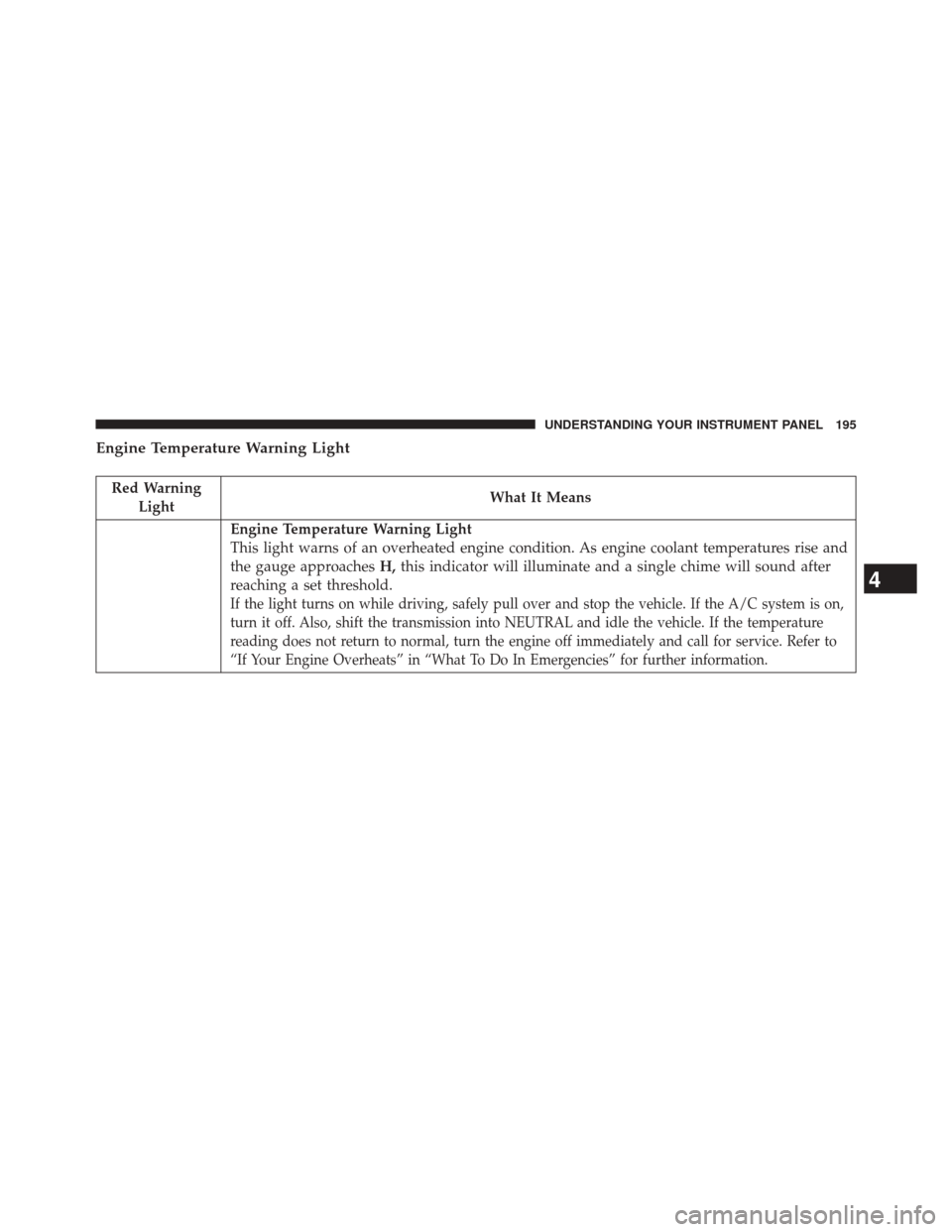
Engine Temperature Warning Light
Red WarningLight What It Means
Engine Temperature Warning Light
This light warns of an overheated engine condition. As engine coolant temperatures rise and
the gauge approaches
H,this indicator will illuminate and a single chime will sound after
reaching a set threshold.
If the light turns on while driving, safely pull over and stop the vehicle. If the A/C system is on,
turn it off. Also, shift the transmission into NEUTRAL and idle the vehicle. If the temperature
reading does not return to normal, turn the engine off immediately and call for service. Refer to
“If Your Engine Overheats” in “What To Do In Emergencies” for further information.
4
UNDERSTANDING YOUR INSTRUMENT PANEL 195
Page 209 of 406
on the vehicle placard or tire inflation pressure label, you
should determine the proper tire inflation pressure for
those tires.
As an added safety feature, your vehicle has been
equipped with a Tire Pressure Monitoring System
(TPMS) that illuminates a low tire pressure telltale when
one or more of your tires is significantly under-inflated.
Accordingly, when the low tire pressure telltale illumi-
nates, you should stop and check your tires as soon as
possible and inflate them to the proper pressure. Driving
on a significantly under-inflated tire causes the tire to
overheat and can lead to tire failure. Under-inflation also
reduces fuel efficiency and tire tread life, and may affect
the vehicle’s handling and stopping ability.Please note that the TPMS is not a substitute for proper
tire maintenance, and it is the driver ’s responsibility to
maintain correct tire pressure, even if under-inflation has
not reached the level to trigger illumination of the TPMS
low tire pressure telltale.
Your vehicle has also been equipped with a TPMS
malfunction indicator to indicate when the system is not
operating properly. The TPMS malfunction indicator is
combined with the low tire pressure telltale. When the
system detects a malfunction, the telltale will flash for
approximately one minute and then remain continuously
illuminated. This sequence will continue upon subse-
quent vehicle start-ups as long as the malfunction exists.
When the malfunction indicator is illuminated, the sys-
tem may not be able to detect or signal low tire pressure
as intended. TPMS malfunctions may occur for a variety
of reasons, including the installation of replacement or
alternate tires or wheels on the vehicle that prevent the
TPMS from functioning properly. Always check the
4
UNDERSTANDING YOUR INSTRUMENT PANEL 207