oil change Ram 2500 2017 Diesel Supplement
[x] Cancel search | Manufacturer: RAM, Model Year: 2017, Model line: 2500, Model: Ram 2500 2017Pages: 228, PDF Size: 1.35 MB
Page 82 of 228
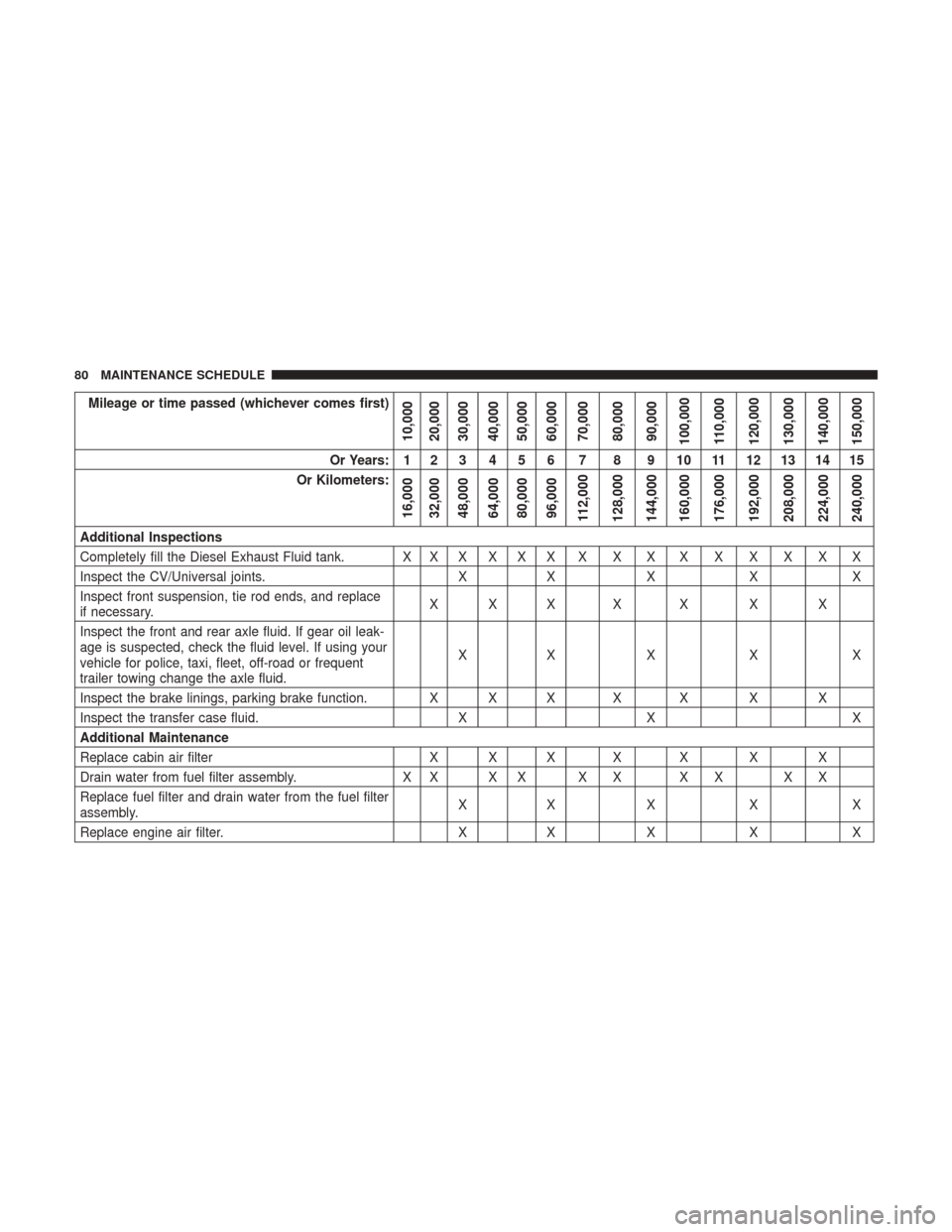
Mileage or time passed (whichever comes first)
10,000
20,000
30,000
40,000
50,000
60,000
70,000
80,000
90,000
100,000
110,000
120,000
130,000
140,000
150,000
Or Years: 1 2 3 4 5 6 7 8 9 10 11 12 13 14 15
Or Kilometers:
16,000
32,000
48,000
64,000
80,000
96,000
112,000
128,000
144,000
160,000
176,000
192,000
208,000
224,000
240,000
Additional Inspections
Completely fill the Diesel Exhaust Fluid tank. X X X X X X X X X X X X X X X
Inspect the CV/Universal joints. XX X X X
Inspect front suspension, tie rod ends, and replace
if necessary. XXX X X X X
Inspect the front and rear axle fluid. If gear oil leak-
age is suspected, check the fluid level. If using your
vehicle for police, taxi, fleet, off-road or frequent
trailer towing change the axle fluid. XX X X X
Inspect the brake linings, parking brake function. X X X X X X X
Inspect the transfer case fluid. XX X
Additional Maintenance
Replace cabin air filter X X X X X X X
Drain water from fuel filter assembly. X X X X X X X X X X
Replace fuel filter and drain water from the fuel filter
assembly. XX X X X
Replace engine air filter. XX X X X
80 MAINTENANCE SCHEDULE
Page 84 of 228
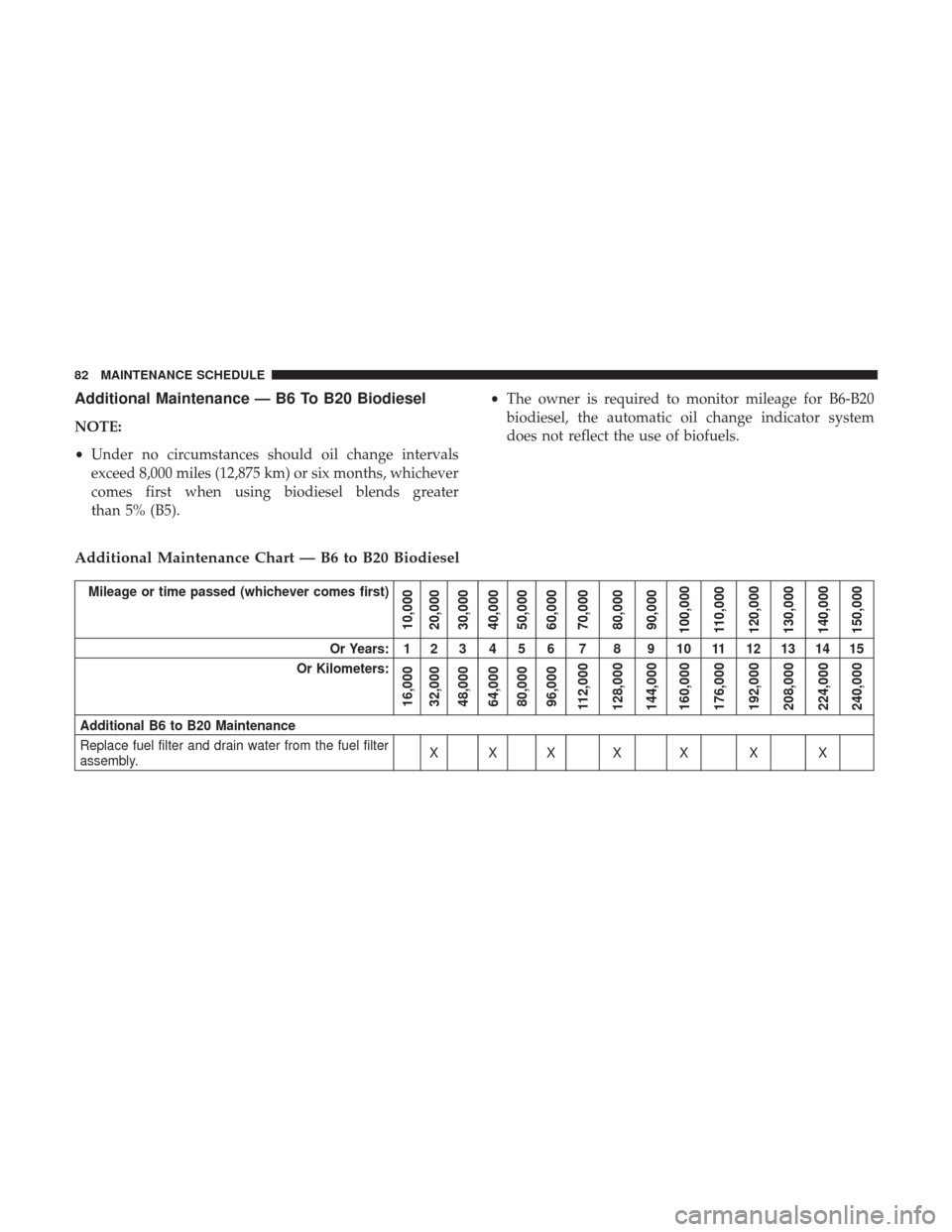
Additional Maintenance — B6 To B20 Biodiesel
NOTE:
•Under no circumstances should oil change intervals
exceed 8,000 miles (12,875 km) or six months, whichever
comes first when using biodiesel blends greater
than 5% (B5). •
The owner is required to monitor mileage for B6-B20
biodiesel, the automatic oil change indicator system
does not reflect the use of biofuels.
Additional Maintenance Chart — B6 to B20 Biodiesel
Mileage or time passed (whichever comes first)
10,000
20,000
30,000
40,000
50,000
60,000
70,000
80,000
90,000
100,000
110,000
120,000
130,000
140,000
150,000
Or Years: 1 2 3 4 5 6 7 8 9 10 11 12 13 14 15
Or Kilometers:
16,000
32,000
48,000
64,000
80,000
96,000
112,000
128,000
144,000
160,000
176,000
192,000
208,000
224,000
240,000
Additional B6 to B20 Maintenance
Replace fuel filter and drain water from the fuel filter
assembly. XXX X X X X
82 MAINTENANCE SCHEDULE
Page 113 of 228
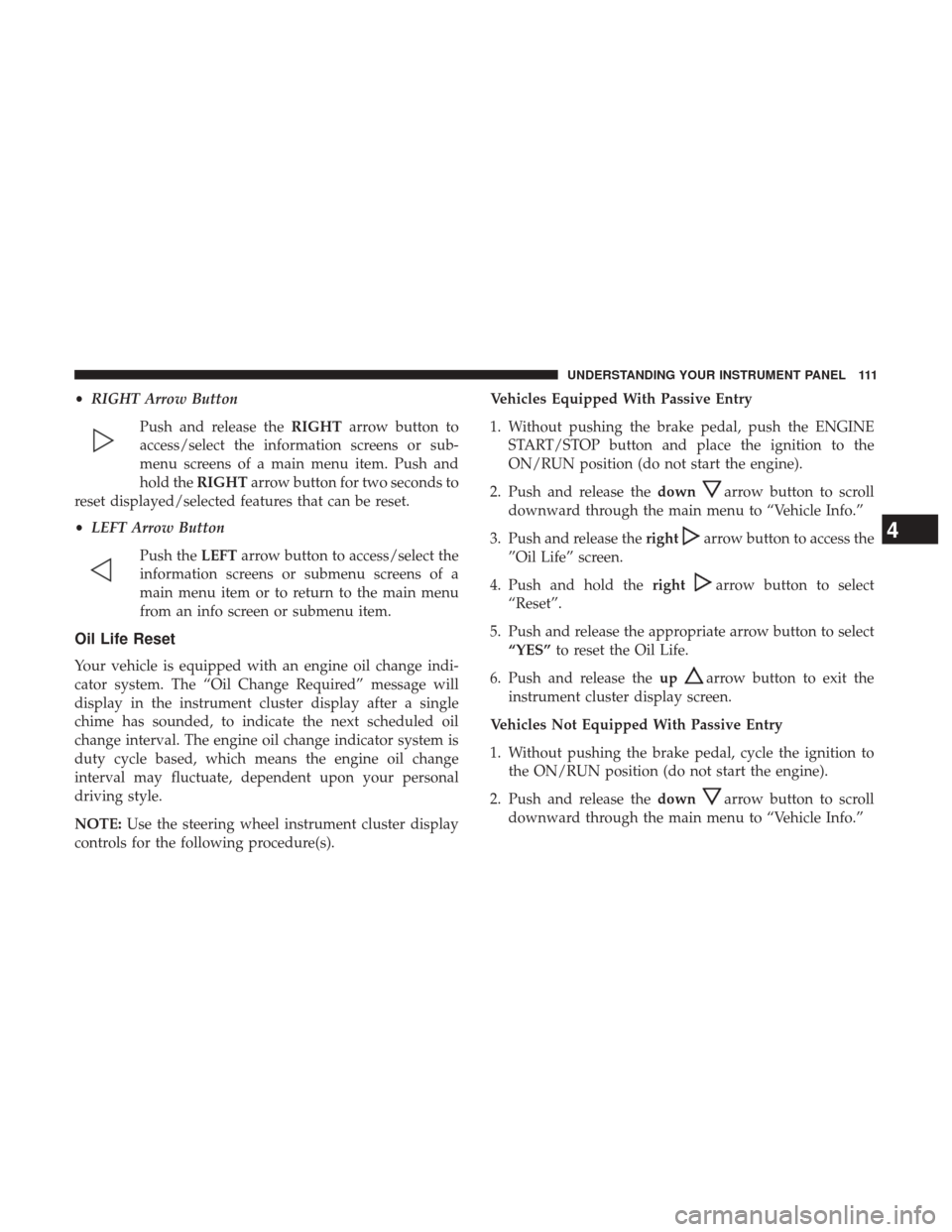
•RIGHT Arrow Button
Push and release the RIGHTarrow button to
access/select the information screens or sub-
menu screens of a main menu item. Push and
hold the RIGHTarrow button for two seconds to
reset displayed/selected features that can be reset.
• LEFT Arrow Button
Push the LEFTarrow button to access/select the
information screens or submenu screens of a
main menu item or to return to the main menu
from an info screen or submenu item.
Oil Life Reset
Your vehicle is equipped with an engine oil change indi-
cator system. The “Oil Change Required” message will
display in the instrument cluster display after a single
chime has sounded, to indicate the next scheduled oil
change interval. The engine oil change indicator system is
duty cycle based, which means the engine oil change
interval may fluctuate, dependent upon your personal
driving style.
NOTE: Use the steering wheel instrument cluster display
controls for the following procedure(s). Vehicles Equipped With Passive Entry
1. Without pushing the brake pedal, push the ENGINE
START/STOP button and place the ignition to the
ON/RUN position (do not start the engine).
2. Push and release the down
arrow button to scroll
downward through the main menu to “Vehicle Info.”
3. Push and release the right
arrow button to access the
”Oil Life” screen.
4. Push and hold the right
arrow button to select
“Reset”.
5. Push and release the appropriate arrow button to select “YES” to reset the Oil Life.
6. Push and release the up
arrow button to exit the
instrument cluster display screen.
Vehicles Not Equipped With Passive Entry
1. Without pushing the brake pedal, cycle the ignition to the ON/RUN position (do not start the engine).
2. Push and release the down
arrow button to scroll
downward through the main menu to “Vehicle Info.”
4
UNDERSTANDING YOUR INSTRUMENT PANEL 111
Page 135 of 228
Engine Warm-Up
Avoid full throttle operation when the engine is cold. When
starting a cold engine, bring the engine up to operating
speed slowly to allow the oil pressure to stabilize as the
engine warms up.
NOTE:High-speed, no-load running of a cold engine can
result in excessive white smoke and poor engine perfor-
mance. No-load engine speeds should be kept under 1,200
RPM during the warm-up period, especially in cold ambi-
ent temperature conditions.
Your vehicle is equipped with a turbo speed limiter, this
feature limits the engine speed to 1,200 RPM when engine
coolant temperatures are below 70°F (21°C). This feature is
designed to protect the turbocharger from damage and will
only operate in PARK or NEUTRAL.
If temperatures are below 32°F (0°C), operate the engine at
moderate speeds for five minutes before full loads are
applied.
NOTE: If ambient temperatures are low and the coolant
temperature is below 180°F (82°C), the engine idle speed
will slowly increase to 1,000 RPM after two minutes of idle,
if the following conditions are met:
• Foot is off brake pedal and throttle pedal. •
Automatic transmission is in PARK.
• Vehicle speed is 0 mph (0 km/h).
• Applying the throttle will cancel fast idle.
• Operating the exhaust brake at idle will greatly improve
warm up rate and will help keep the engine close to
operating temperature during extended idle.
Engine Idling
Avoid prolonged idling, long periods of idling may be
harmful to your engine because combustion chamber tem-
peratures can drop so low that the fuel may not burn
completely. Incomplete combustion allows carbon and
varnish to form on piston rings, engine valves, and injector
nozzles. Also, the unburned fuel can enter the crankcase,
diluting the oil and causing rapid wear to the engine.
If the engine is allowed to idle or the truck is driven on low
engine speed drive cycles for more than 2 hours, the
system will automatically enter an emissions operating
mode that will increase the engine idle speed to 900 RPM
(1050 RPM for Chassis Cab). While in this mode, which is
designed to help maintain the diesel particulate filter, the
engine idle speed will return to normal when the brake
pedal is applied. A small change in engine tone or a slight
change in engine performance while accelerating may also5
STARTING AND OPERATING 133
Page 139 of 228
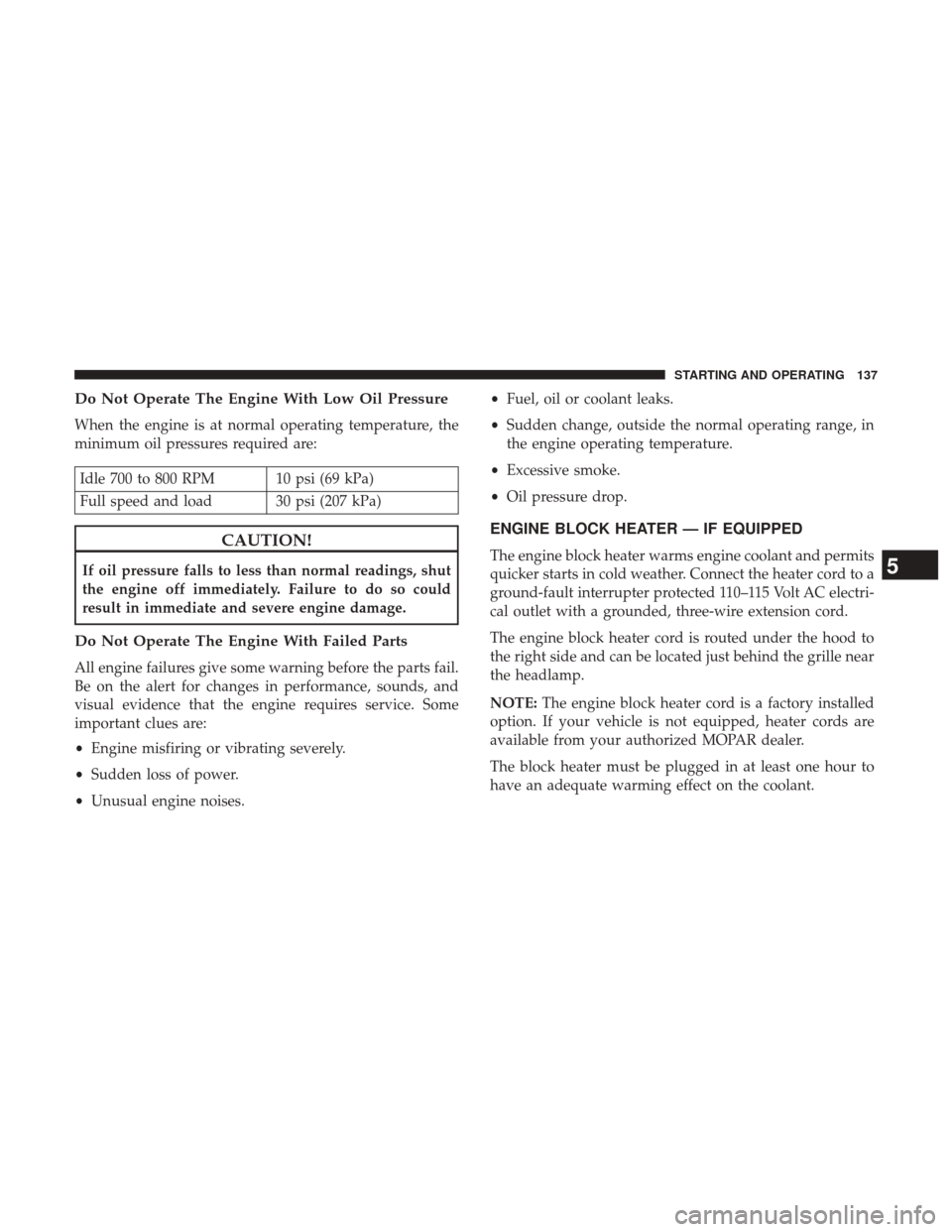
Do Not Operate The Engine With Low Oil Pressure
When the engine is at normal operating temperature, the
minimum oil pressures required are:
Idle 700 to 800 RPM 10 psi (69 kPa)
Full speed and load 30 psi (207 kPa)
CAUTION!
If oil pressure falls to less than normal readings, shut
the engine off immediately. Failure to do so could
result in immediate and severe engine damage.
Do Not Operate The Engine With Failed Parts
All engine failures give some warning before the parts fail.
Be on the alert for changes in performance, sounds, and
visual evidence that the engine requires service. Some
important clues are:
•Engine misfiring or vibrating severely.
• Sudden loss of power.
• Unusual engine noises. •
Fuel, oil or coolant leaks.
• Sudden change, outside the normal operating range, in
the engine operating temperature.
• Excessive smoke.
• Oil pressure drop.
ENGINE BLOCK HEATER — IF EQUIPPED
The engine block heater warms engine coolant and permits
quicker starts in cold weather. Connect the heater cord to a
ground-fault interrupter protected 110–115 Volt AC electri-
cal outlet with a grounded, three-wire extension cord.
The engine block heater cord is routed under the hood to
the right side and can be located just behind the grille near
the headlamp.
NOTE: The engine block heater cord is a factory installed
option. If your vehicle is not equipped, heater cords are
available from your authorized MOPAR dealer.
The block heater must be plugged in at least one hour to
have an adequate warming effect on the coolant.5
STARTING AND OPERATING 137
Page 160 of 228
NOTE:
•If you accidentally fill the fuel tank with gasoline on
your diesel vehicle, Do not start the vehicle. If you
restart your vehicle you risk damaging the engine and
fuel system. Please call your local dealer for service.
• A maximum blend of 5% biodiesel meeting ASTM
specification D-975 may be used with your Cummins
diesel engine. (Chassis Cab models not configured with
B20 capability.)
• A maximum blend of 20% biodiesel meeting ASTM
specification D-7467 may be used with your Cummins
diesel engine. (Pickup models and Chassis Cab models
configured with B20 Capability.)
• In addition, commercially available fuel additives are
not necessary for the proper operation of your Cummins
diesel engine. However, if seasonably adjusted fuel is
not available and you are operating below 20°F (-6°C),
MOPAR Premium Diesel Fuel Treatment (or equivalent)
may be beneficial to avoid fuel gelling.
• No. 1 Ultra Low Sulfur diesel fuel should only be used
where extended arctic conditions (-10°F or -23°C) exist.Bio-Diesel Fuel Requirements
Chassis Cab Models
A maximum blend of 5% biodiesel meeting ASTM specifi-
cation D975 may be used with your Cummins diesel
engine. If operation with biodiesel blends greater than 5%
but not greater than 20% (B6-B20) is desired, the truck must
first be reconfigured by an authorized Ram dealer and the
provisions in the following section must be adhered to.
Pickup Models And Chassis Cab Models Ordered
With B20 Option
Your vehicle has been validated and approved for the use
of biodiesel in blends up to 20% (B20) provided that you
comply with the requirements outlined below. It is impor-
tant that you understand and comply with these require-
ments. Failure to comply with Oil Change requirements for
vehicles operating on biodiesel blends up to B20 will result
in premature engine wear. Such wear is not covered by the
New Vehicle Limited Warranty.
Biodiesel is a fuel produced from renewable resources
typically derived from animal fat, rapeseed oil (Rapeseed
Methyl Ester (RME) base), or soybean oil (Soy Methyl Ester
(SME or SOME) base). Biodiesel fuel has inherent limita-
tions which require that you understand and adhere to the
158 STARTING AND OPERATING
Page 161 of 228
following requirements if you use blends of biodiesel
greater then 5% but not greater than 20% (B6-B20). There
are no unique restrictions for the use of B5. Use of blends
greater than 20% is not approved. Use of blends greater
than 20% can result in engine damage. Such damage is not
covered by the New Vehicle Limited Warranty.
Fuel Quality — Must Comply With ASTM
Standards
The quality of biodiesel fuel may vary widely. Only fuel
produced by a BQ9000 supplier to the following specifica-
tions may be blended to meet biodiesel blend (B6–B20) fuel
meeting ASTM specification D-7467:
•Pretrodiesel fuel meeting ASTM specification D-975 and
biodiesel fuel (B100) meeting ASTM specification
D-6751.
Fuel Oxidation Stability — Must Use Fuel Within
Six Months Of Manufacture
Biodiesel fuel has poor oxidation stability which can result
in long term storage problems. Fuel produced to approved
ASTM standards, if stored properly, provides for protec-
tion against fuel oxidation for up to six months.
Fuel Water Separation — Must Use MOPAR/
Cummins Approved Fuel Filter Elements
You must use MOPAR/Cummins approved fuel filter
elements in both your engine mounted filter and frame
mounted filter.
Biodiesel fuel has a natural affinity to water and water
accelerates microbial growth. Your MOPAR/Cummins fil-
tration system is designed to provide adequate fuel water
separation capabilities.
Bio-Diesel Fuel Properties — Low Ambient
Temperatures
Biodiesel fuel may gel or solidify at low ambient tempera-
tures, which may pose problems for both storage and opera-
tion. Precautions can be necessary at low ambient tempera-
tures, such as storing the fuel in a heated building or a heated
storage tank, or using cold temperature additives.
Fuel In Oil Dilution — Must Adhere To Required
Oil Change Interval
Fuel dilution of lubricating oil has been observed with the
use of biodiesel fuel. Fuel in oil must not exceed 5%. To
ensure this limit is met your oil change interval must be
maintained to the following schedule:
5
STARTING AND OPERATING 159
Page 162 of 228
•Ram PickUp 2500/3500 Only — 15,000 Miles*
• Ram 3500/4500/5500 Chassis Cab — 12,500 Miles*
(*unless otherwise notified with a oil service message)
CAUTION!
•Under no circumstances should oil change intervals
exceed 15,000 miles (24 000 km) pickup or 12,500 miles
(20 000 km) chassis cab if operation occurs with greater
than 5% biodiesel blends. Oil change intervals should
not exceed 6 months in either case. Failure to comply
with these Oil Change requirements for vehicles op-
erating on biodiesel blends up to B20 may result in
premature engine wear. Such wear is not covered by
the New Vehicle Limited Warranty.
• B20 Biodiesel capable: The engine may suffer severe
damage if operated with concentrations of Biodiesel
higher than 20%.
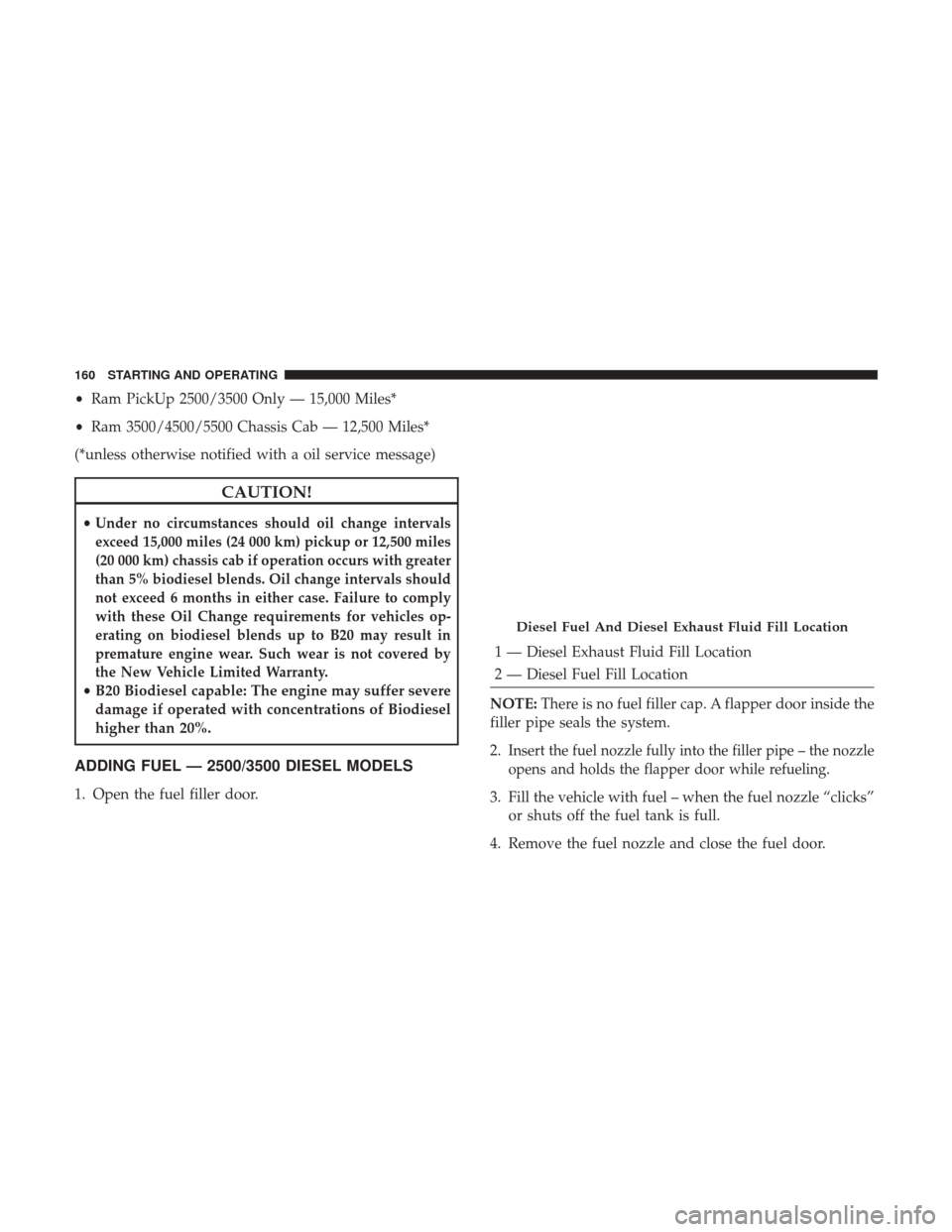
ADDING FUEL — 2500/3500 DIESEL MODELS
1. Open the fuel filler door.
1 — Diesel Exhaust Fluid Fill Location
2 — Diesel Fuel Fill Location
NOTE: There is no fuel filler cap. A flapper door inside the
filler pipe seals the system.
2.
Insert the fuel nozzle fully into the filler pipe – the nozzle
opens and holds the flapper door while refueling.
3. Fill the vehicle with fuel – when the fuel nozzle “clicks” or shuts off the fuel tank is full.
4. Remove the fuel nozzle and close the fuel door.
Diesel Fuel And Diesel Exhaust Fluid Fill Location
160 STARTING AND OPERATING
Page 179 of 228
Checking the oil while the vehicle is on level ground will
improve the accuracy of the oil level readings. Add oil only
when the level on the dipstick is below the “ADD” mark.
The total capacity from the ADD mark to the Full mark is
2 qts (1.9L).
CAUTION!
Overfilling or underfilling the crankcase will cause oil
aeration or loss of oil pressure. This could damage your
engine.
Never operate the engine with oil level below the “ADD”
mark or above the upper “SAFE” mark.
Change Engine Oil
Refer to the “Maintenance Schedule” for the proper main-
tenance intervals.
Engine Oil Selection
For best performance and maximum protection under all
types of operating conditions, the manufacturer only rec-
ommends engine oils that are API CJ-4 certified and meet
the requirements of FCA LLC. Use MOPAR or an equiva-
lent oil meeting FCA Material Standard MS-10902. Prod-
ucts meeting Cummins CES 20081 may also be used. The
identification of these engine oils are typically located on
the back of the oil container.
Engine Oil Dipstick
1 — ADD Range
2—FullMark
3 — SAFE Range7
MAINTAINING YOUR VEHICLE 177
Page 180 of 228
American Petroleum Institute (API) Engine Oil
Identification Symbol
This symbol means that the oil has been
certified by the American Petroleum In-
stitute (API). The manufacturer only rec-
ommends API Certified engine oils.
Oils with a high ash content may produce damaging
deposits on cylinder head valves and/or aftertreatment
system damage. A maximum sulfated ash content of 1.00
mass % is recommended for all oil used in the engine.
The same oil change interval is to be followed for synthetic
oil as for petroleum based oil. Also, synthetic oil must meet
the same performance specifications as petroleum oil.
CAUTION!
Do not use chemical flushes in your engine oil as the
chemicals can damage your engine. Such damage is not
covered by the New Vehicle Limited Warranty.
Engine Oil Viscosity (SAE Grade)
In ambient temperatures above 0°F (-18°C), we recommend
you use SAE 15W-40 engine oil such as MOPAR, Shell
Rotella and Shell Rimula that meets FCA Material Standard
MS-10902 and the API CJ-4 engine oil category is required.
Products meeting Cummins CES 20081 may also be used.
The identification of these engine oils is typically located
on the back of the oil container.
In ambient temperatures below 0°F (-18°C), SAE 5W-40 we
recommend you use syntheticengine oil such as MOPAR,
Shell Rotella and Shell Rimula that meets FCA Material
Standard MS-10902 and the API CJ-4 engine oil category is
required.
CAUTION!
Failure to use SAE 5W-40 synthetic engine oil in
ambient temperatures below 0°F (-18°C) could result in
severe engine damage.
178 MAINTAINING YOUR VEHICLE