service Ram 2500 2017 Diesel Supplement
[x] Cancel search | Manufacturer: RAM, Model Year: 2017, Model line: 2500, Model: Ram 2500 2017Pages: 228, PDF Size: 1.35 MB
Page 42 of 228
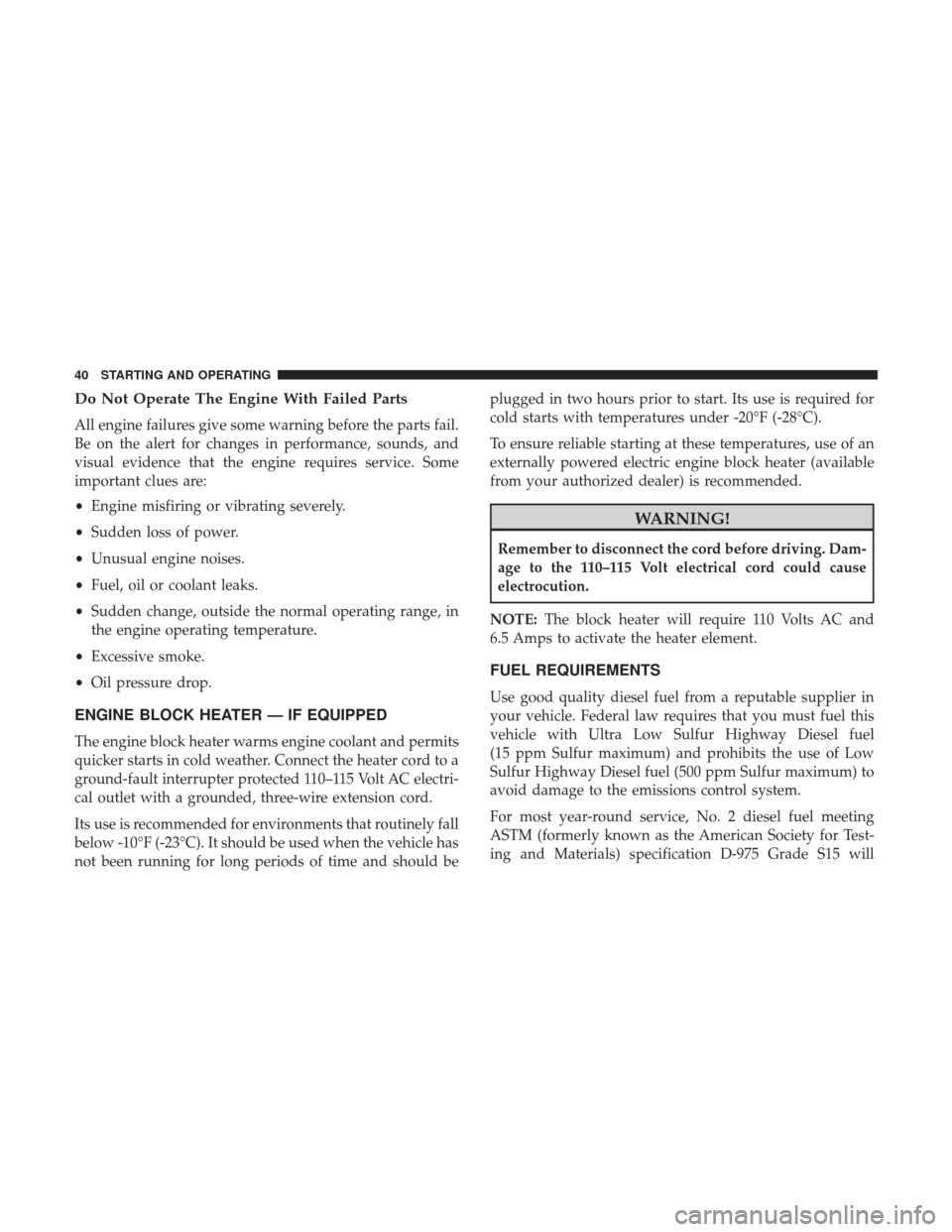
Do Not Operate The Engine With Failed Parts
All engine failures give some warning before the parts fail.
Be on the alert for changes in performance, sounds, and
visual evidence that the engine requires service. Some
important clues are:
•Engine misfiring or vibrating severely.
• Sudden loss of power.
• Unusual engine noises.
• Fuel, oil or coolant leaks.
• Sudden change, outside the normal operating range, in
the engine operating temperature.
• Excessive smoke.
• Oil pressure drop.
ENGINE BLOCK HEATER — IF EQUIPPED
The engine block heater warms engine coolant and permits
quicker starts in cold weather. Connect the heater cord to a
ground-fault interrupter protected 110–115 Volt AC electri-
cal outlet with a grounded, three-wire extension cord.
Its use is recommended for environments that routinely fall
below -10°F (-23°C). It should be used when the vehicle has
not been running for long periods of time and should be plugged in two hours prior to start. Its use is required for
cold starts with temperatures under -20°F (-28°C).
To ensure reliable starting at these temperatures, use of an
externally powered electric engine block heater (available
from your authorized dealer) is recommended.
WARNING!
Remember to disconnect the cord before driving. Dam-
age to the 110–115 Volt electrical cord could cause
electrocution.
NOTE: The block heater will require 110 Volts AC and
6.5 Amps to activate the heater element.
FUEL REQUIREMENTS
Use good quality diesel fuel from a reputable supplier in
your vehicle. Federal law requires that you must fuel this
vehicle with Ultra Low Sulfur Highway Diesel fuel
(15 ppm Sulfur maximum) and prohibits the use of Low
Sulfur Highway Diesel fuel (500 ppm Sulfur maximum) to
avoid damage to the emissions control system.
For most year-round service, No. 2 diesel fuel meeting
ASTM (formerly known as the American Society for Test-
ing and Materials) specification D-975 Grade S15 will
40 STARTING AND OPERATING
Page 43 of 228
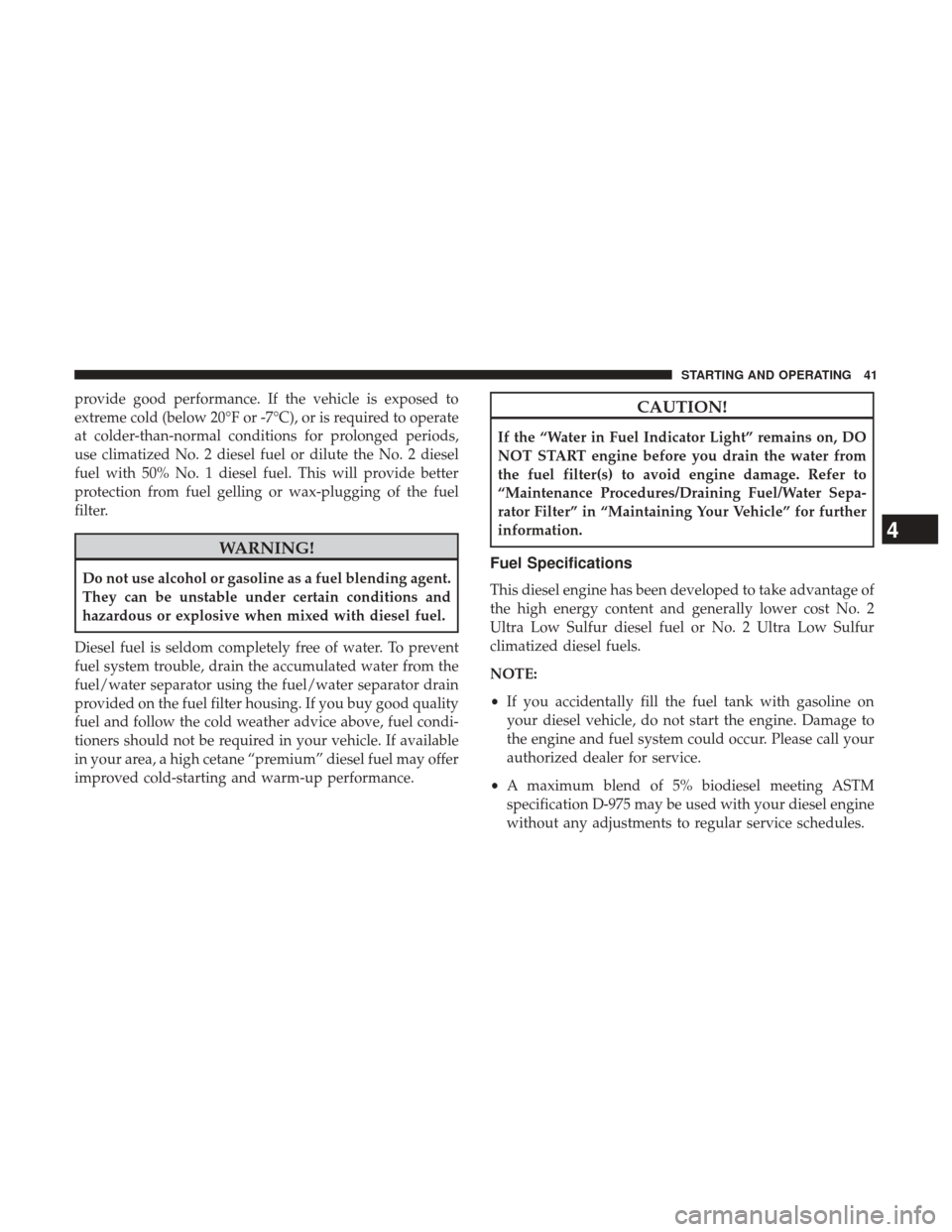
provide good performance. If the vehicle is exposed to
extreme cold (below 20°F or -7°C), or is required to operate
at colder-than-normal conditions for prolonged periods,
use climatized No. 2 diesel fuel or dilute the No. 2 diesel
fuel with 50% No. 1 diesel fuel. This will provide better
protection from fuel gelling or wax-plugging of the fuel
filter.
WARNING!
Do not use alcohol or gasoline as a fuel blending agent.
They can be unstable under certain conditions and
hazardous or explosive when mixed with diesel fuel.
Diesel fuel is seldom completely free of water. To prevent
fuel system trouble, drain the accumulated water from the
fuel/water separator using the fuel/water separator drain
provided on the fuel filter housing. If you buy good quality
fuel and follow the cold weather advice above, fuel condi-
tioners should not be required in your vehicle. If available
in your area, a high cetane “premium” diesel fuel may offer
improved cold-starting and warm-up performance.
CAUTION!
If the “Water in Fuel Indicator Light” remains on, DO
NOT START engine before you drain the water from
the fuel filter(s) to avoid engine damage. Refer to
“Maintenance Procedures/Draining Fuel/Water Sepa-
rator Filter” in “Maintaining Your Vehicle” for further
information.
Fuel Specifications
This diesel engine has been developed to take advantage of
the high energy content and generally lower cost No. 2
Ultra Low Sulfur diesel fuel or No. 2 Ultra Low Sulfur
climatized diesel fuels.
NOTE:
• If you accidentally fill the fuel tank with gasoline on
your diesel vehicle, do not start the engine. Damage to
the engine and fuel system could occur. Please call your
authorized dealer for service.
• A maximum blend of 5% biodiesel meeting ASTM
specification D-975 may be used with your diesel engine
without any adjustments to regular service schedules.
4
STARTING AND OPERATING 41
Page 52 of 228
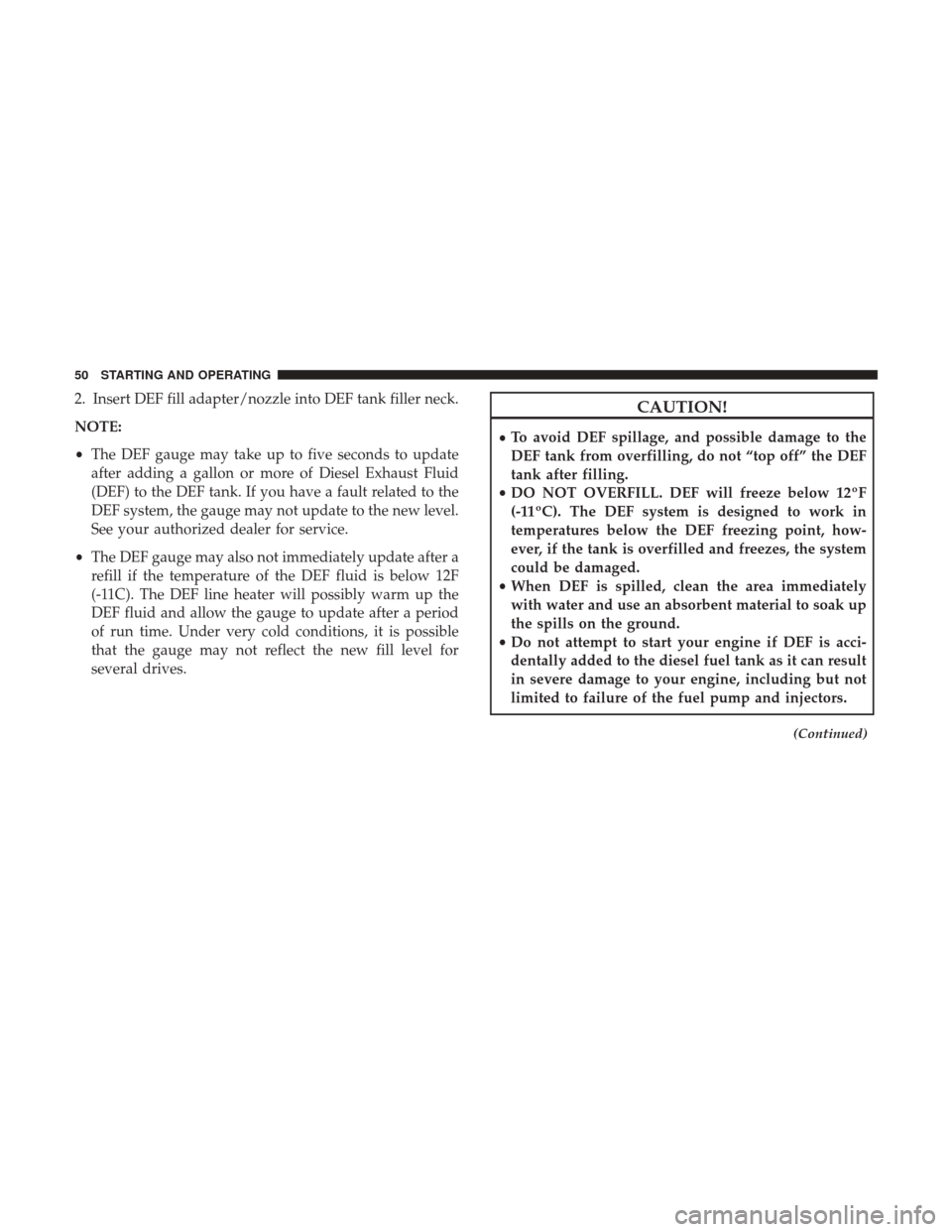
2. Insert DEF fill adapter/nozzle into DEF tank filler neck.
NOTE:
•The DEF gauge may take up to five seconds to update
after adding a gallon or more of Diesel Exhaust Fluid
(DEF) to the DEF tank. If you have a fault related to the
DEF system, the gauge may not update to the new level.
See your authorized dealer for service.
• The DEF gauge may also not immediately update after a
refill if the temperature of the DEF fluid is below 12F
(-11C). The DEF line heater will possibly warm up the
DEF fluid and allow the gauge to update after a period
of run time. Under very cold conditions, it is possible
that the gauge may not reflect the new fill level for
several drives.CAUTION!
• To avoid DEF spillage, and possible damage to the
DEF tank from overfilling, do not “top off” the DEF
tank after filling.
• DO NOT OVERFILL. DEF will freeze below 12ºF
(-11ºC). The DEF system is designed to work in
temperatures below the DEF freezing point, how-
ever, if the tank is overfilled and freezes, the system
could be damaged.
• When DEF is spilled, clean the area immediately
with water and use an absorbent material to soak up
the spills on the ground.
• Do not attempt to start your engine if DEF is acci-
dentally added to the diesel fuel tank as it can result
in severe damage to your engine, including but not
limited to failure of the fuel pump and injectors.
(Continued)
50 STARTING AND OPERATING
Page 57 of 228
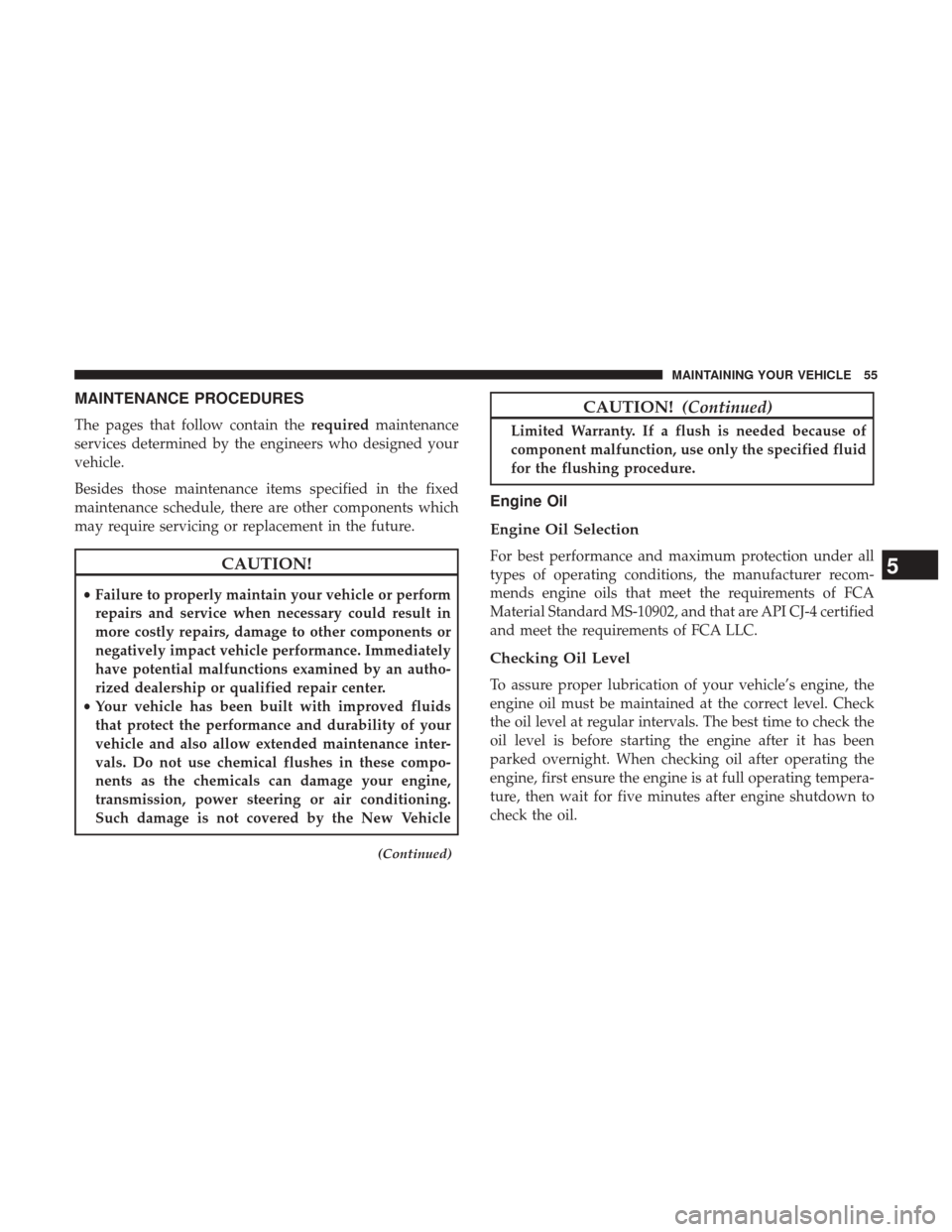
MAINTENANCE PROCEDURES
The pages that follow contain therequiredmaintenance
services determined by the engineers who designed your
vehicle.
Besides those maintenance items specified in the fixed
maintenance schedule, there are other components which
may require servicing or replacement in the future.
CAUTION!
• Failure to properly maintain your vehicle or perform
repairs and service when necessary could result in
more costly repairs, damage to other components or
negatively impact vehicle performance. Immediately
have potential malfunctions examined by an autho-
rized dealership or qualified repair center.
• Your vehicle has been built with improved fluids
that protect the performance and durability of your
vehicle and also allow extended maintenance inter-
vals. Do not use chemical flushes in these compo-
nents as the chemicals can damage your engine,
transmission, power steering or air conditioning.
Such damage is not covered by the New Vehicle
(Continued)
CAUTION! (Continued)
Limited Warranty. If a flush is needed because of
component malfunction, use only the specified fluid
for the flushing procedure.
Engine Oil
Engine Oil Selection
For best performance and maximum protection under all
types of operating conditions, the manufacturer recom-
mends engine oils that meet the requirements of FCA
Material Standard MS-10902, and that are API CJ-4 certified
and meet the requirements of FCA LLC.
Checking Oil Level
To assure proper lubrication of your vehicle’s engine, the
engine oil must be maintained at the correct level. Check
the oil level at regular intervals. The best time to check the
oil level is before starting the engine after it has been
parked overnight. When checking oil after operating the
engine, first ensure the engine is at full operating tempera-
ture, then wait for five minutes after engine shutdown to
check the oil.
5
MAINTAINING YOUR VEHICLE 55
Page 59 of 228
CAUTION!(Continued)
into the atmosphere. The durability of your engine and
life expectancy of this diesel particulate filter emission
device is highly dependent on the use of the correct
engine oil.
We recommend you use 5W-40 syntheticengine oil such as
MOPAR or Shell Rotella that meets FCA Material Standard
MS-10902 and the API CJ-4 engine oil category is required.
Materials Added To Engine Oil
The manufacturer strongly recommends against the addi-
tion of any additives (other than leak detection dyes) to the
engine oil. Engine oil is an engineered product and its
performance may be impaired by supplemental additives.
Engine Oil Filter
Refer to “Fluids, Lubricants, And Genuine Parts” in “Main-
taining Your Vehicle” for further information. The engine
oil filter should be changed at every engine oil change.
Disposing Of Used Engine Oil And Oil Filters
Care should be taken in disposing of used engine oil and
oil filters from your vehicle. Used oil and oil filters,
indiscriminately discarded, can present a problem to the environment. Contact your authorized dealer, service sta-
tion or governmental agency for advice on how and where
used oil and oil filters can be safely discarded in your area.
Engine Air Cleaner Filter
WARNING!
The air induction system (air cleaner, hoses, etc.) pro-
vides a measure of protection. Do not remove the air
induction system (air cleaner, hoses, etc.) unless such
removal is necessary for repair or maintenance. Make
sure that no one is near the engine compartment before
starting the vehicle with the air induction system (air
cleaner, hoses, etc.) removed. Failure to do so can result
in serious personal injury.
CAUTION!
All air entering the engine intake must be filtered. The
abrasive particles in unfiltered air will cause rapid
wear to engine components.
Refer to the “Maintenance Schedule” for the proper main-
tenance intervals.
5
MAINTAINING YOUR VEHICLE 57
Page 60 of 228
CAUTION!
Many aftermarket performance air filter elements do
not adequately filter the air entering the engine. Use of
such filters can severely damage your engine.
Engine Air Cleaner Filter Selection
The quality of replacement engine air cleaner filters varies
considerably. Only high quality filters should be used to
assure most efficient service. MOPAR engine air cleaner
filters are a high quality filter and are recommended.
Engine Air Cleaner Filter Inspection and
Replacement
Inspect engine air cleaner filter for dirt and or debris, if you
find evidence of either dirt or debris you should change
your air cleaner filter.
Engine Air Cleaner Filter Removal
1. Release the spring clips from the air cleaner cover.2. Lift the air cleaner cover to access the air cleaner filter.
3.0 Diesel Air Cleaner Filter Cover
1 — Air Cleaner Filter Cover
2 — Spring Clips
58 MAINTAINING YOUR VEHICLE
Page 63 of 228
in the ON position, there may be a problem with your
water separator wiring or sensor. See your authorized
dealer for service.
Upon proper draining of the water from the fuel filter, the
“Water In Fuel Indicator Light” will remain illuminated for
approximately 10 seconds. If the water was drained while
the engine was running, the “Water In Fuel Indicator
Light” may remain on for approximately three minutes.
NOTE:Care should be taken in disposing of used fluids
from your vehicle. Used fluids, indiscriminately discarded,
can present a problem to the environment. Contact an
authorized dealer, service station, or government agency
for advice on recycling programs and for where used fluids
and filters can be properly disposed of in your area.
Drain the fuel/water separator filter when the “Water In
Fuel Indicator Light” is ON. Within 10 minutes of vehicle
shutdown, turn the filter drain valve (located on the
bottom of the filter housing) counterclockwise to drain
fuel/water, then turn the ignition switch to the ON posi-
tion, and allow any accumulated water to drain. Leave the
drain valve open until all water and contaminants have
been removed. When clean fuel is visible, close the drain
valve by turning it clockwise, and turn the ignition switch
to OFF. If more than two ounces or 60 milliliters of fuel have been
drained, follow the directions for “Priming If The Engine
Has Run Out Of Fuel.”
Underbody Mounted Fuel Filter Replacement
NOTE:
Using a fuel filter that does not meet the manufac-
turer’s filtration and water separating requirements can
severely impact fuel system life and reliability.
CAUTION!
• Diesel fuel will damage blacktop paving surfaces.
Drain the filter into an appropriate container.
• Do not prefill the fuel filter when installing a new
fuel filter. There is a possibility debris could be
introduced into the fuel filter during this action. It is
best to install the filter dry and allow the in-tank lift
pump to prime the fuel system.
5
MAINTAINING YOUR VEHICLE 61
Page 64 of 228
1 — Water in Fuel Drain
2 — Fuel Filter Access
1. Turn engine off.
2. Place a drain pan under the fuel filter assembly.
3. Open the water drain valve, and let any accumulated water drain.
4. Close the water drain valve. 5. Remove bottom cover using a strap wrench. Rotate
counterclockwise for removal. Remove the used o-ring
and discard it.
6. Remove the used filter cartridge from the housing and dispose of it according to your local regulations.
7. Wipe the sealing surfaces of the lid and housing clean.
8. Install a new o-ring into the ring groove on the filter housing and lubricate with clean engine oil.
NOTE: WIF (Water In Fuel) sensor is re-usable. Service kit
comes with new o-ring for filter canister and WIF sensor.
Priming If The Engine Has Run Out Of Fuel
WARNING!
Do not open the high pressure fuel system with the
engine running. Engine operation causes high fuel
pressure. High pressure fuel spray can cause serious
injury or death.
1. Add a substantial amount of fuel to the tank, approxi- mately 2 to 5 gal (8L to 19L).
Fuel Filter Assembly
62 MAINTAINING YOUR VEHICLE
Page 71 of 228
Charge Air Cooler — Inter-Cooler
The charge air cooler is positioned in front of the radiator
and the air conditioner condenser. Air enters the engine
through the air cleaner and passes through the turbo-
charger, where it is pressurized. This pressurized air rap-
idly reaches high temperature. The air is then directed
through a hose to the charge air cooler and through another
hose to the intake manifold of the engine. This cooling
process enables more efficient burning of fuel resulting in
fewer emissions.
To guarantee optimum performance of the system, keep
the surfaces of the charge air cooler, condenser and radiator
clean and free of debris. Periodically check the hoses
leading to and from the charge air cooler for cracks or loose
clamps resulting in loss of pressure and reduced engine
performance.
Brake System
Brake Master Cylinder — Brake Fluid Level Check
The fluid level of the master cylinder should be checked
when performing under the hood service, or immediately
if the “Brake System Warning Light” indicates system
failure.The brake master cylinder has a translucent plastic reser-
voir. On the outboard side of the reservoir, there is a
“MAX” mark and a “MIN” mark. The fluid level must be
kept within these two marks. Do not add fluid above the
full mark because leakage may occur at the cap.
With disc brakes, the fluid level can be expected to fall as
the brake linings wear. However, an unexpected drop in
fluid level may be caused by a leak and a system check
should be conducted.
Refer to “Fluids, Lubricants, And Genuine Parts” in “Main-
taining Your Vehicle” for further information.
WARNING!
•
Use only manufacturer’s recommended brake fluid.
Refer to “Fluids, Lubricants, and Genuine Parts” in
“Maintaining Your Vehicle” for further information.
Using the wrong type of brake fluid can severely
damage your brake system and/or impair its perfor-
mance. The proper type of brake fluid for your
vehicle is also identified on the original factory
installed hydraulic master cylinder reservoir.
(Continued)
5
MAINTAINING YOUR VEHICLE 69
Page 75 of 228
ComponentFluid, Lubricant, or Genuine Part
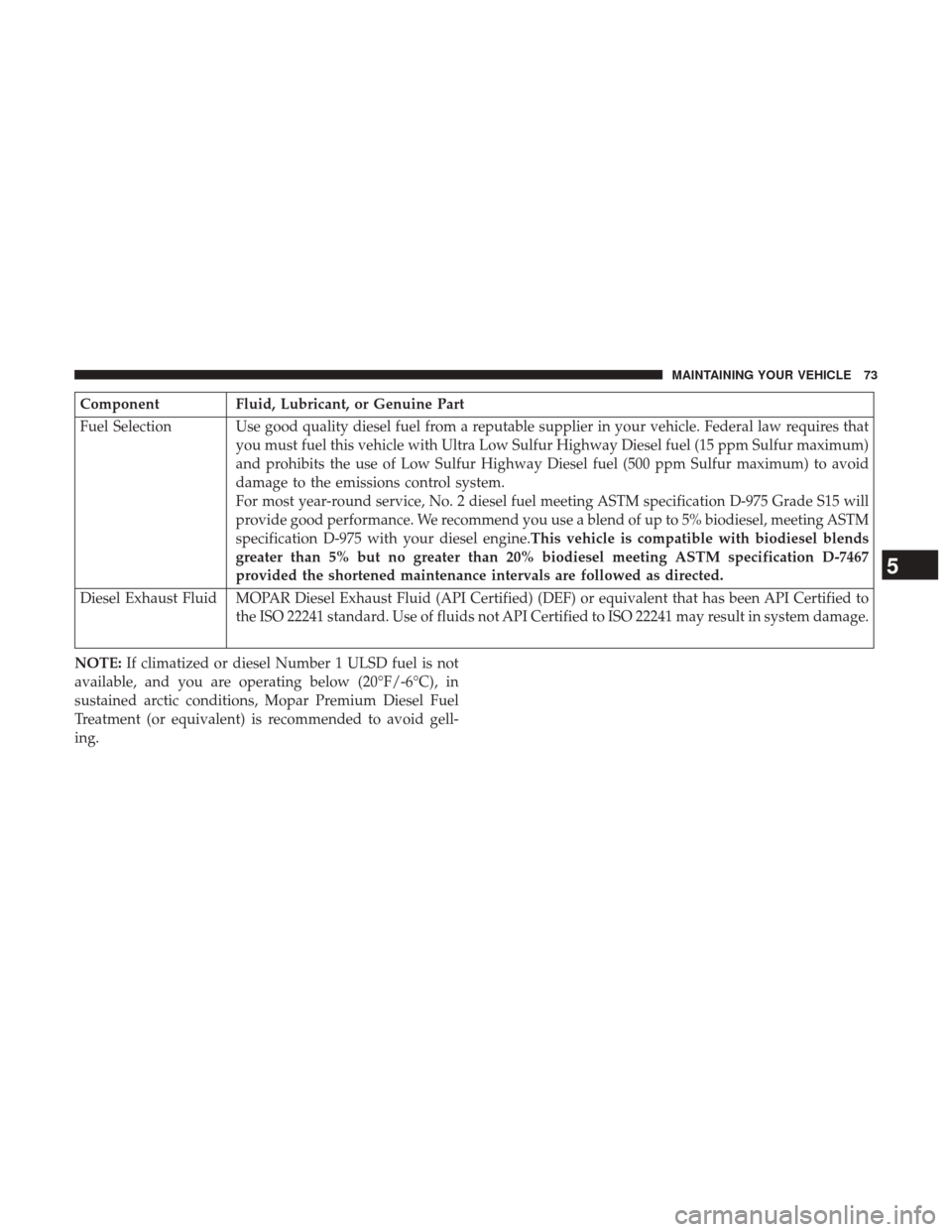
Fuel Selection Use good quality diesel fuel from a reputable supplier in your vehicle. Federal law requires that you must fuel this vehicle with Ultra Low Sulfur Highway Diesel fuel (15 ppm Sulfur maximum)
and prohibits the use of Low Sulfur Highway Diesel fuel (500 ppm Sulfur maximum) to avoid
damage to the emissions control system.
For most year-round service, No. 2 diesel fuel meeting ASTM specification D-975 Grade S15 will
provide good performance. We recommend you use a blend of up to 5% biodiesel, meeting ASTM
specification D-975 with your diesel engine.This vehicle is compatible with biodiesel blends
greater than 5% but no greater than 20% biodiesel meeting ASTM specification D-7467
provided the shortened maintenance intervals are followed as directed.
Diesel Exhaust Fluid MOPAR Diesel Exhaust Fluid (API Certified) (DEF) or equivalent that has been API Certified to the ISO 22241 standard. Use of fluids not API Certified to ISO 22241 may result in system damage.
NOTE: If climatized or diesel Number 1 ULSD fuel is not
available, and you are operating below (20°F/-6°C), in
sustained arctic conditions, Mopar Premium Diesel Fuel
Treatment (or equivalent) is recommended to avoid gell-
ing.
5
MAINTAINING YOUR VEHICLE 73