transmission Ram 2500 2017 Diesel Supplement
[x] Cancel search | Manufacturer: RAM, Model Year: 2017, Model line: 2500, Model: Ram 2500 2017Pages: 228, PDF Size: 1.35 MB
Page 146 of 228
WARNING!(Continued)
•Never leave children alone in a vehicle, or with
access to an unlocked vehicle. Allowing children to
be in a vehicle unattended is dangerous for a number
of reasons. A child or others could be seriously or
fatally injured. Children should be warned not to
touch the parking brake, brake pedal or the trans-
mission gear selector.
• Do not leave the key fob in or near the vehicle (or in
a location accessible to children), and do not leave
the ignition (in a vehicle equipped with Keyless
Enter-N-Go) in the ACC or ON/RUN mode. A child
could operate power windows, other controls, or
move the vehicle.
CAUTION!
• Before moving the transmission gear selector out of
PARK, you must turn the ignition to the ON/RUN
mode, and also press the brake pedal. Otherwise,
damage to the gear selector could result.
• DO NOT race the engine when shifting from PARK
or NEUTRAL into another gear range, as this can
damage the drivetrain. The following indicators should be used to ensure that you
have engaged the transmission into the PARK position:
•
When shifting into PARK, pull the gear selector toward
you and move it all the way counterclockwise until it
stops.
• Release the gear selector and make sure it is fully seated
in the PARK gate.
• Look at the transmission gear position display and
verify that it indicates the PARK position (P).
• With brake pedal released, verify that the gear selector
will not move out of PARK.
REVERSE (R)
This range is for moving the vehicle backward. Shift into
REVERSE only after the vehicle has come to a complete
stop.
NEUTRAL (N)
Use this range when the vehicle is standing for prolonged
periods with the engine running. The engine may be
started in this range. Apply the parking brake and shift the
transmission into PARK if you must leave the vehicle.
144 STARTING AND OPERATING
Page 147 of 228
WARNING!
Do not coast in NEUTRAL and never turn off the
ignition to coast down a hill. These are unsafe practices
that limit your response to changing traffic or road
conditions. You might lose control of the vehicle and
have a collision.
CAUTION!
Towing the vehicle, coasting, or driving for any other
reason with the transmission in NEUTRAL can cause
severe transmission damage. Refer to “Recreational
Towing” in “Starting And Operating” and “Towing A
Disabled Vehicle” in “What To Do In Emergencies” for
further information.
DRIVE (D)
This range should be used for most city and highway
driving. It provides the smoothest upshifts and downshifts,
and the best fuel economy. The transmission automatically
upshifts through underdrive first, second, and third gears,
direct fourth gear and overdrive fifth and sixth gears. The
DRIVE position provides optimum driving characteristics
under all normal operating conditions. When frequent transmission shifting occurs (such as when
operating the vehicle under heavy loading conditions, in
hilly terrain, traveling into strong head winds, or while
towing a heavy trailer), use the Electronic Range Select
(ERS) shift control (refer to “Electronic Range Select (ERS)
Operation” in this section for further information) to select
a lower gear range. Under these conditions, using a lower
gear range will improve performance and extend transmis-
sion life by reducing excessive shifting and heat buildup.
If the transmission temperature exceeds normal operating
limits, the powertrain controller will modify the transmis-
sion shift schedule and expand the range of torque con-
verter clutch engagement. This is done to prevent trans-
mission damage due to overheating.
If the transmission becomes extremely hot or is in danger
of overheating, the “Transmission Temperature Warning
Light” may illuminate and the transmission may operate
differently until the transmission cools down.
5
STARTING AND OPERATING 145
Page 148 of 228
NOTE:Use caution when operating a heavily loaded
vehicle at low speeds (such as towing a trailer up a steep
grade, or in stop-and-go traffic) during hot weather. In
these conditions, torque converter slip can impose a sig-
nificant additional heat load on the cooling system. Down-
shifting the transmission to the lowest possible gear (when
climbing a grade), or shifting to NEUTRAL (when stopped
in heavy traffic) can help to reduce this excess heat
generation.
During cold temperatures, transmission operation may be
modified depending on engine and transmission tempera-
ture as well as vehicle speed. This feature improves warm
up time of the engine and transmission to achieve maxi-
mum efficiency. Engagement of the torque converter clutch
is inhibited until the transmission fluid is warm (refer to
the “Note” under “Torque Converter Clutch” in this sec-
tion). On Pickup models with 68RFE transmission, top
overdrive gear is also inhibited until the transmission fluid
is warm, and during extremely cold temperatures (-16°F
[-27°C] or below), operation may briefly be limited to first
and direct gears only. On trucks with AS69RC transmis-
sion, fifth and sixth gears may be inhibited briefly on cold
starts below 41°F (5°C), and during very cold temperatures
(-4°F [-20°C] or below), operation may briefly be limited to
third gear only. During this condition, the ability of the vehicle to accelerate under heavily loaded conditions may
be reduced. In all cases, normal operation will resume once
the transmission temperature has risen to a suitable level.
Transmission Limp Home Mode
Transmission function is monitored electronically for ab-
normal conditions. If a condition is detected that could
result in transmission damage, Transmission Limp Home
Mode is activated. In this mode, the transmission remains
in fourth gear (for 68RFE transmission) or third gear (for
AS69RC transmission) regardless of which forward gear is
selected. If an AS69RC-equipped truck enters Limp Home
Mode at highway speeds, it will initially engage fifth gear,
until the vehicle slows to a speed where third gear can be
engaged. PARK, REVERSE, and NEUTRAL will continue
to operate. The Malfunction Indicator Light (MIL) may be
illuminated. Limp Home Mode allows the vehicle to be
driven to an authorized dealer for service without damag-
ing the transmission.
In the event of a momentary problem, the transmission can
be reset to regain all forward gears by performing the
following steps:
1. Stop the vehicle.
2. Shift the transmission into PARK.
146 STARTING AND OPERATING
Page 149 of 228
3. Turn the ignition to the OFF position.
4. Wait approximately 10 seconds.
5. Restart the engine.
6. Shift into the desired gear range. If the problem is nolonger detected, the transmission will return to normal
operation.
NOTE: Even if the transmission can be reset, we recom-
mend that you visit your authorized dealer at your earliest
possible convenience. Your authorized dealer has diagnos-
tic equipment to determine if the problem could recur.
If the transmission cannot be reset, authorized dealer
service is required.
Electronic Range Select (ERS) Operation
The Electronic Range Select (ERS) shift control allows the
driver to limit the highest available gear when the trans-
mission is in DRIVE. For example, if you set the transmis-
sion gear limit to 4 (fourth gear), the transmission will not
shift above fourth gear, but will shift through the lower
gears normally.
You can switch between DRIVE and ERS mode at any
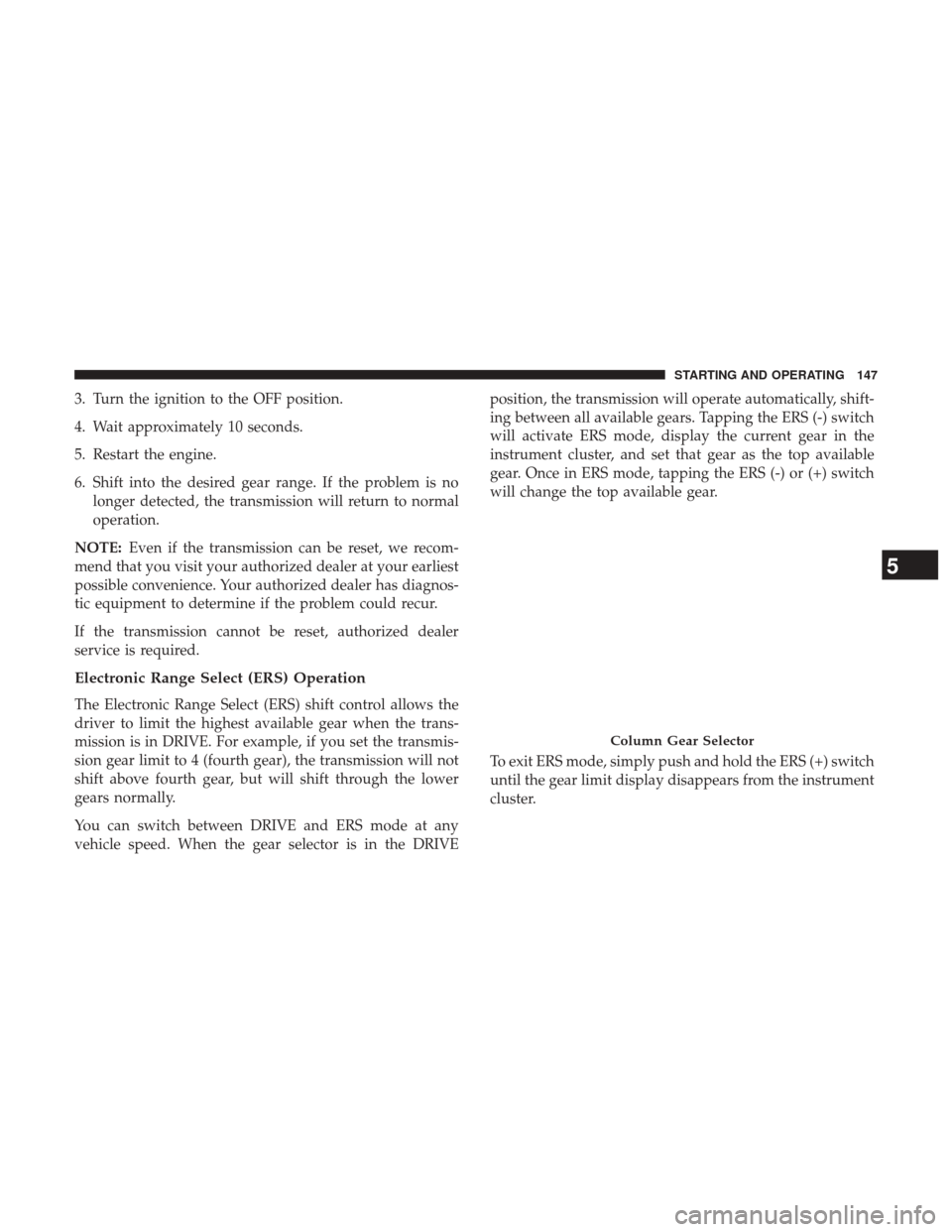
vehicle speed. When the gear selector is in the DRIVE position, the transmission will operate automatically, shift-
ing between all available gears. Tapping the ERS (-) switch
will activate ERS mode, display the current gear in the
instrument cluster, and set that gear as the top available
gear. Once in ERS mode, tapping the ERS (-) or (+) switch
will change the top available gear.
To exit ERS mode, simply push and hold the ERS (+) switch
until the gear limit display disappears from the instrument
cluster.
Column Gear Selector
5
STARTING AND OPERATING 147
Page 150 of 228
WARNING!
Do not downshift for additional engine braking on a
slippery surface. The drive wheels could lose their grip
and the vehicle could skid, causing a collision or
personal injury.
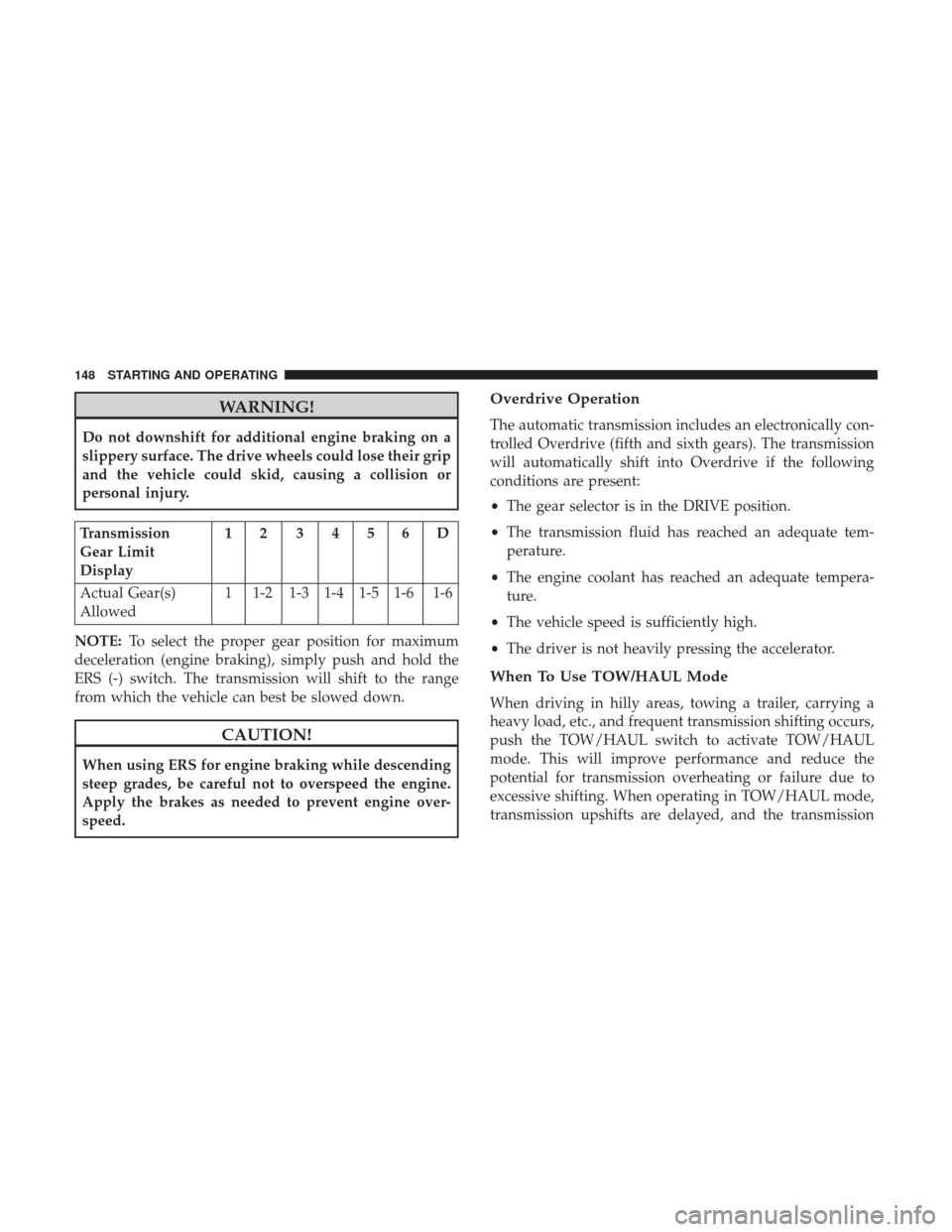
Transmission
Gear Limit
Display12 3 456D
Actual Gear(s)
Allowed 1 1-2 1-3 1-4 1-5 1-6 1-6
NOTE: To select the proper gear position for maximum
deceleration (engine braking), simply push and hold the
ERS (-) switch. The transmission will shift to the range
from which the vehicle can best be slowed down.
CAUTION!
When using ERS for engine braking while descending
steep grades, be careful not to overspeed the engine.
Apply the brakes as needed to prevent engine over-
speed.
Overdrive Operation
The automatic transmission includes an electronically con-
trolled Overdrive (fifth and sixth gears). The transmission
will automatically shift into Overdrive if the following
conditions are present:
• The gear selector is in the DRIVE position.
• The transmission fluid has reached an adequate tem-
perature.
• The engine coolant has reached an adequate tempera-
ture.
• The vehicle speed is sufficiently high.
• The driver is not heavily pressing the accelerator.
When To Use TOW/HAUL Mode
When driving in hilly areas, towing a trailer, carrying a
heavy load, etc., and frequent transmission shifting occurs,
push the TOW/HAUL switch to activate TOW/HAUL
mode. This will improve performance and reduce the
potential for transmission overheating or failure due to
excessive shifting. When operating in TOW/HAUL mode,
transmission upshifts are delayed, and the transmission
148 STARTING AND OPERATING
Page 151 of 228
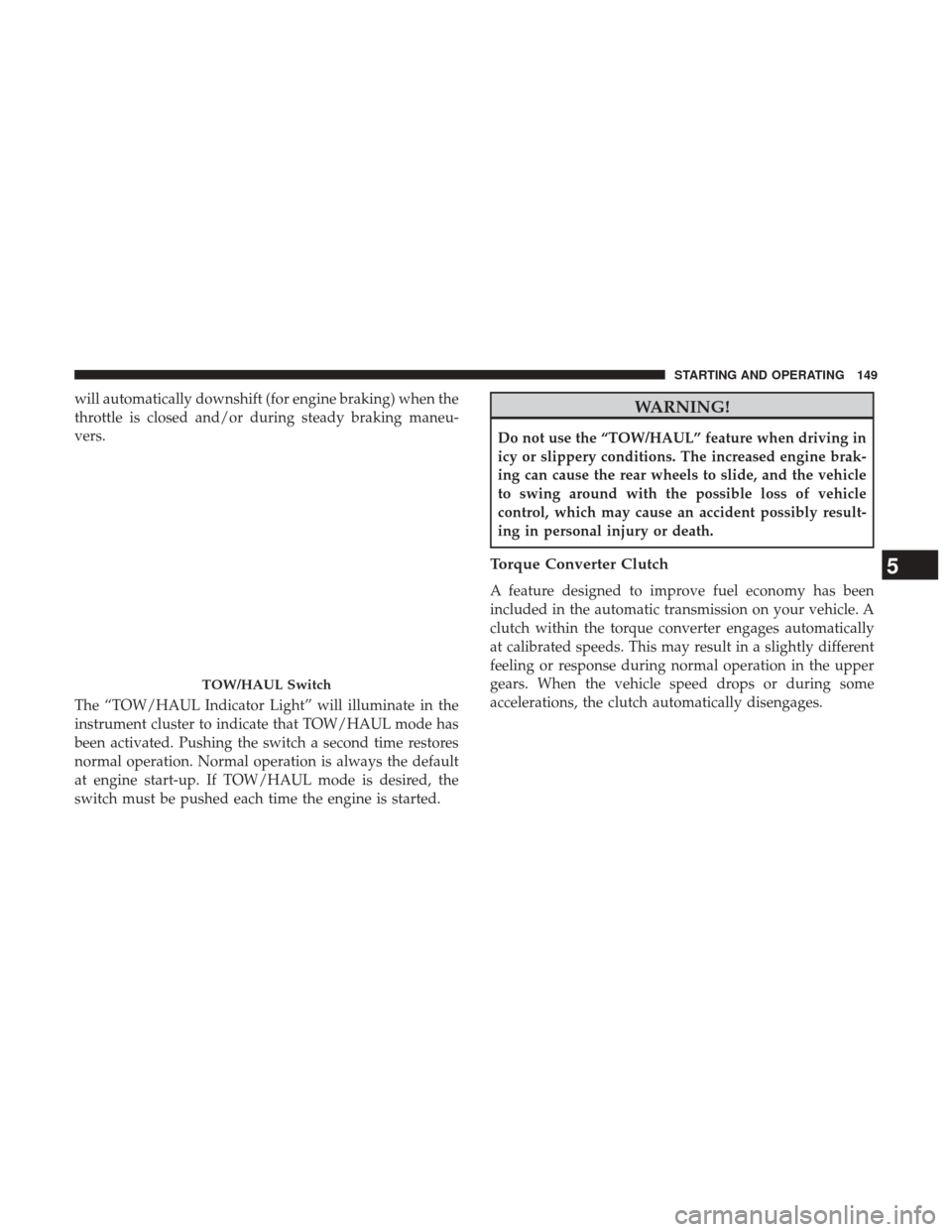
will automatically downshift (for engine braking) when the
throttle is closed and/or during steady braking maneu-
vers.
The “TOW/HAUL Indicator Light” will illuminate in the
instrument cluster to indicate that TOW/HAUL mode has
been activated. Pushing the switch a second time restores
normal operation. Normal operation is always the default
at engine start-up. If TOW/HAUL mode is desired, the
switch must be pushed each time the engine is started.WARNING!
Do not use the “TOW/HAUL” feature when driving in
icy or slippery conditions. The increased engine brak-
ing can cause the rear wheels to slide, and the vehicle
to swing around with the possible loss of vehicle
control, which may cause an accident possibly result-
ing in personal injury or death.
Torque Converter Clutch
A feature designed to improve fuel economy has been
included in the automatic transmission on your vehicle. A
clutch within the torque converter engages automatically
at calibrated speeds. This may result in a slightly different
feeling or response during normal operation in the upper
gears. When the vehicle speed drops or during some
accelerations, the clutch automatically disengages.
TOW/HAUL Switch
5
STARTING AND OPERATING 149
Page 152 of 228
NOTE:
•The torque converter clutch will not engage (and 68RFE-
equipped trucks will not shift to sixth gear), until the
transmission fluid and engine coolant are warm [usually
after 1 to 3 miles (2 to 5 km) of driving]. Because the
engine speed is higher when the torque converter clutch
is not engaged, it may seem as if the transmission is not
shifting properly when cold. This is normal. Using the
Electronic Range Select (ERS) shift control, when the
transmission is sufficiently warm, will demonstrate that
the transmission is able to shift into and out of Over-
drive.
• If the vehicle has not been driven for several days, the
first few seconds of operation after shifting the transmis-
sion into gear may seem sluggish. This is due to the fluid
partially draining from the torque converter into the
transmission. This condition is normal and will not
cause damage to the transmission. The torque converter
will refill within five seconds after starting the engine.MANUAL TRANSMISSION — IF EQUIPPED
WARNING!
You or others could be injured if you leave the vehicle
unattended without having the parking brake fully
applied. The parking brake should always be applied
when the driver is not in the vehicle, especially on an
incline.
CAUTION!
Never drive with your foot resting on the clutch pedal,
or attempt to hold the vehicle on a hill with the clutch
pedal partially engaged, as this will cause abnormal
wear on the clutch.
NOTE: During cold weather, you may experience in-
creased effort in shifting until the transmission fluid warms
up. This is normal.
150 STARTING AND OPERATING
Page 153 of 228
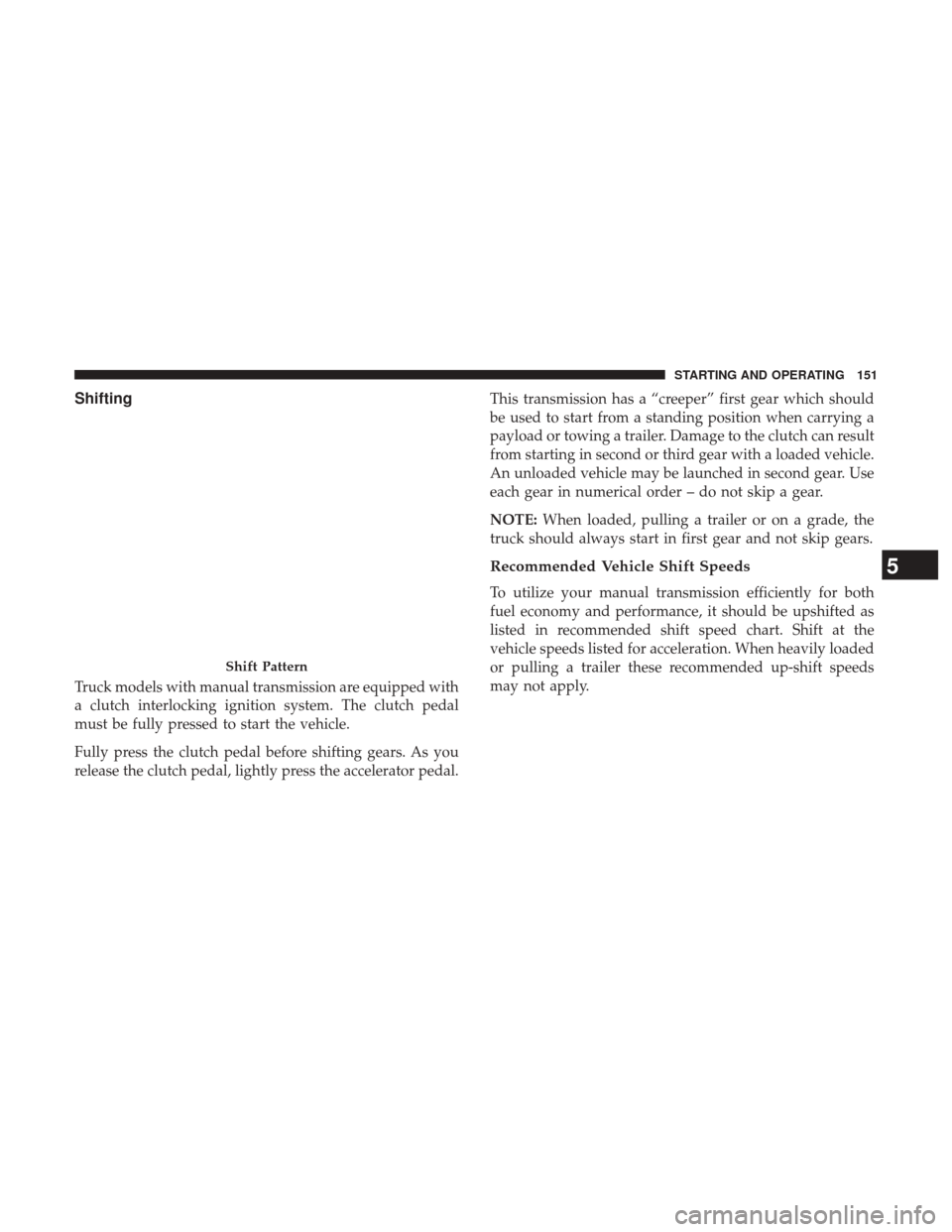
Shifting
Truck models with manual transmission are equipped with
a clutch interlocking ignition system. The clutch pedal
must be fully pressed to start the vehicle.
Fully press the clutch pedal before shifting gears. As you
release the clutch pedal, lightly press the accelerator pedal.This transmission has a “creeper” first gear which should
be used to start from a standing position when carrying a
payload or towing a trailer. Damage to the clutch can result
from starting in second or third gear with a loaded vehicle.
An unloaded vehicle may be launched in second gear. Use
each gear in numerical order – do not skip a gear.
NOTE:
When loaded, pulling a trailer or on a grade, the
truck should always start in first gear and not skip gears.
Recommended Vehicle Shift Speeds
To utilize your manual transmission efficiently for both
fuel economy and performance, it should be upshifted as
listed in recommended shift speed chart. Shift at the
vehicle speeds listed for acceleration. When heavily loaded
or pulling a trailer these recommended up-shift speeds
may not apply.
Shift Pattern
5
STARTING AND OPERATING 151
Page 155 of 228
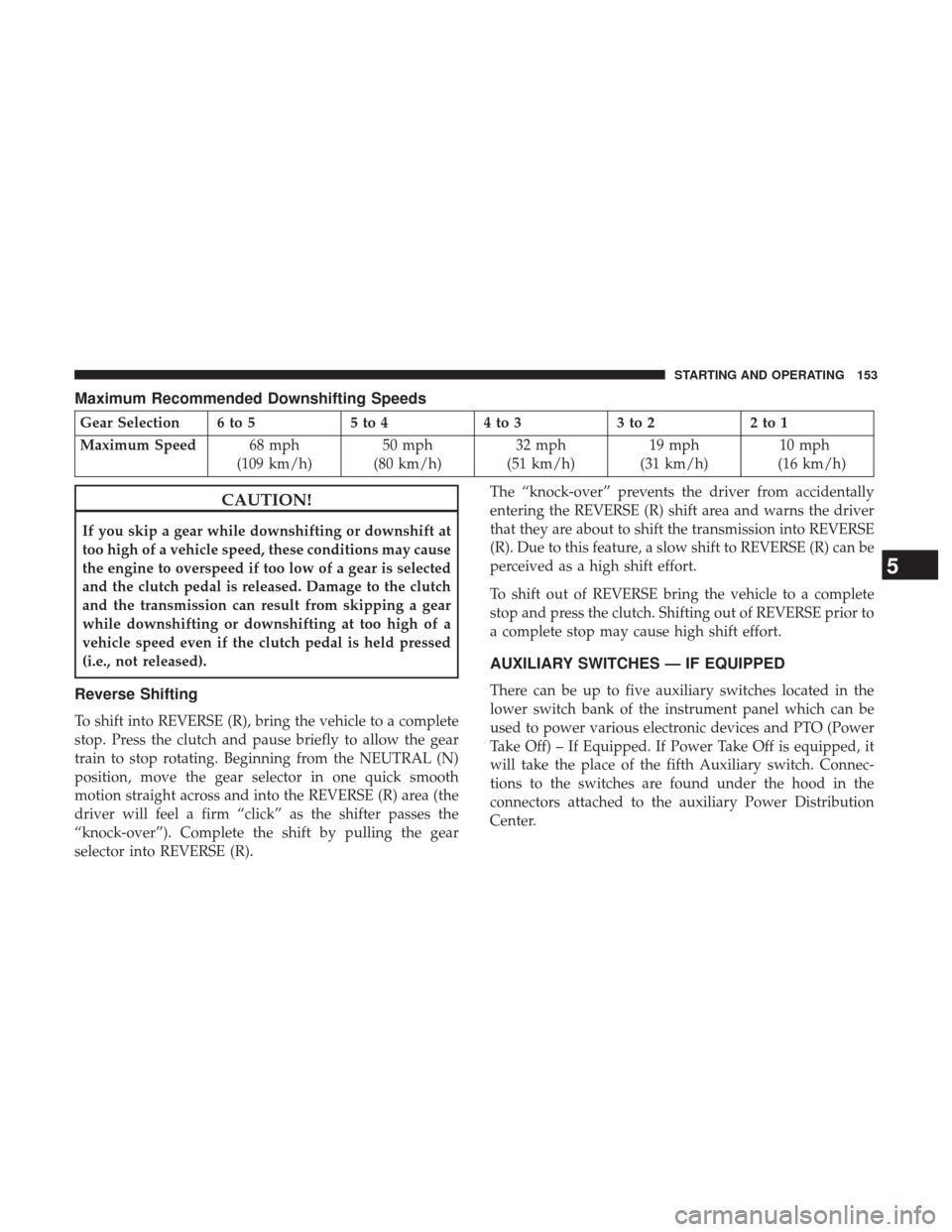
Maximum Recommended Downshifting Speeds
Gear Selection 6 to 55 to 44 to 33 to 22 to 1
Maximum Speed 68 mph
(109 km/h) 50 mph
(80 km/h) 32 mph
(51 km/h) 19 mph
(31 km/h) 10 mph
(16 km/h)
CAUTION!
If you skip a gear while downshifting or downshift at
too high of a vehicle speed, these conditions may cause
the engine to overspeed if too low of a gear is selected
and the clutch pedal is released. Damage to the clutch
and the transmission can result from skipping a gear
while downshifting or downshifting at too high of a
vehicle speed even if the clutch pedal is held pressed
(i.e., not released).
Reverse Shifting
To shift into REVERSE (R), bring the vehicle to a complete
stop. Press the clutch and pause briefly to allow the gear
train to stop rotating. Beginning from the NEUTRAL (N)
position, move the gear selector in one quick smooth
motion straight across and into the REVERSE (R) area (the
driver will feel a firm “click” as the shifter passes the
“knock-over”). Complete the shift by pulling the gear
selector into REVERSE (R). The “knock-over” prevents the driver from accidentally
entering the REVERSE (R) shift area and warns the driver
that they are about to shift the transmission into REVERSE
(R). Due to this feature, a slow shift to REVERSE (R) can be
perceived as a high shift effort.
To shift out of REVERSE bring the vehicle to a complete
stop and press the clutch. Shifting out of REVERSE prior to
a complete stop may cause high shift effort.
AUXILIARY SWITCHES — IF EQUIPPED
There can be up to five auxiliary switches located in the
lower switch bank of the instrument panel which can be
used to power various electronic devices and PTO (Power
Take Off) – If Equipped. If Power Take Off is equipped, it
will take the place of the fifth Auxiliary switch. Connec-
tions to the switches are found under the hood in the
connectors attached to the auxiliary Power Distribution
Center.
5
STARTING AND OPERATING 153
Page 156 of 228
You have the ability to configure the functionality of the
auxiliary switches via the instrument cluster display. All
switches can now be configured for setting the switch type
operation to latching or momentary, power source of either
battery or ignition, and ability to hold last state across key
cycles.
NOTE:Holding last state conditions are met when switch
type is set to latching and power source is set to ignition.
For further information on using the auxiliary switches,
please refer to the Ram Body Builders Guide by accessing
www.rambodybuilder.comand choosing the appropriate
links.
POWER TAKE OFF OPERATION — IF EQUIPPED
(CHASSIS CAB ONLY)
This vehicle when equipped with PTO Prep and either the
AS69RC automatic six-speed or G-56 manual six-speed
transmissions, will allow for an aftermarket upfit with a
transmission driven PTO (power take off). The customer
will have the ability to operate the PTO in either a
“stationary” or “mobile” mode. The vehicles will be factory
set to the “stationary” mode. To select ’mobile mode’ You
will need to enter the commercial vehicle menu on the
instrument cluster display and select mobile PTO mode. Details of the PTO selection modes and further PTO
information is available at the Ram Truck Bodybuilders
web site.
rambodybuilder.com
AS69RC Six-Speed Automatic Transmission Only
The PTO drive gear (part of the AS69RC) operates at torque
converter turbine speed. The turbine speed will be less
than engine speed when the torque converter clutch is not
engaged and will be same as engine speed when the torque
converter clutch is engaged.
Stationary Mode
To operate the PTO in this mode the vehicle must meet the
following conditions:
•
Transmission in PARK position (vehicles equipped with
automatic transmission.)
• PTO switch has been activated.
• Parking brake applied (vehicles equipped with manual
transmission).
• Brake pedal must not be applied.
• Vehicle engine must be running.
• No vehicle, brake or clutch switch faults present.
154 STARTING AND OPERATING