Ac system Ram 2500 2017 Owner's Manual
[x] Cancel search | Manufacturer: RAM, Model Year: 2017, Model line: 2500, Model: Ram 2500 2017Pages: 734, PDF Size: 7.3 MB
Page 662 of 734

To prevent freeze-up of your windshield washer system in
cold weather, select a solution or mixture that meets or
exceeds the temperature range of your climate. This rating
information can be found on most washer fluid containers.
WARNING!
Commercially available windshield washer solvents
are flammable. They could ignite and burn you. Care
must be exercised when filling or working around the
washer solution.
After the engine has warmed up, operate the defroster for
a few minutes to reduce the possibility of smearing or
freezing the fluid on the cold windshield. Windshield
washer solution used with water as directed on the con-
tainer, aids cleaning action, reduces the freezing point to
avoid line clogging, and is not harmful to paint or trim.
Exhaust System
The best protection against carbon monoxide entry into the
vehicle body is a properly maintained engine exhaust
system.
If you notice a change in the sound of the exhaust system;
or if the exhaust fumes can be detected inside the vehicle;
or when the underside or rear of the vehicle is damaged; have an authorized technician inspect the complete ex-
haust system and adjacent body areas for broken, dam-
aged, deteriorated, or mispositioned parts. Open seams or
loose connections could permit exhaust fumes to seep into
the passenger compartment. In addition, have the exhaust
system inspected each time the vehicle is raised for lubri-
cation or oil change. Replace as required.
WARNING!
•
Exhaust gases can injure or kill. They contain carbon
monoxide (CO), which is colorless and odorless.
Breathing it can make you unconscious and can
eventually poison you. To avoid breathing CO, refer
to “Safety Tips/Exhaust Gas” in “Things To Know
Before Starting Your Vehicle” for further informa-
tion.
• A hot exhaust system can start a fire if you park over
materials that can burn. Such materials might be
grass or leaves coming into contact with your exhaust
system. Do not park or operate your vehicle in areas
where your exhaust system can contact anything that
can burn.
660 MAINTAINING YOUR VEHICLE
Page 664 of 734
Cooling System
WARNING!
You or others can be badly burned by hot engine
coolant (antifreeze) or steam from your radiator. If you
see or hear steam coming from under the hood, do not
open the hood until the radiator has had time to cool.
Never try to open a cooling system pressure cap when
the radiator is hot.
Engine Coolant Checks
Check the engine coolant (antifreeze) protection every 12
months (before the onset of freezing weather, where appli-
cable). If the engine coolant (antifreeze) is dirty or rusty in
appearance, the system should be drained, flushed and
refilled with fresh coolant. Check the front of the A/C
condenser (if equipped) or radiator for any accumulation
of bugs, leaves, etc. If dirty, clean by gently spraying water
from a garden hose vertically down the face of the A/C
condenser (if equipped) or the back of the radiator core.
Check the engine cooling system hoses for brittle rubber,
cracking, tears, cuts and tightness of the connection at the
coolant recovery bottle and radiator. Inspect the entire
system for leaks.DO NOT REMOVE THE COOLANT PRESSURE CAP
WHEN THE COOLING SYSTEM IS HOT.
Cooling System — Drain Flush And Refill
If the engine coolant (antifreeze) is dirty or contains a
considerable amount of sediment, clean and flush with a
reliable cooling system cleaner. Follow with a thorough
rinsing to remove all deposits and chemicals. Properly
dispose of old engine coolant (antifreeze).
Refer to the “Maintenance Schedule” for the proper main-
tenance intervals.
Selection Of Coolant
Refer to “Fluids, Lubricants, And Genuine Parts” in “Main-
taining Your Vehicle” for further information.
CAUTION!
•Mixing of engine coolant (antifreeze) other than speci-
fied Organic Additive Technology (OAT) engine cool-
ant (antifreeze), may result in engine damage and may
decrease corrosion protection. Organic Additive Tech-
nology (OAT) engine coolant is different and should
(Continued)
662 MAINTAINING YOUR VEHICLE
Page 665 of 734
CAUTION!(Continued)
not be mixed with Hybrid Organic Additive Technol-
ogy (HOAT) engine coolant (antifreeze) or any “glob-
ally compatible” coolant (antifreeze). If a non-OAT
engine coolant (antifreeze) is introduced into the cool-
ing system in an emergency, the cooling system will
need to be drained, flushed, and refilled with fresh
OAT coolant (conforming to MS.90032), by an autho-
rized dealer as soon as possible.
•Do not use water alone or alcohol-based engine
coolant (antifreeze) products. Do not use additional
rust inhibitors or antirust products, as they may not
be compatible with the engine coolant and may plug
the radiator.
• This vehicle has not been designed for use with
propylene glycol-based engine coolant (antifreeze).
Use of propylene glycol-based engine coolant (anti-
freeze) is not recommended.
Adding Coolant
Your vehicle has been built with an improved engine
coolant (OAT coolant conforming to MS.90032) that allows
extended maintenance intervals. This engine coolant (anti-
freeze) can be used up to ten years or 150,000 miles (240,000 km) before replacement. To prevent reducing this
extended maintenance period, it is important that you use
the same engine coolant (OAT coolant conforming to
MS.90032) throughout the life of your vehicle.
Please review these recommendations for using Organic
Additive Technology (OAT) engine coolant (antifreeze)
that meets the requirements of FCA Material Standard
MS.90032. When adding engine coolant (antifreeze):
•
We recommend using MOPAR Antifreeze/Coolant 10
Year/150,000 Mile Formula OAT (Organic Additive
Technology) that meets the requirements of FCA Mate-
rial Standard MS.90032.
• Mix a minimum solution of 50% OAT engine coolant
that meets the requirements of FCA Material Standard
MS.90032 and distilled water. Use higher concentrations
(not to exceed 70%) if temperatures below 34°F (37°C)
are anticipated. Please contact your authorized dealer
for assistance.
• Use only high purity water such as distilled or deionized
water when mixing the water/engine coolant (anti-
freeze) solution. The use of lower quality water will
reduce the amount of corrosion protection in the engine
cooling system.
7
MAINTAINING YOUR VEHICLE 663
Page 666 of 734
NOTE:
•It is the owner’s responsibility to maintain the proper
level of protection against freezing according to the
temperatures occurring in the area where the vehicle is
operated.
• Some vehicles require special tools to add coolant prop-
erly. Failure to fill these systems properly could lead to
severe internal engine damage. If any coolant is needed
to be added to the system, please contact your local
authorized dealer.
•
Mixing engine coolant (antifreeze) types is not recom-
mended and can result in cooling system damage. If
HOAT and OAT coolant are mixed in an emergency, have
a authorized dealer drain, flush, and refill with OAT
coolant (conforming to MS.90032) as soon as possible.
Cooling System Pressure Cap
The cap must be fully tightened to prevent loss of engine
coolant (antifreeze), and to ensure that the engine coolant
(antifreeze) will return to the radiator from the coolant
expansion bottle.
The cap should be inspected and cleaned if there is any
accumulation of foreign material on the sealing surfaces.
WARNING!
• Do not open hot engine cooling system. Never add
engine coolant (antifreeze) when the engine is over-
heated. Do not loosen or remove the cap to cool an
overheated engine. Heat causes pressure to build up
in the cooling system. To prevent scalding or injury,
do not remove the pressure cap while the system is
hot or under pressure.
• Do not use a pressure cap other than the one speci-
fied for your vehicle. Personal injury or engine
damage may result.
Disposal Of Used Engine Coolant
Used ethylene glycol-based engine coolant (antifreeze) is a
regulated substance requiring proper disposal. Check with
your local authorities to determine the disposal rules for
your community. To prevent ingestion by animals or
children, do not store ethylene glycol-based engine coolant
(antifreeze) in open containers or allow it to remain in
puddles on the ground. If ingested by a child or pet, seek
emergency assistance immediately. Clean up any ground
spills immediately.
664 MAINTAINING YOUR VEHICLE
Page 668 of 734
Checking Coolant Level — 6.4L Engine
The level of the coolant in the pressurized coolant bottle
should be between the “MIN” and “MAX” range on the
bottle when the engine is cold.
The radiator normally remains completely full, so there is
no need to remove the cap unless checking for coolant
freeze point or replacing engine coolant (antifreeze). Ad-
vise your service attendant of this. As long as the engine
operating temperature is satisfactory, the coolant bottle
need only be checked once a month. When additional
engine coolant (antifreeze) is needed to maintain the
proper level, it should be added to the coolant bottle. Do
not overfill.
Points To Remember
NOTE:When the vehicle is stopped after a few miles/
kilometers of operation, you may observe vapor coming
from the front of the engine compartment. This is normally
a result of moisture from rain, snow, or high humidity
accumulating on the radiator and being vaporized when
the thermostat opens, allowing hot engine coolant (anti-
freeze) to enter the radiator. If an examination of your engine compartment shows no
evidence of radiator or hose leaks, the vehicle may be
safely driven. The vapor will soon dissipate.
•
Do not overfill the coolant expansion bottle.
• Check the coolant freeze point in the radiator and in the
coolant expansion bottle. If engine coolant (antifreeze)
needs to be added, the contents of the coolant expansion
bottle must also be protected against freezing.
• If frequent engine coolant (antifreeze) additions are
required, the cooling system should be pressure tested
for leaks.
• Maintain engine coolant (antifreeze) concentration at a
minimum of 50% OAT coolant (conforming to
MS.90032) and distilled water for proper corrosion pro-
tection of your engine which contains aluminum com-
ponents.
• Make sure that the coolant expansion bottle overflow
hoses are not kinked or obstructed.
• Keep the front of the radiator clean. If your vehicle is
equipped with air conditioning, keep the front of the
condenser clean.
666 MAINTAINING YOUR VEHICLE
Page 669 of 734
•Do not change the thermostat for Summer or Winter
operation. If replacement is ever necessary, install ONLY
the correct type thermostat. Other designs may result in
unsatisfactory engine coolant (antifreeze) performance,
poor gas mileage, and increased emissions.
Brake System
In order to assure brake system performance, all brake
system components should be inspected periodically. Refer
to the “Maintenance Schedule” for the proper maintenance
intervals.
WARNING!
Riding the brakes can lead to brake failure and possi-
bly a collision. Driving with your foot resting or riding
on the brake pedal can result in abnormally high brake
temperatures, excessive lining wear, and possible
brake damage. You would not have your full braking
capacity in an emergency.
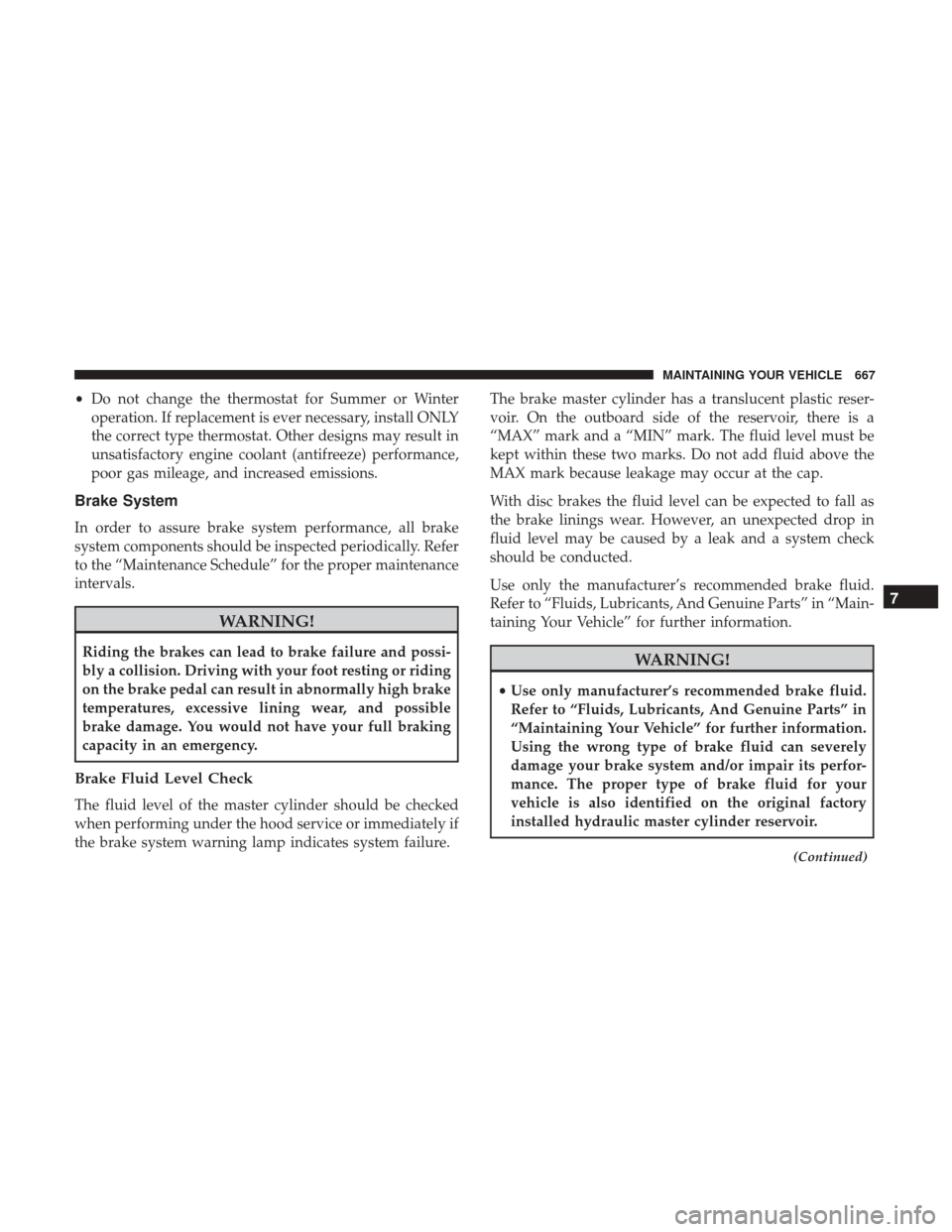
Brake Fluid Level Check
The fluid level of the master cylinder should be checked
when performing under the hood service or immediately if
the brake system warning lamp indicates system failure. The brake master cylinder has a translucent plastic reser-
voir. On the outboard side of the reservoir, there is a
“MAX” mark and a “MIN” mark. The fluid level must be
kept within these two marks. Do not add fluid above the
MAX mark because leakage may occur at the cap.
With disc brakes the fluid level can be expected to fall as
the brake linings wear. However, an unexpected drop in
fluid level may be caused by a leak and a system check
should be conducted.
Use only the manufacturer’s recommended brake fluid.
Refer to “Fluids, Lubricants, And Genuine Parts” in “Main-
taining Your Vehicle” for further information.
WARNING!
•
Use only manufacturer’s recommended brake fluid.
Refer to “Fluids, Lubricants, And Genuine Parts” in
“Maintaining Your Vehicle” for further information.
Using the wrong type of brake fluid can severely
damage your brake system and/or impair its perfor-
mance. The proper type of brake fluid for your
vehicle is also identified on the original factory
installed hydraulic master cylinder reservoir.
(Continued)
7
MAINTAINING YOUR VEHICLE 667
Page 680 of 734

Replace the belts if they appear frayed or worn or if the
buckles do not work properly.
NOTE:If the belts retract slowly, inspect the upper turning
loop for soiling. If soiling is present, clean with a wet soft
cloth until all residue is removed.
WARNING!
A frayed or torn belt could rip apart in a collision and
leave you with no protection. Inspect the belt system
periodically, checking for cuts, frays, or loose parts.
Damaged parts must be replaced immediately. Do not
disassemble or modify the system. Seat belt assemblies
must be replaced after a collision if they have been
damaged (i.e., bent retractor, torn webbing, etc.).
Tri-Fold Soft Tonneau Cover Care
For cleaning and protecting the vinyl Tri-Fold Tonneau
cover, use MOPAR Whitewall & Vinyl Top Cleaner and
MOPAR Leather and Vinyl Conditioner/Protectant.
Spray-On Bedliner – If Equipped
During ownership, the shine and luster of the Spray-On
Bedliner can fade from oxidation, road dirt, heavy-duty hauling and hard water stains. Weathering and UV expo-
sure will lead to fading, dulling, and loss of gloss over
time.
To help maintain the appearance of your Spray-On Bed-
liner, the manufacturer recommends you periodically rinse
all loose dirt from your truck bed and clean your truck at
least twice per year using the MOPAR Spray-On Bedliner
Conditioner available at your local authorized dealer.
To Help Maintain The Appearance Of Your Spray-On
Bedliner, Follow The Steps Below:
1. Rinse your truck bed out with water to remove any
loose dirt and debris.
2. Mix a mild soap or detergent with water with a soft cloth or brush.
3. Rinse bedliner with water.
4. Once dry, apply a small amount of MOPAR Spray-On Bedliner Conditioner to a moist towel or sponge and
wipe over the entire surface of the truck bedliner.
678 MAINTAINING YOUR VEHICLE
Page 681 of 734
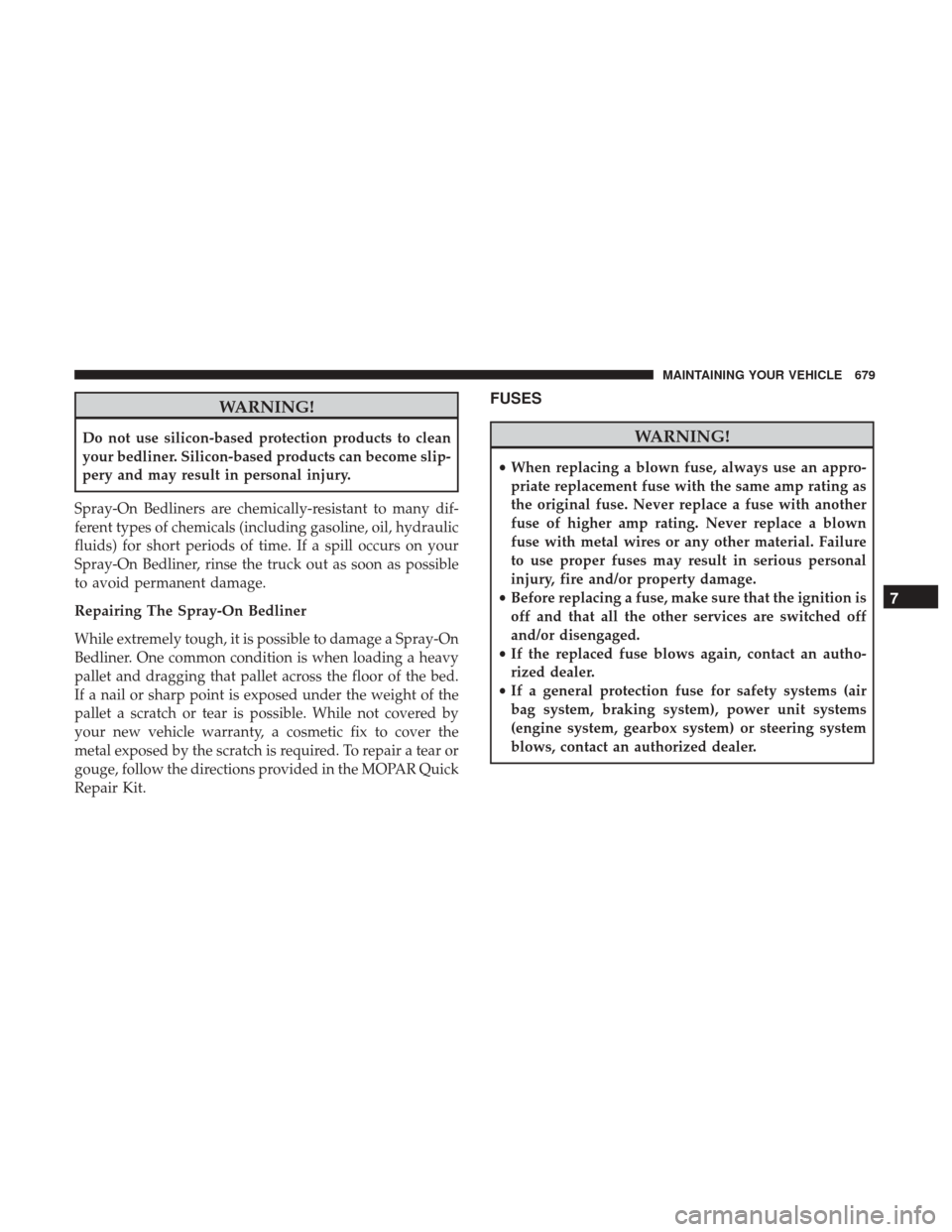
WARNING!
Do not use silicon-based protection products to clean
your bedliner. Silicon-based products can become slip-
pery and may result in personal injury.
Spray-On Bedliners are chemically-resistant to many dif-
ferent types of chemicals (including gasoline, oil, hydraulic
fluids) for short periods of time. If a spill occurs on your
Spray-On Bedliner, rinse the truck out as soon as possible
to avoid permanent damage.
Repairing The Spray-On Bedliner
While extremely tough, it is possible to damage a Spray-On
Bedliner. One common condition is when loading a heavy
pallet and dragging that pallet across the floor of the bed.
If a nail or sharp point is exposed under the weight of the
pallet a scratch or tear is possible. While not covered by
your new vehicle warranty, a cosmetic fix to cover the
metal exposed by the scratch is required. To repair a tear or
gouge, follow the directions provided in the MOPAR Quick
Repair Kit.
FUSES
WARNING!
• When replacing a blown fuse, always use an appro-
priate replacement fuse with the same amp rating as
the original fuse. Never replace a fuse with another
fuse of higher amp rating. Never replace a blown
fuse with metal wires or any other material. Failure
to use proper fuses may result in serious personal
injury, fire and/or property damage.
• Before replacing a fuse, make sure that the ignition is
off and that all the other services are switched off
and/or disengaged.
• If the replaced fuse blows again, contact an autho-
rized dealer.
• If a general protection fuse for safety systems (air
bag system, braking system), power unit systems
(engine system, gearbox system) or steering system
blows, contact an authorized dealer.
7
MAINTAINING YOUR VEHICLE 679
Page 685 of 734
CavityCartridge Fuse Micro Fuse Description
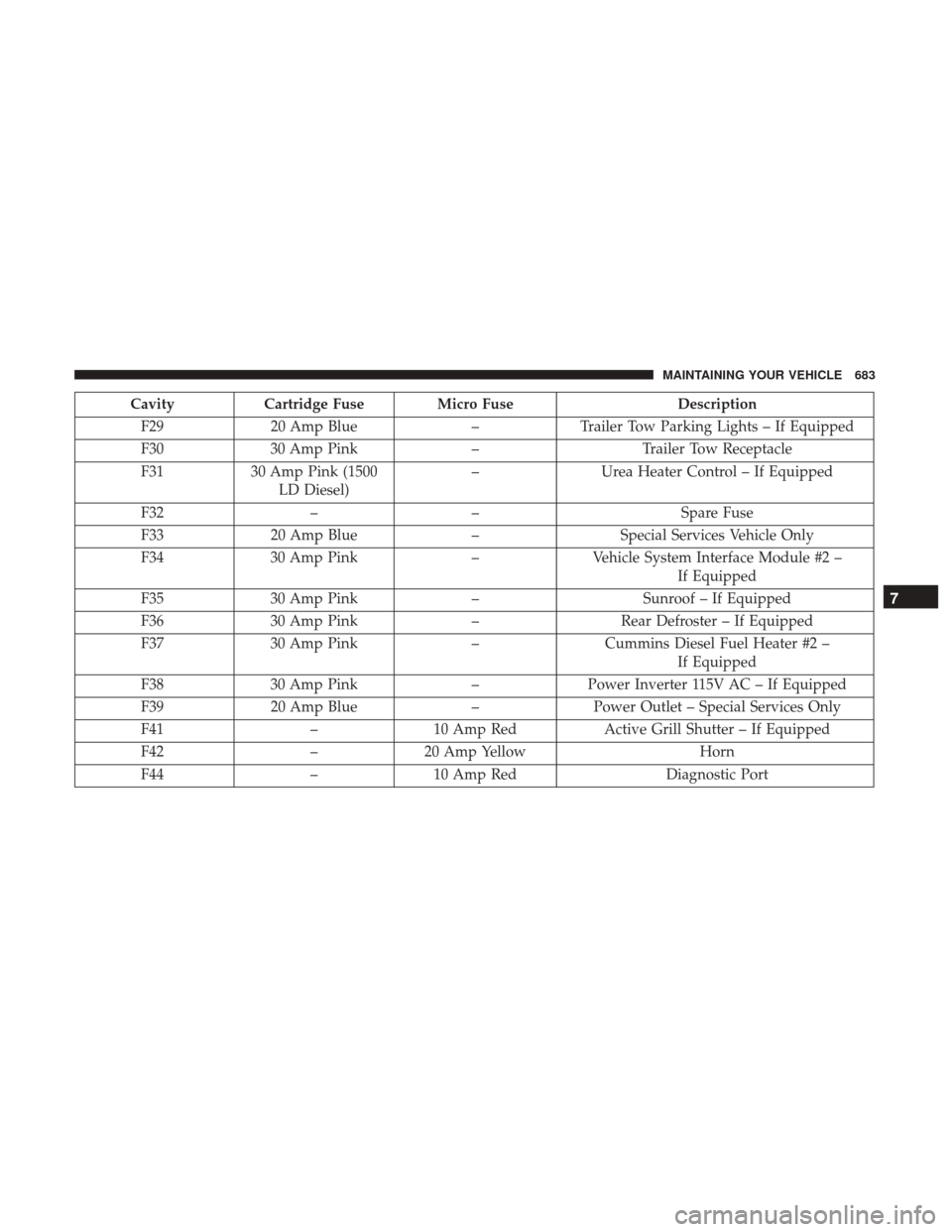
F29 20 Amp Blue –Trailer Tow Parking Lights – If Equipped
F30 30 Amp Pink –Trailer Tow Receptacle
F31 30 Amp Pink (1500
LD Diesel) –
Urea Heater Control – If Equipped
F32 –– Spare Fuse
F33 20 Amp Blue –Special Services Vehicle Only
F34 30 Amp Pink –Vehicle System Interface Module #2 –
If Equipped
F35 30 Amp Pink –Sunroof – If Equipped
F36 30 Amp Pink –Rear Defroster – If Equipped
F37 30 Amp Pink –Cummins Diesel Fuel Heater #2 –
If Equipped
F38 30 Amp Pink –Power Inverter 115V AC – If Equipped
F39 20 Amp Blue –Power Outlet – Special Services Only
F41 –10 Amp Red Active Grill Shutter – If Equipped
F42 –20 Amp Yellow Horn
F44 –10 Amp Red Diagnostic Port
7
MAINTAINING YOUR VEHICLE 683
Page 690 of 734
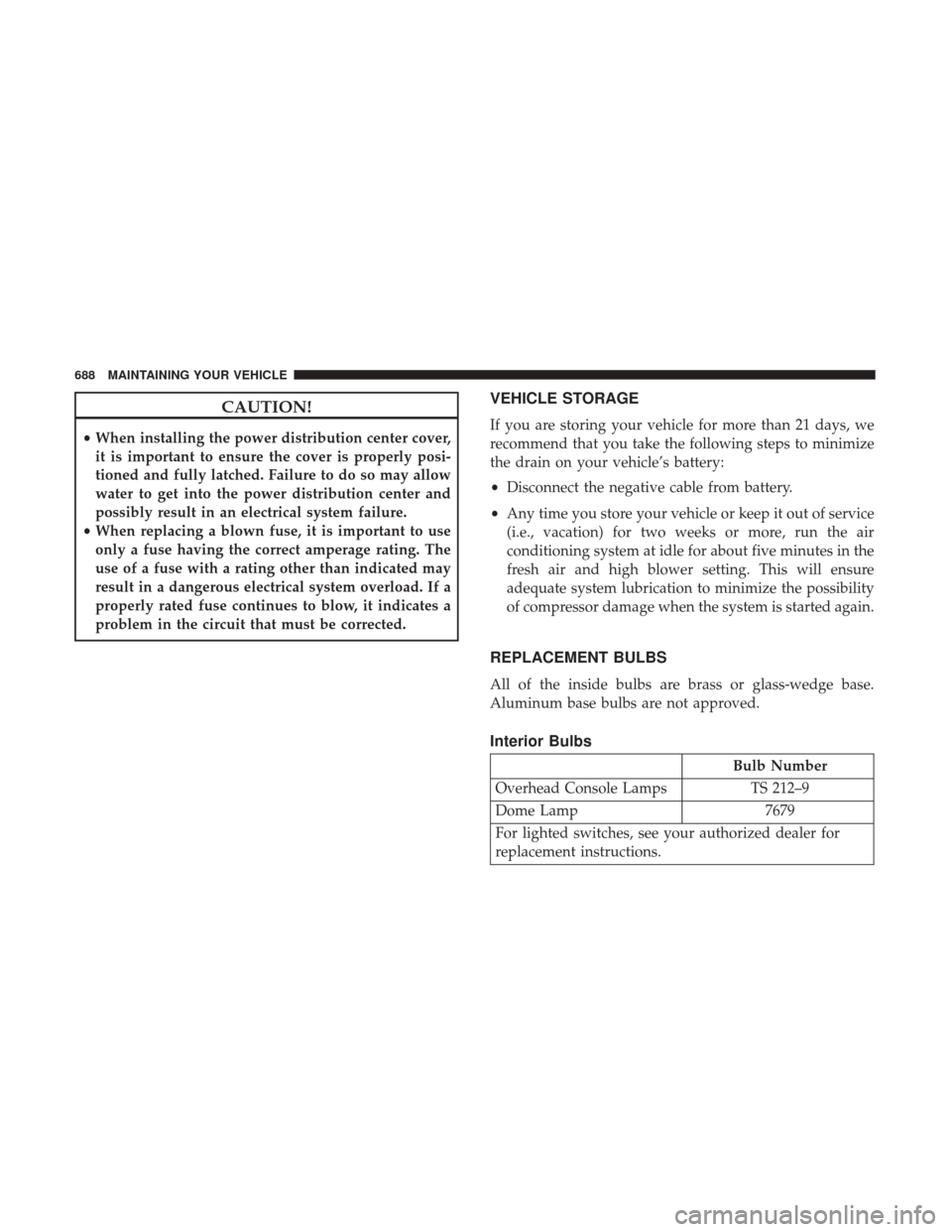
CAUTION!
•When installing the power distribution center cover,
it is important to ensure the cover is properly posi-
tioned and fully latched. Failure to do so may allow
water to get into the power distribution center and
possibly result in an electrical system failure.
• When replacing a blown fuse, it is important to use
only a fuse having the correct amperage rating. The
use of a fuse with a rating other than indicated may
result in a dangerous electrical system overload. If a
properly rated fuse continues to blow, it indicates a
problem in the circuit that must be corrected.
VEHICLE STORAGE
If you are storing your vehicle for more than 21 days, we
recommend that you take the following steps to minimize
the drain on your vehicle’s battery:
• Disconnect the negative cable from battery.
• Any time you store your vehicle or keep it out of service
(i.e., vacation) for two weeks or more, run the air
conditioning system at idle for about five minutes in the
fresh air and high blower setting. This will ensure
adequate system lubrication to minimize the possibility
of compressor damage when the system is started again.
REPLACEMENT BULBS
All of the inside bulbs are brass or glass-wedge base.
Aluminum base bulbs are not approved.
Interior Bulbs
Bulb Number
Overhead Console Lamps TS 212–9
Dome Lamp 7679
For lighted switches, see your authorized dealer for
replacement instructions.
688 MAINTAINING YOUR VEHICLE