spare Ram 2500 2018 Owner's Guide
[x] Cancel search | Manufacturer: RAM, Model Year: 2018, Model line: 2500, Model: Ram 2500 2018Pages: 700, PDF Size: 8.86 MB
Page 577 of 700
Snow Tires
Some areas of the country require the use of snow tires
during the Winter. Snow tires can be identified by a
“mountain/snowflake” symbol on the tire sidewall.If you need snow tires, select tires
equivalent in size and type to the origi-
nal equipment tires. Use snow tires only
in sets of four; failure to do so may
adversely affect the safety and handling
of your vehicle.
Snow tires generally have lower speed ratings than what
was originally equipped with your vehicle and should not
be operated at sustained speeds over 75 mph (120 km/h).
For speeds above 75 mph (120 km/h) refer to original
equipment or an authorized tire dealer for recommended
safe operating speeds, loading and cold tire inflation
pressures.
While studded tires improve performance on ice, skid and
traction capability on wet or dry surfaces may be poorer
than that of non-studded tires. Some states prohibit stud-
ded tires; therefore, local laws should be checked before
using these tire types.
Spare Tires — If Equipped
NOTE: For vehicles equipped with Tire Service Kit instead
of a spare tire, please refer to “Tire Service Kit” in “In Case
Of Emergency” for further information.
CAUTION!
Because of the reduced ground clearance, do not take
your vehicle through an automatic car wash with a
compact or limited use temporary spare installed.
Damage to the vehicle may result.
Spare Tire Matching Original Equipped Tire And
Wheel — If Equipped
Your vehicle may be equipped with a spare tire and wheel
equivalent in look and function to the original equipment
tire and wheel found on the front or rear axle of your
vehicle. This spare tire may be used in the tire rotation for
your vehicle. If your vehicle has this option, refer to an
authorized tire dealer for the recommended tire rotation
pattern.
Compact Spare Tire — If Equipped
The compact spare is for temporary emergency use only.
You can identify if your vehicle is equipped with a compact
8
SERVICING AND MAINTENANCE 575
Page 578 of 700
spare by looking at the spare tire description on the Tire
and Loading Information Placard located on the driver ’s
side door opening or on the sidewall of the tire. Compact
spare tire descriptions begin with the letter “T” or “S”
preceding the size designation. Example: T145/80D18
103M.
T, S = Temporary Spare Tire
Since this tire has limited tread life, the original equipment
tire should be repaired (or replaced) and reinstalled on
your vehicle at the first opportunity.
Do not install a wheel cover or attempt to mount a
conventional tire on the compact spare wheel, since the
wheel is designed specifically for the compact spare tire.
Do not install more than one compact spare tire and wheel
on the vehicle at any given time.
WARNING!
Compact and collapsible spares are for temporary
emergency use only. With these spares, do not drive
more than 50 mph (80 km/h). Temporary use spares
have limited tread life. When the tread is worn to the
tread wear indicators, the temporary use spare tire
(Continued)
WARNING!(Continued)
needs to be replaced. Be sure to follow the warnings,
which apply to your spare. Failure to do so could result
in spare tire failure and loss of vehicle control.
Collapsible Spare Tire — If Equipped
The collapsible spare is for temporary emergency use only.
You can identify if your vehicle is equipped with a collaps-
ible spare by looking at the spare tire description on the
Tire and Loading Information Placard located on the
driver ’s side door opening or on the sidewall of the tire.
Collapsible spare tire description example: 165/80-17 101P.
Since this tire has limited tread life, the original equipment
tire should be repaired (or replaced) and reinstalled on
your vehicle at the first opportunity.
Inflate collapsible tire only after the wheel is properly
installed to the vehicle. Inflate the collapsible tire using the
electric air pump before lowering the vehicle.
Do not install a wheel cover or attempt to mount a
conventional tire on the collapsible spare wheel, since the
wheel is designed specifically for the collapsible spare tire.
576 SERVICING AND MAINTENANCE
Page 579 of 700
WARNING!
Compact and Collapsible spares are for temporary
emergency use only. With these spares, do not drive
more than 50 mph (80 km/h). Temporary use spares
have limited tread life. When the tread is worn to the
tread wear indicators, the temporary use spare tire
needs to be replaced. Be sure to follow the warnings,
which apply to your spare. Failure to do so could result
in spare tire failure and loss of vehicle control.
Full Size Spare — If Equipped
The full size spare is for temporary emergency use only.
This tire may look like the originally equipped tire on the
front or rear axle of your vehicle, but it is not. This spare
tire may have limited tread life. When the tread is worn to
the tread wear indicators, the temporary use full size spare
tire needs to be replaced. Since it is not the same as your
original equipment tire, replace (or repair) the original
equipment tire and reinstall on the vehicle at the first
opportunity.
Limited Use Spare — If Equipped
The limited use spare tire is for temporary emergency use
only. This tire is identified by a label located on the limited
use spare wheel. This label contains the driving limitations
for this spare. This tire may look like the original equipped
tire on the front or rear axle of your vehicle, but it is not.
Installation of this limited use spare tire affects vehicle
handling. Since it is not the same as your original equip-
ment tire, replace (or repair) the original equipment tire
and reinstall on the vehicle at the first opportunity.
WARNING!
Limited use spares are for emergency use only. Instal-
lation of this limited use spare tire affects vehicle
handling. With this tire, do not drive more than the
speed listed on the limited use spare wheel. Keep
inflated to the cold tire inflation pressures listed on
your Tire and Loading Information Placard located on
the driver ’s side B-Pillar or the rear edge of the driver ’s
side door. Replace (or repair) the original equipment
tire at the first opportunity and reinstall it on your
vehicle. Failure to do so could result in loss of vehicle
control.8
SERVICING AND MAINTENANCE 577
Page 582 of 700
WARNING!
Using tires of different size and type (M+S, Snow)
between front and rear axles can cause unpredictable
handling. You could lose control and have a collision.
CAUTION!
To avoid damage to your vehicle or tires, observe the
following precautions:
•Because of restricted traction device clearance be-
tween tires and other suspension components, it is
important that only traction devices in good condi-
tion are used. Broken devices can cause serious
damage. Stop the vehicle immediately if noise occurs
that could indicate device breakage. Remove the
damaged parts of the device before further use.
• Install device as tightly as possible and then re-
tighten after driving about ½ mile (0.8 km).
• Do not exceed 30 mph (48 km/h).
• Drive cautiously and avoid severe turns and large
bumps, especially with a loaded vehicle.
• Do not drive for a prolonged period on dry pave-
ment.
(Continued)
CAUTION! (Continued)
•Observe the traction device manufacturer ’s instruc-
tions on the method of installation, operating speed,
and conditions for use. Always use the suggested
operating speed of the device manufacturer ’s if it is
less than 30 mph (48 km/h).
• Do not use traction devices on a compact spare tire.
Tire Rotation Recommendations
Tires on the front and rear axles of vehicles operate at
different loads and perform different steering, driving, and
braking functions. For these reasons, they wear at unequal
rates.
These effects can be reduced by timely rotation of tires. The
benefits of rotation are especially worthwhile with aggres-
sive tread designs such as those on all season type tires.
Rotation will increase tread life, help to maintain mud,
snow and wet traction levels and contribute to a smooth,
quiet ride.
Refer to the “Maintenance Plan” for the proper mainte-
nance intervals. More frequent rotation is permissible if
desired. The reasons for any rapid or unusual wear should
be corrected prior to rotation being performed.
580 SERVICING AND MAINTENANCE
Page 584 of 700

Dual Rear Wheels — If Equipped
The tires used on dual wheel assemblies should be
matched for wear to prevent overloading one tire in a set.
To check if tires are even, lay a straight edge across all four
tires. The straight edge should touch all the tires.
NOTE:If your vehicle is equipped with a Tire Pressure
Information System (TPIS):
• The Tire Pressure Information System (TPIS) uses
unique sensors in the inner rear wheels to help identify
them from the outer rear wheels, because of this, the
inner and outer wheel locations can’t be switched. •
After a tire rotation is completed, as shown below, the
system can auto learn the locations of each sensor ID.
Auto learning/localization occurs when the vehicle ig-
nition status is changed from Off to On and speeds of
greater than 5 mph (8km/h) are obtained and remain
over 5 mph (8km/h) for at about a 15 minute period.
You may need to drive for 20 minutes to account slower
speeds and stops.
• If the tires are rotated incorrectly, The auto localization
of the TPIS sensors will fail to locate correctly resulting
in incorrect locations for the pressure values displayed
in the instrument cluster.
CAUTION!
•3500 Dual Rear Tires may only have one approved
direction of rotation. This is to accommodate the
asymmetrical design (tread pattern) of the On/Off-
Road tire and the use of Outline White Letter (OWL)
tires.
• When replacing a flat, the spare tire may have to be
remounted on the rim, or installed at a different
location, to maintain the correct placement of the tire
on the wheel relative to the tire/wheel position on
(Continued)
Tire Rotation
582 SERVICING AND MAINTENANCE
Page 585 of 700
CAUTION!(Continued)
the truck. For example, if the spare is used to replace
an outer rear tire it will have to be remounted on the
rim so that the wheel is dished inward. That way the
tread design of asymmetrical tires and the white
writing of the OWL tires will maintain proper posi-
tion.
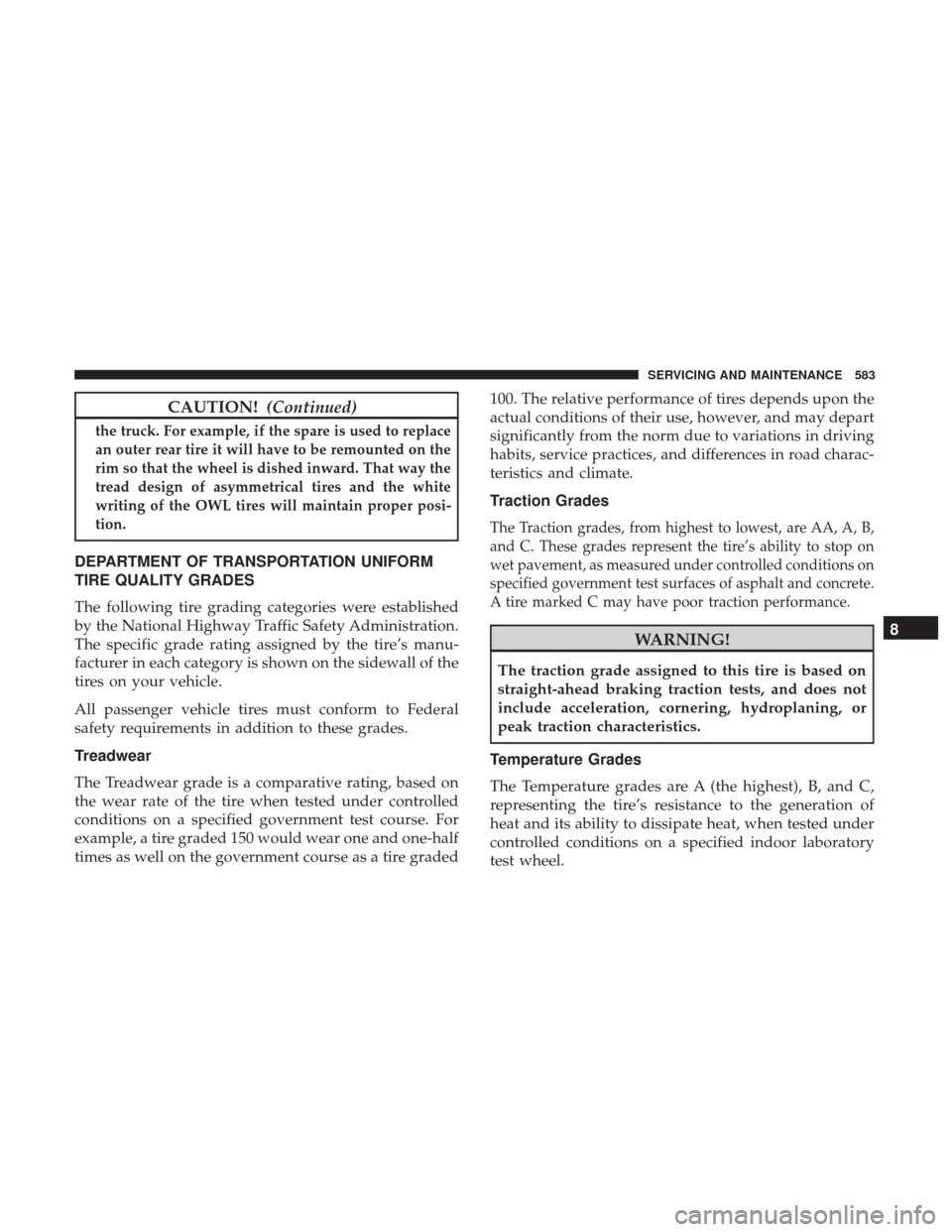
DEPARTMENT OF TRANSPORTATION UNIFORM
TIRE QUALITY GRADES
The following tire grading categories were established
by the National Highway Traffic Safety Administration.
The specific grade rating assigned by the tire’s manu-
facturer in each category is shown on the sidewall of the
tires on your vehicle.
All passenger vehicle tires must conform to Federal
safety requirements in addition to these grades.
Treadwear
The Treadwear grade is a comparative rating, based on
the wear rate of the tire when tested under controlled
conditions on a specified government test course. For
example, a tire graded 150 would wear one and one-half
times as well on the government course as a tire graded 100. The relative performance of tires depends upon the
actual conditions of their use, however, and may depart
significantly from the norm due to variations in driving
habits, service practices, and differences in road charac-
teristics and climate.
Traction Grades
The Traction grades, from highest to lowest, are AA, A, B,
and C. These grades represent the tire’s ability to stop on
wet pavement, as measured under controlled conditions on
specified government test surfaces of asphalt and concrete.
A tire marked C may have poor traction performance.
WARNING!
The traction grade assigned to this tire is based on
straight-ahead braking traction tests, and does not
include acceleration, cornering, hydroplaning, or
peak traction characteristics.
Temperature Grades
The Temperature grades are A (the highest), B, and C,
representing the tire’s resistance to the generation of
heat and its ability to dissipate heat, when tested under
controlled conditions on a specified indoor laboratory
test wheel. 8
SERVICING AND MAINTENANCE 583
Page 641 of 700

Setting NameSelectable Options
Rain Sensing Auto Wipers — If Equipped On
Off
NOTE:
When the “Rain Sensing Auto Wipers” feature is selected, the system will automatically activate the windshield wip-
ers if it senses moisture on the windshield. Hill Start Assist — If Equipped On
Off
Setting Name Selectable Options
Two Or Four Corner Air Suspension Modes — If Equipped Tire Jack Mode Transport Mode Wheel Alignment
ModeProtection Mode
NOTE:
There are four air suspension modes designed to protect the system in unique situations. Tire Jack Mode is selected to
assist in changing a spare tire. Transport Mode is selected to assist when the vehicle is being flat bed towed. Wheel
Alignment Mode is selected before performing a wheel alignment, refer to your authorized dealer for information.
Protection Mode will automatically be selected to “protect” the air suspension system when the payload has been ex-
ceeded or load leveling cannot be achieved.
10
MULTIMEDIA 639
Page 648 of 700

Setting NameSelectable Options
Flash Lights With Lower
NOTE:
When the “Flash Lights With Lower” feature is selected, the front and rear turn signals will flash when the key fob
remote lower button is pressed twice. This feature may be selected with or without the Sound Horn on Lower feature
selected. Suspension Display Messages AllWarning
Automatic Aero Mode (1500 Model Only)
NOTE:
When the “Automatic Aero Mode” feature is selected, the Ride Height will automatically be adjusted depending on
the vehicle speed.
Tire Jack Mode
NOTE:
When the “Tire Jack Mode” feature is selected, the air suspension system is disabled to assist with changing a spare
tire.Transport Mode
NOTE:
When the “Transport Mode” feature is selected, the air suspension system lowers and then disables to assist with flat
bed towing.
646 MULTIMEDIA
Page 686 of 700
Child Restraint............................252
Child Restraints Booster Seats ............................256
Child Restraints ........................ .252
Child Seat Installation ..................268, 269
How To Stow An Unused ALR Seat Belt ........266
Infants And Child Restraints ................254
Locating The LATCH Anchorages .............262
Lower Anchors And Tethers For Children .......258
Older Children And Child Restraints ...........255
Seating Positions ........................ .257
Cigar Lighter ............................ .137
Clean Air Gasoline ........................ .597
Cleaning Wheels ............................... .578
Climate Control ............................86
Manual ................................86
Cold Weather Operation ..................... .294
Compact Disc (CD) Maintenance ................673
Compact Spare Tire ........................ .575
Contract, Service .......................... .678
Coolant Pressure Cap (Radiator Cap) .............549
Cooling System ............................546
Adding Coolant (Antifreeze) .................548
Coolant Capacity ........................ .603Coolant Level
....................546, 549, 551
Disposal Of Used Coolant ..................549
Drain, Flush, And Refill ....................547
Inspection ..........................549, 551
Points To Remember ..................... .551
Pressure Cap ............................549
Radiator Cap .......................... .549
Selection Of Coolant (Antifreeze) .......547, 603, 604
Corrosion Protection ........................584
Cruise Light ............................. .199
Cupholders ...............................132
Customer Assistance ........................676
Customer
Programmable Features ...............633
Daytime Running Lights ......................74
Dealer Service ............................ .527
Defroster, Rear Window .......................86
Defroster, Windshield .....................86, 280
Delay (Intermittent) Wipers ....................84
Diagnostic System, Onboard ...................200
Differential, Limited-Slip .....................375
Dipsticks Power Steering ..........................394
Disabled Vehicle Towing .....................510
684 INDEX
Page 695 of 700
Memory............................ .44, 49
Power .................................46
Rear Folding ........................44, 55, 56
Reclining Rear ...........................46
Seatback Release ..........................44
Tilting .................................44
Vented .................................44
Ventilated ...............................44
Security Alarm ..........................35, 191
Selection Of Coolant (Antifreeze) ...............604
Sentry Key Key Programming .........................34
Sentry Key (Immobilizer) ......................33
Sentry Key Replacement ......................34
Service Assistance ..........................676
Service Contract .......................... .678
Service Manuals .......................... .680
Settings, Personal ..........................182
Shifting .................................297
Automatic Transmission .............299, 306, 315
Transfer Case .......................... .326
Transfer Case, Shifting Into Transfer Case
Neutral (N) ............................ .438
Transfer Case, Shifting Out Of Transfer Case
Neutral (N) ............................ .440Shift Lever Override
........................506
Signals, Turn ........................78, 198, 281
Snow Chains (Tire Chains) ....................579
Snow Plow ...............................433
Snow Tires ...............................575
Spare Tire ............................ .575, 577
Spark Plugs ............................. .604
Speed Control Accel/Decel ............................397
Cancel ............................... .397
Resume ...............................397
Speed Control (Cruise Control) .................395
Stabilizer/Sway Bar System ...................361
Starting ............................. .288, 289
Automatic Transmission ....................288
Cold Weather .......................... .294
Engine Fails
To Start..................... .293
Starting And Operating ..................... .289
Starting Procedures ........................ .289
Starting Procedures (Gas Engines) ...............288
Steering Power ..........................392, 393, 394
Tilt Column .............................61
Wheel, Heated ...........................61
Wheel, Tilt ..............................61
12
INDEX 693