height Ram 2500 2019 User Guide
[x] Cancel search | Manufacturer: RAM, Model Year: 2019, Model line: 2500, Model: Ram 2500 2019Pages: 696, PDF Size: 13.89 MB
Page 320 of 696

318 STARTING AND OPERATING
Trailer Decoupling/Unloading - The air suspension system
will load level (lower/exhaust only) once after 12 minutes
after the vehicle is turned off. This allows for easy removal of
a trailer and/or load from the back of the truck by main -
taining the ride height. After 12 minutes you will need to
turn the ignition to the run position for the air suspension to
re-level due to addition/removal of load in the vehicle. If the
air suspension system is disabled using the settings menu
(Tire Jack Mode, Transport Mode, Alignment Mode, or Bed
Lowering Mode) the system will remain disabled when the
vehicle is turned off. Reactivating the air suspension can be
accomplished via the settings menu or driving the vehicle
above 5 mph (8 km/h) for Tire Jack Mode or Alignment
Mode and 16 mph (26 km/h) for Transport Mode and Bed
Lowering Mode.
NOTE:
• Most 3500 models will not lower to Alternate Trailer Height (ATH) when unloaded.
• Refer to “Trailer Towing” in “Starting And Operating” for further information. Ignition OFF Behavior
For a predetermined amount of time after the ignition is off the
air suspension may adjust to maintain a proper appearance.
Air Suspension Modes
The air suspension system has multiple modes to protect the
system in unique situations:
Tire/Jack Mode
To assist with changing a tire, the air suspension system has a
feature which allows the automatic leveling to be disabled. This
mode is intended to be enabled with engine running. Refer to
“Instrument Cluster Display” in “Getting To Know Your Instru
-
ment Panel” or “Uconnect Settings” in “Multimedia” if equipped
with a touch screen radio for further information.
NOTE:
This mode is intended to be enabled with engine running.
WARNING!
The air suspension system uses a high pressure volume
of air to operate the system. To avoid personal injury or
damage to the system, see your authorized dealer for
service.
Page 321 of 696

STARTING AND OPERATING 319
Transport Mode
For towing your vehicle with four wheels off the road, the air
suspension system has a feature which will put the vehicle
below Normal Ride Height (NRH) and disable the automatic
load leveling system. This mode is intended to be enabled
with engine running. Refer to “Instrument Cluster Display”
in “Getting To Know Your Instrument Panel” or “Uconnect
Settings” in “Understanding Your Instrument Panel” if
equipped with a touch screen radio for further information.
NOTE:
This mode is intended to be enabled with engine running.
Wheel Alignment Mode
Before performing a wheel alignment this mode must be
enabled. Refer to “Instrument Cluster Display” in “Getting
To Know Your Instrument Panel” or “Uconnect Settings” in
“Multimedia” if equipped with a touch screen radio for
further information.
NOTE:
This mode is intended to be enabled with engine running.Bed Lowering Mode
For towing your vehicle with four wheels off the road, the air
suspension system has a feature which will put the vehicle
below Normal Ride Height (NRH) and disable the automatic
load leveling system. This mode is intended to be enabled
with engine running. Refer to “Instrument Cluster Display”
in “Getting To Know Your Instrument Panel” or “Uconnect
Settings” in “Understanding Your Instrument Panel” if
equipped with a touch screen radio for further information.
Protection Strategy
In order to “protect” the air suspension system, the vehicle
will disable load leveling as required (suspension over
-
loaded, battery charge low, etc.). Load leveling will automat -
ically resume as soon as system operation requirements are
met. See your authorized dealer if system does not resume.
5
Page 322 of 696

320 STARTING AND OPERATING
Instrument Cluster Display Messages
When the appropriate conditions exist, a message will
appear in the instrument cluster display. Refer to “Instru-
ment Cluster Display” in “Getting To Know Your Instru-
ment Panel” for further information.
An audible chime will be heard whenever a system error has
been detected.
See your authorized dealer for system service if normal oper-
ation does not resume.
Operation
Pushing the Alternate Trailer Height (ATH) button once
while at Normal Ride Height (NRH), will lower the vehicle
to Alternate Trailer Height (ATH) and will illuminate the
LED.
NOTE:
The LED will continuously blink until vehicle Alternate
Trailer Height (ATH) has been achieved and the LED will
turn on.
Pushing the Alternate Trailer Height (ATH) again will raise
the vehicle to Normal Ride Height (NRH). NOTE:
The LED will continuously blink until Normal Ride Height
(NRH) has been achieved and the LED will turn off.
• Transport Mode – No indicator lamps will be illuminated.
Transport Mode is disabled by driving the vehicle, or dese -
lecting the mode via the interface.
• Tire/Jack Mode – No indicator lamps will be illuminated. Tire/Jack Mode is disabled by driving the vehicle, or by
deselecting the mode via the interface.
• Wheel Alignment Mode – No indicator lamps will be illu -
minated. Wheel Alignment Mode is disabled by driving
the vehicle, or by deselecting the mode via the interface.
• Bed Lowering Mode – No indicator lamps will be illumi -
nated. Bed Lowering Mode is disabled by driving the
vehicle, or deselecting the mode via the interface.
AXLE LOCKER SYSTEM — POWER WAGON
MODELS ONLY (IF EQUIPPED)
This vehicle is equipped with electronically locking front
and rear differentials. These differentials, when engaged,
mechanically lock together the axle shafts forcing the wheels
to spin at an equal rate. This allows the vehicle to maintain
its momentum and prevents it from becoming stuck. The
locking front and rear differentials should only be engaged
Page 324 of 696

322 STARTING AND OPERATING
To lock the rear axle, place the vehicle in 4LO. Refer to “Four
Wheel Drive Operation” in “Starting And Operating” for
further information. Push the REAR LOCK button while
traveling less than 3 mph (5 km/h). The RR indicator light
will remain on when the rear axle is locked.
NOTE:
Left to right wheel speed difference may be necessary to
allow the axle to fully lock. If the indicator light is flashing
after placing the switch in the REAR LOCK or FRONT/
REAR LOCK position, drive the vehicle in a turn or on loose
gravel to expedite the locking action.
To lock the front axle; push the FRONT/REAR LOCK button
while traveling less than 3 mph (5 km/h). The indicator light
will be solid when the front axle is locked.
NOTE:
The rear axle must be locked before the front axle will lock. To unlock the front axle; push the REAR LOCK button. The
FRONT/REAR LOCK indicator light will go out when the
axle is unlocked.
NOTE:
The axle lockers could be torque locked due to side to side
loads on the axle. Driving slowly while turning the steering
wheel from a left hand turn to a right hand turn or driving in
REVERSE for a short distance may be required to release the
torque lock and unlock the axles.
To unlock the rear axle; push the AXLE UNLOCK button.
The REAR LOCK indicator light will go out when the rear
axle is unlocked.
STABILIZER/SWAY BAR SYSTEM — POWER WAGON
ONLY
Your vehicle is equipped with an electronic disconnecting
stabilizer/sway bar. This system allows greater front
suspension travel in off-road situations.
Due to the use of taller springs, this vehicle has an increased
ride height of approximately 1.9 in (48.3 mm) in the front
and 1.5 in (38.1 mm) in the rear. A major advantage to
increasing ride height is the positive effect it has on
approach/departure and break over angles.
WARNING!
Do not use the locked axle position for normal driving. A
locked front axle is intended for off-road driving only.
Locking the front axle during on-road driving will
reduce the steering ability. This could cause a collision
and you may be seriously injured.
Page 325 of 696
STARTING AND OPERATING 323
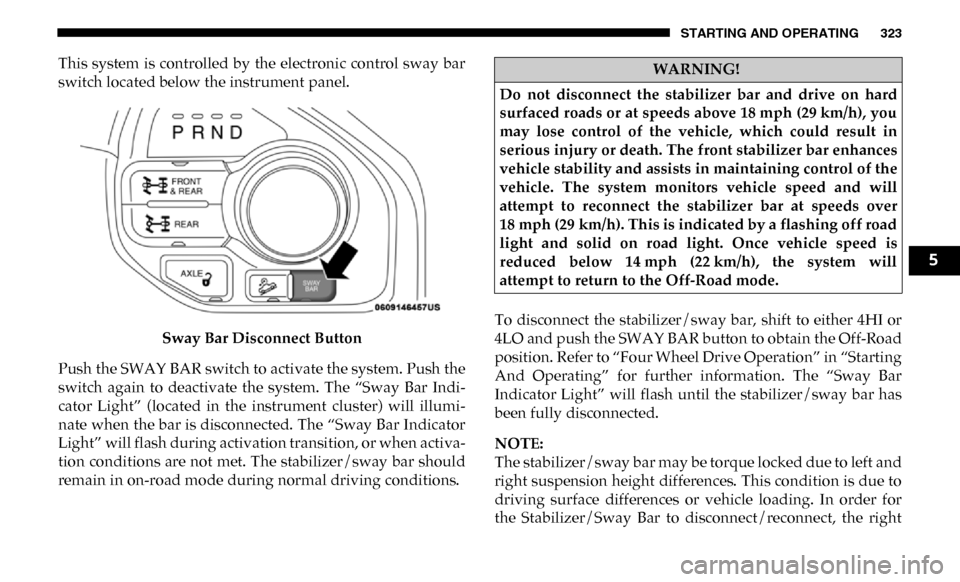
This system is controlled by the electronic control sway bar
switch located below the instrument panel.Sway Bar Disconnect Button
Push the SWAY BAR switch to activate the system. Push the
switch again to deactivate the system. The “Sway Bar Indi -
cator Light” (located in the instrument cluster) will illumi -
nate when the bar is disconnected. The “Sway Bar Indicator
Light” will flash during activation transition, or when activa -
tion conditions are not met. The stabilizer/sway bar should
remain in on-road mode during normal driving conditions. To disconnect the stabilizer/sway bar, shift to either 4HI or
4LO and push the SWAY BAR button to obtain the Off-Road
position. Refer to “Four Wheel Drive Operation” in “Starting
And Operating” for further information. The “Sway Bar
Indicator Light” will flash until the stabilizer/sway bar has
been fully disconnected.
NOTE:
The stabilizer/sway bar may be torque locked due to left and
right suspension height differences. This condition is due to
driving surface differences or vehicle loading. In order for
the Stabilizer/Sway Bar to disconnect/reconnect, the rightWARNING!
Do not disconnect the stabilizer bar and drive on hard
surfaced roads or at speeds above 18 mph (29 km/h), you
may lose control of the vehicle, which could result in
serious injury or death. The front stabilizer bar enhances
vehicle stability and assists in maintaining control of the
vehicle. The system monitors vehicle speed and will
attempt to reconnect the stabilizer bar at speeds over
18 mph (29 km/h). This is indicated by a flashing off road
light and solid on road light. Once vehicle speed is
reduced below 14 mph (22 km/h), the system will
attempt to return to the Off-Road mode.
5
Page 327 of 696

STARTING AND OPERATING 325
Water Fording Characteristics
Water fording characteristic is the vehicle's ability to cross a
body of still water, where the powertrain and drivetrain are
safe from water ingestion. This vehicle has high water
fording characteristics with the ability to cross a pool of
water, without stopping, 24 inches (60 cm) deep at a
maximum speed of 10 mph (16 km/h) and a pool of water
30 inches (76 cm) deep at a maximum speed of 5 mph (8 km/
h), both with an entrance ramp angle of 1.3 degrees.
Simultaneous Brake And Throttle Operation
Many off-road driving conditions require the simultaneous
use of the brake and throttle (two footed driving). When
climbing rocks, logs, or other stepped objects, using light
brake pressure with light throttle will keep the vehicle from
jerking or lurching. This technique is also used when you
need to stop and restart a vehicle on a steep incline.The Basics Of Off-Road Driving
You will encounter many types of terrain driving off-road.
You should be familiar with the terrain and area before
proceeding. There are many types of surface conditions:
hard packed dirt, gravel, rocks, grass, sand, mud, snow and
ice. Every surface has a different effect on your vehicle's
steering, handling and traction. Controlling your vehicle is
one of the keys to successful off-road driving, so always keep
a firm grip on the steering wheel and maintain a good
driving posture. Avoid sudden accelerations, turns or
braking. In most cases there are no road signs, posted speed
limits or signal lights. Therefore you will need to use your
own good judgment on what is safe and what isn't. When on
a trail you should always be looking ahead for surface obsta
-
cles and changes in terrain. The key is to plan your future
driving route while remembering what you are currently
driving over.
CAUTION!
The door sill height is 25 inches (63.5 cm). Water may
intrude into the interior of the vehicle at greater depths.
WARNING!
Always wear your seat belt and firmly tie down cargo.
Unsecured cargo can become projectiles in an off-road
situation.
5
Page 373 of 696

STARTING AND OPERATING 371
The “ACC/FCW Limited Functionality Clean Front Wind-
shield” message can sometimes be displayed while driving
in adverse weather conditions. The ACC/FCW system will
recover after the vehicle has left these areas. Under rare
conditions, when the camera is not tracking any vehicles or
objects in its path this warning may temporarily occur.
If weather conditions are not a factor, the driver should
examine the windshield and the camera located on the back
side of the inside rear view mirror. They may require
cleaning or removal of an obstruction.
When the condition that created limited functionality is no
longer present, the system will return to full functionality.
NOTE:
If the “ACC/FCW Limited Functionality Clean Front Wind -
shield” message occurs frequently (e.g. more than once on
every trip) without any snow, rain, mud, or other obstruc -
tion, have the windshield and forward facing camera
inspected at your authorized dealer. Service ACC/FCW Warning
If the system turns off, and the instrument cluster displays
“ACC/FCW Unavailable Service Required” or “Cruise/
FCW Unavailable Service Required”, there may be an
internal system fault or a temporary malfunction that limits
ACC functionality. Although the vehicle is still drivable
under normal conditions, ACC will be temporarily unavail
-
able. If this occurs, try activating ACC again later, following
an ignition cycle. If the problem persists, see your authorized
dealer.
Precautions While Driving With ACC
In certain driving situations, ACC may have detection issues.
In these cases, ACC may brake late or unexpectedly. The
driver needs to stay alert and may need to intervene.
NOTE:
• Aftermarket add-ons such as snow plows, lift kits, and brush/grille bars can hinder module performance. Ensure
the radar/camera has no obstructions in the field of view.
• Height modifications can limit module performance and functionality.
5
Page 415 of 696

STARTING AND OPERATING 413
Tongue Weight (TW)
The tongue weight is the downward force exerted on the
hitch ball by the trailer. You must consider this as part of the
load on your vehicle.
Trailer Frontal Area
The frontal area is the maximum height multiplied by the
maximum width of the front of a trailer.
Trailer Sway Control
The trailer sway control can be a mechanical telescoping link
that can be installed between the hitch receiver and the
trailer tongue that typically provides adjustable friction asso-
ciated with the telescoping motion to dampen any unwanted
trailer swaying motions while traveling.
If equipped, the electronic Trailer Sway Control (TSC) recog -
nizes a swaying trailer and automatically applies individual
wheel brakes and/or reduces engine power to attempt to
eliminate the trailer sway. Weight-Carrying Hitch
A weight-carrying hitch supports the trailer tongue weight,
just as if it were luggage located at a hitch ball or some other
connecting point of the vehicle. These kinds of hitches are the
most popular on the market today and they are commonly
used to tow small and medium sized trailers.
Weight-Distributing Hitch
A weight-distributing system works by applying leverage
through spring (load) bars. They are typically used for
heavier loads to distribute trailer tongue weight to the tow
vehicle's front axle and the trailer axle(s). When used in
accordance with the manufacturer's directions, it provides
for a more level ride, offering more consistent steering and
brake control, thereby enhancing towing safety. The addi
-
tion of a friction/hydraulic sway control also dampens sway
caused by traffic and crosswinds and contributes positively
to tow vehicle and trailer stability. Trailer sway control and
a weight distributing (load equalizing) hitch are recom -
mended for heavier Tongue Weights (TW) and may be
required depending on vehicle and trailer configuration/
loading to comply with GAWR requirements.
5
Page 417 of 696
STARTING AND OPERATING 415
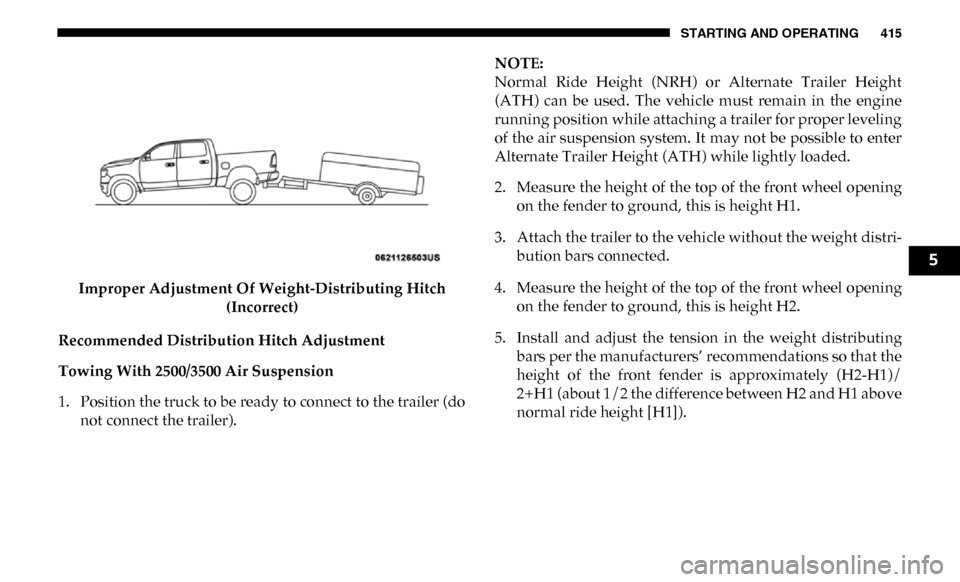
Improper Adjustment Of Weight-Distributing Hitch (Incorrect)
Recommended Distribution Hitch Adjustment
Towing With 2500/3500 Air Suspension
1. Position the truck to be ready to connect to the trailer (do not connect the trailer). NOTE:
Normal Ride Height (NRH) or Alternate Trailer Height
(ATH) can be used. The vehicle must remain in the engine
running position while attaching a trailer for proper leveling
of the air suspension system. It may not be possible to enter
Alternate Trailer Height (ATH) while lightly loaded.
2. Measure the height of the top of the front wheel opening
on the fender to ground, this is height H1.
3. Attach the trailer to the vehicle without the weight distri -
bution bars connected.
4. Measure the height of the top of the front wheel opening on the fender to ground, this is height H2.
5. Install and adjust the tension in the weight distributing bars per the manufacturers’ recommendations so that the
height of the front fender is approximately (H2-H1)/
2+H1 (about 1/2 the difference between H2 and H1 above
normal ride height [H1]).
5
Page 418 of 696

416 STARTING AND OPERATING
6. Perform a visual inspection of the trailer and weightdistributing hitch to confirm manufacturers’ recommen -
dations have been met.
NOTE:
For all towing conditions, we recommend towing with tow
haul mode engaged.
Towing With All Other 2500/3500 (Non-Air Suspension)
1. Position the truck to be ready to connect to the trailer (do not connect the trailer).
2. Measure the height of the top of the front wheel opening on the fender to ground, this is height H1.
3. Attach the trailer to the vehicle without the weight distri -
bution bars connected. 4. Measure the height of the top of the front wheel opening
on the fender to ground, this is height H2.
5. Install and adjust the tension in the weight distributing bars per the manufacturers’ recommendations so that the
height of the front fender is approximately (H2-H1)/
2+H1 (about 1/2 the difference between H2 and H1 above
normal ride height [H1]).
6. Perform a visual inspection of the trailer and weight distributing hitch to confirm manufacturers’ recommen -
dations have been met.
NOTE:
For all towing conditions, we recommend towing with tow
haul mode engaged.
Measurement Example
Example 2500/3500
Height (mm)
H1 1030
H2 1058
H2-H1 28
(H2-H1)/2 14
(H2-H1)/2 + H1 1044
Measurement ExampleExample 2500/3500
Height (mm)
H1 1030
H2 1058
H2-H1 28
(H2-H1)/2 14
(H2-H1)/2 + H1 1044